You can get a great deal on a fine horse of superb breeding by purchasing an OTTB. However… the horse you get will be a racehorse accustomed only to running full tilt on a track. Your new horse will require lots of training to turn him into a hunter or ordinary riding horse. Naturally, some OTTBs will not be trainable.
Years ago, my wife and I and a friend looked at a Thoroughbred being offered for sale at a Ridgefield, Connecticut stable. I had met the ladies at the train station after commuting back from Manhattan, and I was handicapped by wearing ordinary trousers and street shoes.
The horse was handsome and large and up to weight, but he had the most horrible gaits any of us ever encountered on a horse. His trot was bone-jarring and so violent that both my wife and our female friend were bounced right out of the saddle after a few strides.
I climbed uncomfortably aboard (ordinary trousers work poorly for riding), gathered up the reins and signaled my steed to move off with my heels. His walk was decidedly uncomfortable. As I prepared to put him into a trot, I noticed the seller deliberately averting her eyes from the impending disaster. His trot was what I’d describe as a unique experience. It was so violent and extreme that in a very short time it was obvious to me that I had the choice of pulling up immediately and getting off, or getting bounced right off just like the girls. I pulled up.
Everyone who rides gets run away with from time to time. I always experience the imprudent temptation to let the horse go and enjoy the gallop. Fortunately for me, I have always been able to pull the horse up, or simply arrived on his back home at the stable where his stall and his hay are waiting. One time, the runaway ignored me and ran right into a tree, but I simply stepped off when he went down. Nick Bull was much less fortunate and seems to have experienced what the Irish refer to as “a crucifying fall.”
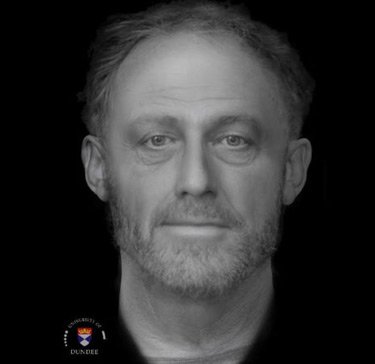
Gizmodo reports on the reconstruction of the face of a man who lived 700 years ago by Cambridge scientists.
[H]ere’s what we know about Context 958.
He was just slightly over 40 years old when he died. His skeleton showed signs of considerable wear-and-tear, so he likely lead a tough and hard working life. His tooth enamel stopped growing during two occasions in his youth, suggesting he likely lived through bouts of famine or sickness when he was young. The archaeologists found traces of blunt force trauma inflicted to the back of his head, which healed over before he died. The researchers aren’t sure what he did for a living, but they think he was a working-class person who specialized in some kind of trade.
Context 958 ate a diverse diet rich in meat or fish, according to an analysis of weathering patterns on his teeth. His profession may have provided him with more access to such foods than the average person at the time. His presence at the charitable hospital suggests he fell on hard times, with no one to take care of him.
“Context 958 was probably an inmate of the Hospital of St John, a charitable institution which provided food and a place to live for a dozen or so indigent townspeople—some of whom were probably ill, some of whom were aged or poor and couldn’t live alone,†noted John Robb, a professor from Cambridge University’s Division of Archaeology, in a statement.
Strangely, he was buried face down, which is rare but not unheard of in medieval burials.
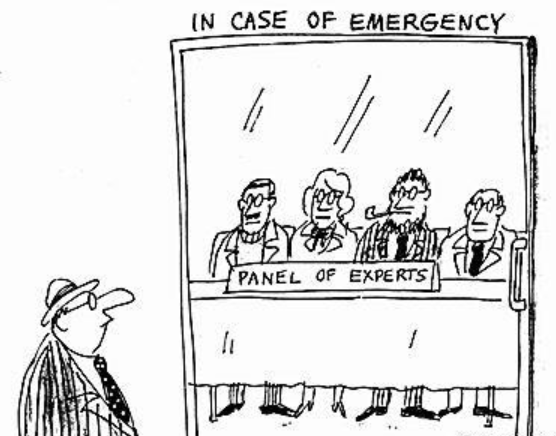
Glenn Reynolds points out that when members of today’s establishment class of credentialed experts complain that ordinary Americans commonly reject their scientific consensus on Climate Change, their moral consensus, and their economic and policy consensus, there are reasons that the prestige and authority of the credentialed experts class have dramatically declined within the lifetimes of the Baby Boom generation.
[T]he “experts†don’t have the kind of authority that they possessed in the decade or two following World War II. Back then, the experts had given us vaccines, antibiotics, jet airplanes, nuclear power and space flight. The idea that they might really know best seemed pretty plausible.
But it also seems pretty plausible that Americans might look back on the last 50 years and say, “What have experts done for us lately?†Not only have the experts failed to deliver on the moon bases and flying cars they promised back in the day, but their track record in general is looking a lot spottier than it was in, say, 1965.
It was the experts — characterized in terms of their self-image by David Halberstam in The Best and the Brightest — who brought us the twin debacles of the Vietnam War, which we lost, and the War On Poverty, where we spent trillions and certainly didn’t win. In both cases, confident assertions by highly credentialed authorities foundered upon reality, at a dramatic cost in blood and treasure. Mostly other people’s blood and treasure.
And these are not isolated failures. The history of government nutritional advice from the 1960s to the present is an appalling one: The advice of “experts†was frequently wrong, and sometimes bought-and-paid-for by special interests, but always delivered with an air of unchallengeable certainty.
In the realm of foreign affairs, which should be of special interest to the people at Foreign Affairs, recent history has been particularly dreadful. Experts failed to foresee the fall of the Soviet Union, failed to deal especially well with that fall when it took place, and then failed to deal with the rise of Islamic terrorism that led to the 9/11 attacks. Post 9/11, experts botched the reconstruction of Iraq, then botched it again with a premature pullout.
On Syria, experts in Barack Obama’s administration produced a policy that led to countless deaths, millions of refugees flooding Europe, a new haven for Islamic terrorists, and the upending of established power relations in the mideast. In Libya, the experts urged a war, waged without the approval of Congress, to topple strongman Moammar Gadhafi, only to see — again — countless deaths, huge numbers of refugees and another haven for Islamist terror.
It was experts who brought us the housing bubble and the subprime crisis. It was experts who botched the Obamacare rollout. And, of course, the experts didn’t see Brexit coming, and seem to have responded mostly with injured pride and assaults on the intelligence of the electorate, rather than with constructive solutions.
By its fruit the tree is known, and the tree of expertise hasn’t been doing well lately. As Nassim Taleb recently observed: “With psychology papers replicating less than 40%, dietary advice reversing after 30 years of fatphobia, macroeconomic analysis working worse than astrology, the appointment of Bernanke who was less than clueless of the risks, and pharmaceutical trials replicating at best only 1/3 of the time, people are perfectly entitled to rely on their own ancestral instinct and listen to their grandmothers.â€
Then there’s the problem that, somehow, over the past half-century or so the educated classes that make up the “expert†demographic seem to have been doing pretty well, even as so many ordinary folks, in America and throughout the West, have seen their fortunes decaying. Is it any surprise that claims to authority in the form of “expertise†don’t carry the same weight that they once did?
If experts want to reclaim a position of authority, they need to make a few changes. First, they should make sure they know what they’re talking about, and they shouldn’t talk about things where their knowledge isn’t solid. Second, they should be appropriately modest in their claims of authority. And, third, they should check their egos. It doesn’t matter what your SAT scores were, voters are under no obligation to listen to you unless they find what you say persuasive.
John Scalzi’s latest, The Collapsing Empire, released today by Tor Books, apparently has some resemblances to Isaac Asimov’s Foundation series.
Scalzi and the publishers of Tor books are both prominent on the Social Justice Warrior side in the current and ongoing political conflicts within the Sci Fi-Fantasy community.
Consequently, Vox Day’s Castalia House released yesterday a parody, titled “The Corroding Empire,” purportedly written by one Johan Kalsi, described by Vox Day as, “Finland’s hottest science fiction author. An accomplished geneticist as well as a 6’3″ ex-Finnish Marine.”
The cover of “The Corroding Empire,” as you can see above, has a recognizable resemblance to the cover of “The Collapsing Empire,” and features the imaginary plug line: “Kalzi rips off Asimov even better than Scalzi rips off Heinlein!”
All this seems rather funny, but Tor Books was not amused and (who knew that such a minor publisher had that kind of power?) promptly prevailed on the great and powerful Amazon to remove the parody.
Tor Books author John Scalzi announced a book, which he turned in late, titled The Collapsing Empire.
Castalia House quickly and effectively put out a parody book titled The Corroding Empire by Johan Kalsi, which beat out Scalzi’s actual work in pre-orders for several days.
The parody, The Corroding Empire released today, to much fanfare (I’ve read a little myself, it is good science fiction work).
Tor sent Amazon an ultimatum telling them to take it down.
Amazon complied and sent Castalia House a notification that they were taking it down because they were pretending to be John Scalzi.
Castalia House had their book removed, and there’s nothing they can do about it.
Wow! Amazon sucks with a leftwing conformist vacuum about as powerful as that of Mozilla, Target, Starbuck’s, ESPN, &c.
Vox Day apparently foresaw the possibility of censorship, and cleverly had ready an alternative cover, title, and auctorial pseudonym: “Harry Seldon” referencing Hari Seldon, the mathematician hero of Asimov’s “Foundation.” (see below). But… you won’t find “Corrosion” on offer at Amazon this morning either.
Here’s where both titles were pre-release yesterday on Amazon’s bestseller list:
Bartolomeo Scappi, [as] head chef for popes and cardinals throughout the middle decades of the sixteenth century, … prepared unashamedly decadent banquets for the most powerful men on earth. For thirty years, his art embodied the thrilling, brief moment when the papal court was one of the world’s leading patrons of artistic expression and intellectual enquiry. But no sooner had he hit his peak than he was forced to lay down his ladle: reform had gripped the Vatican.
Realizing that his life’s work would soon be only a memory lingering on the taste buds of a chosen few, in the last years of his life he recorded his genius in Opera dell’arte del cucinare. Published in 1570, the year of Scappi’s seventieth birthday, it was the world’s first illustrated cookbook, a colossal nine-hundred-page tome that includes a thousand recipes and serves as a treatise on cooking as an art form, a courtly pursuit, and a domestic science. …
Scappi was born to modest circumstances around the turn of the sixteenth century, probably in Dumenza, a tiny town about forty miles north of Milan. At the time, medieval tastes still dominated elite dinner tables. In the Ancient world, the cuisine of the Mediterranean, based on bread, oil, and wine, was held up as a marker of its innate superiority over the Germanic peoples, with their supposedly barbaric fare of meat, milk, and beer. After the fall of Rome, the two traditions slowly merged until, in the late Middle Ages, the food served on the tables of the mighty across Europe was broadly similar: heavily spiced sweet-and-sour combinations, given layers of earthy complexity with great heaps of garden herbs. Many of the dishes Scappi chose to record in his magnum opus retain that sensibility, such as his recipe for an omelette made with pig’s blood goat cheese, spring onion, cinnamon, clover, nutmeg, marjoram, and mint—the kind of concoction that would nowadays be considered inedible just about anywhere on earth. Yet, among these forbidding relics of the medieval world, the Opera abounds with innovation that put cooking—perhaps for the first time—on a plinth next to the other creative arts. …
The Opera overflows with references to a Bolognese sauce for this, a Genoese garnish for that, or a delicious dessert known and loved by the people of Padua but virtually secret from anyone else. It suggests he traveled a lot with the express intention of trawling markets, speaking to traders, and experimenting with every new ingredient that came his way. Though he hardly ever refers to something as “Italian,†in a rudimentary way Scappi’s recipes inadvertently assemble the nation that had yet to be made, sitting side by side dishes from the Veneto to the Kingdom of Naples in a single, sumptuous meal. This roving palate also encompassed the New World, the flavors of which are on every page of the Opera—especially sugar, which features in something like 90 percent of its recipes, including as a pizza topping, along with pine nuts and rosewater.
It was never enough for Scappi to please diners: he set out to amuse, astonish, and confuse them with vast menus of pungent flavors and retina-searing colors, presented in displays more akin to a performance art piece than a dinner party. His banquets were the talk of royal and ecclesiastical courts throughout Christendom; one of them comprised hundreds of dishes, including seventy-seven different desserts and edible statues of weird beasts from the Orient, Greek gods, and cavorting nymphs. Once their bellies had been filled, guests were presented with posies of silk flowers attached to stems of pure gold. Scappi specialized in elaborate visual jokes, such as salmon sculpted into the form of a glazed ham or a goat’s head, and everything was served on highly polished tableware of silver, gold, and exquisite Maiolica. Decorous restraint was not to be found in his kitchen.
Russia’s tank force is largely staffed by teenagers drafted to serve their country for 12-month terms. The T-80UD has a manual transmission. Maybe you can see where this is going.
Real article by Howard Rachlin, Emeritus Research Professor of Psychology, Stony Brook University and Marvin Frankel, Professor of psychology, Sarah Lawrence College:
It may be objected that parents’ desire to have their own biological children is so strong that they would be blind to the public good, that they would have babies and bring them up in secret. But those babies would not have birth certificates, they would not be citizens, they could not vote, serve in public office and so forth. If discovered, the children might be taken away after the strong bonds of psychological (as opposed to biological) parenthood had been formed. Few Americans would risk these penalties. …
Genetic chauvinism lives on very strongly in our culture. Modern fiction and cinema often present adoptees’ searches for biological parents and siblings in a highly positive light. The law in child custody cases is biased towards biological parents over real parents. You might claim that this bias itself is ‘natural’. It is so common as to seem part of our biological makeup. But subjugation of women was also common in primitive human cultures and remains so in many cultures today. Unnatural as it sounds, social mixing promises many advantages. If we are not willing to adopt it, we should consider carefully why. And if naturalness is the key, we should ask ourselves why on this matter, ungoverned nature should trump social cohesion.
A rising Canadian folk singer was killed by coyotes this week in a national park in Nova Scotia, a park spokesman said Thursday.
Taylor Mitchell, 19, was at the beginning of the Skyline Trail in Cape Breton Highlands National Park on Tuesday afternoon when she was attacked, according to Chip Bird, the Parks Canada field unit superintendent for Cape Breton.
Bird said hikers saw the coyotes attacking Mitchell and called 911. She was airlifted to a hospital in Halifax, where she died about 12 hours later, he said.
Mitchell was recently nominated for Young Performer of the Year honors by Canadian Folk Music Awards. She was touring the Maritime provinces and had a break between gigs to go hiking Tuesday, her manager, Lisa Weitz, said in an e-mail.
“She loved the woods and had a deep affinity for their beauty and serenity,” she wrote.
“Words can’t begin to express the sadness and tragedy of losing such a sweet, compassionate, vibrant, and phenomenally talented young woman,” Weitz said.
“Her warmth, loving nature, astounding artistry, and infectious enthusiasm will be so missed and forever remembered.”
Mitchell, who was originally from the Georgian Bay area in Ontario, lived in Toronto, Weitz said.
Bird said the area where the attack occurred is popular and well traveled. It remained closed, and park authorities had shot one coyote believed to be involved. A pathologist will test the animal’s body for diseases that might have triggered the attack, he said.
Searches for other aggressive animals in the park continue, he said.
“Public safety is our primary concern,” he said.
He said no other coyote attacks had ever occurred in the park. “We’ve had coyotes approach people too closely,” he said, and about six years ago one nipped a person.
That animal was killed because of “lack of fear,” he said.
But Tuesday’s attack is “unprecedented and a totally isolated incident,” he said.
100 years ago, human beings engaging in recreational activity in wilderness areas inhabited by large predators would normally be armed. Not today.
The Spring issue of Black Powder Cartridge magazine has a really superb photograph of a group of Golden Age Schuetzen shooters, contributed by Lee Remiger from the collection of John Wills. Kneeling in the center foreground and holding an exceptionally lovely Ballard with an ivory cue-ball palm-rest is the legendary gunsmith Axel W. Peterson. There are three lady shooters.
What a collection of fantastic Ballards! And we also see a few Winchesters, some Stevens, and at least one Sharps Borchardt. Single-shot target rifles of this quality go for serious money today.
Sir Samuel Luke Fildes KCVO RA, The Doctor, 1891, Tate Gallery. In 1949, Fildes’ painting “The Doctor” (1891) was used by the American Medical Association in a campaign against a proposal for nationalized medical care put forth by President Harry S. Truman. The image was used in posters and brochures along with the slogan, “Keep Politics Out of this Picture.” 65,000 posters of The Doctor were distributed, which helped to raise public skepticism of the nationalized health care campaign. In 2008, the AMA was no longer defending the sanctity of the doctor-patient relationship and the independence of the Medical Profession, but was instead supporting Obamacare and the nationalization of health care.
Dr. Publius, at Ricochet, explains how all this happened.
For the medical profession, there is one ethical obligation that surpasses all others. It is the very obligation that defines a classic profession, and once it is abandoned, members of that so-called profession no longer have any claim whatsoever to any of the special regard, respect, perquisites, or considerations that commonly accrue to true professionals in our society.
Physicians have referred to this obligation as the doctor-patient relationship. Like the lawyer-client relationship and the clergy-parishioner relationship, the doctor-patient relationship is supposed to be a sacred, protected, fiduciary one, in which the patient can feel safe in disclosing private information they may not even willingly tell their spouses, and in return the doctor agrees not only to keep that information private, but also to act on that information in such a way that furthers and optimizes the individual patient’s own best medical interests, without regard to which actions or recommendations might be to the doctor’s interests — or to society’s.
The abandonment of this sacred, fiduciary obligation (honored by physicians for over 2000 years) cannot be blamed on Obamacare. It was formally abandoned years before most of us had ever heard of Mr. Obama. The doctor-patient relationship, never as pure in practice as it was in concept, began to significantly erode in the 1990s. This, of course, was the heyday of for-profit HMOs, when the insurers used extreme coercion to make certain that doctors learned who their real customers were. Doctors who did not place the payers first had their reimbursements slashed, and often found themselves excluded from panels, and therefore from access to patients. In a surprisingly short time doctors by the thousands were signing “gag clauses,†in which they agreed to withhold from patients certain information that might be adverse to the interests of the HMOs.
It would be wrong to say that doctors did not mind these things. It troubled many of them deeply. Indeed, by the turn of the millennium many members of the profession were feeling, and occasionally publicly expressing, tremendous guilt for having had to abandon their chief ethical obligation to their patients, in order to continue practicing medicine.
Faced with an ethical dilemma which was increasingly difficult for them to tolerate, an outcry arose from within the medical profession demanding that their leadership take up the problem, and do something about it. Most doctors had in mind some sort of organized action by which the profession would attempt to reclaim its ethical grounding. And so, conferences were convened, debates (of a sort) engaged in, and at last, action taken.
What doctors in the trenches failed to realize was that the physicians who dedicate their careers to leading professional organizations are almost always Progressives, because this is what Progressives do. So the action that was finally taken was the official adoption of a new set of medical ethics, which was published in 2002: “Medical Professionalism in the New Millennium: A Physician Charter. “(Annals of Internal Medicine, February 5, 2002). This document described a new ethical precept which was to be formally adopted by the medical profession. That new precept was, of course, “Social Justice.†Under the precept of social justice, doctors, in making medical decisions at the bedside, suddenly became obligated to take the equitable distribution of healthcare resources into account. Covert rationing at the bedside at the behest of payers (who presumably knew more about equitable distribution of resources than individual physicians did), was not only acceptable, and not only a positive good, but an ethical requirement.
During the intervening years this new charter of medical ethics was indeed formally adopted by virtually every medical professional organization in the world.
Adding social justice to the ethical obligations of physicians or course did nothing to ease the discrepancy between the needs the patient and the needs of the payer. But its addition at least assuaged some of the guilt of some of the doctors who chose not to think too deeply about it.
This modernized, progressive version of medical ethics was not the result of Obamacare, but it has served Obamacare well. It was a matter of mere moments before doctors noticed that it would behoove them to shift their efforts from making the insurers happy to making the government happy.
Today, when a doctor makes a medical recommendation to a patient, that patient can no longer be confident that the recommendation is truly the one the doctor believes is best for him or her. For it may instead simply represent what the doctor has decided the patient deserves, given his/her needs in relation to the needs of all the other patients in the Accountable Care Organization, the state, the country, or the world.