
01 Sep 2015
Guardian Takes Down West Point Law Professor
Laws of War, Media Bias, Strategy, The Atlantic, The Guardian, William C. Bradford


The hadj will now culminate at a glowing crater.
Last Saturday, the left-wing British Guardian launched a full-scale marginalizing and discrediting attack on William C. Bradford, an assistant law professor teaching at the US Military Academy at West Point.
The attack on Bradford was occasioned by his publication of an academic paper last April which made a couple of colorful and controversial proposals.
An assistant professor in the law department of the US military academy at West Point has argued that legal scholars critical of the war on terrorism represent a “treasonous†fifth column that should be attacked as enemy combatants.
In a lengthy academic paper, the professor, William C Bradford, proposes to threaten “Islamic holy sites†as part of a war against undifferentiated Islamic radicalism. That war ought to be prosecuted vigorously, he wrote, “even if it means great destruction, innumerable enemy casualties, and civilian collateral damageâ€.
Other “lawful targets†for the US military in its war on terrorism, Bradford argues, include “law school facilities, scholars’ home offices and media outlets where they give interviews†– all civilian areas, but places where a “causal connection between the content disseminated and Islamist crimes incited†exist.
“Shocking and extreme as this option might seem, [dissenting] scholars, and the law schools that employ them, are – at least in theory – targetable so long as attacks are proportional, distinguish noncombatants from combatants, employ nonprohibited weapons, and contribute to the defeat of Islamism,†Bradford wrote. …
[A] clique of about forty†scholars, Bradford writes, have “converted the US legal academy into a cohort whose vituperative pronouncements on the illegality of the US resort to force and subsequent conduct in the war against Islamism†represent a “super-weapon that supports Islamist military operations†aimed at “American political will†to fight. They are supported by “compliant journalists†marked by “defeatism, instinctive antipathy to war, and empathy for American adversariesâ€, but Bradford considers the lawyers a greater threat.
The offending legal scholars “effectively tilt the battlefield against US forces [and] contribute to timorousness and lethargy in US military commandersâ€, he writes. They are among several “useful idiots†who “separate Islam from Islamists by attributing to the former principles in common with the West, including ‘justice and progress’ and ‘the dignity of all human beings’â€. …
The West Point faculty member urges the US to wage “total war†on “Islamismâ€, using “conventional and nuclear force and [psychological operations]â€, in order to “leave them prepared to coexist with the West or be utterly eradicatedâ€. He suggests in a footnote that “threatening Islamic holy sites might create deterrence, discredit Islamism, and falsify the assumption that decadence renders Western restraint inevitableâ€.
——————————
Bradford’s paper: Trahison des Professeurs: The Critical Law of Armed Conflict Academy as an Islamist Fifth Column
——————————
The Guardian’s hatchet job appeared on Saturday, and the next day Bradford was being bundled out the door of West Point, whose representatives were busily disavowing ever having known him.
Yesterday, the Guardian was gloating and finishing up a thorough job of carpet-bombing the heretic’s reputation.
‘Dr William Bradford resigned on Sunday,’ army lieutenant colonel Christopher Kasker, a West Point spokesman, told the Guardian on Monday. Bradford had taught five lessons for cadets in a common-core law course, from 17 to 27 August.
We are given to understand that Bradford is, naturally, some kind of complete crackpot and congenital liar. Bradford, you see, is alleged to have exaggerated his academical positions (never a problem in the case of University of Chicago Law Professor Barack Obama) and –with no actual proof– his military service.
——————————
The Atlantic also piled on, noting that the National Security Law Journal had decided to denounce Bradford’s paper as an “egregious breach of professional decorum” unworthy of publication, to repudiate it, and to publish a four-page denunciation of the Bradford paper by Jeremy Rabkin.
——————————
Rules for Radicals 13: “Pick the target, freeze it, personalize it, and polarize it.â€
01 Sep 2015
Hunter Thompson’s Daily Routine
Alcohol, Drugs, Hunter Thompson, The Writing Life, Tobacco


31 Aug 2015
But Who Decided That a Swiss Army Knife Was a “Weapon”?
Hoplophobia, Official Idiocy, Pennsylvania, Zero Tolerance Policies
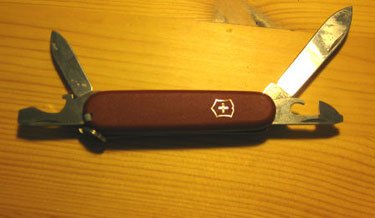
We have gotten used to reading about these little-kid-expelled-from-school-for-possession-of-a-pocket-knife happening in the suburbs of New England or California, but in Pennsylvania?
Recently a ten-year-old female violinist was expelled from the toney Valley School of Ligonier because the young musician was found to be using a Swiss Army Knife to remove broken strings from her violin bow.
Her parents consequently attempted to enroll her in the public school for their local district, but found her admission jeopardized by the report of her expulsion for “bringing weapons onto school property” from the young lady’s previous school.
All this nincompoopery is connected, in Pennsylvania, to a Safe School Act (passed in 1995, and amended in 1997 and subsequently added to) which in the case of a student expelled due to a weapon or drugs being brought on to school property, obligates other schools to apply the same expulsion. The parents are suing on the basis that these zero tolerance policies have inflicted on their daughter a “defamatory stigma.â€
The Violin Channel
31 Aug 2015
WWII Plexiglass Photo Grips
Miltaria, Photography, Plexiglass, Theater Knives, WWII
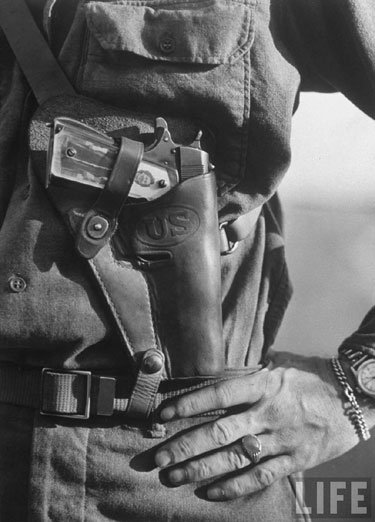
This Life magazine photo, taken at Loiano, Italy in April 1945, is a closeup by internationally-famous photographer Margaret Bourke-White of the plexiglass grip of Lieutenant John Ernser’s .45 pistol containing a photo of his girlfriend. Ernser, age 26, was commanding an infantry platoon engaged in attacking fortified German positions.
The availability of acrylic plexiglass from the canopies of crashed or shot-down aircraft during WWII led to a common practice by American troops of replacing the original standard-issue grips on pistols or fighting knives with clear plexiglass replacements over photographs.
If you were not killing an enemy soldier with the modified weapon, you could stare at the image of your girlfriend and dream of home.
Below is a captured German trench knife (from my own collection) which has had its blade chromed and which has a girlfriend photo on one side, and two male photos on the other side.


31 Aug 2015
Japanese Import
Godzilla, Humor, Photography, Photoshop

Allegedly observed crossing Route 128 in Northeastern Massachusetts.
30 Aug 2015
European Suicide
Demographics, Der Untergang das Abendlandes, Immigration, Imre Kertesz, Islam

The Muslim Issue quotes a Swedish review of Hungarian 2002 Nobel Prize for Literature winner Imre Kertesz’s new book (not yet available in English):
“Europe will soon go under because of its former liberalism that has proved childish and suicidal. Europe has produced Hitler, and after Hitler the continent stands there with no arguments: the doors are wide open for Islam, they no longer dare talk about race and religion while Islam only knows the language of hatred against alien races and religions,†writes Kertész in his book. …
“I should say a few words about politics too … Then I would talk about how Muslims are flooding, occupying, in clear verbs, destroying Europe, and how Europe relates to this, the suicidal liberalism and the stupid democracy … It always ends the same way: civilization reaches a certain stage of maturation where it is not only able to defend itself, but where it is in a seemingly incomprehensible worship of their own enemy.â€
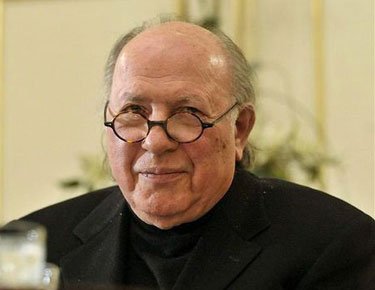
Imre Kertesz
30 Aug 2015
Duesenberg Coupe Simone: The Car Which May or May Not Have Ever Actually Been Built
Automobiles, Design, Duesenberg, Duesenberg Coupe Simone, Myths and Legends
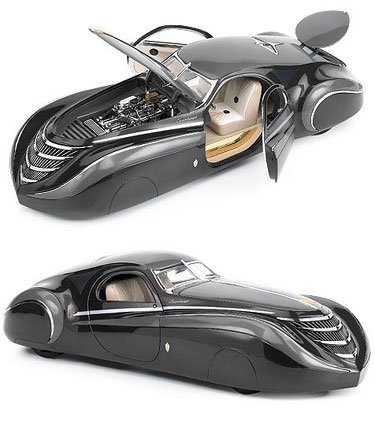


What actually exists are 1:24 models of the car made by the Franklin Mint, by one account, from drawings found in a barn on the remote Central Pennsylvania estate of Guy de LaRouche.
The legend says that the Duesenberg Coupe Simone was created by the coachbuilding firm Emmet-Armand on the Duesenberg Type J frame in response to a special order from French cosmetics magnate Guy (or Gui) de LaRouche (or LaRoche). The coupe took three years to build and was finished after the bankruptcy of Cord and the end of Duesenberg production. The Coupe Simone was named for LaRouche’s lover and was intended to be a gift to her. It was sent to France for LaRouche’s approval, before it was to be exhibited at the 1939 New York World’s Fair, but disappeared as the result of a love triangle and the outbreak of the Second World War. The Coupe Simone was either destroyed during the war, or remains forgotten today, rusting away, in a barn somewhere in rural France.
An alternative story contends that plans for the car were drawn up in the 1930s, but the car was never built, and only the Franklin Mint models made from drawing re-discovered decades later were ever actually built.
Another version contends that neither car nor drawings nor French cosmetics king ever actually existed, and the model car was invented in the late 1990s by a couple of Franklin Mint designers, who made up a romantic story to explain the Art Deco automobile they had imagined.
Diesel Punks: The Strange Case of the Midnight Ghost.
Opposite Lock: The Duesenberg Coupe Simone: A One-Off that Never Was.
Wikicars: Duesenberg Coupe Simone
Before Its News: A Duesenberg That Didn’t Get Past the Drawing and Planning Stages of a Coachbuilder.

29 Aug 2015
Knot of Herakles and Butterfly Brooch
Antiquity, Eros, Jewelry, Psyche
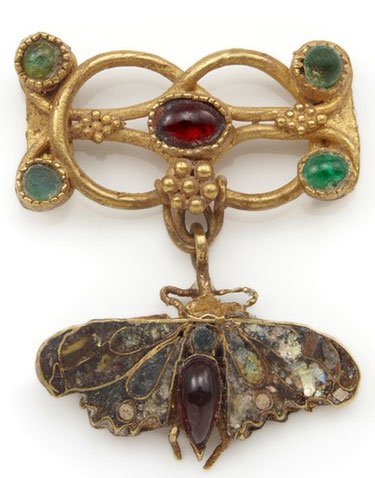
Brooch with Heracles knot and butterfly pendant, 300-100 B.C. Gold, Almandine, Emerald, Glass. Greece. Museum für Angewandte Kunst, Cologne. (Photo: Martin Kilmas.)
The marriage-knot or knot of Hercules, a strong knot created by two intertwined ropes, originated as a healing charm in ancient Egypt, but is best known for its use in ancient Greece and Rome as a protective amulet, most notably as a wedding symbol, incorporated into the protective girdles worn by brides, which were ceremonially untied by the new groom. This custom is the likely origin of the phrase “tying the knot.â€
According to Roman lore, the knot symbolized the legendary fertility of the God Herakles; it probably relates to the legendary Girdle of Artemis captured from the Amazon Queen Hippolyta. In this, the marriage-knot was probably a representation of the virginity of the bride.
The butterfly symbolizes the Greek princess Psyche, whose beauty was such as to provoke the envy and wrath of Aphrodite. The goddess’s revenge was foiled, however, when her son Eros fell in love with Psyche, and after various difficulties, persuaded the gods to make her immortal and thus his equal. Eros then married Psyche and the couple were bonded together eternally in passionate union.
This remarkable object was clearly made as a wedding present for a bride.





