Category Archive '2016 Election'
06 Sep 2016

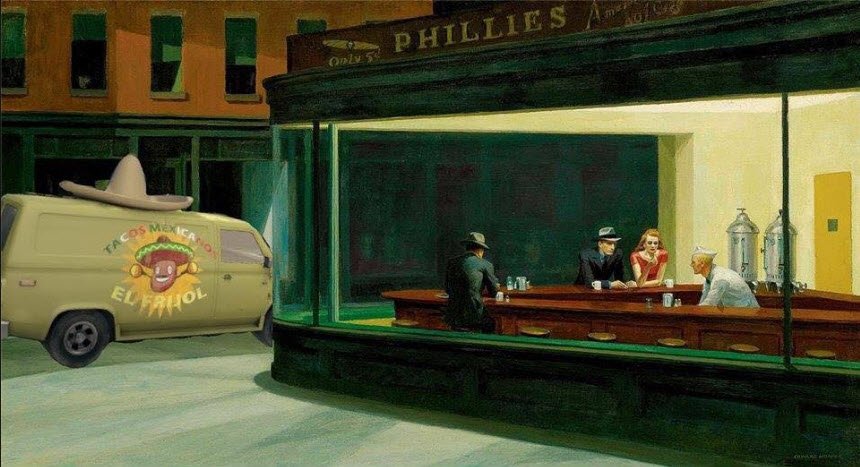
“My culture is a very dominant culture, and it’s imposing and it’s causing problems. If you don’t do something about it, you’re going to have taco trucks on every corner.â€
—Marco Gutierrez, founder of the group Latinos for Trump.
Hat tip to David Larkin.
05 Sep 2016

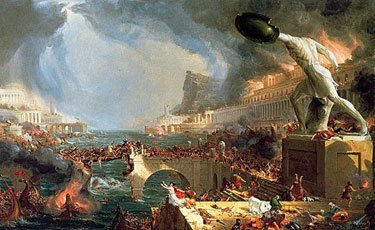
Thomas Cole, The Course of Empire — Destruction, 1836, New York Historical Society
Richard Fernandez pessimistically compares the current governing styles of Russia and the United States.
Russia is pretty representative of many states which are simply collections of informal power groups. Whether these groups are called cartels, clans, sects or Communist parties, they may essentially be described as what James Madison called factions. He regarded them as both a danger to democracy and the natural forge of leadership and so spent a lot of time figuring out how to control them.
in the fall of 1787, when he was still in his mid-30s, [Madison] began collaborating with Alexander Hamilton and John Jay to write a series of 85 newspaper essays explaining the U.S. Constitution and urging the people of New York to adopt it. …
Given the talismanic power the word “democracy†has to modern ears, it is worth reminding ourselves that the U.S. Constitution was largely an effort to curb or trammel democracy. Democracies, Madison wrote in Federalist 10, the most widely read and cited of the essays, “have in general been as short in their lives as they have been violent in their deaths.†Why? A mot often attributed to Benjamin Franklin explains it in an image. “Democracy is two wolves and a lamb voting on what to have for lunch.†…
The biggest threat to “popular†governments, he wrote in Federalist 10, are “factions,†interest groups whose operations are “adverse to the rights of other citizens†or the “permanent…interests of the community.†Factions are thus not accidental. They are—famous phrase—“sown in the nature of man.†Why? Because freedom and the unequal distribution of talent inevitably yield an unequal distribution of property, the “most common and durable source of faction.†…
Madison’s solution was the creation of a large republic in which a scheme of representation and a large variety of interests “make it less probable†that they will be able to “invade the rights of other citizens†successfully. … Madison’s central insight was that power had to be dispersed and decentralized if it was to serve liberty and control faction.
The paradox that Putin exemplifies is that while factions breed formidable conspirators, they also create poisonous leaders. They succeed in themselves but cause the society around them to fail. That is because they dispense a favoritism which is ultimately ruinous for the nation. The result is a self-vetoing enterprise. Marian Tupy observed that Chile began to succeed at the moment when its junta began to allow economic freedom while Venezuela started to fail by going the other way. But few ruling elites have the sense to get themselves out of the way. Usually they have to be shoved aside.
The question is whether Madison’s defenses failed and the factions are inside the wire. America for a long time beat the odds but recently things have taken a turn for the worse. It is no accident that many of America’s troubles have coincided with the growth of identity politics, special interest groups, foreign lobbying and corruption. If so they have spread their poison and created an American version of the “informal networks” that proved so fatal in other countries, as Madison feared.
Moreover, the American factional system operates in the worst possible way. The Clinton Foundation and private email scandal is a portrait of venality without competence. The peculiar characteristics of American factionalism have bred something singular; a phenomenon at once cunning yet stupid, both corrupt and inept. America is no longer exceptional, just another bum in the ring. Yet while Putin can often outwit Obama (and Hillary when she was in State), the Russian cannot seem to turn anything to lasting advantage. The outcome is a kind of impotence afflicting both sides.
2016 should have been an election charged with passion, but it is atmospherically deadening, as if many voters wished the candidates would just go away. If the 20th century was one in which people believed government could solve all the world’s problems, the 21st century is fast developing into one where government has become like the weather: chaotic, capricious and ultimately arbitrary — something everyone talks about but no one can do anything about.
Read the whole thing.
03 Sep 2016

Arlie Russell Hochschild, in Mother Jones, surprisingly sympathetically, explains where Trump’s support is coming from.
The deep story of the right goes like this:
You are patiently standing in the middle of a long line stretching toward the horizon, where the American Dream awaits. But as you wait, you see people cutting in line ahead of you. Many of these line-cutters are black—beneficiaries of affirmative action or welfare. Some are career-driven women pushing into jobs they never had before. Then you see immigrants, Mexicans, Somalis, the Syrian refugees yet to come. As you wait in this unmoving line, you’re being asked to feel sorry for them all. You have a good heart. But who is deciding who you should feel compassion for? Then you see President Barack Hussein Obama waving the line-cutters forward. He’s on their side. In fact, isn’t he a line-cutter too? How did this fatherless black guy pay for Harvard? As you wait your turn, Obama is using the money in your pocket to help the line-cutters. He and his liberal backers have removed the shame from taking. The government has become an instrument for redistributing your money to the undeserving. It’s not your government anymore; it’s theirs.
Read the whole thing.
03 Sep 2016
 illary C illary C
31 Aug 2016
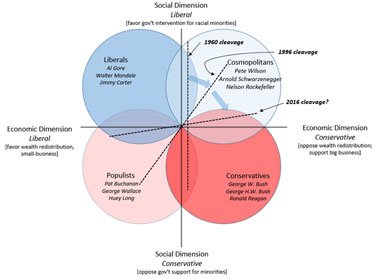
Lee Drutman views the world partisanly, through red-tinted Progressive lenses, and his screed features all the usual sanctimonious liberal stereotypes (We Republicans are just a bunch of nasty racists), but I thought there was an interesting grain of truth, underneath all the cant, in all this, specifically in the technical analysis of the party sociology that led to Donald Trump’s victory in the Republican primaries.
Our story effectively begins in 1932, when Democrats formed a majority coalition that included Northern liberals and Southern conservatives. The Great Depression had made economics the fundamental dividing line of conflict. And with Republican President Herbert Hoover getting the blame for the collapse, Democrats were on the winning side of the issue.
Now, if the median voter theorem explained the world, Republicans would have simply become the party of the New Deal as well — as some would say Eisenhower attempted to do. But Eisenhower’s New Deal–light Republicanism angered the activists and economic elites in the Republican Party, who still wanted to undo the New Deal and who were sure that if they really truly opposed the New Deal, public opinion would miraculously move to their side.
When the far-right economic conservative Goldwater lost in 1964, however, it became clear Republicans couldn’t win purely on limited government as a defense of liberty. They would have to attach limited government to a winning position on some other issue that would split the Democratic Party…
Like all majorities, the Democratic majority from 1932 to 1964 contained within it the seeds of its own destruction — in particular, an internal conflict between Northern liberals and Southern conservatives over the issue of civil rights. Eventually, Northern liberals became the majority faction within the Democratic Party and exerted pressure, and Democrats passed a series of civil rights bills into law.
And with that, the Democrats effectively lost their winning political hand for the sake of moral principle. The civil rights laws created a backlash among Southern white Democratic conservatives and Northern working-class whites who were most directly affected by urban riots, and housing and school desegregation.
This gave Republicans the cross-cutting issue with a clear majority they needed: race and identity. With Nixon’s strategic guidance, Republicans went full steam ahead in making it the central dividing line in American politics.
They were certainly aided in this effort by Democrats, who struggled to speak to the urban unrest that drove many former Democrats to the Republican Party, or to acknowledge some of their own hubris in the power of a government run by Ivy League intellectuals to solve deep social problems. Democrats also nominated George McGovern to be their standard-bearer in 1972, whose label as the effete candidate of “acid, amnesty, and abortion” stuck, and also stuck with Democrats.
Moreover, as the economy stagnated in the 1970s, and businesses choked on a slew of new regulations and inflation increased, Democrats’ traditional advantages on economic issues also waned.
With Ronald Reagan’s election in 1980, Republicans solidified a winning coalition that successfully strengthened the appeal of “limited government” beyond economic conservatism, where it had traditionally lived. “Limited government” now also meant not meddling in the private lives of citizens to enforce some elitist Ivy League intellectual’s idea of racial justice, and not asking middle-class taxpayers to pay welfare support for poor black people. …
But like all winning political coalitions, this, too was full of internal contradictions. In particular, many of the economic conservatives (who tended to be more libertarian and thus more culturally cosmopolitan) and many of the cultural conservatives (who tended to be former New Deal Democrats and thus very supportive of universal entitlements like Social Security) didn’t have a ton in common, other than feeling like they didn’t have a home in the Democratic Party (though for different reasons). …
[Subsequently] Republicans and Democrats essentially underwent a four-decade exchange program. Democrats sent Republicans their non-college-educated, culturally conservative white voters, mostly in declining rural and exurban areas, who had once been the core of the New Deal. In return, Democrats got culturally liberal wealthy professionals, largely in prosperous urban and suburban areas, many of whom were once “Rockefeller Republicans” and had once opposed many elements of the New Deal.
This happened slowly, because partisan loyalties are really sticky and most voters don’t play close attention to issues. (To really understand how sticky partisan identities are, consider that up until 2010, Democrats were a majority in the Alabama state legislature).
It also happened slowly because in the 1990s, Democrats managed to stem some of the flow by taking more conservative stands on race and culture under the leadership of Bill Clinton, who won a bunch of Southern states. But it could only be a temporary hold, especially once Republicans started winning back southern congressional seats and retook the House in 1995. …
For Republicans, this initially looked like a really good deal, more like a two-for-one swap. And it largely was, from the early 1970s until about the mid-2000s.
But the deal had a long-term liability. America was steadily becoming more diverse, and more highly educated. And the younger generation was much more culturally and socially liberal than the previous generation. Republicans might have been converting more Democrats to Republicans than vice versa. But Democrats were making greater gains among new voters, and also doing better and better among increasingly cosmopolitan wealthy Americans. What looked like a losing coalition for Democrats in 1972 would be a winning coalition for Democrats nationally in 2008.
There was also second problem for the Republican elites whose vision of “limited government” was always far more motivated by economic conservatism than by cultural conservatism. By the mid-2000s, they were becoming more and more of a minority within their party as the party had become more dependent on conservative working-class whites to win elections.
And while these voters could be convinced to support “limited government” and “free enterprise” as abstract moral principles, they also had no great love for Wall Street, or for corporate CEOs or globalization. More often than not, they were from rural and exurban places that had increasingly become hotbeds of political resentment, places that had been on a steady multi-decade economic decline as more and more talent and capital investment flowed to the largest cities, mostly on the coasts. Their communities were slowly dying, both literally and figuratively.
These voters had no interest in Republican elites’ priorities of voucherizing Medicare or privatizing Social Security. They wanted their entitlements. They wanted government to do more for old people and the middle class. And they were really concerned about immigration. And as Republican elites failed to respond to their concerns, these voters grew more and more frustrated.
Given this dilemma, Republican leadership had essentially two choices. One was to recognize that the Republican Party was becoming the middle-class party, and to offer a set of economic policies targeted to help these increasingly struggling middle-class voters. …
The other choice was to instead continue to push the very economically conservative policies most preferred by the now minority-within-the-party wealthy establishment Republicans by turning “limited government” into a nearly religious crusade, and feeding the overarching argument that the federal budget was nothing but a giant transfer program from strained “maker” middle-class taxpayers (mostly white) to poor “taker” criminal welfare recipients and illegal immigrants (almost entirely black and Hispanic). And, even more apocalyptically, that any expansion of government was akin to socialism and communism and fascism all rolled into one horrible totalitarian nightmare overrun with illegal immigrants, which just happened to be Barack Obama’s secret black Muslim takeover plan for America.
Whether or not Republican leaders actually believed any of this rhetoric is hard to say. But these are the kinds of things Republican voters began to say in the 2010s. And Republican leaders did nothing to stop it. After all, all this rhetoric allowed the party to keep its donor-class activists happy by obscuring these donors’ deeply unpopular policy goals under the guise of something else. …
[O]nce Democrats were freed of their remaining “blue dog” Southern conservatives in Congress after the 2010 midterm landslide, and they felt increasingly confident they could win national elections with the “Obama coalition” of racial minorities and white liberals …, they had fewer reasons to moderate on racial and social issues, as Bill Clinton had needed to in order to win nationally in 1992 and 1996.
It’s no surprise, then, that Democrats have recently taken strong stands on same-sex marriage, have felt more comfortable speaking to the concerns of the Black Lives Matter movement, and have even been willing to take more aggressive stands on gun control. And given all this, it’s no wonder that socially conservative whites have become so convinced their country is being taken from them.
Immigration has also contributed. It’s important to understand that between 1990 and 2014, the share of foreign-born citizens in the United States went from 7.9 percent to 13.9 percent — a near doubling. The last time the share of foreign-born citizens got this high (about 100 years ago), it provoked enough nativist backlash in the 1920s to largely close the borders for four decades, until 1965.
It appears that the rising tide of immigration has indeed provoked some backlash, and that backlash has been channeled into the Republican Party. …
Now, in retrospect, it becomes increasingly clear how the Republican Party got to a place where it was primed for Trump’s white grievance message. Republicans spent the past half-century winning over socially conservative, non-college-educated whites on issues of race and identity, to the point that these voters became the dominant faction within the party.
Read the whole screed.
Putting it slightly differently from Drutman, I’d say that Barack Obama’s intensification of national racial divisions, his Culture War aggressions, and his artificially-prolonged economic bad times which fell most heavily on middle and working class Americans really did provoke an uprising of major elements of the Republican base and of a great many loosely-affiliated cross-over democrat voters.
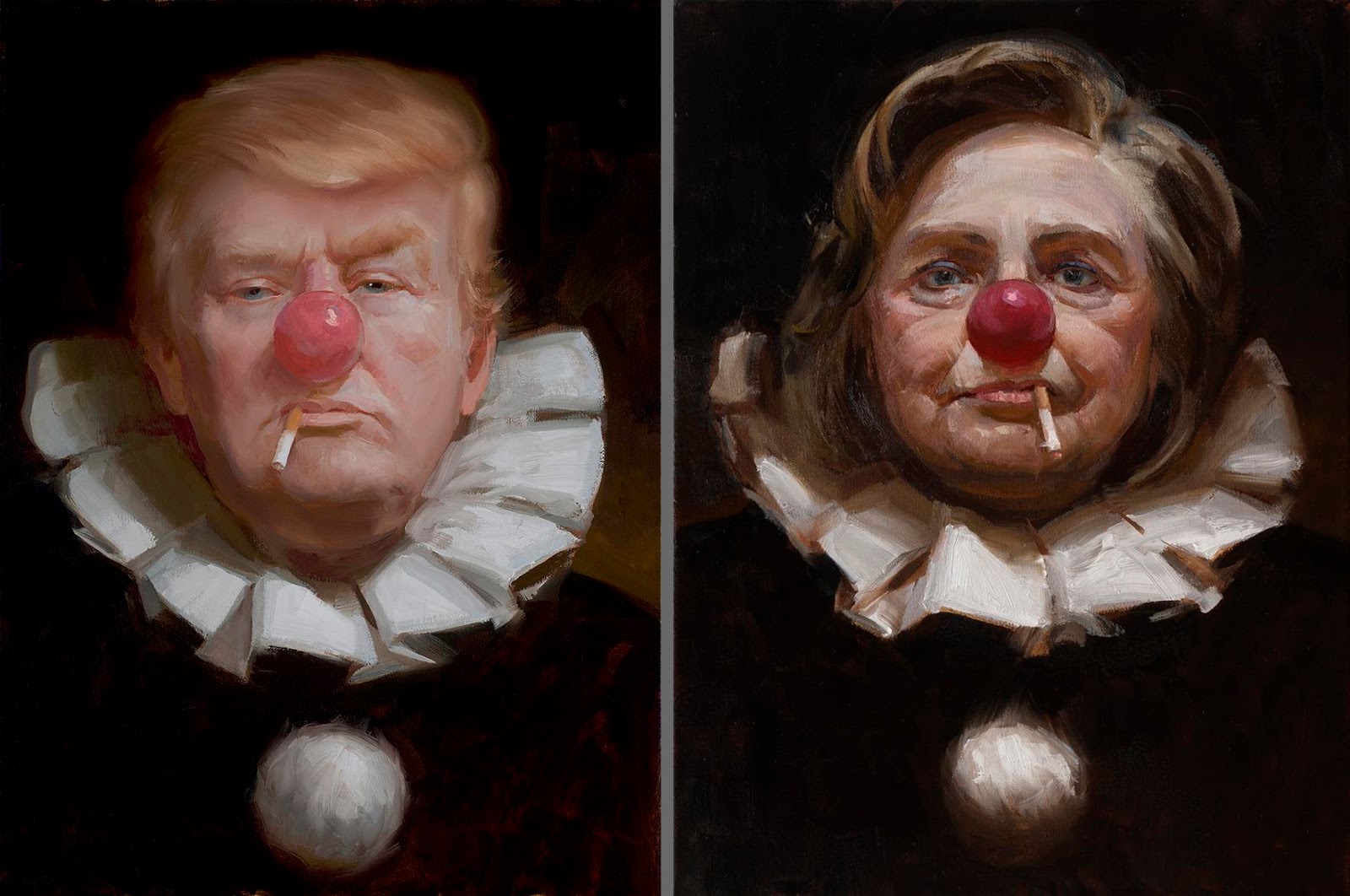
This populist insurgency is strongly anti-immigration, (from the Progressive viewpoint) transgressively opposed to governmentally-imposed minority privilege, and –it’s true– frequently lacking in conservative or libertarian principles. The populist wave proved strong enough to gain victory in the primaries, but the sad truth is the democrats misgoverned and awakened the fury of the peasants who came out with pitchforks and torches, discrediting themselves and their movement in the process by selecting a clown for a leader on the basis of a bunch of pernicious slogans and reprehensible political postures.
The poignant irony is that it was precisely the damage to the economy and the national morale inflicted by a Progressive democrat administration that caused the portion of the Republican base that the democrat party alienated and drove over to us to run amok and to effectively democratize the Republican Party, adopting traditional democrat demagogy talking points complaining about free trade, opposing labor competition and the export of jobs, promising to punish corporations, offering special governmental patronage and protection, and urging American retreat from International Leadership. The peasant revolt in the GOP is almost certainly going to result in an absurd and completely undeserved democrat party victory in what on-every-rational-basis ought to have been a landslide Republican year.
Where I grew up, a rational observer might remark that “the democrat party is exactly like the guy who fell into the septic tank and came up with a harp and a piano.” “Piano” being pronounced “PIE-ano.”
25 Aug 2016
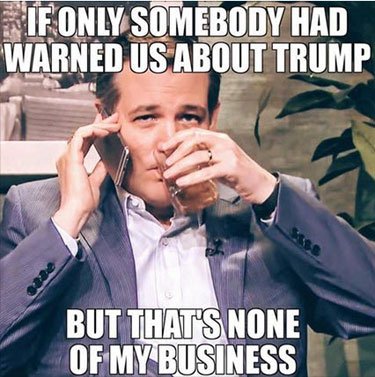
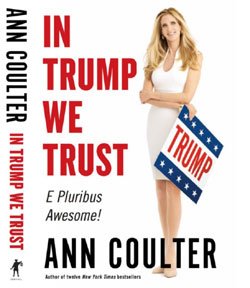
Personally, I prefer Trump’s position on immigration now that he has flipflopped, but Ann Coulter, poor girl!, is having kittens over it, and just two days after her very own pro-Trump campaign book was released.
What do you suppose all the Trumpkins who stay on board are going to say when Trump starts revising his position on Gun Control? and when he announces his new and thoroughly-revised list of potential Supreme Court appointees?
23 Aug 2016
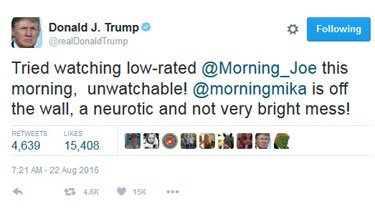
Rod Dreher shakes his head in frustration over “Trump at his Trumpiest.”
Trump supporters must want to put their heads on the table at this kind of thing. Here is a man who stands a chance of becoming President of the United States, but he cannot stay focused enough on the campaign to do what’s necessary. Instead, the media have gotten inside his head.
Somebody inside the Trump campaign apparently twisted his arm to get him to quit reading his Twitter feed long enough to get down to Louisiana with some relief supplies. He handled himself well while he was here, and even won praise from the Democratic governor, and our former US Senator, also a Democrat. He did well! It ought to have been the occasion for a campaign reset, however small. The fact that Hillary Clinton has been attending fundraisers with the superrich instead of visiting the suffering here is a golden campaign issue that reinforces his themes about the elites being out of touch.
But no. Here he is on Monday morning, being Trump at his Trumpiest, bitching and moaning about the hosts of a low-rated morning television show, and doing so in language that does not demean them, but demeans himself. See, this is a good example of why he’s unfit for office. Can you imagine being on President Trump’s staff and having to get him to put down his smartphone and listen to the daily briefing? Sad!
At just about every turn, Trump steps on his own chances, through his egotism, his lack of self-restraint, and his inability to focus on the long game. Yes, the media are biased, but at some point, he’s got to realize that his greatest obstacle in the task of being elected president is himself.
22 Aug 2016

How did we get to this point? Where are we going in the future? Jonathan Rauch, in the Atlantic, argues that we democratized and reformed our way to chaos, disorder, and allowing the momentary whims of the least common denominator to make the key decisions, and he thinks it is only going to get worse.
It’s 2020, four years from now. The campaign is under way to succeed the president, who is retiring after a single wretched term. Voters are angrier than ever—at politicians, at compromisers, at the establishment. Congress and the White House seem incapable of working together on anything, even when their interests align. With lawmaking at a standstill, the president’s use of executive orders and regulatory discretion has reached a level that Congress views as dictatorial—not that Congress can do anything about it, except file lawsuits that the divided Supreme Court, its three vacancies unfilled, has been unable to resolve.
On Capitol Hill, Speaker Paul Ryan resigned after proving unable to pass a budget, or much else. The House burned through two more speakers and one “acting†speaker, a job invented following four speakerless months. The Senate, meanwhile, is tied in knots by wannabe presidents and aspiring talk-show hosts, who use the chamber as a social-media platform to build their brands by obstructing—well, everything. The Defense Department is among hundreds of agencies that have not been reauthorized, the government has shut down three times, and, yes, it finally happened: The United States briefly defaulted on the national debt, precipitating a market collapse and an economic downturn. No one wanted that outcome, but no one was able to prevent it.
As the presidential primaries unfold, Kanye West is leading a fractured field of Democrats. The Republican front-runner is Phil Robertson, of Duck Dynasty fame. Elected governor of Louisiana only a few months ago, he is promising to defy the Washington establishment by never trimming his beard. Party elders have given up all pretense of being more than spectators, and most of the candidates have given up all pretense of party loyalty. On the debate stages, and everywhere else, anything goes. …
Trump, however, didn’t cause the chaos. The chaos caused Trump. What we are seeing is not a temporary spasm of chaos but a chaos syndrome.
Chaos syndrome is a chronic decline in the political system’s capacity for self-organization. It begins with the weakening of the institutions and brokers—political parties, career politicians, and congressional leaders and committees—that have historically held politicians accountable to one another and prevented everyone in the system from pursuing naked self-interest all the time. As these intermediaries’ influence fades, politicians, activists, and voters all become more individualistic and unaccountable. The system atomizes. Chaos becomes the new normal—both in campaigns and in the government itself.
Our intricate, informal system of political intermediation, which took many decades to build, did not commit suicide or die of old age; we reformed it to death. For decades, well-meaning political reformers have attacked intermediaries as corrupt, undemocratic, unnecessary, or (usually) all of the above. Americans have been busy demonizing and disempowering political professionals and parties, which is like spending decades abusing and attacking your own immune system. Eventually, you will get sick.
The disorder has other causes, too: developments such as ideological polarization, the rise of social media, and the radicalization of the Republican base. But chaos syndrome compounds the effects of those developments, by impeding the task of organizing to counteract them. Insurgencies in presidential races and on Capitol Hill are nothing new, and they are not necessarily bad, as long as the governing process can accommodate them. Years before the Senate had to cope with Ted Cruz, it had to cope with Jesse Helms. The difference is that Cruz shut down the government, which Helms could not have done had he even imagined trying.
Like many disorders, chaos syndrome is self-reinforcing. It causes governmental dysfunction, which fuels public anger, which incites political disruption, which causes yet more governmental dysfunction. Reversing the spiral will require understanding it.
——————————————–
Michael Rosemblum, at HuffPo, thinks it’s simpler than that. Ignore the polls, Trump will win because he’s the biggest celebrity and America has evolved into a television-based celebrity culture. Get ready for Kanye West vs. Phil Robertson next time!
Donald Trump is going to be elected president.
The American people voted for him a long time ago.
They voted for him when The History Channel went from showing documentaries about the Second World War to Pawn Stars and Swamp People.
They voted for him when The Discovery Channel went from showing Lost Treasures of the Yangtze Valley to Naked and Afraid.
They voted for him when The Learning Channel moved from something you could learn from to My 600 Pound Life.
They voted for him when CBS went from airing Harvest of Shame to airing Big Brother.
These networks didn’t make these programming changes by accident. They were responding to what the American people actually wanted. And what they wanted was Naked and Afraid and Duck Dynasty.
The polls may show that Donald Trump is losing to Hillary Clinton, but don’t you believe those polls. When the AC Nielsen Company selects a new Nielsen family, they disregard the new family’s results for the first three months. The reason: when they feel they are being monitored, people lie about what they are watching. In the first three months, knowing they are being watched, they will tune into PBS. But over time they get tired of pretending. Then it is back to The Kardashians.
The same goes for people who are being asked by pollsters for whom they are voting. They will not say Donald Trump. It is too embarrassing. But the truth is, they like Trump. He is just like their favorite shows on TV.
Mindless entertainment.
Trump’s replacement of Paul Manafort with Breitbart’s Steve Bannon shows that Trump understands how Americans actually think. They think TV. They think ratings. They think entertainment.
Your are browsing
the Archives of Never Yet Melted in the '2016 Election' Category.
/div>

Feeds
|