Per the 1940 Federal census, the Gladsky family (Joseph and Sophia, their three children, and Joe’s father, born in what became Poland but was then the Russian Empire) occupied 422 West Lloyd Street in said town, Shenandoah Borough, Schuylkill Co, PA. Sophia is about 31 in this photo. … Joe died in Fairmont, West Virginia in 1961, age about 57. His son, Joe Jr., died at 73 in New Jersey. Sophia herself died in New Jersey in 1996, aged 89 years.
Some interesting touches in this shot are the rather worn armchair with faint shadow of an antimacassar on the back and the apparently new widow casings and baseboard.
I was born ten years later on a farm my father bought after the war in Locust Valley, but around 1953 my mother forced him to give up the farm and move back into town. In those days, working class families were lucky to own a single automobile, and most women (including my mother) never learned to drive. Living out in the country without transportation was naturally unpleasant for her.
We wound up living across the street and one block west from Mr. & Mrs. Gladski (with whom we were not acquainted as far as I know), at 515-517 West Lloyd. My father also worked as a coal miner at Maple Hill (the last of the collieries to shut down). Maple Hill ended mining operations in 1954. While working there, my father was once (briefly) buried by a cave-in of coal. He was able to dig himself out, but the fall had knocked his miner’s helmet off and one rock split open his scalp. He had to go to the hospital to have the wound stitched up. When he was an old man, you could see blue particles of coal embedded in the skin on top of his head.
Needless to say, I am old enough to remember this style of domestic furnishings. Mrs. Gladski was a good looking woman with the kind of aquiline nose which has always seemed to me to be a distinctly Polish feature.
Whole Foods produce section, Reno, Nevada
Venkatesh Rao (as is becoming ever more frequent these days, we Americans get our explanations about ourselves from Indians) describes a longstanding American cultural pattern of concealing out Hamiltonian realities behind more pleasing Jeffersonian facades.
Every time you set foot in a Whole Foods store, you are stepping into one of the most carefully designed consumer experiences on the planet. Produce is stacked into black bins in order to accentuate its colour and freshness. Sale items peek out from custom-made crates, distressed to look as though they’ve just fallen off a farmer’s truck. Every detail in the store, from the font on a sign to a countertop’s wood finish, is designed to make you feel like you’re in a country market. Most of us take these faux-bucolic flourishes for granted, but shopping wasn’t always this way.
George Gilman’s early A&P stores are the spiritual ancestors of the Whole Foods experience. If you were a native of small-town America in the 1860s, walking into one of Gilman’s A&P stores was a serious culture shock. You would have stared agog at gaslit signage, advertising, tea in branded packages, and a cashier’s station shaped like a Chinese pagoda. You would have been forced to wrap your head around the idea of mail-order purchases.
Before Gilman, pre-industrial consumption was largely the unscripted consequence of localised, small-scale patterns of production. With the advent of A&P stores, consumerism began its 150-year journey from real farmers’ markets in small towns to fake farmers’ markets inside metropolitan grocery stores. Through the course of that journey, retailing would discover its natural psychological purpose: transforming the output of industrial-scale production into the human-scale experience we call shopping.
Gilman anticipated, by some 30 years, the fundamental contours of industrial-age selling. Both the high-end faux-naturalism of Whole Foods and the budget industrial starkness of Costco have their origins in the original A&P retail experience. The modern system of retail pioneered by Gilman — distant large-scale production facilities coupled with local human-scale consumption environments — was the first piece of what I’ve come to think of as the ‘American cloud’: the vast industrial back end of our lives that we access via a theatre of manufactured experiences. If distant tea and coffee plantations were the first modern clouds, A&P stores and mail-order catalogues were the first browsers and apps. …
The American cloud is the product of a national makeover that started in 1791 with Alexander Hamilton’s American School of economics — a developmental vision of strong national institutions and protectionist policies designed to shelter a young, industrialising nation from British dominance. Hamilton’s vision was diametrically opposed to Thomas Jefferson’s competing vision based on small-town, small-scale agrarian economics. Indeed, the story of America is, in many ways, the story of how Hamilton’s vision came to prevail over Jefferson’s.
By the early 19th century, Hamilton’s ideas had crystallised into two complementary doctrines, both known as the ‘American system’. The first was senator Henry Clay’s economic doctrine, based on protectionist tariffs, a national bank, and ongoing internal infrastructure improvements. The second was the technological doctrine of precision manufacturing based on interchangeable parts, which emerged around Springfield and Harpers Ferry national armouries. Together, the two systems would catalyse the emergence of an industrial back end in the country’s heartland, and the establishment of a consumer middle class on the urbanising coasts. But it would take another century, and the development of the internet, for the American cloud to retreat almost entirely from view.
By the 1880s, the two American systems had given rise to a virtuous cycle of accelerating development, with emerging corporations and developing national infrastructure feeding off each other. The result was the first large-scale industrial base: a world of ambitious infrastructure projects, giant corporations and arcane political structures. Small farms gave way to transcontinental railroads, giant dams, Standard Oil and US Steel. The most consequential political activity retreated into complex new governance institutions that few ordinary citizens understood, such as the Interstate Commerce Commission, the Federal Reserve, and the War Industries Board. Politics began to acquire its surreal modern focus on broadly comprehensible sideshows.
Over the course of two centuries, the Hamiltonian makeover turned the isolationist, small-farmer America of Jefferson’s dreams into the epicentre of the technology-driven, planet-hacking project that we call globalisation. The visible signs of the makeover — I call them Hamiltonian cathedrals — are unprepossessing. Viewed from planes or interstate highways, grain silos, power plants, mines, landfills and railroad yards cannot compete visually with big sky and vast prairie. Nevertheless, the Hamiltonian makeover emptied out and transformed the interior of America into a technology-dominated space that still deserves the name heartland. Except that now the heart is an artificial one.
The makeover has been so psychologically disruptive that during the past century, the bulk of America’s cultural resources have been devoted to obscuring the realities of the cloud with simpler, more emotionally satisfying illusions. These constitute a theatre of pre-industrial community life primarily inspired, ironically enough, by Jefferson’s small-town visions. This theatre, which forms the backdrop of consumer lifestyles, can be found today inside every Whole Foods, Starbucks and mall in America. I call it the Jeffersonian bazaar.
August 1940. “Old house in Upper Mauch Chunk, Pennsylvania. In the background is East Mauch Chunk.” Photo by Jack Delano.
Mauch Chunk, renamed as Jim Thorpe in 1953 in an outrageous feat of Babbitry, is the county seat of Carbon County. Described as “the Switzerland of Pennsylvania,” the town lies at the eastern edge of the Anthracite Mining region. Four Molly Maguire terrorists were hanged there in 1876.
Upper Mauch Chunk is distinguished by its proximity to a mountain ridge where rock hounds can find carnotite, a radioactive mineral containing uranium. Guess how I know that.
I’ve always had a personal weakness for old, decayed houses, and for the gingerbread Victorian ornamentation found on small town Pennsylvania houses.
NC Statistics grad student Joshua Katz used an algoritm to map responses to a 120-question survey of regional English by Bert Vaux of Cambridge University.
My native Schuylkill County, Pennsylvania, apparently, falls into a small zone which pronounces syrup as “SEARup,” and whose residents think Mary and merry sound the same, but marry sounds different. I have trouble imagining alternative viewpoints.
On the female front: I expect the popularity of Jane Austen explains the rise of Emma. Sophia is a lot more problematic, though similar in period quality. Exactly why Ava is doing so well in Vermont is seriously intriguing.
On the male front: At least Jared and Justin have faded, but Jacob is still hanging in there in popularity in a few states. Jaydon?!? What is Florida’s major malfunction? The other big question is where the heck did Mason come from?
Could be worse, though, Mohammed is not on top in any state.
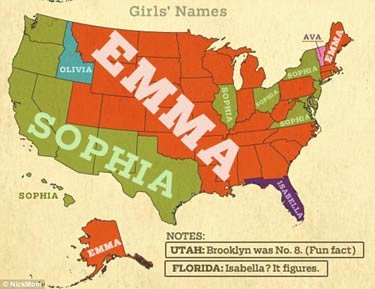
Maybe you’ve never heard of Emmaland or Sophialand, but if you’re reading this in the United States, there’s a better than 90% chance that you live in either one of these two curious nations.
The former is made up of the 31 states where ‘Emma’ was the most popular baby name for girls in 2012. In spite of that institutional majority, another girl’s name proved more popular nationwide. ‘Sophia’ also came out ahead in 16 states, including America’s three most populous ones.
Last year, a total of 20,791 Emmas were born in the United States. The size of that cohort was only surpassed by the 22,158 Sophias added to the US population in 2012. Together, both names came out on top in 47 of the 50 states. The exceptions were Florida, where baby girls were most likely to be named Isabella (#3 nationwide); Idaho, where new parents preferred Olivia for their girls (#4 overall); and Vermont, where new parents favoured Ava for their newborn daughters (#5 in the national ranking).
Few aspects of anthrophonomastics are as eagerly discussed as the names people give their children. Perhaps because few acts are as simultaneously intimate and public: the name you give your child reveals something of the hopes and ambitions you have for your progeny, not to mention the tastes and traditions you inherited from your forebears.
In the last half century, baby-naming has become a lot more agonising. Until the mid-20th century, the popularity of baby names was less prone to variation and fluctuation. Fitting in was a greater priority than standing out: if you weren’t named after a family member of a previous generation (often your godfather and/or godmother), you were still most likely stuck with a name from a canonical list of biblical and classical names.
“But let anyone born in 1926 try to stay home on a Saturday night in 1998 and listen to Dick Haymes singing ‘Those Little White Lies.’ Just have them do that, and then tell me afterwards if they have not understood at last the celebrated doctrine of the catharsis effected by tragedy.”
[New Editor-and-Publisher Richard K. Fox] reduced subscription rates for saloon keepers, barbers, and hotel managers — business owners that happened to cater to the Police Gazette’s target audience of young, single, urban men. Second, Fox further increased the number of illustrations and effectively created the men’s magazine tradition of featuring sexy layouts of women by introducing his “Footlight Favorites†— engravings of buxom burlesque dancers and soubrettes who showed an occasional bare arm or ankle (*wolf whistle* *cat call* *drooling*). Third, noticing America’s increasing interest in sports, Fox had the vision to create America’s first journalistic sports department in 1879 and wrote full-page stories about boxing, football, and baseball. Fourth, to provide stories for his magazine and to curry favor with his readers, Fox began sponsoring boxing prize fights. Finally, ever the marketing and branding master, Fox began printing the Police Gazette on distinctive pink paper that became a trademark for the magazine. Fox framed all these new additions and features with a cheeky irony and humor that made the magazine an easy and entertaining read.
Fox’s changes to the magazine paid off big time. In just a few short years he tripled the circulation from what it was under Matsell and ad revenue was on par with some of the largest and most popular magazines of the time. Alternatively referred to as the “bachelor bible†and the “barber shop bible,†circulation reached 150,000 a week, with special issues snatched up by more than 400,000; and these numbers really understate the magazine’s reach, as one copy of the Gazette might be read by a hundred men at a saloon or barber shop. The magazine was so firmly established as a fixture in the latter that a common joke sprung up that went like this: “Did you read The National Police Gazette?†“No, I shave myself.†(yuk, yuk, yuk.)
All this makes me feel like the Ancient Mariner. The Police Gazette was actually still a barbershop staple during my boyhood in 1950s Pennsylvania. I was already an avid reader, but the Gazette just wasn’t for me. I found it boring, old-fashioned, and slightly unsavory. I preferred Field & Stream.
Footlight Fairies were a lot tamer than Playboy Playmates.