Down in Somerset County, next Saturday, the John Henry Mellot auction company will be holding an estate auction at a local farm.
Since they posted a photo of this round object mounted decoratively at the gable of the barn, I expect it will probably be for sale.
I’m not actually looking to own one of these myself, but I am curious as to what is the identity of this large, obviously antique, article of agricultural technology?
Company D, Frontier Battalion, Texas Rangers, 1887
Heritage Auctions is selling the original cabinet card photo of this iconic Western image from the John N. McWilliams Texas Ranger Collection on September 20th in Dallas.
Back row from left: Jim King (murdered while working undercover February 11, 1890), Bass Outlaw (discharged 1889, killed by Constable John Selman in El Paso April 4, 1894), Riley Boston, Charles Fusselman (ambushed and killed by rustlers April 17, 1890), James William “Tink” Durbin, Ernest Rogers, Charles Barton, Walter Jones; Sitting (from left): Robert Bell, Cal Aten, Captain Frank Jones (Killed in a fight with Mexican bandits near San Elizario, Texas, June 30, 1893, Joseph Walter Durbin (retired and became sheriff of Frio County), Frank L. Schmid Jr. (died June 17, 1893 of gunshot wounds received August 16, 1889 in Fort Bend County when caught in a crossfire between two hostile political parties).
Winchester and Colt Model 1873s seem to be the universal choice.
The mortality rate from gunshots for members of this small group of men was pretty impressive. Five out of fourteen (four on the right side of the law) were dead with the next seven years.
Company, had been sought after by London’s Victoria and Albert Museum since 1941
The story begins in 1640 when the head of the Dutch East India Company’s Japanese office commissioned an order including ‘four extraordinarily fine coffers’.
They were sold 18 years later with other lacquerware to French First Minister Cardinal Mazarin, and added to his extensive collection.
Two were later acquired by British poet William Beckford. Beckford’s daughter Euphemia married the Duke of Hamilton and the coffers would form part of the Hamilton Palace contents sale of 1882, staged to raise funds for the palace upkeep.
The V&A bought one coffer and the other, a larger one, was sold to collector Sir Trevor Lawrence, then to Welsh colliery owner Sir Clifford Cory.
When Sir Clifford died in 1941, as one expert phrased it: ‘It disappeared off the radar.’
Unknown to the art world, a London-based Polish doctor called Zaniewski had bought it at a bargain price – and later sold it to a French Shell Oil engineer in 1970 for £100.
The French engineer took the chest home with him to the Loire Valley, where his children used the chest to hide in, and where it served for years as a television stand and later as a liquor cabinet.
Finally, after the owner’s death, his now-in-her-50s daughter called in the Rouillac Auction House which recognized the chest as one of the most sought after art objects in the world.
It was purchased at auction on June 9th for £6.3 million ($9.5 million) by the Amsterdam Rijksmuseum.
The exterior features gold and lacquer decorations depicting scenes from the Tale of Genji, views of Ishiyama temple where Murasaki composed the Tale of Genji, while the interior is decorated with hunting scenes from the Story of the Soga Brothers.
Lambrecht Chevrolet in Pierce, Nebraska was owned and operated by Ray and Mildred Lambrecht for 50 years until they retired in 1996 at ages 78 and 75. Now 17 years later, they have finally decided to liquidate the dealership’s massive inventory of 500 vehicles, including a number of brand-new 1950s and 1960s Chevrolet cars and trucks.
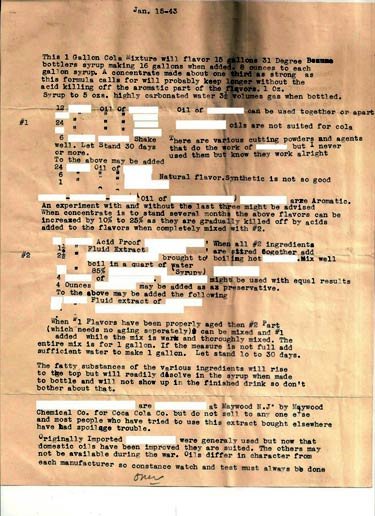
A Georgia antiques collector is the latest person to claim that he might have found the original recipe for Coca-Cola.
Cliff Kluge and his wife Arlene recently bought a box of letters at an estate sale, and one of the yellowed papers, dated 1943, includes instructions for making cola, according to Atlanta’s WXIA. Kluge thinks it could potentially be the recipe for Coca-Cola and is trying to sell it on eBay; bidding starts at $5 million, but customers can buy it now for $15 million.
———————————————–
Somebody clearly believed that it was real, as it Sold via “Buy It Now” on May 15th:
On May 8th, 1886, Dr. John Stythe Pemberton, a pharmacist and inventor of medicinal beverages, invented the world’s most famous drink – Coca Cola. Shortly after, he began selling the fountain drink in a nearby Atlanta pharmacy. Concocted in a brass kettle in his back yard, this patent medicine was billed as being able to cure anything from morphine addiction to headaches to impotence.The ingredients, their ratio and the process method of the beverage is one ofthe most closely guarded secrets in the world. To this day, it is said that only two of Coca Cola’s executives know the entire ingredients.
In 1899, Benjamin F. Thomas and Joseph B. Whitehead of Chattanooga, met with Asa Chandler, then President and owner of the Coca Cola Company. They approached him with the idea of bottling the beverage. Until then, Coca Cola was only available as a fountain drink. After much negotiations, Mr. Chandler agreed to grant bottling rights to the two gentleman, for the astronomical fee of $1.00.(He never collected the $1.00, by the way) Thus born was the world’s first Coca Cola Bottling Company, located in Chattanooga, Tennessee.
Fast forward 100+ years later to the 21st Century – we were at an estate sale of a deceased, renown Chattanooga chemist, who at one time worked at one of the more prominent chemical companies in the area. There were masses upon masses of personal paperwork at the sale. Curious, we bought several boxes of this paperwork, which yielded some interesting finds. Among those finds is what is offered for sale here – what we believe to be the formula for Coca Cola.
Typed on January 15th, 1943, this single page (front and back) breaks down the formula into exact amounts of specific ingredients to make one gallon of concentrate, which, when combined and processed yields enough to make 16 gallons..
May we make this perfectly clear – we can never guarantee and never claim that this is the actual recipe for Coca Cola. Even if this formula was 100% accurate in every aspect– as mentioned above– there are only two people in the world that can verify it’s accuracy, and I doubt they will be willing to compromise Coca Cola to acknowledge our exactness. That is why we are selling this as a historic artifact.
What I can guarantee is that offered for sale is a single page, hand typed and written, 70+ year old recipe on yellowed paper that was purchased out of an estate of a local chemist in a city that claims the right of being where Coca Cola Bottling originated. Whoever typed this letter back in 1943, had access to the original recipe, and references that fact on the second page – “On page 83 of the Extractor is the original Coca Cola formula(e) which might serve as a source of preparation information.”
Though you’re looking at the “Swiss Cheese” version of that formula, with the ingredients edited out, you will be purchasing the entire recipe to include ingredients, ratios and preparation details. The formula is an interesting read in itself – including the Maywood Chemical Company, now the Stepan Chemical Company, which has the solitary right of decocanizing the coca leaves for Coca Cola. Indeed, until 1903, Coca Cola had an average of 9 milligrams of cocaine in each serving. No wonder it got rid of headaches.
It is to our belief that the interest in this will be so great, that the questions through eBay will be monumental– so we ask “serious inquires only”. I will never reveal any portion of the formula in any shape or form, so don’t waste the energy asking. You may find the “Buy It Now” price exceptionally steep, but it will be a drop in the bucket if this formula rises to the occasion and yields an accurate formula for CocaCola – the most popular drink in the world , with over a billion served daily. A billion plus per day – my goodness.
Update: It’s interesting to see how this is unfolding. According to some news sources, it appears that during World War II (this letter is dated January 15, 1943) Coca Cola was concerned that they were not going to be able to obtain all the ingredients they needed to make the formula – either by war time shortages, or the countries where the ingredients came from were deep in battle and couldn’t meet supply demands. This is pure speculation – the estate we bought this from — this person was a renown chemist — is it possible that this informal letter was written to that chemist to find other avenues to reach the same tasting Coca Cola recipe? Personally, I don’t believe it was written to compromise Coca Cola or the formula. There is no doubt (at least in my mind) that whoever typed the letter had seen the original recipe for Coca Cola, and they reference that on the second page – “On page 83 of the Extractor….” Is it the original recipe? I don’t know, but more evidence and external factors are falling in place to bolster the fact that this could be the original, with an emphasis on the word “could”. Looking at the recipe, it certainly is a lot more complicated than I could have ever imagined.
The big network news story last week was the $2.22 million bowl sold by Sotheby’s in London [sic: the sale was in New York] on March 19, 2013. A New York couple had bought the bowl in 2007 for $3. Here are the facts culled from many news stories: The bowl is 5 inches in diameter. It was made during the Northern Song Dynasty (960-1127). Only one other like it is known and that one is in the British Museum. The expensive bowl is white and has a molded leaf decoration outside and an etched flower design inside. The sellers displayed the bowl either on their mantel or a table until recently, when they noticed the high prices being paid for Chinese ceramics. So they had the bowl appraised and Sotheby’s listed it for sale at $200,000 to $300,000. When the owners were informed the bowl sold for millions, they emailed back “WOW!!!” The buyer, one of four serious bidders, is considered by many to be the world’s foremost dealer in Oriental art. He says he is sure he will be able to sell the bowl.
Sotheby’s Fine Chinese Ceramics & Works of Art sale, New York, March 19, lot 94:
PROPERTY FROM A NEW YORK STATE FAMILY COLLECTION
A RARE AND IMPORTANT ‘DING’ BOWL
NORTHERN SONG DYNASTY
Estimate: 200,000 – 300,000 USD
LOT SOLD. 2,225,000 USD (Hammer Price with Buyer’s Premium)
the finely potted body of slightly rounded and steep flared form rising from a short spreading foot to an upright rim, deftly carved to the interior with scrolling leafy lotus sprays, the exterior carved and molded with three rows of overlapping upright leaves, applied overall with an even ivory-colored glaze with characteristic teardrops at the base, the rim of the bowl and the footrim left unglazed showing the fine compact body beneath
Diameter 5 3/8 in., 13.4 cm
The British Museum tells us that these ceramics were “produced at the Ding kilns in Hebei province, northern China, whose white porcelains were considered one of the ‘five great wares’ of the Song Dynasty (AD 960-1279 AD).”
William Alexander Anderson “Bigfoot” Wallace (April 3, 1817 – January 7, 1899)
The highlight of Heritage Auctions’ upcoming March 1-2 “Texana” sale seems to be an albumen photograph dating from 1872 of the famous veteran of the Texas War of Independence and the Mexican War, Indian fighter, and Texas Ranger “Bigfoot” Wallace.
Bigfoot Wallace appears in the Larry McMurtry novel Dead Man’s Walk, later made into a movie in which Wallace was played by Keith Carradine.
It’s interesting to note that, as late as 1872, the legendary frontiersman is found leaning on a percussion lock long rifle. No Spencer repeater or Model 1866 Winchester for him. Wallace is also packing some unidentifiable large pistol in a covered holster, facing forward on his left hip. He looks like a tough hombre.
George Armstrong Custer’s Personal Army-Issue Model 1865 Spencer Carbine
A good friend from Yale, Tom Slater (JE ’72), is Director of Americana at Heritage Auctions in Dallas. An email update from that auction house reports that Tom has outdone himself in putting together a really spectacular group of offerings for Heritage’s December 11th & 12th Western Americana auction
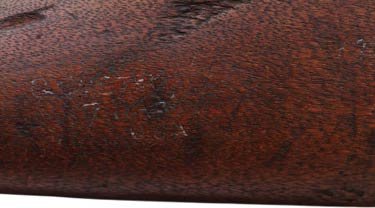
The undoubted highlight of the sale is George Armstrong Custer’s personal Spencer repeating carbine, bearing his name scratched on the buttstock, and frequently mentioned in his accounts of hunting. The bidding starts at $50,000; but, even with recession clouds still lowering over Obamistan, it will probably go much higher.
[T]he Spencer carbine offered here pre-dates his Fort Abraham Lincoln period, it does date from the Indian Wars, and could quite possibly have been with him at the Battle of Washita.
It was part of the legendary collection of Dr. Lawrence A. Frost of Monroe, Michigan, who at one time had what may have been the most extensive private collection of Custer artifacts and relics ever assembled. A signed identification tag in Frost’s hand which accompanies the gun identifies it as a “Spencer Carbine – Saddle Ring / Cal. 50, No. 3658, Model 1865 / ‘G. Custer – 7 Cav USA’ cut into wooden stock…Used by Gen. Custer in Kansas in 1867 campaign.” …
Dr. Frost purchased the carbine in 1955 from Howard Berry. A notarized bill of sale describes the gun in detail. In a 1973 letter (a copy of which is included in this lot), Frost refers to purchasing various Custer items from Berry, whom he describes as “a former 7th Cavalryman”. Frost states that he showed them to James Calhoun Custer (a nephew of Gen. Custer and son of Nevin Custer), and that Custer assured him he remembered these items which had been shown to him by his father who stated that they were the General’s.
Custer used a wide range of military and commercially available firearms over the course of his career, but he had a special familiarity with Spencer carbines. During the Civil War his Michigan regiments were armed with Spencers (Carbines of the U.S. Cavalry, John McAulay, p. 32). As the war ended, a new Spencer model was issued to the army with a more powerful 56-50 cartridge (Spencer Repeating Firearms, Roy Marcot, pp. 80-81). When the 7th Cavalry was formed in 1866 (Bugles, Banners and War Bonnets, Ernest Reedstrom, pp. 1-2), the Spencer Carbine became standard issue (Carbines of the U.S. Cavalry, p. 88), and was in use by them until replaced by the Sharps carbine in 1870 (Carbines of the U.S. Cavalry, p. 95). In his 1980 book, Nomad, George A. Custer in Turf, Field and Farm, Brian W. Dippie reproduces an 1867 article written by Custer in which he describes in great detail a buffalo hunting expedition. He describes learning that pistol shots “only seemed to increase (the buffalo’s) speed.” Accordingly, Custer wrote, “I concluded to discard the use of my revolvers and trust my Spencer carbine” (p.117). The example offered here, serial #3658, is the 1865 model and should not be confused with the Spencer rifle gifted to Custer in 1866; that gun has never surfaced (Spencer Repeating Firearms, p. 152). The presentation gun would have been the 56-44 sporting model.
Custer’s regard for his Spencer carbine is evidenced in his own words in his autobiography, My Life on the Plains, where he writes: “Leaping from my bed I grasped my trusty Spencer which was always at my side” (p. 77).
Ettore Bugatti made only six examples of his stupendously large and luxurious type 41 Royale. He originally intended to produce 25 examples for the use of European royalty and Indian maharajahs, but during the first Great Depression even royalty were a bit hard up.
Type 41s are among the rarest of collectible automobiles and there are none currently for sale but, if you actually still have money these days, you have a chance next month at a great Royale memento: a type 41 elephant radiator cap mascot is being sold by L’art et l’automobile auction on December 12th. Bidding starts at $75,000. Take it home and mount it on the bonnet of your Range Rover and you’ll really make an impression. Also, the perfect gift for the rabid Republican.
It was Ettore Bugatti’s most exclusive creation, the Type 41 Royale. From the onset, only 25 examples were ever planned and in the end, only six were ever produced. Using a huge 12.7-Liter, inline eight-cylinder engine rated at 300 hp, everything about the Royale was massive. Each car had a 169.3-inch wheelbase, 24-inch wheels, a weight of more than 7,000 lbs and a price tag that was just as colossal at around $25,000 U.S. dollars in 1929. On top of the base chassis price, each car had a custom-ordered body ranging in price from $5,000 to $18,000 in pre-depression 1929 dollars.
To finish off this grand automobile, the radiator mascot had to be something just as special and just as big. For the crowning touch, Ettore Bugatti turned to the work of his beloved younger brother Rembrandt, a noted and talented artist. The younger Bugatti brother made animals the subject of his art. He was a patron of the city zoo in Antwerp, Belgium, and used many of the animals there as the basis for his works. Sadly, during World War I, many of these exotic creatures had to be killed due to the inability to properly care for the animals in the zoo during the war. The story goes that Rembrandt was so distraught with these actions, he traveled to Paris and committed suicide in 1916.
Ettore Bugatti felt that one of his brother’s most exquisite works was the mighty elephant rising up on its rear legs with his trunk high in the air. This, he felt, would be the finishing touch for his most exclusive automobile, the Type 41 Royale.
Using an original bronze casting from Rembrandt, a very limited run of these mascots were produced. Each was cast in sterling silver by the Charkles Valsuani Foundry in Paris using the “Cire Perdue†(lost wax) method.
Pierre-Auguste Renoir, Paysage Bords de Seine [Landscape Banks of the Seine], c.1879
The Washington Post apparently did a little investigating of its own, and found that the Flea-Market-find Renoir about to be auctioned tomorrow at Potomack Galleries in Alexandria belonged to a Baltimore Museum and had been stolen in 1951.
[A] Washington Post reporter entered the library at the Baltimore Museum of Art. In a box full of Saidie May’s letters and artwork receipts lay one major clue: records showing that she had lent the painting to the museum in 1937. The discovery startled museum officials, who had already said the flea-market Renoir never entered their institution.
But armed with the loan registration number, museum officials dug up in their collection records an even-more-astounding clue about the Renoir’s journey. An old museum loan registration document revealed that the tiny landscape, measuring 51 / 2 by 9 inches, was stolen Nov. 17, 1951, from the BMA — shortly after May’s death.
Now the painting’s highly anticipated auction by the Potomack Company has been canceled. The FBI is investigating, and museum officials are trying to learn more about the painting’s theft. They couldn’t explain why it does not appear on a worldwide registry of stolen and lost art.
Pierre-Auguste Renoir, Paysage Bords de Seine [Landscape Banks of the Seine], c.1879
The Boston Globe story explains that the frame featured a very broad hint, and it didn’t take a lot of research to authenticate the painting.
A woman who paid $7 for a box of trinkets at a West Virginia flea market two years ago apparently acquired an original painting by French impressionist Pierre-Auguste Renoir without knowing it.
The woman considered discarding the painting to salvage its frame, but instead made an appointment to have it evaluated in July by the Potomack Co. auction house in Alexandria, Va., said its fine arts director Anne Norton Craner.
When the woman pulled the painting out of a garbage bag she carried it in, Craner was nearly certain the painting was a Renoir with its distinct colors, light and brushwork. A plaque on the front labeled it ‘‘Renoir.’’
‘‘My gut said that it was right, but you have to then check,’’ Craner said.
French handwriting on the back of the canvass included a label and number. Craner turned to the catalog by French gallery Bernheim-Jeune that’s published all of Renoir’s work.
‘‘Low and behold, it was in volume one,’’ she said.
An image of the painting was published in black and white, and the gallery’s stock number matched the flea market find. So Craner made a digital image of the flea market painting, converted it to black and white for a closer look, and the brush strokes also matched, she said.
‘‘It’s not a painting you would fake,’’ Craner said. ‘‘If you’re going to fake something, you’d fake something easier.’’
Painting No. 24349 turns out to be Renoir’s painting ‘‘Paysage Bords de Seine,’’ which translates to Banks of the River Seine, Craner determined. It dates to about 1879 and measures 6 inches by 10 inches.
The painting is set for auction Sept. 29. It could fetch $75,000 or more, Craner said.