Category Archive 'Guns'
26 Nov 2010


.500 Linebaugh Custom Revolver
The most prominent trend in handguns in recent years has been the consumer’s perceived need for ultra-powerful, larger than .44 Magnum chambered, super revolvers. The movement was pioneered by custom pistolsmiths like Hamilton Bowen and John Linebaugh, who began equipping heavy single action revolvers with stouter five-round cylinders allowing shooters to fire really souped-up loadings of the .45 Colt. Then, Mr. Linebaugh began creating wildcat revolver cartridges on a previously unimaged scale, allowing the shooter to fire from a handgun bullets of size and velocity suitable for the largest and most dangerous big game animals.
John Linebaugh’s Ruger Bisley conversions offered the shooter the opportunity to have a really decisive weapon available, the kind that will stop an angry grizzly, lion, or Cape buffalo in its tracks, in the form of a readily carry-able backup handgun.
Before long, the standard handgun manufacturing companies hastened to jump on the bandwagon, and today’s shooter can buy super-revolvers made by Smith & Wesson, Ruger, or Taurus in colossal .50 caliber chamberings for a good deal under the price of a custom handgun.
These kinds of trends have a tendency to keep going in a particular direction, and big bore handguns, I just learned from the News Junkie at Maggie’s Farm, have taken another big step in the direction of way-too-far.

.600 Nitro Express Pfeifer-Zeliska Revolver
Tony Rogers:
It seems that Swiss enthusiast by the name of Zeliska commissioned the firm of Pfeifer Waffen of Feldkirch, Austria to make for him der stärkste Revolver der Welt. The Pfeifer-Zeliska Revolver would be chambered in the largest hunting cartridge ever produced during big game hunting’s golden age, the legendary .600 Nitro Express. Introduced by Jeffrey in 1903, the .600 Nitro Express was intended to be the decisive solution to the extremely angry elephant problem. The .600 was loaded with 900 grain bullets and propelled them elephantwards at a vigorous 2050 feet per second. You wouldn’t want to fire many rounds, because in addition to what the gun will do to you, each round costs something like $40.
The Pfeifer-Zeliska has a 13″ (33 cm.) barrel and weighs 13.23 lbs. (6.01 k). It costs 13.840,- EUR — $18,338.
My own version of John Linebaugh’s .500 revolver has a 5″ (12.7 cm.) barrel, and weighs 2 lb. 11 oz. (.94 k). Linebaugh charges $2200 (1.665, EUR).
The last time I test fired my .500 Limbaugh I developed considerable bruising and a distinct lump at the base of my right thumb. Even with the addition of the extra poundage, I expect a .600 Nitro Express revolver would go harder with the shooter.
24 Nov 2010

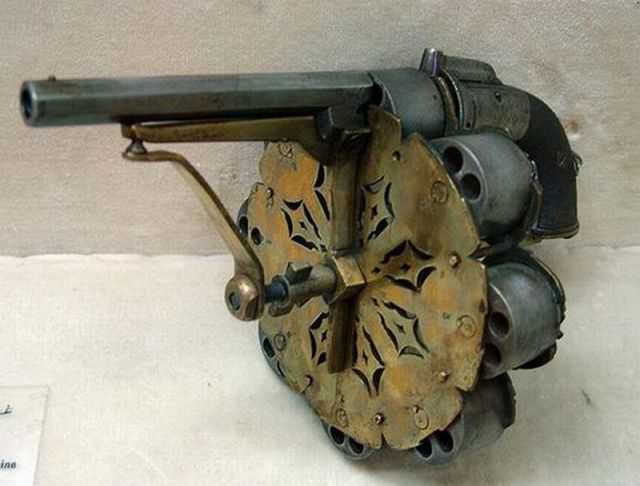
This bad idea seems to be an 8-cylinder, 48-shot percussion revolver with what looks like a pepperbox-style of hammer. Exactly how the multiple cylinders would be indexed into place in sequence is unclear.
The basic shape of the original weapon reminds me somewhat of the lines of the Savage-North .36 Navy Revolver, but the dropping hammer is characteristic of the older pepperbox revolver era.
As Mark Twain testified in his account of his own adventures in the American West, Roughing It (1872), even ordinary 5 or 5-shot pepperbox revolvers had atrociously long and stiff trigger-pulls inevitably resulting in great inaccuracy, and they were highly liable to multiple ignition.
He wore in his belt an old original “Allen” revolver, such as irreverent people called a “pepper-box.” Simply drawing the trigger back, cocked and fired the pistol. As the trigger came back, the hammer would begin to rise and the barrel to turn over, and presently down would drop the hammer, and away would speed the ball. To aim along the turning barrel and hit the thing aimed at was a feat which was probably never done with an “Allen” in the world. But George’s was a reliable weapon, nevertheless, because, as one of the stage-drivers afterward said, “If she didn’t get what she went after, she would fetch something else.” And so she did. She went after a deuce of spades nailed against a tree, once, and fetched a mule standing about thirty yards to the left of it. Bemis did not want the mule; but the owner came out with a double-barreled shotgun and persuaded him to buy it, anyhow. It was a cheerful weapon–the “Allen.” Sometimes all its six barrels would go off at once, and then there was no safe place in all the region round about, but behind it.
Take the inaccuracy and ignition hazards of Mark Twain’s Allen pepperbox, throw in lots of weight and really terrible balance, then multiply the opportunity for multiple ignition by eight, and you have this contraption.
Hat tip to Theo.
14 Oct 2010

Popular Mechanics talks to C.J. Chivers, author of , who shares some interesting insights on the infamous AK-47 assault rifle.
It was not really the sole invention of peasant genius Mikhail Kalashnikov, and the Communist world’s ability to distribute examples by the millions was not so much the result of the weapon’s simplicity and cheapness of manufacture as a serendipitous (from their point of view) result of command economies.
Rival teams were given a set of specification and deadlines, and through a series of stages the teams presented prototypes, and contest supervisors winnowed the field. Stalin liked these contests. They created urgency and a strong sense of priorities, and they helped speed along development. This was also a system without patents or even firm notions of intellectual property, at least as we know them in the West. So design convergence was part of the process—the teams and the judges, as time passed, could mix and match features from different submissions. Think of a game of Mr. Potato Head. Now imagine a similar game, in which many different elements and features of an automatic rifle are available to you, and more are available at each cycle, and you can gradually pluck the best features and assemble them into a new whole. …
One common misperception is that the AK-47 is reliable and effective, therefore it is abundant. This is not really the case. The weapon’s superabundance, its near ubiquity, is related less to its performance than to the facts of its manufacture. Once it was designated a standard Eastern Bloc arm, it was assembled and stockpiled in planned economies whether anyone paid for or wanted the rifles or not. This led to an uncountable accumulation of the weapons. And once the weapons existed, they moved. Had the weapon not been hooked up to the unending output of the planned economy, it would have been a much less significant device. If it had been invented in Liechtenstein, you might have never even heard of it. …
For the Soviet Union, the AK-47 is arguably the most apt physical symbol of the Soviet period and what it left behind. It was the Kremlin’s most successful product, even the nation’s flagship brand, and it came into existence through distinct Soviet behaviors and traits. But it was a breakout weapon, and its fuller meaning and deeper legacy lie in its effects on security and war. It leveled the battlefield in many ways and changed the way wars are fought, prompting a host of reactions and shifts in fighting styles and risks. Its effects will be with us for many more decades, probably for the rest of this century, at least. This is perhaps its real legacy—as the fighting tool like no other, which we will confront, and often suffer from, for the rest of our lives.
The correct translation of sturmgewehr, the felicitous term coined by Adolph Hitler himself, is really “assault weapon.” It is a “storm rifle” in the sense of a rifle desiged for storming enemy positions, not a weapon as formidable as bad weather.
Hitler’s coinage was a typically exaggeratedly romantic misnomer. The Sturmgewehr 42 was designed to be a compromise mixed-use weapon combining the some of the long range accuracy of the infantry rifle along with the firepower of the submachinegun. In WWII, the German Army found the role of infantry had changed. Instead of dominating the battlefield and exchanging fire with other masses of infantry, infantry principally spent its time accompanying and protecting tanks from being disabled or eliminated by other infantry. Most exchanges of fire were at close range where high rates of fire would be desirable, but simply taking away all the Mausers and giving every infantryman a Maschinenpistole-40 “Schmeisser” firing 9mm Parabellum cartridges did not seem a completely satisfactory idea either.
Hat tip to Glenn Reynolds.
26 Aug 2010

Typical copper-jacketed 150 grain .308 lead bullets
The National Shooting Sports Foundation warns that Lisa Perez Jackson, Barack Obama’s Environmental Protection Agency Administrator, the same leftwing fashionista who misused her state environmental office to pander to the whims of liberal extremist groups by imposing a ban on bear hunting in New Jersey, is considering implementing a nationwide ban on all traditional lead ammunition in response to a petition from the Center for Biological Diversity.
Lead sinkers would be banned for fishing, too, by the way.
Here is their petition filed August 3, urging a nationwide ban on lead-based ammunition and fishing tackle.
The estimates of wildlife deaths caused by lead ingestion are the purest of fabrications, based entirely on supposititious estimates created with massaged figures drawn from artfully selected data. Who ever saw an animal eat a spent bullet?
Nonetheless, such a ban, implemented by the EPA (on the basis of legislation which explicitly exempted ammunition) would have a devastating impact on all the shooting sports, enormously raising ammunition costs while drastically impairing performance. The quantities of game animals wounded rather than killed would be enormous if such a ban became a reality.
The NSSF is strongly urging us to send in letters opposing the EPA action, but personally I think the fix is in, and writing Lisa Jackson is a waste of time. I suggest advising your congressman and senators of your strong opposition, and voting Republican in November.
19 Aug 2010

M1 Garand
The Korea Times reports that the Obama administration is blocking the sale to US importers of tens of thousands of surplus M1 Garands and M1 carbines, avidly desired by American target shooters and collectors on grounds that they might find their way into the hands of terrorists (!).
The U.S. government opposed South Korea’s bid to sell hundreds of thousands of aging U.S. combat rifles to American gun collectors, a senior government official said Thursday.
The ministry announced the plan last September as part of efforts to boost its defense budget, saying the export of the M1 Garand and carbine rifles would start by the end of 2009.
The U.S. administration put the brakes on the plan, citing “problems†that could be caused by the importation of the rifles.
The problems the U.S. government cited were somewhat ambiguous, said an official at the Ministry of National Defense on condition of anonymity.
“The U.S. insisted that imports of the aging rifles could cause problems such as firearm accidents. It was also worried the weapons could be smuggled to terrorists, gangs or other people with bad intentions,†the official told The Korea Times. …
The Seoul government sought to sell the outdated U.S guns back to the United States.
A total of 86,000 M1 rifles and another 22,000 carbines were to be sold, as the weapons have been mothballed for about five decades in military warehouses. The per-unit price of the M1 rifle is about $220 and the carbine is more than $140, according to the ministry.
M1s were made first in 1926 and used in World War II and the 1954-1975 Vietnam War. The carbines were first produced in 1941 and used during the 1950-1953 Korean War.
Hat tip to David Kopel.

30 Jul 2010

If you take apart GarE Maxton’s 40-45 lb. (18.18-20.45 kgs.) puzzle sculpture, comprised of over 100 pieces which took a year’s worth of precision machining to produce, you can assemble from a number of concealed parts the single shot .45 caliber muzzle-loading pistol seen below.
6:46 video of disassembly.
8:22 video of assembly

Hat tip to Brian Barrett via Karen L. Myers.
14 Jul 2010

ChinaSmack, a blogsite translating Chinese news and comments, publishes a Chinese comment thread on gun ownership in America. They are even sold in Walmart!
Hat tip to Bird Dog.
07 May 2010

video frame shows XM25 round exploding just inside window target
The Army’s equipment development and procurement office, Program Executive Office (PEO) Soldier, was kind enough to invite Wired’s Nathan Hodge to the Aberdeen Proving Ground to test a variety of toys including the XM25 (25mm) grenade launcher, a non-lethal green laser, improved night-vision goggles, a new easily-changed (no headspace or timing adjustment needed) barrel for the ever-popular M2 .50 caliber Browning machine gun, and a Modular Accessory Shotgun system, consisting of a straight-pull bolt-action 12-gauge shotgun that can be used as a standalone weapon or as an under-barrel accessory on a rifle or carbine. The shotgun makes a useful tool for opening locked doors and is an effective close-range definitive argument as well.
Let’s hope PEO Soldier adds NYM to its list of journalist invitees next time. I’m not too far from Aberdeen.
12 Mar 2010

Lot Number 73, in Amoskeag Auction Company’s Auction #76 – March 27, 2010 sale, is a really spectacular Pair of Duelling Pistols with Original Accessories by Faure LePage, whose shop at 8 Rue Richelieu operated between 1865 and 1913.
Faure LePage was clearly a very worthy representative of a family of gunmakers descended from Perin LePage, assistant to Nicolas Boutet at the manufacture Imperiale de Versailles, 1793 until 1813, then Arquebusier de l’Empereur to Napoleon I. Perin LePage’s manufactory at Versailles was sacked by Blucher in July, 1815. LePage subsequently built fine firearms in Paris originally with Nicolas Bernard as his barrel maker. Bernard left to establish his own firm in 1821.
LePage Duelling pistols were renowned for their accuracy. Pushkin’s Eugene Onegin brings Лепажа3 Ñтволы роковые [VI:25: LePage’s fatal barrels] to his duel with Lensky, and John Leonard, in the New York Times, notes:
Lensky, a reader of Goethe rather than Rousseau and therefore a much nicer person than Eugene, falls victim in the verse epic to ”fell barrels” hand tooled in Paris by Lepage. So, too, did Pushkin insist on Lepage pistols for his appointment with d’Anthes, pawning some table silver to pay for them. And as if to salt this open sore, the all-knowing and all-telling Binyon informs us that the pistol d’Anthes used to kill Pushkin was borrowed from the French ambassador’s son, who would use it four years later to kill Mikhail Lermontov.
The LePage duellers being offered by Amoskeag this month are demonstrated to have been made some decades later by their splendid Art Nouveau ornamentation, probably during the 1890s.
These beautiful weapons come down to us carrying all the romantic associations of the Mauve Decade and the gas-lit Paris of Trilby, Absinthe, and Toulouse-Lautrec, when Honor was still a vital part of human existence, and members of the upper classes of society were expected to be prepared to defend theirs. Generals fought Prime Ministers (Boulanger v. Floquet) and painters (Manet v. Duranty) and novelists (Proust v. Lorrain) sought satisfaction from their critics. The owner of this set of pistols knew he would have one final glimpse of luxury and beauty, if worst came to worst.

Ilya Repin, ДуÑль Ð•Ð²Ð³ÐµÐ½Ð¸Ñ ÐžÐ½ÐµÐ³Ð¸Ð½Ð° и Владимира ЛенÑкого [Duel Between Eugene Onegin and Vladimir Lensky], 1899, Pushkin Museum, St. Petersburg.
17 Feb 2010

In the old days, Triad wars featured more traditional weapons.
Recently the police in Taiwan captured a more modern, but equally unusual, example of Triadic weaponry. EDNDO Gun Blog:
(bad Google translation from Chinese, edited by me)
Police said 19-year-old gang member So and So was apprehended for violation of weapon-carry laws resulting in the search and seizure of an arsenal housed on the 7th Floor of Linsen North Road, Suite A. A revolver and 6 rounds of canister-style shotgun ammunition, as well as four pistols, one a standard Beretta, the other three improvised firearms, along with 15 bullets and 19 blank cartridges.
This is the very large shotgun revolver, can be loaded with 6 rounds. The frame is of steel construction. With a short barrel, it weighs more than 3 kilograms (6 lbs, 10 oz.). There is no rifling, but there is a base intended for a sight. There is no guard on the exposed trigger, and so safety, so when fully loaded, if the trigger were to pulled intentionally or by mistake, the weapon will fire, which is very dangerous.
The incongruous home-made Beretta logo and the “Made in USA” must both be decorative efforts to add logos to make the piece look more like a factory manufactured weapon.


From Gizmodo via Karen L Myers.
———————————————–
I suppose Triad members in Taiwan must have importing issues, but nearly 7 pounds worth of revolver is a lot to carry, and the recoil from a 12 gauge revolver must be awfully unpleasant. Taurus actually produces a series of revolvers chambered for both .45 Long Colt/.410 Shotshell representing a considerably more practical application of the same idea.
2:23 video
/div>

Feeds
|