Mike Franc, at Human Events in 2005, identified the real reason for celebration at the first Thanksgiving.
Writing in his diary of the dire economic straits and self-destructive behavior that consumed his fellow Puritans shortly after their arrival, Governor William Bradford painted a picture of destitute settlers selling their clothes and bed coverings for food while others “became servants to the Indians,†cutting wood and fetching water in exchange for “a capful of corn.†The most desperate among them starved, with Bradford recounting how one settler, in gathering shellfish along the shore, “was so weak … he stuck fast in the mud and was found dead in the place.â€
The colony’s leaders identified the source of their problem as a particularly vile form of what Bradford called “communism.†Property in Plymouth Colony, he observed, was communally owned and cultivated. This system (“taking away of property and bringing [it] into a commonwealthâ€) bred “confusion and discontent†and “retarded much employment that would have been to [the settlers’] benefit and comfort.â€
Just how did the Pilgrims solve the problem of famine? In addition to receiving help from the local Indians in farming, they decided allow the private ownership of individual plots of land.
On the brink of extermination, the Colony’s leaders changed course and allotted a parcel of land to each settler, hoping the private ownership of farmland would encourage self-sufficiency and lead to the cultivation of more corn and other foodstuffs.
As Adam Smith would have predicted, this new system worked famously. “This had very good success,†Bradford reported, “for it made all hands very industrious.†In fact, “much more corn was planted than otherwise would have been†and productivity increased. “Women,†for example, “went willingly into the field, and took their little ones with them to set corn.â€
The famine that nearly wiped out the Pilgrims in 1623 gave way to a period of agricultural abundance that enabled the Massachusetts settlers to set down permanent roots in the New World, prosper, and play an indispensable role in the ultimate success of the American experiment.
A profoundly religious man, Bradford saw the hand of God in the Pilgrims’ economic recovery. Their success, he observed, “may well evince the vanity of that conceit…that the taking away of property… would make [men] happy and flourishing; as if they were wiser than God.†Bradford surmised, “God in his wisdom saw another course fitter for them.â€
The real story of Thanksgiving is the triumph of capitalism and individualism over collectivism and socialism, which is the summation of the story of America.
Translated from Polish Catholic DEON.pl news item:
A Two-Euro coin design by Miroslav Hric to be released into circulation in May of next year by the National Bank of Slovakia (NSB) in commemoration of the 1150th anniversary of the arrival of the two saints in Moravia was changed.
Currently, there is the image of the two saints, and between them a double cross representing the national emblem of Slovakia. However, the symbol of the cross was removed from the saints’ vestments, and halos were removed from around their head. NSB spokeswoman Petra Pauerova told the Slovak newspaper “Pravda” that “the European Commission, assenting to the ‘request of some Commonwealth countries’ prescribed the removal of these attributes from the original coin design.” Since the coin will be released into circulation in all euro area countries, the project should respect the principle of “religious neutrality,” explained Pauerova.
The removal of those features from the Slovakian coins was announced on Sunday on public television and radio stations in Slovakia.
The Slovakian Bishops’ Conference in a statement did not hesitate to use the word “disgrace”. “The resignation of the key attributes associated conceptually with Saints Cyril and Methodius demonstrates the lack of respect for the Christian tradition of Europe.” indignantly remarked Church spokesman Rev. Jozef Kovaczik. He added the Church only learned that the two symbols would not appear on the Two-Euro coin via the media.
“In 1988, before the Velvet Revolution, the faithful in Slovakia risked their lives, preaching the doctrine of the two saints. Do we really live in a nation of law, or in a totalitarian system, which dictates to us what attributes we may use?” asked Rev. Kovaczik, noting that Slovakia is a Catholic country.
St. Cyril (926-869) and St. Methodius (815-885) were the first missionaries to the Slavs. It was to their mission that the Slavic portions of Europe owe the adoption of the Christian faith and their own roots in the culture of Europe.
These saints in both the Catholic Church and the Orthodox Church are called the Apostles of the Slavs, and came from Byzantium to the Moravian state in 862 A.D. at the request of the local ruler Rostislav. They knew both the language and customs of the Slavs, having dealt previously with Christianized Southern Slavs living in the area around the Byzantine Thessalonica. Both had already made a translation of the Bible into Slavonic, having for purposes of translation created a special 40-letter alphabet, the Glagolitic script.
Cyril and Methodius’ students continued their mission to the Eastern and Southern Slavs. The complicated Glagolitic script ultimately replaced in liturgical writings by the simpler Cyrillic alphabet, modeled upon the Greek alphabet.
Pope John Paul II gave Sts. Cyril and Methodius the title of patron saints of Europe.
In church iconography the saints are depicted dressed in pontifical garb as Greek or Latin bishops. Their attributes are a cross, a book and an unrolled scroll displaying the Slavic alphabet.
———————–
The NBS web-site. announcing the winning design, says blandly:
The original competition design was modified in line with recommendations made within the notification and approval procedure conducted pursuant to Council Regulation (EC) No 975/98 on denominations and technical specifications of euro coins intended for circulation, as amended.
Vanity Fair contemplates with mixed admiration, fascination, and horror the reactionary brio and romantic history of the French Foreign Legion.
Immediately after World War II, which claimed 9,017 of its men, the Legion went to war in Indochina, where it lost more than 10,000. Recently, near Marseille, an old legionnaire told me about a lesson he learned as a young recruit, when a veteran sergeant took a moment to explain dying to him. He said, “It’s like this. There is no point in trying to understand. Time is unimportant. We are dust from the stars. We are nothing at all. Whether you die at age 15 or 79, in a thousand years there is no significance to it. So fuck off with your worries about war.â€
With the French withdrawal from Indochina, the Legion returned to Algeria under the command of embittered army officers, many of whom believed that they had been betrayed by the civilian elites and that only they, the officers, had the moral fiber to defend the integrity of France. These were dangerous delusions for officers to have, particularly because the Legion now found itself embroiled in something like a French civil war—the savage eight-year struggle over Algerian independence. It was an emotional fight, characterized by the systematic use of torture, retributive killings, and atrocities on all sides. The Foreign Legion committed its share of the crimes. It also lost 1,976 men. Altogether perhaps a million people died. It won’t matter in a thousand years. For cultural reference, Brigitte Bardot was in her prime.
The Legion emerged from the experience reduced to 8,000 men and reassigned to bases in southern France, where it spent the next decade doing little more than marching around and building roads. The trauma was deep. This is a sensitive subject, and officially denied, but the history of defeat encouraged a reactionary culture in the Legion, where, beneath an appearance of neutral professionalism, the officer corps today harbors virulent right-wing views. It is common at closed social gatherings to hear even young officers regretting the loss of Algeria, disparaging Communists, insulting homosexuals, and seething at what they perceive as the decadence and self-indulgence of modern French society. In the southern city of Nîmes, home to the Legion’s largest infantry regiment, the Second, a French officer complained to me about the local citizens. He said, “They speak about their rights, their rights, their rights. Well, what about their responsibilities? In the Legion we don’t speak about our rights. We speak about our duties!â€
I said, “It angers you.â€
He looked at me with surprise, as if to say, And you it does not?
WWI came to an end by an armistice arranged to occur at the eleventh hour of the eleventh day of the eleventh month of 1918. The date and time, selected at a point in history when mens’ memories ran much longer, represented a compliment to St. Martin, patron saint of soldiers, and thus a tribute to the fighting men of both sides. The feast day of St. Martin, the Martinmas, had been for centuries a major landmark in the European calendar, a date on which leases expired, rents came due; and represented, in Northern Europe, a seasonal turning point after which cold weather and snow might be normally expected.
It fell about the Martinmas-time, when the snow lay on the borders…
—-Old Song.
———————————
This year’s Veteran’s Day will be the first without a surviving WWI veteran. Florence Green, a mess steward in the RAF, and the last US Doughboy, Frank Woodruff Buckles, both died last February both aged 110.
———————————
From Robert Chambers, The Book of Days, 1869:
St. Martin, the son of a Roman military tribune, was born at Sabaria, in Hungary, about 316. From his earliest infancy, he was remarkable for mildness of disposition; yet he was obliged to become a soldier, a profession most uncongenial to his natural character. After several years’ service, he retired into solitude, from whence he was withdrawn, by being elected bishop of Tours, in the year 374.
The zeal and piety he displayed in this office were most exemplary. He converted the whole of his diocese to Christianity, overthrowing the ancient pagan temples, and erecting churches in their stead. From the great success of his pious endeavours, Martin has been styled the Apostle of the Gauls; and, being the first confessor to whom the Latin Church offered public prayers, he is distinguished as the father of that church. In remembrance of his original profession, he is also frequently denominated the Soldier Saint.
The principal legend, connected with St. Martin, forms the subject of our illustration, which represents the saint, when a soldier, dividing his cloak with a poor naked beggar, whom he found perishing with cold at the gate of Amiens. This cloak, being most miraculously preserved, long formed one of the holiest and most valued relics of France; when war was declared, it was carried before the French monarchs, as a sacred banner, and never failed to assure a certain victory. The oratory in which this cloak or cape—in French, chape—was preserved, acquired, in consequence, the name of chapelle, the person intrusted with its care being termed chapelain: and thus, according to Collin de Plancy, our English words chapel and chaplain are derived.
The canons of St. Martin of Tours and St. Gratian had a lawsuit, for sixty years, about a sleeve of this cloak, each claiming it as their property. The Count Larochefoucalt, at last, put an end to the proceedings, by sacrilegiously committing the contested relic to the flames. …
The festival of St. Martin, happening at that season when the new wines of the year are drawn from the lees and tasted, when cattle are killed for winter food, and fat geese are in their prime, is held as a feast-day over most parts of Christendom. On the ancient clog almanacs, the day is marked by the figure of a goose; our bird of Michaelmas being, on the continent, sacrificed at Martinmas. In Scotland and the north of England, a fat ox is called a mart, clearly from Martinmas, the usual time when beeves are killed for winter use. In ‘Tusser’s Husbandry, we read:
When Easter comes, who knows not then,
That veal and bacon is the man?
And Martilmass beef doth bear good tack,
When country folic do dainties lack.’
Barnaby Googe’s translation of Neogeorgus, shews us how Martinmas was kept in Germany, towards the latter part of the fifteenth century
‘To belly chear, yet once again,
Doth Martin more incline,
Whom all the people worshippeth With roasted geese and wine.
Both all the day long, and the night, Now each man open makes
His vessels all, and of the must, Oft times, the last he takes,
Which holy Martin afterwards Alloweth to be wine,
Therefore they him, unto the skies, Extol with praise divine.’
A genial saint, like Martin, might naturally be expected to become popular in England; and there are no less than seven churches in London and Westminster, alone, dedicated to him. There is certainly more than a resemblance between the Vinalia of the Romans, and the Martinalia of the medieval period.
Indeed, an old ecclesiastical calendar, quoted by Brand, expressly states under 11th November: ‘The Vinalia, a feast of the ancients, removed to this day. Bacchus in the figure of Martin.’ And thus, probably, it happened, that the beggars were taken from St. Martin, and placed under the protection of St. Giles; while the former became the patron saint of publicans, tavern-keepers, and other ‘dispensers of good eating and drinking. In the hall of the Vintners’ Company of London, paintings and statues of St. Martin and Bacchus reign amicably together side by side.
On the inauguration, as lord mayor, of Sir Samuel Dashwood, an honoured vintner, in 1702, the company had a grand processional pageant, the most conspicuous figure in which was their patron saint, Martin, arrayed, cap-Ã -pie, in a magnificent suit of polished armour; wearing a costly scarlet cloak, and mounted on a richly plumed and caparisoned white charger: two esquires, in rich liveries, walking at each side. Twenty satyrs danced before him, beating tambours, and preceded by ten halberdiers, with rural music. Ten Roman lictors, wearing silver helmets, and carrying axes and fasces, gave an air of classical dignity to the procession, and, with the satyrs, sustained the bacchanalian idea of the affair.
A multitude of beggars, ‘howling most lamentably,’ followed the warlike saint, till the procession stopped in St. Paul’s Churchyard. Then Martin, or his representative at least, drawing his sword, cut his rich scarlet cloak in many pieces, which he distributed among the beggars. This ceremony being duly and gravely performed, the lamentable howlings ceased, and the procession resumed its course to Guildhall, where Queen Anne graciously condescended to dine with the new lord mayor.
Five Marine Corps privates with fixed bayonets under the command of their non-commissioned officer, who displays his M1859 Marine NCO sword. Navy Yard, Washington, DC, April 1864.
Founded November 10, 1775.
——————————
Maj. Gen. John A. Lejeune’s Birthday Message
RPS ORDERS
No. 47 (Series 1921)
HEADQUARTERS U.S. MARINE CORPS
Washington, November 1, 1921
759. The following will be read to the command on the 10th of November, 1921, and hereafter on the 10th of November of every year. Should the order not be received by the 10th of November, 1921, it will be read upon receipt.
(1) On November 10, 1775, a Corps of Marines was created by a resolution of Continental Congress. Since that date many thousand men have borne the name “Marine”. In memory of them it is fitting that we who are Marines should commemorate the birthday of our corps by calling to mind the glories of its long and illustrious history.
(2) The record of our corps is one which will bear comparison with that of the most famous military organizations in the world’s history. During 90 of the 146 years of its existence the Marine Corps has been in action against the Nation’s foes. From the Battle of Trenton to the Argonne, Marines have won foremost honors in war, and is the long eras of tranquility at home, generation after generation of Marines have grown gray in war in both hemispheres and in every corner of the seven seas, that our country and its citizens might enjoy peace and security.
(3) In every battle and skirmish since the birth of our corps, Marines have acquitted themselves with the greatest distinction, winning new honors on each occasion until the term “Marine” has come to signify all that is highest in military efficiency and soldierly virtue.
(4) This high name of distinction and soldierly repute we who are Marines today have received from those who preceded us in the corps. With it we have also received from them the eternal spirit which has animated our corps from generation to generation and has been the distinguishing mark of the Marines in every age. So long as that spirit continues to flourish Marines will be found equal to every emergency in the future as they have been in the past, and the men of our Nation will regard us as worthy successors to the long line of illustrious men who have served as “Soldiers of the Sea” since the founding of the Corps.
Tun Tavern, Philadelphia, Pennsylvania, November 10th 1775
Captains Nicholas and Mullens, having been tasked by the 2nd Continental Congress to form 2 battalions of Marines, set up the Corps’ first recruiting station in the tavern.
The first likely prospect was, in typical recruiters fashion, promised a “life of high adventure in service to Country and Corps”. And, as an extra bonus: If he enlisted now he would receive a free tankard of ale….
The recruit gladly accepted the challenge and, receiving the free tankard of ale, was told to wait at the corner table for orders.
The first Marine sat quietly at the table sipping the ale when he was joined by another young man, who had two tankards of ale.
The first Marine looked at the lad and asked where he had gotten the two tankards of ale?
The lad replied that he had just joined this new outfit called the Continental Marines, and as an enlistment bonus was given two tankards of ale.
The first Marine took a long hard look at the second Marine and said, ” It wasn’t like that in the old Corps.”
A line of blue counties stretches across the usually red-voting South which parallels curiously enough an ancient sea coast from 100 million years ago. Why?
Hale County in west central Alabama and Bamberg County in southern South Carolina are 450 miles apart. Both counties have a population of 16,000 of which around 60% are African American. The median households and per capita incomes are well below their respective state’s median, in Hale nearly $10,000 less. Both were named after confederate officers–Stephen Fowler Hale and Francis Marion Bamberg. And although Hale’s county seat is the self-proclaimed Catfish Capitol, pulling catfish out of the Edisto River in Bamberg County is a favorite past time. These two counties share another unique feature. Amidst a blanket of Republican red both Hale and Bamberg voted primarily Democratic in the 2000, 2004, and again in the 2008 presidential elections. Indeed, Hale and Bamberg belong to a belt of counties cutting through the deep south–Mississippi, Alabama, Georgia, South Carolina, and North Carolina–that have voted over 50% Democratic in recent presidential elections. Why? A 100 million year old coastline.
During the Cretaceous, 139-65 million years ago, shallow seas covered much of the southern United States. These tropical waters were productive–giving rise to tiny marine plankton with carbonate skeletons which overtime accumulated into massive chalk formations. The chalk, both alkaline and porous, lead to fertile and well-drained soils in a band, mirroring that ancient coastline and stretching across the now much drier South. This arc of rich and dark soils in Alabama has long been known as the Black Belt. But many, including Booker T. Washington, coopted the term to refer to the entire Southern band. Washington wrote in his 1901 autobiography, Up from Slavery, “The term was first used to designate a part of the country which was distinguished by the color of the soil. The part of the country possessing this thick, dark, and naturally rich soil…â€
Cretaceous rock units (139-65 million years old) are shown in shades of green. Older rock units are in gray, younger ones in yellow. From Geology and Election 2000.
Over time this rich soil produced an amazingly productive agricultural region, especially for cotton. In 1859 alone a harvest of over 4,000 cotton bales was not uncommon within the belt. And yet, just tens of miles north or south this harvest was rare. Of course this level of cotton production required extensive labor.
As Washington notes further in his autobiography, “The part of the country possessing this thick, dark, and naturally rich soil was, of course, the part of the South where the slaves were most profitable, and consequently they were taken there in the largest numbers. Later and especially since the war, the term seems to be used wholly in a political sense—that is, to designate the counties where the black people outnumber the white.â€
Readers can compare 2012 results using individual state maps at Politico.
Hurricane Sandy gave New Haven a little Halloween present.
The 16-acre New Haven Green was laid out in 1638 as the central square of a 9-square town layout. Reputedly, the size of the town green was intended to be sufficiently large as to accommodate all human beings saved at the time of the Day of Judgment, whose number was calculated by the Puritan divines on the basis of various theological considerations to amount to 144,000.
The New Haven Green served as a marketplace and militia parade ground and in the course of its history contained a watch house, a prison, a school, several churches, and a succession of statehouses during the period extending up to 1875 when New Haven shared the seat of government of the colony and later state with Hartford.
The Green also served as the colonial burying ground until 1821. Among those buried in the New Haven Green is the regicide John Dixwell. After the use of the Green as a cemetery was abandoned, the headstones were removed to Grove Street Cemetery, but the burials were undisturbed.
Winds from Hurricane Sandy knocked over an oak tree on Monday, October 29th, on the Upper Green. The following afternoon, a homeless woman recognized that a human skeleton was intertwined with the tree’s exposed roots. She called for the police, and detectives and the state medical examiner went to work, concluding that the remains were those of someone buried in the colonial era.
Jo Teeuwisse of Amsterdam has overlaid WWII photographs over many identical locations today in France, the Netherlands, and Italy with startlingly evocative results.
(In the contemporary painting above: “The Catholic ships form a cross and the Muslim ships form a cresent. – The standard of the Holy Cross which was blessed by Pope Pius V can be seen on Don Juan of Austria’s ship which is leading the charge. – Papal ships (St. Peter’s keys) – The miracle of the wind: just before the armies met the wind completely switched in favor of the Catholic ships. – Devils can be seen amongst the Muslim ships (they were summoned from hell by the Muslim leader). The devils have peacock feathers as swords, a manifestation of their pride. – Our Lady of Victory with a sword in one hand ready to crush the devils and the other hand outstretched to the Muslim souls. – St. Michael leading the Angels – There are small white lights by the oars on the Muslim ships representing the souls of the Catholic prisoners.”)
————————
October 7, 1571, the fleet of the Holy League, an alliance of the kingdoms of Spain, of Sicily and of Naples, of the Republics of Venice and of Genoa, of the Grand Duchy of Tuscany, of the Duchy of Savoy, of the Papal States, and of the Sovereign and Military Order of St. John, decisively defeated the Ottoman Empire’s main battle fleet in five hours of fighting at Lepanto at the northern edge of the Gulf of Corinth.
Rev. Fr. Luis Coloma, The Story of Don John of Austria, trans. Lady Moreton, (New York: John Lane Company, 1912), pp. 265-271:
The Turkish fleet came on imposing and terrible, all sails set, impelled by a fair wind, and it was only half a mile from the line of galliasses and another mile from the line of the Christian ships.
D. John waited no longer; he humbly crossed himself, and ordered that the cannon of challenge should be fired on the “Real,” and the blue flag of the League should be hoisted at the stern, which unfurled itself like a piece of the sky on which stood out an image of the Crucified. A moment later the galley of Ali replied, accepting the challenge by firing another cannon, and hoisting at the stern the standard of the Prophet, guarded in Mecca, white and of large size, with a wide green “cenefa,” and in the center verses from the Koran embroidered in gold.
At the same moment a strange thing happened, a very simple one at any other time, but for good reason then considered a miracle: the wind fell suddenly to a calm, and then began to blow favorably for the Christians and against the Turks. It seemed as if the Voice had said to the sea, “calm,” and to the wind, “Be still.” The silence was profound, and nothing was heard but the waves breaking on the prows of the galleys, and the noise of the chains of the Christian galley slaves as they rowed.
Fr. Miguel Servia blessed from the quarter-deck all those of the fleet, and gave them absolution in the hour of death. It was then a quarter to twelve.
Mahound is in his paradise above the evening star,
(Don John of Austria is going to the war.)
He moves a mighty turban on the timeless houri’s knees,
His turban that is woven of the sunset and the seas.
He shakes the peacock gardens as he rises from his ease,
And he strides among the tree-tops and is taller than the trees,
And his voice through all the garden is a thunder sent to bring
Black Azrael and Ariel and Ammon on the wing.
Giants and the Genii,
Multiplex of wing and eye,
Whose strong obedience broke the sky
When Solomon was king.
They rush in red and purple from the red clouds of the morn,
From temples where the yellow gods shut up their eyes in scorn;
They rise in green robes roaring from the green hells of the sea
Where fallen skies and evil hues and eyeless creatures be;
On them the sea-valves cluster and the grey sea-forests curl,
Splashed with a splendid sickness, the sickness of the pearl;
They swell in sapphire smoke out of the blue cracks of the ground,
They gather and they wonder and give worship to Mahound.
And he saith, “Break up the mountains where the hermit-folk can hide,
And sift the red and silver sands lest bone of saint abide,
And chase the Giaours flying night and day, not giving rest,
For that which was our trouble comes again out of the west.
We have set the seal of Solomon on all things under sun,
Of knowledge and of sorrow and endurance of things done,
But a noise is in the mountains, in the mountains, and I know
The voice that shook our palaces four hundred years ago:
It is he that saith not ‘Kismet’; it is he that knows not Fate ;
It is Richard, it is Raymond, it is Godfrey in the gate!
It is he whose loss is laughter when he counts the wager worth,
Put down your feet upon him, that our peace be on the earth.”
For he heard drums groaning and he heard guns jar,
(Don John of Austria is going to the war.)
Cairo rioters surrounding US Embassy carrying black flag. The round circle represents the personal seal of Mohammed (used in correspondence with foreign leaders) and is a standard feature found in al Qaeda flags.
Charles C.W. Cooke delivers a history lesson on the negative symbolism of black flags.
‘Every normal man,†wrote H. L. Mencken, “must be tempted, at times, to spit on his hands, hoist the black flag, and begin to slit throats.†Given that his subject was modern poetry, he can be forgiven the impulse. But we might politely decline to join him. There are few occasions on which the raising of a black flag has been an overture to something pretty, and a great many on which it has augured something ill. Black flags are harbingers of chaos.
The recent events in the Arab world are no exception. The barbarism in Egypt and Libya pushed back into view the nefarious purposes to which black flags are most commonly deployed. Having scaled the walls of the American embassy compound in Cairo on September 11, protesters ripped down Old Glory, set fire to it, and managed to replace it temporarily with their own pennant. At the consulate in Benghazi, marauders put up their flag, murdered the ambassador and three other Americans, and caused as much damage as they could. The unrest has not yet stopped, with U.S. citizens and property being targeted in Lebanon, Yemen, Tunisia, and Syria.
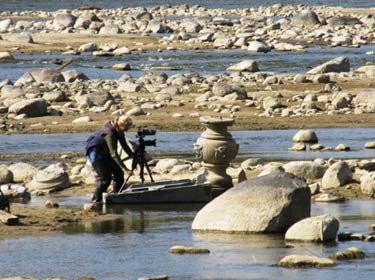
The small number of readers familiar with Henryk Sienkiewicz’s novel of the 17th Century Swedish Invasion of Poland-Lithuania The Deluge will have some sense of its devastating impact on the country. No one living today, however, realised that Swedish looting included the theft of Polish architecture on a massive scale.
A recent major drought in Poland caused the waters of the River Vistula to recede to levels unprecedented in living memory, revealing tons of architectural masonry looted by the Swedes and loaded onto barges for transport down the river to Gdansk, and thence across the Baltic to Sweden. The invaders’ greed apparently exceeded their navigational judgment, and one or more of the barges sank in the river, possibly as the result of overloading.
Low rainfall over the past few months has brought the Vistula, Poland’s longest river, to its lowest level since regular records began 200 years ago. …
Historians believed that the Swedes who invaded Poland in the 17th century planned to move the looted cargo up the Vistula to Gdansk, where the river joins the Baltic Sea, and from there transport it home. There is still no firm explanation of why the boats sank on the way.
Kowalski said he and his team had so far located up to 10 tonnes of stonework, but this was only the beginning. “The boats had a capacity of 50-60 tonnes (each), so we think that we should find much more,” he said.
Once it has been removed from the river bed and catalogued, the plan is to take the masonry to Warsaw’s Royal Castle, one of the sites from which, historians believe, it was looted by the Swedish invaders.
For now though, the low water levels that revealed the artefacts are hampering efforts to retrieve them. Regular lifting equipment would sink into the mud, but the river is too low for the researchers to bring in floating cranes.
“We need to wait until it gets higher,” Kowalski said.
——————————-
Gość Warszawski [Warsaw’s Guest] has a slideshow