Steve Sailor, doubtless ruefully, quotes an article from last year by Richard Savill.
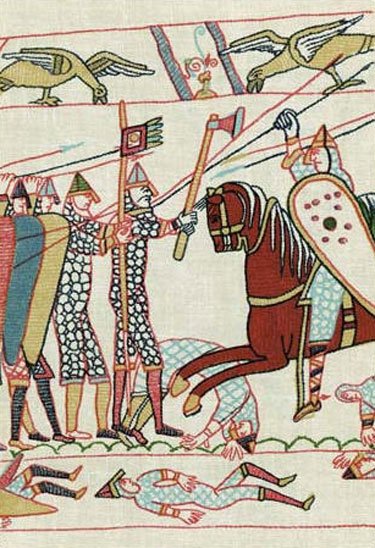
In Britain, there is still a small but measurable difference in social metrics between people on different sides of the Ivanhoe gap after nearly a millennium. From The Telegraph in 2011:
People with Norman names wealthier than other Britons
People with “Norman” surnames like Darcy and Mandeville are still wealthier than the general population 1,000 years after their descendants conquered Britain, according to a study into social progress.
Research shows that the descendants of people who in 1858 had “rich” surnames such as Percy and Glanville, indicating they were descended from the French nobility, are still substantially wealthier in 2011 than those with traditionally “poor” or artisanal surnames.
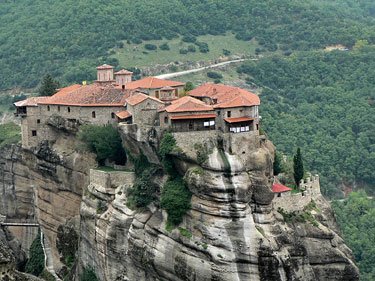
Greek Orthodox monks built 20 monasteries atop rock pillars at Meteora overlooking the Thessalian Plain, from the 10th to the 16th century, in order to get away from Byzantine politics and raiding Turks.
Wikipedia says:
Access to the monasteries was originally (and deliberately) difficult, requiring either long ladders lashed together or large nets used to haul up both goods and people. This required quite a leap of faith – the ropes were replaced, so the story goes, only “when the Lord let them break”. In the words of UNESCO, “The net in which intrepid pilgrims were hoisted up vertically alongside the 373 metres (1,224 ft) cliff where the Varlaam monastery dominates the valley symbolizes the fragility of a traditional way of life that is threatened with extinction.” In the 1920s there was an improvement in the arrangements. Steps were cut into the rock, making the complex accessible via a bridge from the nearby plateau. During World War II the site was bombed. Many art treasures were stolen.
Until the 17th century, the primary means of conveying goods and people from these eyries was by means of baskets and ropes.
Six of the monasteries remain today. Of these six, four were inhabited by men, and two by women. Each monastery has fewer than 10 inhabitants. The monasteries are now tourist attractions.
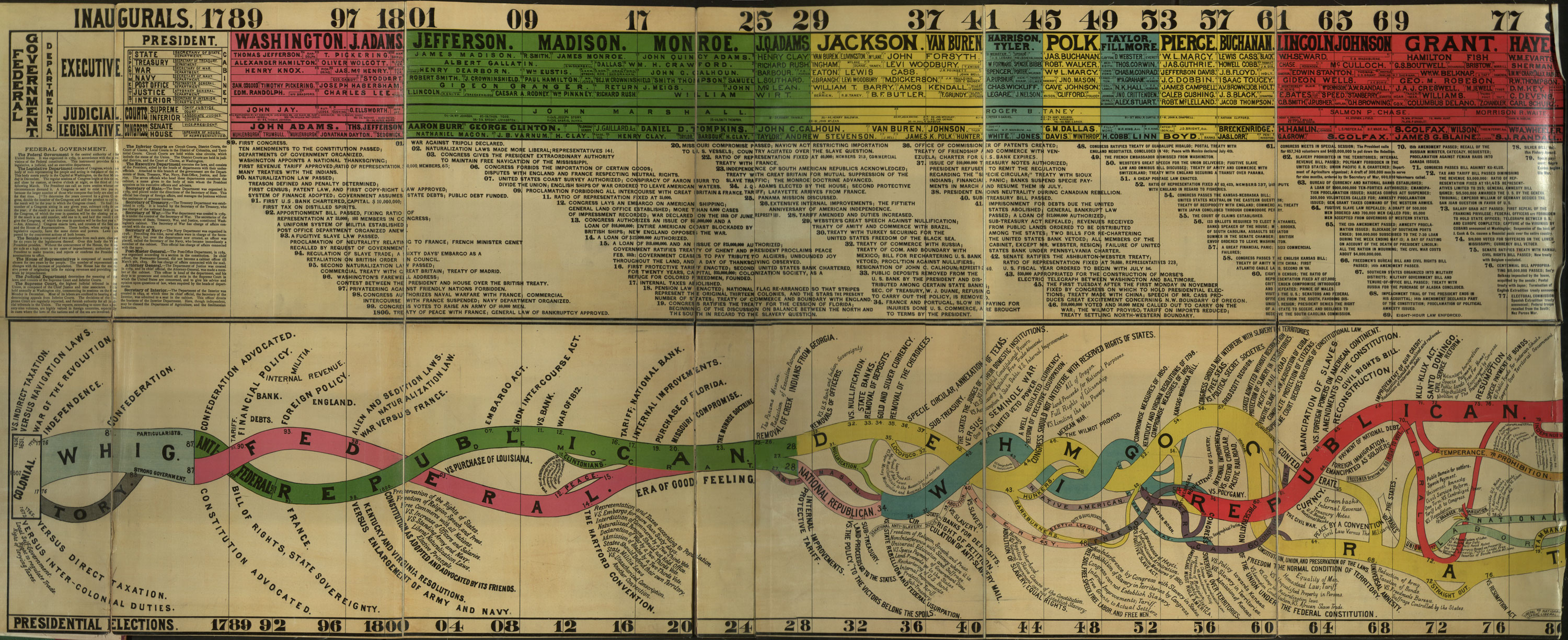
Detail of 1880 “Conspectus of the History of (US) Political Parties,” an attempt to represent graphically just over a century of American politics.
Susan Schulten introduces this interesting antique item at Mapping the Nation.
I had never heard of a “conspectus,†which is a nineteenth-century term meaning “a comprehensive mental survey.†And that is exactly the idea. I have only reproduced the image here, and left out the extensive narrative that was designed to be laid out under the chart, which lists political events, Supreme Court decisions, and acts of Congress.
In fact, there’s so much detail that I wonder about the purpose of the chart. Perhaps the point was to collapse the chaos of change into a single view, one where a party’s power could be traced over time. The appeal seems to be to capture an overall state of change, of flux. Notice how much the chart resembles a a river. The metaphor is useful — the wider the river at any spot, the more “powerful†the party at that time. I’m particularly impressed by the representation of the turbulent 1850s, when the Whig Party disintegrated and the Republican Party was founded.
This Model 1911 Colt .45 was found in the waistband of Clyde Barrow’s trousers by Texas Ranger Frank Hamer who brought the outlaws to justice via a high firepower ambush on a rural Louisiana road on May 23, 1934.
A breakout raid on a Texas prison farm by the Barrow gang in which two guards were shot (one of whom died) infuriated Texas state officials, who responded by hiring retired Ranger Captain Frank Hamer, a veteran of a hundred gun fights who had been shot 17 times and who had reputedly killed between 50 and 70 men, to track down the Barrow gang and out an end to their criminal careers.
Hamer’s commission was to deliver justice, not bring them back alive. He was encouraged to trap the gang, making sure the correctness of his identification of the suspects, and then to just “shoot everybody in sight.” Part of Hamer’s compensation for the manhunt included authorization to appropriate as trophies the weapons and personal effects of the criminals.
Hamer caught up with Bonnie and Clyde on a rural highway in Louisiana with an ambush by six lawmen, armed with a Browning Automatic Rifle, Winchesters, and two Remington semiautomatic rifles. The outlaws’ car was riddled with bullets before either had a chance to shoot back.
RR Auctions of New Hampshire is offering for sale next September 30, with documented provenance going back to Frank Hamer, two pistols found on the bodies of the deceased bandits, Bonnie Parker’s cosmetics case, and Clyde Barrow’s Elgin pocket watch.
This Buckley video is movingly nostalgic. Bill Buckley is so young and elegant. Of course, watching him perform, one cannot avoid noticing the very characteristic way he systematically relies upon style in deliberate preference to substance. It is also fascinating to look back and realize just how “insensitive” Buckley could get away with being way back in 1965. No conservative intellectual today could display such public disregard for the sacred cows of civil rights and sodomy, or so condescend to a prominent queer Black author. The topic was: “Has the American Dream Been Achieved at the Expense of the American Negro?” Buckley here, of course, represents one small voice trying to stand in the face of an onrushing avalanche of compensatory racial privilege yelling, “Stop!” In 1965, it was still vaguely possible to argue that a massive new era of coercive National Reconstruction and indoctrination was not really morally or practically necessary. Today, four more decades worth of Americans have been taught from infancy that coercive racial egalitarianism represents the most vital moral necessity as well as the supreme triumph of human civilization and political philosophy.
The issue of Edward IV’s legitimacy was revived, after more than 500 years, by a British television documentary, titled Britain’s Real Monarch, which aired in 2004 and which produced documentation from Rouen Cathedral to Richard Plantagenet’s absence during the relevant period.
Theoreticians of this sort of thing exclude female claimants from the hypothetical Clarentian Succession, as the possibility of female succession was a creation by Henry VIII, who by this theory was never king anyway. By their calculations, Michael Abney-Hastings, 14th Earl of Loudoun, who passed away recently in Australia, was the 19th successor to the British throne in descent from George I, former Duke of Clarence.
The 14th Earl of Loudoun and Jerilderie councillor Michael Abney-Hastings died on Saturday morning at the age of 69.
Mr Abney-Hastings is well known in the Jerilderie Shire but is most famous for the 2004 documentary Britain’s Real Monarch, which suggests he should be the King of England in place of Queen Elizabeth II. Mr Abney-Hastings had been battling a debilitating illness and had been in and out of hospital in the lead-up to his death.
But he continued to serve Jerilderie Shire Council to the end and council general manager Craig Moffitt yesterday paid tribute to the “much-loved guyâ€.
“It is very sad,†Mr Moffitt said.
“He was quite a character around the town.â€
Mr Abney-Hastings was born in Sussex in 1942 and attended a private school in Yorkshire before moving to Jerilderie with his family.
His parents were Captain Walter Strickland Lord and the 13th Countess of Loudoun Barbara Abney-Hastings, making him the 14th Earl of Loudoun.
He made world headlines in 2004 when Britain’s Real Monarch explained King Edward IV was conceived illegitimately, and therefore as the direct descendant of the 1st Duke of Clarence he should be the rightful King.
But Mr Abney-Hastings was voted onto Jerilderie council that same year and decided to focus his energy on that.
“He didn’t take his royal position too seriously, at least here in Jerilderie,†Mr Moffitt said.
“He would go over to England for royal ceremonies which he took seriously, but he always found it quite funny.â€
Michael Edward Abney-Hastings, 14th Earl of Loudoun (22 July 1942 – 30 June 2012)
Celebrating its 200th anniversary, the New England Journal of Medicine takes a look back, comparing causes of death in 1811, 1900, and 2010.
We have more heart disease and cancer, and seem to less frequently expire due to spontaneous combustion or the impact of a cannon ball. Fears of racial suicide and belief in the progress of eugenics are not what they were in 1912.
General Gordon is clearly intentionally turned so as to avoid exposing the wounded side of his face.
Defending the sunken road, known as “Bloody Lane,” at the Battle of Antietam, Brigadier General John B. Gordon was commanding the 6th Alabama Regiment. In his 1903 memoir, he describes being wounded repeatedly.
General Gordon, nonetheless, survived the battle, and the war, and lived until 1904.
My extraordinary escapes from wounds in all the previous battles had made a deep impression upon my comrades as well as upon my own mind. So many had fallen at my side, so often had balls and shells pierced and torn my clothing, grazing my body without drawing a drop of blood, that a sort of blind faith possessed my men that I was not to be killed in battle. This belief was evidenced by their constantly repeated expressions: “They can’t hurt him.†“He’s as safe one place as another.†“He’s got a charmed life.â€
If I had allowed these expressions of my men to have any effect upon my mind the impression was quickly dissipated when the Sharpsburg storm came and the whizzing Minies, one after another, began to pierce my body.
The first volley from the Union lines in my front sent a ball through the brain of the chivalric Colonel [Charles C.] Tew, of North Carolina, to whom I was talking, and another ball through the calf of my right leg. On the right and the left my men were falling under the death-dealing crossfire like trees in a hurricane. The persistent Federals, who had lost so heavily from repeated repulses, seemed now determined to kill enough Confederates to make the debits and credits of the battle’s balance-sheet more nearly even. Both sides stood in the open at short range and without the semblance of breastworks, and the firing was doing a deadly work. Higher up in the same leg I was again shot; but still no bone was broken. I was able to walk along the line and give encouragement to my resolute rifle-men, who were firing with the coolness and steadiness of peace soldiers in target practice. When later in the day the third ball pierced my left arm, tearing asunder the tendons and mangling the flesh, they caught sight of the blood running down my fingers, and these devoted and big-hearted men, while still loading their guns, pleaded with me to leave them and go to the rear, pledging me that they would stay there and fight to the last. I could not consent to leave them in such a crisis. The surgeons were all busy at the field-hospitals in the rear, and there was no way, therefore, of stanching the blood, but I had a vigorous constitution, and this was doing me good service.
A fourth ball ripped through my shoulder, leaving its base and a wad of clothing in its track. I could still stand and walk, although the shocks and loss of blood had left but little of my normal strength. I remembered the pledge to the commander that we would stay there till the battle ended or night came. I looked at the sun. It moved very slowly; in fact, it seemed to stand still.
I thought I saw some wavering in my line, near the extreme right, and Private [Benjamin F.] Vickers, of Alabama, volunteered to carry any orders I might wish to send. I directed him to go quickly and remind the men of the pledge to General Lee, and to say to them that I was still on the field and intended to stay there. He bounded away like an Olympic racer; but he had gone less than fifty yards when he fell, instantly killed by a ball through his head. I then attempted to go myself, although I was bloody and faint, and my legs did not bear me steadily. I had gone but a short distance when I was shot down by a fifth ball, which struck me squarely in the face, and passed out, barely missing the jugular vein. I fell forward and lay unconscious with my face in my cap; and it would seem that I might have been smothered by the blood running into my cap from this last wound but for the act of some Yankee, who, as if to save my life, had at a previous hour during the battle, shot a hole through the cap, which let the blood out.
I was borne on a litter to the rear, and recall nothing more till revived by stimulants at a late hour that night.
It is not really difficult to understand Poles being offended, when at the presentation of a posthumous American valor award for Jan Karski, a Polish officer who risked his life obtaining knowledge of the Holocaust and then carried that information to the Western Allies, President Barack Obama referred to Karski being “smuggled into a Polish death camp.”
The Commonwealth of Poland-Lithuania served as homeland to the overwhelming majority of European Jewry for six centuries until that country was invaded, wiped from the map, and occupied by Prussia, Austria, and Russia at the end of the 18th century.
Jews lived for all those centuries in Poland-Lithuania as a self-governing estate under the protection of royal charters which granted Jews privileges and immunities nearly equal to those of the noble estate.
The witches’ brew of demagogic populist ideologies of the late 19th century, Socialism and Nationalism, impacted occupied Poland and Lithuania, as they did the rest of Central and Eastern Europe, dividing classes, ethnicities, and religious groups, but the so-often-alluded-to Polish antisemitism was far less virulent than elsewhere. During the Nazi-era persecution of the Jews, Poles themselves were on the receiving end of nearly equivalent scale murder and atrocities, but nevertheless Poles, like Karski, did much more on behalf of the Jews than citizens of any other occupied country.
Routine reference to “Polish death camps” by the ignorant and reflexively biased naturally deeply offend Poles.
From a Bulgarian source, an animated history of Europe from the Early Middle Ages showing how countries and empires came and went and boundaries changed. Look at what happened to Lithuania!