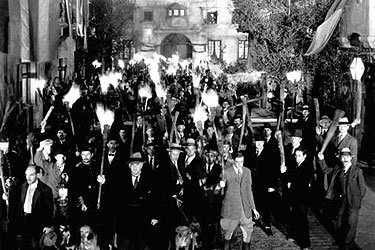
ObamaCare Architect Jonathan Gruber admits Obamacare was passed only because America was intentionally deceived. “…call it the stupidity of the American voter or whatever…”
—————————-
Fox News Megyn Kelly reports on the scandal resulting from Professor Gruber’s remarks, and find that this was not the first time Jonathan Gruber publicly gloated that American voters are “too stupid to understand” how democrats were flimflamming them.
—————————-
Ian Tuttle observes that no one should be surprised by any of this. Progressives commonly fail to conceal their sense of moral and intellectual superiority based upon being progressive.
Jonathan Gruber is smart. He is an economist. He teaches at MIT. Do you teach at MIT? Of course you don’t. He is also the architect behind Obamacare. He is really, really smart. Did we mention that?
Of course, when you are as smart as Jonathan Gruber, it is difficult to resist the temptation to pull your light out from under the bushel on occasion; thus every once in a while there comes an embarrassing revelation. The conservative group American Commitment recently unearthed one such moment. During an interview at the University of Pennsylvania in October 2013, Gruber revealed that
this bill [the Affordable Care Act] was written in a tortured way to make sure CBO [the Congressional Budget Office] did not score the mandate as taxes. If CBO scored the mandate as taxes, the bill dies. Okay, so it’s written to do that. In terms of risk-rated subsidies, if you had a law which said that healthy people are going to pay in — you made explicit healthy people pay in and sick people get money, it would not have passed. . . . Lack of transparency is a huge political advantage. And basically, call it the stupidity of the American voter or whatever, but basically that was really, really critical for the thing to pass. . . . Look, I wish . . . that we could make it all transparent, but I’d rather have this law than not.
One could call it an “admission†or “confession,†but Gruber does not seem particularly conflicted. The ends justified the means. That is something the millions of people who have been forced from their insurance plans
When a different economist, Thomas Sowell, quipped that “the road to Hell is paved with Ivy League degrees,†he spoke more truth than he realized. Indeed, smart people often have bad policy ideas. But Hell is not about mistakes; it’s about sins. And despite its pragmatic, do-what-works rhetoric, the progressive Left is convinced not only of its own intellectual superiority but of its accompanying moral superiority. Among progressives, stupidity is sin.
Gruber’s comments are a perfect illustration of this belief. The “stupidity of the American voter,†of which he is obviously disdainful, is not an ignorance of facts. If Obamacare proponents had believed that was the case, they would simply have sought to explain the legislation, trusting that more information would be persuasive. The obfuscation in which they engaged would not have been necessary.
No, Obamacare proponents were certain that Americans could not be persuaded, no matter how much information they absorbed. The voters were incapable of recognizing that Obamacare was in their own best interests — or, to put it another way, they were (and remain) morally deficient, a failing impervious to reasoned argument. Their stupidity was a sin, against themselves and each other. Gruber and company were the messiahs they did not know they needed.
—————————-
Breaking: University of Pennsylvania tries to suppress the Gruber video.
Gillian Wearing, A Real Birmingham Family, 2014, Library of Birmingham
Ikon Gallery commissioned and raised £150,000 in funding from a variety of public and private sources for a monument sculpted over four years by Turner-Prize-winner Gillean Wearing for installation in front of the Library of Birmingham.
Titled “A Real Birmingham Family,” the life-sized bronze sculpture was unveiled last Thursday. The statues are of two real, mixed race, unwed female Birmingham residents, Roma and Emma Jones, with their sons Kyan and Shaye. Emma is depicted 8 months pregnant with her second son Isaac.
The Jones sisters were chosen specifically to represent the 21st Century Birmingham family.
“A nuclear family is one reality but it is one of many and this work celebrates the idea that what constitutes a family should not be fixed.†said sculptor Gillian Wearing.
“Being mixed race, we feel at home here as it’s so diverse and multicultural. As a result, we believe the mixed-race population in Brum will only increase.” said the Jones sisters.
Monuments are not typically erected, of course, to living people, but obviously the Jones sisters qualify for one on the basis of being photogenic representatives of multiculturalism (what used to be called miscegenation) and unwed motherhood.
Birmingham’s community of fashion, of course, in celebrating the Jones sisters and their bastards is really celebrating the death and replacement of the white Anglo-Saxon British nation by a new racially mixed Britain composed of persons of color and the death of Christianity and European Civilization and its multicultural replacement.
Denver is in the process of renovating its long-neglected Union Station, built in 1914 in the Beaux Arts style. Denver Post Fine Arts Critic Ray Mark Rinaldi has serious issues with the renovation of a building designed exclusively in European styles, which thus inevitably celebrates European culture and civilization, while neglecting to represent all those various peoples of colors which our liberal friends all tell us are destined very soon to displace us as the American majority. Evidently Mr. Rinaldi thinks that Denver ought to be consigning European culture, architecture & European history to the ash-heap of history right now.
Union Station is a neo-classical mix of styles — European styles. The symmetry, arched windows, ornate cornice and stacked, stone walls have their roots in the glory days of France, England, Greece and Rome, in empires that were nearly absent of ethnic minorities and who felt fully at ease invading, exploiting and actually enslaving the people of Africa, subcontinent Asia and South America.
Yes, that’s all in the past; things have changed. But the $54 million renovation of Union Station doesn’t take that into account. It restores the symbols of an old world with no updates. The gilded chandeliers have been rewired, the marble polished, but there’s no nod to the present, no interior walls in the bright colors of Mexico, no Asian simplicity is in the remix. There are no giant sculptures by African-American artists bonused into the lobby, no murals on the basement walls.
Would any of those updates have made Union Station more welcoming, made it “Ready for the Next 100 years,” as its marketing proclaims ? Could they still?
A preservationist might object to physical updates. Restoration is about the exact, the original. History has its ups and downs, the thinking goes, and you can’t blame buildings for the good or bad that happened. But a preservationist just might end up with a building that draws mostly white people — with a Union Station.
The present restoration harkens back to Union Station at its height, in the first half of a 20th century when many Americans suffered the social indignity and economic disadvantage of a segregated America. Denver’s neighborhoods, parks, schools and social amenities were divided sharply by race. Denver’s branch of the Ku Klux Klan, one mayor a member, kept things in their place.
The trains themselves were not officially segregated here, but you can bet many people on them boarded or disembarked in stations where blacks entered in separate doors and rode in restricted cars.
Denver’s bigshot bigots are gone, schools and workplaces desegregated. But the structures of back then look the same — are they to be honored or altered to make the past palatable for everyone?
The programming does little to mitigate the obstacles. The local restaurants and chefs that made it onto Union Station were the city’s highest-profile operators whose establishments serve mostly white clientele, and their fans have followed along. Minority businesses were part of the station’s redevelopment, but many of the key players were white, too. These people are not racists. They are our among our best, most creative thinkers.
Still, something is missing. There’s no traditional Mexican restaurant, no soul-food restaurant, no sushi bar, as if no one noticed that the Mexican-American, African-American and Asian-American families that own and operate those places across the city are also our best food purveyors. …
Union Station is programmed toward wallets. You need a password to use the Wi-Fi. Its product is elegance, even exclusivity. You can’t even find the Cooper Lounge unless you know where you are going; it’s set up for insiders. Exclusivity has its own historic baggage. Whether it’s about keeping Jewish people out of a subdivision or gay people out of the military, it historically benefits the majority.
That’s only part of it, of course. Because today’s Denver has a growing middle-class of minorities. Plenty of blacks and Latinos could afford to play at Union Station. The surrounding neighborhoods are diversified with residents who could simply bike over or take the light rail or downtown shuttle. There is no one at the door looking folks over. The workforce is mixed. There’s no open policy of exclusion.
But there may be an institutional one. RTD had a thousand choices when it was rehabbing the station. It could have put in a farmer’s market or a suite of micro-offices. It could have let its imagination run wild and installed a basketball court or a rec center, day-care facility, museum, a theater that any group could rent, an indoor playground, or yes, a Subway.
But it chose a different path. RTD, whose buses and trains are the most diverse places in Denver, created a monster of separation. You can’t keep private enterprise from doing this sort of deed, but a public entity, a common asset, might have more democratic obligations.
Union Station will make plenty of money and that will help keep our transportation system solvent. But how much is lost?
This really was a chance to define today’s Denver, to show off to the world, to say we are as interesting and relevant as anywhere you can name. But this project has defined us narrowly, darkly, negligently. There is danger in that, too.
Lockean Individualist enterprise might again threaten aboriginal rights and cultures.
Saskia Vermeylen, a Senior Lecturer at the Lancaster Environment Centre at Lancaster University, shudders at the thought that there might possibly one day be private property and private enterprise in Outer Space. No, no, no, Space must be reserved only for collectivist statist administration.
Perceiving outer space as a commons was also another way of preventing national sovereignty in space. But neither the USSR nor the US was keen to fight out the Cold War on yet another front. Geopolitics dictated the decision to treat outer space as being non-appropriable.
This principle can be found back in Article II of the 1967 Outer Space Treaty which clearly forbids “national appropriation by claims of sovereignty, means of use or occupation by any other meansâ€. It has been widely accepted: no one complains the various moon landings or satellites in space have infringed their sovereignty.
However, legal commentators disagree over whether this prohibition is also valid for private appropriation. …
[W]hile the idea of buying some lunar real estate might be fun, in order for these plots to be recognised as property there needs to be legal recognition by a superior authority such as a nation state. As states are not allowed to claim sovereign rights in outer space, landed property on the moon and planets will in all likelihood be outlawed.
Legal commentators are hopeful that states will remain loyal to the treaty and refrain from recognising or endorsing a private property claim. …
But all of these arguments are rather theoretical. If you just simply occupy a place and no one else can access or use it, aren’t you the de facto owner? Lawyers call this corporate possession (corpus possidendi) and it represents another reason why title deeds cannot be a legal proof of lunar ownership – no one is physically there. In order to possess something, both mind and body need to be involved. Intention alone is not sufficient; possession also requires a physical act.
The difficulty of physically establishing an act of possession on the moon should protect it from private development, but it seems technology is once again outsmarting the law. Back in the late 1990s commercial firm SpaceDev intended to land robotic prospectors on an asteroid to conduct experiments and claim it as private property. he project eventually ran out of funds and was shelved, but advocates of such “telepossession†point to cases of salvage companies claiming undersea wrecks as property after exploring them with robots. After all, if an undersea probe with a TV camera was all that was required to take possession of a (previously owned, earthly) shipwreck, why shouldn’t a space probe be enough to take possession of an unowned and unclaimed patch of celestial real estate? …
It is never easy to bring oneself to respond in seriousness to editorials so simultaneously fashionable and conventional in their perspectives, yet built upon such completely astounding and preposterous assumptions.
Saskia Vermeylen is a professional scholar specializing (with the support of Western society and the British state) in property theory, from “a critical socio-legal and philosophical perspective,” meaning that she is a Marxist communist and a committed adversary of the civilization, culture, state, and society in which she was born and educated, and which is currently supporting her professional career.
Saskia Vermeylen was educated (at Surry and at Lancaster, but she could just as well have acquired the same perspective at Oxford or Cambridge or Yale or Harvard) to believe that the European settlement of the New World and the development of the United States of America was overall a Bad Thing, and that it is somehow reasonable to imagine Columbus turning around and going home, and the European states of France and Spain and England, the Netherlands, and Sweden all declining, on moral grounds, to settle and develop unoccupied, newly discovered territories for fear of coming into conflict with the interests of Stone-Age barbarians residing nearby.
If Ms. Vermeylen is correct in her beliefs, it would somehow, mysteriously, be possible for the Iroquois to make war and compete for control of territory with the Hurons, the Susquehannoks, the Eries, and whomsoever; but not for Englishmen and European Civilization to compete with the Iroquois. If Ms. Vermeylen were remotely rational, it would be necessary for it to be possible to argue plausibly that, had Europeans never crossed the Atlantic, after four centuries, the aboriginal inhabitants of the Americas would themselves have constructed a state, society, and civilization worthy of comparison in artistic, scientific, philosophical, technological, and political achievement to the United States (and Mexico and Canada), equal or superior in the development of human potential and the promotion of human happiness.
It should be needless to note that imagining any such successful comparisons would be absurd. Consequently, there is no legitimate possible justification for Ms. Vermeylen’s treasonous and nonsensical perspective and no explanation for its etiology other than ignorant conformity to a certain kind of pathological local intellectual fashion.
K.C. Johnson wonders Is the Left Losing its Mind Over Campus Sex? He notes a recent column by Ezra Klein defending California’s recent “affirmative consent” law as so indefensible as to represent an intellectual tipping point.
Klein’s argument was astonishing—he conceded that the law was flawed, even badly flawed, but celebrated the flaws as a virtue. The law will mean that “too much counts as sexual assault†and that innocent students will be branded rapists (though such cases, Klein suggests in a fact-free claim, “very, very rarely†occur). But Klein considered it “necessary†to get more students deemed guilty of rape in “morally ambiguous†situations to convince men in college (but, it seems, not anywhere else) that “they better Be Pretty Damn Sure.â€
Klein’s column has triggered a torrent of criticism. The highest-profile came from New York’s Jon Chait, who expressed amazement that Klein was “arguing for false convictions as a conscious strategy in order to strike fear into the innocent,†a “conception of justice totally removed from the liberal tradition.â€
Johnson also reports on sharp criticism of new Harvard disciplinary policies (adopted by Harvard along with a great many other universities in response to Federal Department of Education threats and prodding) by 28 Harvard Law professors.
———————
The Ezra Klein column was widely criticized because Klein expressed enthusiastic support for injustice when he perceived the injustice as forwarding the leftist process of making Society more just.
All sorts of people dropped their jaws and did a double take at the spectacle of one of the Left’s noisiest moralists foaming at the mouth and demanding that the innocent should be loaded onto the tumbril and carried to a meeting with the guillotine in the Place de la Concorde. But why should anyone be surprised?
The very essence of leftism is its exaggerated claims of victimization and its one-sided perspective. Leftism was never about being fair, and leftist “justice” was never about being just. Leftism is entirely about Revolution, about the triumph of the victim groups by forced political change achieved through perpetual agitation. No one ever said that the left’s agitprop would be balanced and fair. And no one ever said the Revolution was going to practice due process.
Ezra Klein simply dropped the veil a bit too abruptly, being flushed with insolence over his side’s victory in California, and allowed everyone to see him for the tricoteuse he really is.
Camille Paglia thinks the Left’s date-rape witch-hunting blinds women to the dangers of genuine sexual assault.
American campuses are obscuring the true danger to young women, too often distracted by cellphones or iPods in public places: the ancient sex crime of abduction and murder. Despite hysterical propaganda about our “rape culture,†the majority of campus incidents being carelessly described as sexual assault are not felonious rape (involving force or drugs) but oafish hookup melodramas, arising from mixed signals and imprudence on both sides. …
The basic Leftist premise, descending from Marxism, is that all problems in human life stem from an unjust society and that corrections and fine-tunings of that social mechanism will eventually bring utopia. Progressives have unquestioned faith in the perfectibility of mankind.
The horrors and atrocities of history have been edited out of primary and secondary education except where they can be blamed on racism, sexism, and imperialism — toxins embedded in oppressive outside structures that must be smashed and remade. But the real problem resides in human nature, which religion as well as great art sees as eternally torn by a war between the forces of darkness and light. …
The gender ideology dominating academe denies that sex differences are rooted in biology and sees them instead as malleable fictions that can be revised at will. The assumption is that complaints and protests, enforced by sympathetic campus bureaucrats and government regulators, can and will fundamentally alter all men.
But extreme sex crimes like rape-murder emanate from a primitive level that even practical psychology no longer has a language for. Psychopathology, as in Richard von Krafft-Ebing’s grisly Psychopathia Sexualis (1886), was a central field in early psychoanalysis. But today’s therapy has morphed into happy talk, attitude adjustments, and pharmaceutical shortcuts.
There is a ritualistic symbolism at work in sex crime that most women do not grasp and therefore cannot arm themselves against. It is well-established that the visual faculties play a bigger role in male sexuality, which accounts for the greater male interest in pornography. The sexual stalker, who is often an alienated loser consumed with his own failures, is motivated by an atavistic hunting reflex. He is called a predator precisely because he turns his victims into prey.
Misled by the naive optimism and “You go, girl!†boosterism of their upbringing, young women do not see the animal eyes glowing at them in the dark. They assume that bared flesh and sexy clothes are just a fashion statement containing no messages that might be misread and twisted by a psychotic. They do not understand the fragility of civilization and the constant nearness of savage nature.
Damon Linker read Ezekiel J. Emanuel’s Atlantic essay, Why I Hope to Die at 75, and it reminds him of certain last century lines of thought no longer held in great esteem.
Ezekiel J. Emanuel, 57, [Rahm Emanuel’s older brother –JDZ] wants to die 18 years from now. We know this because he’s told us — in the title of an essay that’s received an enormous amount of attention since it appeared on the website of The Atlantic last Wednesday.
“Why I Hope to Die at 75” is one of those essays that will spark a nationwide conversation and debate. But that doesn’t mean it’s smart. On the contrary, given the author’s prominence in the world of health-care policy — he played a major role in designing ObamaCare, contributes frequent health-care-related op-eds to The New York Times, directs the Clinical Bioethics Department at the National Institutes of Health, and heads the Department of Medical Ethics and Health Policy at the University of Pennsylvania — what’s most noteworthy about the essay is its stunning combination of wisdom and insight with moral idiocy. …
Reading Emanuel’s essay, I began to despair — not just about the moral outlook it expresses, but about whether its readers will even recognize how monstrous it is. Emanuel has taken the ethic of meritocratic striving that currently dominates elite culture in the United States and transformed it into a comprehensive vision of the human good. Viewed in its light, the only life worth living is one in which you endlessly, relentlessly strive to look as smart and clever as possible in the eyes of other smart and clever people. The ultimate goal of such a life is to be considered the smartest and cleverest person of all. Once old age or any other misfortune gets in the way of continually striving for that goal, one might as well cease to exist.
But what about everyone else? This includes the millions upon millions of Americans who don’t help to write major pieces of legislation, don’t pen op-eds for leading newspapers, don’t run departments at the NIH, and don’t head institutes at Ivy League universities. … The Emanuel brothers have clawed their way to the very top of the American elite. … Doesn’t a middle manager toiling away in an anonymous office on the outskirts of Des Moines — let alone a burger flipper earning the minimum wage at a McDonald’s down the road — possess far less intelligence, talent, and ambition? Isn’t he comparatively disabled? And if so, shouldn’t he hope to die right now rather than waiting for 75?
This isn’t just an academic question. Emanuel and his striving siblings have an adopted sister named Shoshana who suffers from cerebral palsy. The clear implication of Emanuel’s argument is that her life — like that of someone who endures a steep decline in old age — is not worth living. …
Though he would no doubt blanch at the suggestion, Ezekiel Emanuel has written an essay that in its implications clearly amounts to a defense of eugenics. Yet Emanuel’s position differs in one important respect from the version of eugenics that rose to prominence in the Western world in the early decades of the 20th century. Whereas eugenics was originally motivated by public-spirited ends — by the desire to purify the race for the sake of overall human flourishing — Emanuel’s version is provoked by a more personal concern: Extraordinarily creative, intelligent, ambitious, and successful individuals want to be seen and remembered as exemplars of “vitality,” and not as “burdens” slowly succumbing to the “agonies of decline.”
This is eugenics induced by narcissism.
I think myself that it is unquestionably narcissism, narcissism combined with hubristic confidence in the calculative power of human reason and the complete absence of common sense.
Ezekiel Emanuel, who’s got a degree from Oxford in Biochemistry, nonetheless manages to overlook the extreme variability of human heredity and fate and is perfectly prepared to sit in his office, fingertips pressed together, and prescribe the appropriate human lifespan for everyone. Ezekiel Emanuel obviously never met Melvin Poe, who was riding his horse and hunting hounds until very recently at age 94, and who celebrated his birthday last year by putting his horse over a fence.
Human health and lifespan, like human talent and ambition, varies over a quite extreme range. But one thing obviously doesn’t vary: We’re all ready to die 18 years from today. We are just not ready today. 18 years in the future is always a very long time. I feel perfectly sure however that, if the Atlantic checks back with Ezekiel Emanuel come 2032, the editors will find that he has changed his tune dramatically.
Amy Davidson, in the New Yorker, quarrels with the characterization by the local sheriff of the accidental shooting death of instructor Charles Vacca by a 9-year-old girl firing an Uzi as “an industrial accident.”
The Arizona Last Stop, where a nine-year-old girl accidentally shot her instructor with an Uzi last Monday, has already reopened. It was “booked pretty solid†for the Labor Day weekend, Sam Scarmardo, the owner, told Reuters. The sheriff of Mohave County described a video of the shooting—recorded by the girl’s parents, who were tourists from New Jersey—as “grisly,†and has filed his report. He found that there is no cause for any criminal charges, not against whoever put together the range’s Bullets and Burgers Adventure, designed to put automatic military weapons in the hands of children as young as eight, or against anyone else. Instead, the sheriff referred the case to the Arizona Department of Occupational Safety and Health, because, he said, it was “being viewed as an industrial accident.â€
“An industrial accidentâ€: that phrase raises the question of what industry we are talking about. …
There are many businesses that make up the gun industry, including the buying and selling of political influence. In Arizona and many other states, the realm of firearms is poorly regulated, from gun stores and fairs to tourist traps like Last Stop. As the Arizona Republic wrote, “Arizona statutes do address firing ranges, but the laws primarily deal with noise levels. No laws govern any training protocols for firearms instructors, safety guidelines or age restrictions. But even if there were, there is no regulatory authority to enforce them.†A former Last Stop employee described the range, to the Republic, as a “shake and bake†operation, but, for what it’s worth, its enforcement record was clean. Setting a minimum age of eight to use a gun on a range has been described, since Vacca’s death, as something of an industry standard in many states. There is still an overhanging injunction that workplaces be generally safe, and maybe the Arizona authorities can do something with that, but there is not much cause for optimism.
This shouldn’t be surprising; it is not accidental. The same political forces that gather around gun rights are those railing against government in any form, even the kind that involves keeping children and their gun instructors, or other teachers, safe. We are left not only with lax gun laws but shake-and-bake shooting ranges. This is part of the explanation for why talking to the gun lobby about “common-sense regulations†never seems to go well. They are drawing on, and stoking, a view that presumes the foolishness of regulations. It is sad and telling that the only department left to look into Vacca’s death is the state equivalent of the Occupational Safety and Health Administration—regularly derided by Republicans—and that it’s unlikely to be able to do much at all.
A possible question for a 2016 Republican Party debate is whether the candidates think that nine-year-olds should ever be permitted to fire automatic weapons.
But an industrial accident, i.e. an accident which occurred as the result of improper handling of a tool, was precisely what happened.
The 9-year-old girl was clearly too small, too weak and uncoordinated, and insufficiently instructed in the safe handling and management of that weapon in full-automatic fire. She fired too long a burst and lost control of the weapon, which climbed as the result of recoil as it proceeded to continue to fire causing the muzzle to move beyond her intended target, and finally move upward to the left, winding up pointed at one moment as it continued to discharge at the unfortunate instructor’s head.
Was it unwise to put that Uzi into the hands of this 9-year-old girl? Clearly, it was. Yet, I feel perfectly sure that Mr. Vacca could have put that Uzi into the hands of entire school classes full of 9-year-olds without any such accident occurring. Most children would have kept their heads and never lost control of the Uzi. If warned in advance of the hazards of firing too long a burst, if given a magazine for full-auto fire with a more limited number of rounds, if the child were taller or if the instructor stayed lower or stood further behind the child, if the instructor were more alert, Mr. Vacca’s tragic death could easily have been averted.
All over America and the world, adults, from time to time, in the natural course of life, expose children to the excitement and interest of using dangerous tools, machinery (and sometimes weapons) all of which are potentially lethal. Parents teach children how to drive a car, a tractor, a lawn mower, or an ATV. Adults show children how to use a power saw, a lathe, or other machine tools. Parents take children to the shooting range and allow them to handle and fire guns. That is precisely the way that children grow up acquainted with tools, weapons, and machinery and learn to use them safely.
Amy Davidson’s philosophic approach to a tragic accident of this kind is to demand new federal laws and regulations based on the prejudices and emotional responses of people like herself, bien pensants socially and geographically remote from the kind of people who like to play with guns, and who actually in reality possess no expertise concerning guns or firearm safety themselves whatsoever.
From the liberal point of view, the combination of the administrative state and the pure intrinsic wisdom of the well-educated elite is effectively omnipotent. Just surrender more liberty and money to them, let them pass some more laws and create another federal agency, and they can successfully regulate happenstance, misfortune, and human incompetence and stupidity out of existence.
Obviously, there are a lot of us who disagree.
Instructor Vacca’s death was a tragic accident, but Mr. Vacca himself had as good a chance as anyone could possibly have had of preventing it. He simply failed to foresee one extreme possibility. I expect that shooting instructors nationally are going to be a lot more careful about placing full-auto weapons in the hands of children, and are going to take extra precautions and be more alert when they do.
Davidson obviously falsely depicts shooting ranges as part of an imaginarily lucrative and conspiratorial firearms industry so rich that it can buy political immunity from regulation. Gun control has actually been successfully resisted almost entirely by the purely grass-roots efforts of individual sportsmen, hobbyists, and collectors. The firearms “industry” contributes modestly to the NRA and many of its member corporations sell out to government quite readily.
Shooting ranges are all well aware that they live in a litigious country with a predatory trial bar eager to go after them. They do not need political prodding to implement safety rules and protocols. Every shooting range has already adopted all of them that they could think of as necessary.
The accidental death of Mr. Vacca merely proves that human foresight is limited and that even experts –Mr. Vacca was undoubtedly an expert– make mistakes.
The decision about when a particular child should be permitted to shoot a gun, or drive a tractor, or even I would say, when a child should be permitted to take a drink, ought really to be left up to the child’s parents. We do not need state or national policies and the last people who should be permitted to regulate access to, and usage and possession of guns or other machinery or tools should be the kind of people who write in the New Yorker and who are completely innocent of personal acquaintance and familiarity with the things they wish to regulate.
Michael J. Boyle, an assistant professor of Political Science at LaSalle, in the New York Times, wags his finger, and sermonizes against describing beheadings and mass murder as “immoral” because that might lead to US actions which could trouble his conscience.
Boyle provides a perfect example of the kind of liberal double-think which insists that murderous foreign barbarians are always entitled to complete immunity from morality, the Geneva Convention and other international law, and the rules and customs of war, but any American responses must always be subjected to microscopic ethical analysis and found to be free from any and all contamination by self-interest, world-wide disapproval, collateral damage, or potential untoward consequences of any kind before they can be regarded as licit and be supported by the pure of heart. The enemy is always immune to judgement, but the United States is always in the position of Jonathan Edwards’ “Sinner in the hands of an angry God.”
The beheading of American journalist James Foley by the Islamic State in Iraq and Syria, or ISIS, has rightly provoked global condemnation of the insurgent group and its horrific tactics. Yet it has also led to a disturbing return of the moralistic language once used to describe Al Qaeda in the panicked days after the 9/11 attacks.
In an eerie echo of President George W. Bush’s description of the global war on terrorism as a campaign against “evildoers,†President Obama described ISIS as a “cancer†spreading across the Middle East that had “no place in the 21st century.†Secretary of State John Kerry condemned ISIS as the face of a “savage†and “valueless evil,†while Britain’s prime minister, David Cameron, called the group “barbaric.â€
There is no question that ISIS has committed thousands of grave human rights violations against civilians in Iraq and Syria, and that many of its most gruesome acts, like the execution of Mr. Foley, constitute war crimes. Anyone with a conscience is disgusted by their brutality toward not just Mr. Foley but the thousands of Iraqi and Syrian civilians whom they have killed, raped and even buried alive.
It is natural to want to condemn this organization and to do so in harsh language that fully expresses our revulsion over its tactics. Indeed, condemning the black-clad, masked militants as purely “evil†is seductive, for it conveys a moral clarity and separates ourselves and our tactics from the enemy and theirs.
But if the “war on terror†has taught us anything, it is that such moralistic language can blind its users to consequences. Describing a group as “inexplicable†and “nihilistic,†as Mr. Kerry did, tends to obscure the group’s strategic aims and preclude further analysis. …
he Obama administration should be very careful about lapsing into language about “destroying†the cancer of ISIS without thinking through, and articulating publicly, exactly what that would mean. The strategic drift produced by this moralistic language is already noticeable, as an air campaign first designed to prevent a humanitarian catastrophe has morphed into an effort to roll back, or even defeat, ISIS.
The Obama administration needs to ensure that the just revulsion over Mr. Foley’s murder and ISIS’ other abuses does not lead us down an unplanned path toward open-ended conflict. The language of good and evil may provide a comforting sense of moral clarity, but it rarely, if ever, produces good policy.
Bob Ellis is an illustrious Australian playwright, screenwriter, journalist, filmmaker, and political commentator. Ellis has attracted a great deal of international attention (and incredulity) for his hyper-sophisticated remarks yesterday wondering why there should be so much outrage over the beheading of James Foley by a representative of ISIS. If Joffrey Baratheon can have Ned Stark beheaded, after all…
Queen Elizabeth I, an English hero, beheaded her female cousin. Henry VIII, a popular English monarch, beheaded two of his wives. William Shakespeare, a popular playwright, beheaded no more than eighty of his major characters, including Macbeth, Rosencrantz, Guildenstern, Buckingham, Thomas More and twenty-four of Titus Andronicus’s sons. Charles Dickens, a popular novelist, beheaded his most admired character, Sidney Carton. The Simpsons, a popular television series, beheads in its Halloween specials eight or nine people a year, and in its subseries Itchy and Scratchy hundreds of others. The Simpsons is watched by hundreds of millions of children. And no complaint has been laid. Beheadings occur routinely in Game of Thrones. And no complaint has been laid.
Why then all the fuss? Why especially profess such shock at airbrushed images in which there is no horror at all and serve only, I guess, as Rorschach blots or shadow-puppet silhouettes of imagined beheadings or severed heads?
The only possible observation is that decadence, deracination, and over-exposure to left-wing BS damages the brain and anesthetizes natural human sensibilities, making some people unable to distinguish between contemporary reality and fiction.
Poor innocent 18-year-old Michael Brown, shortly before he was shot by an obviously racially-biased police officer.
Helpfully, in the New Republic, Julia Ioffe warns that African Americans in Ferguson, Missouri have been excessively self critical.
This self-criticism—or self-flagellation—is nothing new. It’s the return of a phenomenon that is referred to by African-American historians as the “politics of respectability.” “During times of unrest, black writers going back to the early 20th century have argued that the reason blacks are facing discrimination or police brutality is because they have not been acting properly in public—particularly young, poor people,†says Michael Dawson, a political scientist and director of the Center for the Study of Race, Politics, and Culture at the University of Chicago. “In the last 20 years, it’s been a criticism of baggy pants, rap music, hair styles. Back in my generation, it was Afros. I remember my grandparents telling me, ‘you should cut your hair.’â€
Respectability, in essence, is about policing the behavior in your community to make sure people are behaving “properly,†so as to not attract unwelcome attention from whites—“with ‘properly’ being a normatively white middle class presentation,†says Dawson. In feminist discourse, a similar phenomenon among women is described as internalizing the patriarchal gaze.
Concerned citizens in Ferguson, Missouri protesting police violence and militarization of the police.