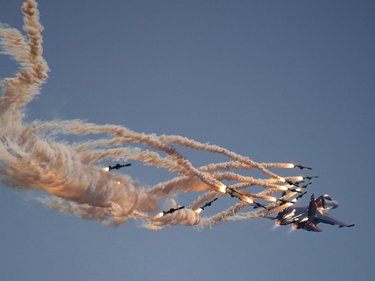
These three waggish hunters are posing with three enormous punt guns, the sort of arm that was used to hunt waterfowl en masse during the reign of Queen Victoria, in front of a duck-billed dinosaur.
Apparently actually a Su-27 Russian Knights Aerobatic Demonstration Team photo. The missiles are photoshopped in, the plane has been launching flares as a tribute to Flight Leader Igor Talachenko who was killed in a mid-air collision a week earlier.
This image was even more extravagantly photoshopped here.
Between 1887 and 1892, John C.H. Grabill sent 188 photographs to the Library of Congress for copyright protection. Grabill is known as a western photographer, documenting many aspects of frontier life & hunting, mining, western town landscapes and white settlers’ relationships with Native Americans. Most of his work is centered on Deadwood in the late 1880s and 1890s. He is most often cited for his photographs in the aftermath of the Wounded Knee Massacre on the Pine Ridge Indian Reservation.link
Charles O’Rear, the professional photographer who took the photograph titled Bliss which he sold to Microsoft to be used as the world-famous wall-paper for Windows XP, explains where he took the photo, what camera and film he used, and tells us: No, it was not Photoshopped.
East Indian locally-made machete, cartridge brass & elephant ivory handle. Sheath marked: “Across the Equator — Batavia to Java 1925.” My own collection.
If a picture is worth a thousand words, a knife is worth a million. …
The collecting started in 2006 on a backpacking trip to Madagascar. I had never collected knives or bought any knives before then. Hell, even the kitchen knives in my apt were a set that an old roommate had left behind when moving out. I was, however, motivated in returning from this trip with a souvenir, or more accurately, an artifact to remind me of my trip, one that was unique. I wasn’t interested in purchasing anymore tchotckes or keepsakes that had been manufactured specifically for tourists. So on a whim, I bought my first knife from a farmer on the outskirts of Fianarantsoa. It was a small hand knife that looked homemade. Both the handle and blade were formed from a worn and pitted metal and crudely fused together. It was dirty and sharp as a spoon. Perfect.
I continued adding to my collection over the next several years and soon my wall was decorated with machetes from Cambodia, Vietnam, Ecuador and Panama. They were all purchased used, having had a history with the previous owner. …
For me, every knife tells a story. It’s a story about the locals, their culture and my travels, all bound up in metal. Large knives and machetes are versatile and extremely durable tools. They are a must for many.
To date I have collected 88 machetes and large knives from 16 countries for the project.
Latin American locally-made machete, hardwood and bone grip with cast brass rooster head pommel, first half 20th century. My own collection.
Francis Frith, Photograph: Batalha, Portugal, mislabeled “Capela Imperfeita [Unfinished Chapel],” actually Main Portal of the Mosteiro de Santa Maria da Vitória [Monastery of St. Mary of Victory], photographed between 1850 and 1880, whole-plate albumen print from wet collodion glass negative, Victoria & Albert Museum.
My personal version of OCD makes me research and identify striking unknown Tumblr images which come to my attention.
The Monastery of Batalha (Portuguese: Mosteiro da Batalha), literally the Monastery of the Battle, is a Dominican convent in the civil parish of Batalha, in the district of Leiria, in central region of Portugal. Originally, and officially known, as the Monastery of Saint Mary of the Victory (Portuguese: Mosteiro de Santa Maria da Vitória), it was erected in commemoration of the 1385 Battle of Aljubarrota, and would serve as the burial church of the 15th-Century Aviz dynasty of Portuguese royals. It is one of the best and original examples of Late Gothic architecture in Portugal, intermingled with the Manueline style.
The convent was built to thank the Virgin Mary for the Portuguese victory over the Castilians in the battle of Aljubarrota in 1385, fulfilling a promise of King John I of Portugal. The battle put an end to the 1383-1385 crisis.
It took over a century to build, starting in 1386 and ending circa 1517, spanning the reign of seven kings. It took the efforts of fifteen architects (Mestre das Obras da Batalha), but for seven of them the title was no more than an honorary title bestowed on them. The construction required an enormous effort, using extraordinary resources of men and material. New techniques and artistic styles, hitherto unknown in Portugal, were deployed.
Work began in 1386 by the Portuguese architect Afonso Domingues who continued till 1402. He drew up the plan and many of the structures in the church and the cloister are his doing. His style was essentially Rayonnant Gothic, however there are influences from the English Perpendicular Period. There are similarities with the façade of York Minster and with the nave and transept of Canterbury Cathedral.
He was succeeded by Huguet from 1402 to 1438. This architect, who was probably from Catalonian descent, introduced the Flamboyant Gothic style. This is manifest in the main façade, the dome of the square chapter house, the Founder’s Chapel, the basic structure of the Imperfect Chapels and the north and east naves of the main cloister. He raised the height of the nave to 32.46 m. By altering the proportions he made the interior of the church even seem narrower. he also completed the transept but he died before he could finish the Imperfect Chapels. …
The portal shows in the archivolt a profusion of 78 statues, divided over six rows, of Old Testament Kings, angels, prophets and saints, each under a baldachin. The splays on both sides display (inferior copies of) statues of the apostles, with one standing on a chained devil. The tympanum shows us Christ enthroned, sitting under a baldachin and flanked by the Four Evangelists, each with his own attribute.