Wojciech Kossak (1857-1942), Noc listopadowa [A November Night]. 1898, oil on canvas, Private Collection.
The succession in 1825 to the throne of the Congress Kingdom of Poland of the autocratic Nicholas I, who made clear his contempt for constitutional government, led inevitably to revolt. The reactionary order imposed by the Congress of Vienna was tested all over Europe in 1830. Greek independence was recognized by Britain. In July, the Bourbon monarchy fell in France. In August, the House of Orange was expelled, and Belgium declared its independence. Fear that the Tsar might use the Polish Army to suppress the revolutions in France and Belgium led to revolution in Poland. Wojciech Kossak, in two famous paintings (the other), illustrated Polish cadets and Warsaw civilians in combat with Russian cuirrasseurs in the attack on the Belvedere Palace, the Polish equivalent of the White House, then the residence of Grand Duke Constantine, the Russian Governor General. The statue of King Jan Sobieski appears to be leading the Polish assault. This was the opening battle of the November Insurrection of 1830-1831.
The small number of readers familiar with Henryk Sienkiewicz’s novel of the 17th Century Swedish Invasion of Poland-Lithuania The Deluge will have some sense of its devastating impact on the country. No one living today, however, realised that Swedish looting included the theft of Polish architecture on a massive scale.
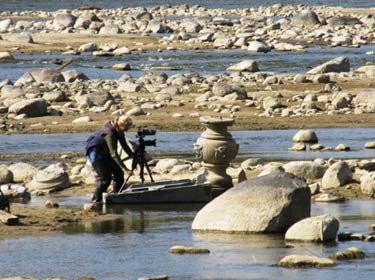
A recent major drought in Poland caused the waters of the River Vistula to recede to levels unprecedented in living memory, revealing tons of architectural masonry looted by the Swedes and loaded onto barges for transport down the river to Gdansk, and thence across the Baltic to Sweden. The invaders’ greed apparently exceeded their navigational judgment, and one or more of the barges sank in the river, possibly as the result of overloading.
Low rainfall over the past few months has brought the Vistula, Poland’s longest river, to its lowest level since regular records began 200 years ago. …
Historians believed that the Swedes who invaded Poland in the 17th century planned to move the looted cargo up the Vistula to Gdansk, where the river joins the Baltic Sea, and from there transport it home. There is still no firm explanation of why the boats sank on the way.
Kowalski said he and his team had so far located up to 10 tonnes of stonework, but this was only the beginning. “The boats had a capacity of 50-60 tonnes (each), so we think that we should find much more,” he said.
Once it has been removed from the river bed and catalogued, the plan is to take the masonry to Warsaw’s Royal Castle, one of the sites from which, historians believe, it was looted by the Swedish invaders.
For now though, the low water levels that revealed the artefacts are hampering efforts to retrieve them. Regular lifting equipment would sink into the mud, but the river is too low for the researchers to bring in floating cranes.
“We need to wait until it gets higher,” Kowalski said.
——————————-
Gość Warszawski [Warsaw’s Guest] has a slideshow
King John Sobieski and the military forces of Poland-Lithuania put a stop to Islamic aggression against Europe and Western Civilization for over three centuries.
How many people realize that the 9/11 attacks were deliberately timed to represent an Islamic response to the Relief of the Siege of Vienna?
Ireland lost to Spain 4-0 in their match in the Euro 12 European Championships, but the Irish fans won the hearts of the hosting Poles.
On Facebook, I see today posting after posting from my Polish correspondents declaring themselves to be “fans of the Irish fans.” “Irish fans are the best fans in the world.” according to many Poles. One declared admiringly: “They sing louder when they’re losing.”
It is not really difficult to understand Poles being offended, when at the presentation of a posthumous American valor award for Jan Karski, a Polish officer who risked his life obtaining knowledge of the Holocaust and then carried that information to the Western Allies, President Barack Obama referred to Karski being “smuggled into a Polish death camp.”
The Commonwealth of Poland-Lithuania served as homeland to the overwhelming majority of European Jewry for six centuries until that country was invaded, wiped from the map, and occupied by Prussia, Austria, and Russia at the end of the 18th century.
Jews lived for all those centuries in Poland-Lithuania as a self-governing estate under the protection of royal charters which granted Jews privileges and immunities nearly equal to those of the noble estate.
The witches’ brew of demagogic populist ideologies of the late 19th century, Socialism and Nationalism, impacted occupied Poland and Lithuania, as they did the rest of Central and Eastern Europe, dividing classes, ethnicities, and religious groups, but the so-often-alluded-to Polish antisemitism was far less virulent than elsewhere. During the Nazi-era persecution of the Jews, Poles themselves were on the receiving end of nearly equivalent scale murder and atrocities, but nevertheless Poles, like Karski, did much more on behalf of the Jews than citizens of any other occupied country.
Routine reference to “Polish death camps” by the ignorant and reflexively biased naturally deeply offend Poles.
Czocha Castle began as a stronghold, on the Czech-Lusatian border. Its construction was ordered by Wenceslaus I of Bohemia, in the middle of 13th century (1241–1247). In 1253 castle was handed over to Konrad von Wallhausen, Bishop of Meissen. In 1319 the complex became part of the dukedom of Henry I of Jawor, and after his death, it was taken over by another Silesian prince, Bolko II the Small, and his wife Agnieszka (see Duchy of Silesia). Origin of the stone castle dates back to 1329.
In the mid-14th century, Czocha Castle was annexed by Charles IV, Holy Roman Emperor and King of Bohemia. Then, between 1389 and 1453, it belonged to the noble families of von Dohn and von Kluks. Reinforced, the complex was besieged by the Hussites in the early 15th century, who captured it in 1427, and remained in the castle for unknown time (see Hussite Wars). In 1453, the castle was purchased by the family of von Nostitz, who owned it for 250 years, making several changes through remodelling projects in 1525 and 1611. Czocha’s walls were strengthened and reinforced, which thwarted a Swedish siege of the complex during the Thirty Years War. In 1703, the castle was purchased by Jan Hartwig von Uechtritz, influential courtier of Augustus II the Strong. On August 17, 1793, the whole complex burned in a fire.
In 1909, Czocha was bought by a cigar manufacturer from Dresden, Ernst Gutschow, who ordered major remodeling, carried out by Berlin architect Bodo Ebhardt, based on a 1703 painting of the castle. Gutschow, who was close to the Russian Imperial Court and hosted several White emigres in Czocha, lived in the castle until March 1945. Upon leaving, he packed up the most valuable possessions and moved them out.
After World War II, the castle was ransacked several times, both by soldiers of the Red Army, and Polish thieves, who came to the so-called Recovered Territories from central and eastern part of the country. Pieces of furniture and other goods were stolen, and in the late 1940s and early 1950s, the castle was home to refugees from Greece (see Greek Civil War). In 1952, Czocha was taken over by the Polish Army. Used as a military vacation resort, it was erased from official maps. The castle has been open to the public since September 1996 as a hotel[1] and conference center. The complex was featured in several movies, including a popular 1963 comedy, Gdzie jest general? (Where is the General?) and The Legend, Beyond Sherwood Forest, Secret Cipher Fortress, Spellbinder.
Looks like a good site for filming Prisoner of Zenda to me.
Holy Trinity Evangelical Lutheran Church in the town of Swidnica in Silesia is one of three Lutheran churches permitted to be constructed in Roman Catholic Silesia by the 1648 Peace of Westphalia which ended the Thirty Years War.
The so-called Peace Churches had to be constructed within one year, and could be built only from wood, loam and straw outside the city walls, without steeples and church bells.
Churches were built in Swidnica, Jawor, and Glogau. The first two survive today and were restored in 2001, the third burned down in 1758.
A short film celebrating the passage of the first liberal constitution in Europe by the Polish senate, May 3, 1791, the passage of which provoked treason by magnatial aristocrats (The Confederacy of Targowica) followed by intervention and partition of the country by Russia, Prussia, and Austria. Tadeusz Kosciuszko led the national resistance to the partition. The final defeat of Kosciuszko’s forces was followed in 1795 by the Third and final Partition of Poland-Lithuania. The actual document wound up locked in an iron box under guard in Moscow’s Kremlin, so much terror did it strike in the hearts of despots. Poles and Lithuanians still sing the praises of the Constitution of the 3rd of May which extended the rights enjoyed by the nobility to the entire country. The Third of May is today a national holiday in both countries.
Poszli, znaleźli Dzieciątko w żłobie,
Z wszystkimi znaki danymi sobie.
Jako Bogu cześć Mu dali,
A witając zawołali,
Z wielkiej radości.
Ach, witaj Zbawco, z dawna żądany!
Tyle tysięcy lat wyglądany;
Na Ciebie króle, prorocy
Czekali, a TyÅ› tej nocy
Nam się objawił.
————————–
Amidst the stillness of the night
Amidst the stillness of the night, a voice proclaims:
Arise ye shepherds – God is born to you!
Seize the moment,
Hasten to Bethlehem
To welcome the Lord.
They came, they found the child in the manger
With all the signs of honor
given by God ,
They shouted a greeting,
With great joy.
Welcome Savior, long desired!
Looked for for one thousand years
By kings and prophets
They waited, and you tonight
Revealed yourself to us.
This video shows a nearly fatal accident which occurred in the course of the ceremonies celebrating the 700th anniversary of the founding of the city of WaÅ‚cz in western Pomerania in 2003. One sees a sign reading “WaÅ‚cz 700 years 1303-2003” atop a kiosk at the end of the video.
The salutes were being fired by the honor guard (“kompania honorowa”) of the city of WaÅ‚cz. The city’s coat of arms can be seen on the lower corner of the flag.
Some commentators blame the thick gloves worn by the city guardsmen for the rifle firing prematurely. Others blame lack of proper training.
At BoingBoing, David Pescovitz posts a theory tracing the origin of abrasive and deprecatory Jewish humor, and the characteristic attitude of the City of New York, to a disastrous event of the 17th century.
According to UC Berkeley theater arts professor Mel Gordon — author of Siegel and Shuster’s Funnyman and Voluptuous Panic — it goes back hundreds of years before the Borscht Belt. Gordon argues that the Badkhn, a jester-like comedian figure common at weddings and Purim celebrations in East European shtetls, was the father of what we know as Jewish humor today. The Badkhn act was only one of many styles of Jewish comedy popular in the shtetls. Then, in the mid-17th century, 100,000 Jews in Ukraine were killed in a pogrom carried out by Cossacks. The ultraorthodox Rabbis of Poland and Ukraine decided that the pogroms were a punishment from God and that Jews should lead stricter lives and not have as much fun. So comedy acts had to go. But on July 3, 1661, the Badkhn was given a special exemption. From the Jerusalem Post:
…A rabbi asked his colleagues, what about the badkhn? He’s not really funny, the rabbi said. In fact, he’s abusive.
The elders agreed, and the badkhn was exempted from the ban — he wasn’t a merrymaker and wasn’t encouraging levity. And that’s how the badkhn became the only Jewish comic permitted in the shtetls, Gordon says, and how his particular brand of sarcastic, bleak humor set the tone for what we know today as Jewish comedy. Before the 1660s, the badkhn was the least popular Jewish entertainer – now he was the sole survivor.
“Jewish humor used to be the same as that of the host country,†Gordon said. “Now it began to deviate from mainstream European humor. It became more aggressive, meaner. All of Jewish humor changed…”
Little remains of the badkhn today outside Chasidic communities, where they are the stars of the yearly Purim spiels. When Gordon lived in New York in the 1980s, he would take journalists to Chasidic synagogues in Brooklyn every spring to witness these raucous celebrations.
But the badkhn’s influence is still felt in mainstream culture, Gordon says, from the Borsch Belt humor of the 1920s and ‘30s, to contemporary Italian and African-American comedians who trade in barbed insults and self-deprecation.
“Even today, almost all Jewish entertainers have badkhn humor,” Gordon said. “Sarah Silverman is completely badkhn.
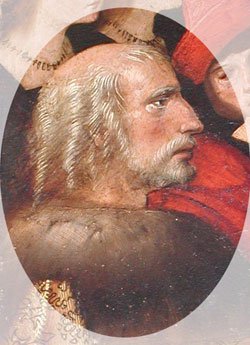
Jan Matejko, Wladyslaw III at Varna, (Detail), 1879.
Wladyslaw III (1424-1444) was a child when he succeeded his father Wladyslaw II Jagiello to the throne of Poland in 1434. The boy king had been molded by the influence of his tutor, Bishop Zbigniew Olesnicki, to embrace eagerly the role of defender of the Christian Faith. In 1440, Wladyslaw accepted the throne of Hungary, pledging himself to defend that country against the Turks. In 1443, he launched a military campaign in the Balkans which liberated Sofia, and inspired a revolt in Albania, forcing the Turks to sign a peace treaty.
Wladyslaw was promised support from a number of European nations and the protection of a strong Christian fleet, and urged to resume the offensive. On August 4th, 1444, he proceeded to break the truce. No support was forthcoming, and it has long been rumored that the Genoese accepted substantial fees to ferry the Turkish Army across to the European shore, where on November 10th Wladislaw and his army was trapped their backs to the sea at Varna. Some authorities think the Christian Army might possibly have fought its way out of the encirclement, but faced with overwhelming enemy forces, the boy king simply placed himself at the head of two squadrons of Polish heavy cavalry, and brandishing a captured scimitar, charged directly at the Sultan’s person surrounded by the janissaries in the center of the Turkish camp. The king’s body was never recovered.
Turkish accounts claim the king’s head was first exhibited on a stake, then preserved in a jar of honey and taken to Brussa, the capital of the Turkish state, as a trophy.
A new book, just released in Spain, titled, “COLON. La Historia Nunca Contada” (COLUMBUS. The Untold Story), by Manuel Rosa, bases itself on a Portuguese legend that Wladyslaw survived and contends that Chrisopher Columbus was his son.
The legend suggests that Wladyslaw renounced his throne as the result of guilt, believing that his defeat was the judgment of God for his breaking the truce. He is said to have traveled in obscurity to the Holy Land as a penitiential pilgrim, becoming a Knight of Saint Catherine of Mount Sinai, and then settled on island of Madeira.
On Madeira, he was allegedly known as Henrique Alemão (Henry the German) and resided on land received directly from the King of Portugal, who served as his best man at his wedding to a Portuguese lady.
He is said to have built the church of Saint Catherine and Saint Mary Magdalene in Madalena do Mar in 1471), in which he is said to have been the model used for Saint Joachim meeting Saint Anne at the Golden Gate in a painting by Master of the Adoration of Machico done at the beginning of the 16th century.
Manuel Rosa adopts the viewpoint of the legend contending that Christopher Columbus had access to four royal courts on the basis of his own royal paternity, that Columbus’s marriage to a Portuguese noblewoman long before his voyages of discovery was only possible on the basis of his own illustrious birth, and that Columbus’s 1498 will stating he was born on Genoa was forged 80 years after his death.
Columbus’s light hair, fair skin, and blue eyes are also cited by the author as evidence of the great navigator’s Lithuanian ancestry.
The author refers to an alleged resemblance between the arms of Columbus and those of Wladyslaw III, but I cannot recognize any myself.
Rosa has proposed modern DNA testing using material from royal burials at Wawel Hill in Cracow to confirm his theory.
The author, incorrectly listed by his publisher as a professor at Duke University, is actually employed as a help desk IT staffer at the Duke University Comprehensive Cancer Center.
Christopher Columbus (detail), from Alejo Fernández, La Virgen de los Navegantes, circa 1505 to 1536, Alcázares Reales de Sevilla.