Yuval Levin, at NR, assesses the denouement of the “Fiscal Cliff” confrontation, and concludes that the democrats played their best card and did not really win all that much.
Republicans… maybe they could have done a little better, but they probably couldn’t have done much better.
But the Democrats could have, and the story of their failure here has not yet gotten the notice it deserves. In the long run, when the dust has settled, I think that will be the real story of the fiscal cliff. For liberals, this was not a moment of danger to be minimized but by far their best opportunity in a generation for increasing tax rates (which is the only fiscal reform they seem to want) and for robbing Republicans of future leverage for spending and entitlement reforms. And it is likely the best one they will encounter for another generation. …
If even under the conditions of the past month — with a very liberal president just re-elected, Republicans in disarray, public opinion on taxes seemingly friendlier to them than it has been in decades, and higher tax rates automatically taking effect — the Democrats can’t get more than a tiny pittance of revenue and no chips to use later, then their basic approach to fiscal issues just won’t work. The idea that they will raise rates again in the Obama years when they don’t have all these factors working in their favor is a fantasy. And the notion that the politics of taxes has decisively changed in their favor has been disproven by their own behavior: Many Democratic senators were as relieved as Republicans to see the threshold for higher rates rise well above $250,000, and would not have stood for it dropping below that level to where their upper middle class voters are. Having discovered an effective political wedge in the tax debate, the Democrats have now basically used it up and gotten awfully little in return. They can’t begin to acknowledge that the levels of spending they want to sustain will require a far greater tax burden on far more people (and in a far more regressive way) than today’s code, and if they can’t even state what they want out loud then they’re not likely to get it. Their bluff has been called. The welfare state they want to retain and expand cannot be funded, and they apparently have no way to do anything about that.
The Politico reports that, in the State of Maine, one candidate’s World of Warcraft gaming hobby has become a campaign issue.
In an unusual press release issued Thursday, the Maine GOP attacked Lachowicz for a “bizarre double life†in which she’s a devotee of the hugely popular online role-playing game World of Warcraft. In the game, she’s “Santiaga,†an “orc assassination rogue” with green skin, fangs, a Mohawk and pointy ears.
Lachowicz is a Democrat running against incumbent state Sen. Tom Martin in south-central Maine, a heavily Democratic district of about 80,000 people. Martin, elected in 2010, is the first Republican to hold the seat since the 1960s, and his seat is one Democrats are eager to flip back.
Lachowicz has blogged under her own name about her World of Warcraft achievements as well as left-wing politics in a dedicated section of the liberal DailyKos.Com. The Maine GOP excerpted several provocative lines form her posts including one on tax policy that concludes, “Now if you’ll excuse me, I may have to go and hunt down Grover Norquist and drown him in my bathtub.â€
Other postings use curse words and make to the joy of “stab[bing] things,†joke about “being in a Socialist guild†and admit to “seriously slacking off at work.â€
—————-
Actually, I think the Maine Republican Party has a point there.
I don’t personally see anything wrong with on-line fantasy gaming, but residents of that senatorial district ought to ask themselves: Do I want for my state senator the kind of person who chooses the identity of an Orc? Orcs are green-colored, unintelligent, primitives affiliated with the Horde, “a ravenous war machine fueled by demonic energy,” which is to say, the really, really bad guys.
Professionally, Ms. Lachowicz has chosen to have her avatar pursue the career of an assassination rogue.
WoW decribes the rogue class thusly:
For rogues, the only code is the contract, and their honor is purchased in gold. Free from the constraints of a conscience, these mercenaries rely on brutal and efficient tactics. Lethal assassins and masters of stealth, they will approach their marks from behind, piercing a vital organ and vanishing into the shadows before the victim hits the ground.
So, voters also need to ask themselves, is the kind of person who chooses for her avatar the conspicuously unethical class of rogue likely to be the kind of person we want making fiscal decisions for our state?
On the whole, I think one wants to be voting into public offices of trust and responsibility the kind of people who, when they play Warcraft, make their avatars humans, elves, or pandarens (Yoda types), and who adopt good guy professions like Paladin or Priest, or at least neutral professions like Hunter or Warlock.
Run around electing the kind of person whose avatar is a Level 68 Orc Assassination Rogue and you are going to be getting the likes of Hillary Clinton or Nancy Pelosi.
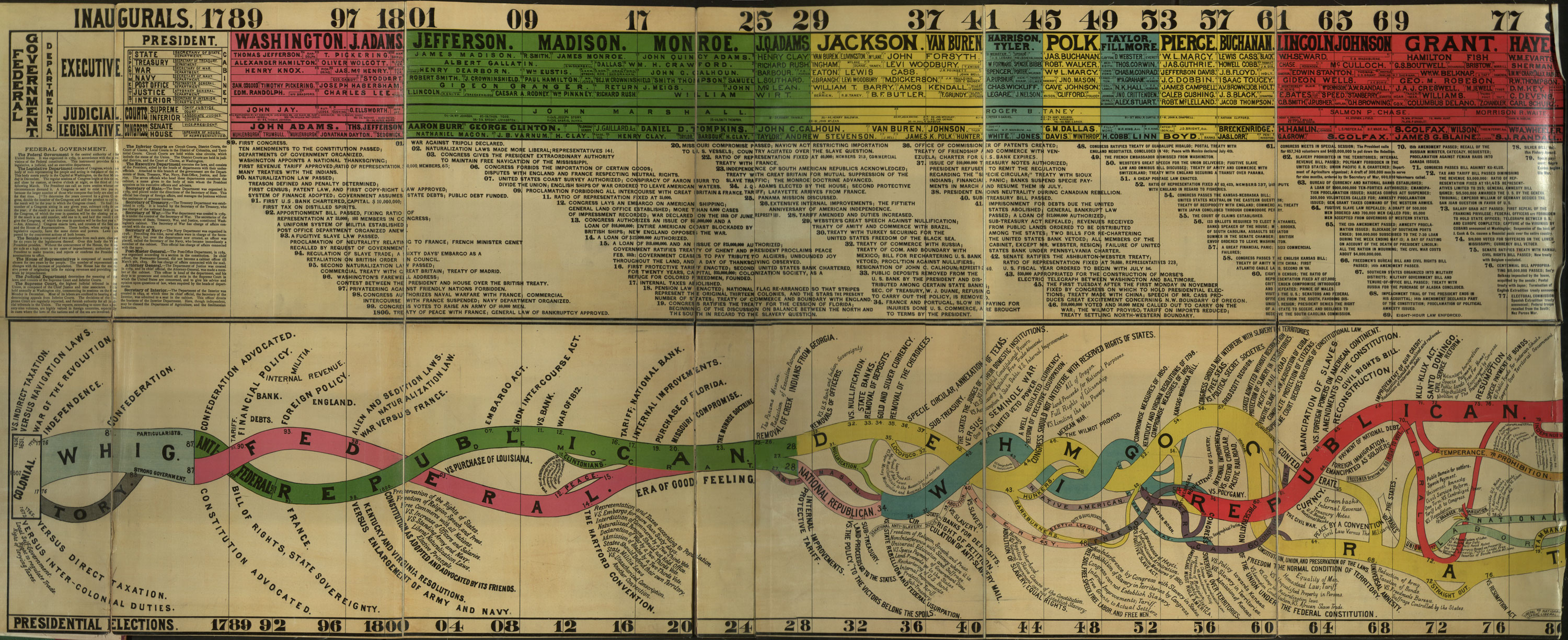
Detail of 1880 “Conspectus of the History of (US) Political Parties,” an attempt to represent graphically just over a century of American politics.
Susan Schulten introduces this interesting antique item at Mapping the Nation.
I had never heard of a “conspectus,†which is a nineteenth-century term meaning “a comprehensive mental survey.†And that is exactly the idea. I have only reproduced the image here, and left out the extensive narrative that was designed to be laid out under the chart, which lists political events, Supreme Court decisions, and acts of Congress.
In fact, there’s so much detail that I wonder about the purpose of the chart. Perhaps the point was to collapse the chaos of change into a single view, one where a party’s power could be traced over time. The appeal seems to be to capture an overall state of change, of flux. Notice how much the chart resembles a a river. The metaphor is useful — the wider the river at any spot, the more “powerful†the party at that time. I’m particularly impressed by the representation of the turbulent 1850s, when the Whig Party disintegrated and the Republican Party was founded.
James Piereson, in the New Criterion, argues that the era of the New Deal political coalition has finally reached its end, and a new epoch of American politics resting on entirely different bases is struggling to be born. America is ready for a new political realignment.
The conflict today between Democrats and Republicans increasingly pits public sector unions, government employees and contractors, and beneficiaries of government programs against middle-class taxpayers and business interests large and small. In states where public spending is high and public sector unions are strong, as in New York, California, Illinois, and Connecticut, Democrats have gained control; where public sector interests are weak or poorly organized, as in most of the states across the south and southwest, Republicans have the edge. This configuration, when added up across the nation, has produced a series of electoral stand-offs in recent decades between the red and blue states that have been decided by a handful of swing states moving in one direction or the other.
This impasse between the two parties signals the end game for the system of politics that originated in the 1930s and 1940s. As the “regime party,†the Democrats are in the more vulnerable position because they have built their coalition around public spending, public debt, and publicly guaranteed credit, all sources of funds that appear to be reaching their limits. The end game for the New Deal system, and for the Democrats as our “regime party,†will arrive when those limits are reached or passed.
This point will arrive fairly soon for the following reasons: (1) unsustainable debt; (2) public promises that cannot be fulfilled; (3) stagnation and slow growth; and (4) political paralysis. The last point is important because it means that the parties will fail to agree on any preemptive solutions to the above problems until they reach a point of crisis.
Dan Greenfield explains how the left turns a political vulnerability into an electoral asset: they frame the narrative.
A debate on the availability of contraception, no matter how well handled, only served the narrative of one side. No matter how well the debate was conducted, it meant that the right was now fighting on the battlefield that had been chosen by the left. All it took was a few sexual insults lobbed Fluke’s way for the diversion to be complete. The right was now either retreating from sexism charges or engaging in it. The social issue was framed in exactly the terms that fit the left’s narrative.
Limbaugh’s apology was nearly as bad of an idea as his original statement. The only time you advance into an enemy’s choice of terrain is when you are confident of being able to fight there and win. You do not give up the high ground just to take a few potshots at the enemy. After a temporary satisfaction, you end up losing the battlefield and being drawn into a battle that you never meant to fight. When that happens, you circle around and take back the high ground, you do not surrender because then there is nothing left to fight for.
The left’s coalitions depend on portraying the other side as engaging in a war on their protected groups. Without that war, their whole feudal lordships suddenly become unnecessary. That means it is in their vital interest to define each policy conflict as a Republican war on a protected class. While it’s advantageous at times to confront them on this when their position is weakest and ridicule it, it wasn’t worth surrendering the coalition of religious freedom to take a few potshots at the absurdity of Fluke’s testimony. Fluke, like every organizer from a protected class, is there to represent an entire group. Attacking her quickly becomes a diversion into the left’s narrative of a war on women.
Religious institutions imposed the terms of the battle by rebelling against the mandate. That forced Obama and his cronies to try and dismiss the battle, refusing to fight on that terrain. But Republicans and even some Democrats insisted on rallying on the field anyway, calling for a battle. So Team Obama diverted the battle to the terrain of their choice. They set new terms of battle, an effort which initially failed, until Limbaugh gave them the talking point they needed.
It is now an uphill battle to return to the original battlefield. It’s possible, but the initial skirmish has gone to the left which was successfully able to dictate the terms of the engagement. Their narrative has no life though, until the right breathes life into it. The larger lesson though is about the terms of battle. It is about the strategy of political warfare.
To win in 2012, the left needs to mobilize its coalition. To do that it doesn’t necessarily need to win battles, it needs to successfully position them on its choice of terrain. It needs to be seen as the feudal lords protecting the rainbow peasantry from the hordes of the right. The purpose of the whole thing is to convince the peasants to support King Hussein, despite the disastrous economy and the general malaise, the abuses of power and all the other problems with his rule.
Both sides exploit a sense of vulnerability in the population during troubled times. The left excels at cross-sectioning the population into specific groups, dividing them up, and making them feel vulnerable as a class, as a group, as a gender, as a race. Organizers emphasize that victimization and offer them a sense of empowerment through the coalition. Or as Obama puts it, “Better Together.”
The path to victory lies in either gathering the largest coalition or in fragmenting the coalition of the other side. The left is not very good at the former, its own habits and tactics limit its scope, but it is quite good at the second. It gains power through disruption, through terror and intimidation, it plays on fears, pits groups against each other and then steps in as the mediator.
It would not be nearly as effective at this if it did not also control the culture’s narrative through the media, popular culture and academia, giving it control of highbrow and lowbrow narratives at the same time. This makes it more difficult to counter its narrative or to choose the field of battle and makes it that much more dangerous to abandon a strategic position for a target of opportunity.
James Taranto, astutely explains that, when Newt Gingrich unlimbers the anti-capitalist “You liquidated companies and killed jobs!” arguments against Mitt Romney, Gingrich is not just being cynical and opportunistic. He is as well (possibly even a bit intentionally) inoculating Romney and developing his immunity to the same kinds of attacks when they are delivered again later by Barack Obama during the actual campaign.
It’s shameful for Romney’s rivals–especially Gingrich, who should know better–to be engaging in this sort of class-warfare idiocy. As Charles Murray asked in an ironically nocturnal tweet: “How can a conservative attack Romney for Bain and sleep at night?”
Yet all that said, assuming that Romney is the eventual nominee, Gingrich is doing him a huge favor. …
If Gingrich didn’t attack Romney over Bain now, Barack Obama would do so in the fall. In fact, Obama will do so in the fall anyway, assuming Romney is the nominee. Others on the left, such as some guy at the Puffington Host, are already doing it:
Romney’s statement [about firing people], and in fact his entire career at Bain Capital, shows that this whole Republican job creator mantra is, to steal a line from Newt Gingrich, pious baloney. The word pious fits because Republicans really do worship the top 1 percent and the Wall Street tycoons like Romney who manipulate money but don’t actually build anything or create net new jobs. In fact, not only do they not create them, they actually destroy them.
By attacking now, Gingrich ensures that it won’t be the first voters hear about the matter, which will take some of the sting out of the Obama attacks. He’s also acting as a proxy for the president–call him Barack Hussein Gingrich–giving Romney the chance to practice and improve his defense, something he unquestionably needs to do.
Contrariwise, if Romney is incapable of learning to defend himself effectively, Republicans are better off learning that now, while there’s still time to nominate someone else.
We’ve all seen this happen before.
Barack Obama’s intimate associations with the Reverend Jeremiah Wright and former Weatherman Bill Ayers were major issues during the nomination fight and caused his candidacy to reel a bit, but Obama survived, and later in the real campaign his former radical associations had magically become transformed into old news, not significantly relevant anymore.
John Podhoretz explains that Barack Obama’s end-run around the Constitution this week is really evidence of his political weakness and desperation.
President Obama’s executive power-grab this week — making four “recess†appointments when the Senate isn’t in recess — is a mark not of his strength, but of his relative weakness. He is asserting an authority he does not possess through the Constitution because he has precious little personal authority left to assert.
He had it and he lost it, and he can’t figure out how to get it back — so he’s just going to take it.
“When Congress refuses to act, and as a result hurts our economy and puts people at risk, I have an obligation as president to do what I can without them,†Obama said Wednesday as he trumpeted his installation of Richard Cordray as head of his new consumer-activism bureau.
This is rhetoric designed to thrill liberals and Democrats, who (like all partisans and ideologues) love what they take to be the “good fight,†and don’t particularly care how it’s waged. That’s true even if they spent eight years screaming about supposed unconstitutional actions on the part of the Bush administration, every one of which had a far firmer foundation in constitutional law than Obama’s unprecedented action this week.
They also love it because they think it represents an awakening by Obama to the nature of the obstructionist efforts against him (and a winning re-election strategy) when he says he’ll do “what I can†to combat Washington’s brokenness.
This supposedly a) acknowledges the public sentiment against the city whose most powerful resident he is, b) alleges he’s not the reason for the problems and c) places the blame on the recalcitrant Congress.
Maybe it’s the best hand Obama has to play, but it’s not a very good hand. For one thing, the voters who have turned on him don’t think he has exercised too little power, but rather too much — so bragging about doing things without congressional sanction may not play well.
Second, no matter how resolute he sounds, the fact that he has to act in a somewhat rogue manner is an expression of a profound loss of presidential authority — and one that he can’t successfully blame on Congress.
Obama lost his ability to push his agenda through Congress when he received what he himself called a “shellacking†in the November 2010 elections. That shellacking was primarily the result of massive policy overreach when he had a Democratic Congress in his pocket.
He spent 2009 and 2010 getting what he wanted: a trillion dollar stimulus. Auto-industry nationalization. And, of course, his health-care law. It was a wildly successful first 18 months — and it led directly to the bruising defeat he suffered as soon as the American people could render their judgment on those actions.
The independent voters who’d put him over the top in 2008 were horrified by the results. Exit polls showed a 24 percent swing among them, from 8 percentage points in favor of Obama and the Democrats in 2008 to 16 points against in 2010.
What may have been even more painful for Obama’s vanity was his discovery in 2011 that his rhetorical gifts had lost their oomph. He gave speech after speech on topics dear to his heart — and found, each time, that the talk was either ineffectual or actually convinced more people to oppose him.
Podhoretz is perfectly right. Obama’s discreditable (and illegal) ploy is only a short-term strategy to gratify his base and keep the small body of support he still possesses behind him by making a strong gesture of partisanship that makes them happy. Who cares that his action will set a really terrible precedent? Who cares that the appointments will probably be struck down in court? Just as long as he can fire up the base.
The Hill says Michele Bachmann was trying to distinguish her candidacy from Newt Gingrich’s by offering this proposal.
She did. I’d say that she proved something very important about herself and her candidacy by advocating a policy so economically disastrous, so historically philistine, so morally repugnant, and so practically impossible.
Even in times of political adversity, even in times of defeat, it is usually agreeable to be conservative and Republican, because we have the better arguments on our side. We know that we are right. Our opponents are fools and knaves, who enjoy whatever successes they achieve by placing themselves on the side of entropy, on the side of water flowing downhill, who appeal to selfishness, self-entitlement, to group and class prejudices, to all the worst aspects of Human Nature.
Illegal Immigration as a political issue has successfully turned American politics on its head, making some Republicans and some conservatives on that particular issue into dangerous crazies, every bit as intellectually derisory, every bit as deluded, every bit as self-entitled as liberals.
What kind of person can endorse the rounding up, the arrest, the forcible transportation, and the involuntary exile of millions upon millions of men, women, and children? I’d say someone willing to contemplate violence and coercion on such a scale as an exercise in pure regulatory enforcement would be a moral monster.
Nativist conservatives attempt to justify their extravagant levels of outrage over illegal immigration and their embrace of fantasies of force and violence on an immense scale in two ways. They try pointing to the relatively modest real association between actual crime and illegal immigrants, and since the reality is not adequate to their purposes they then systematically confuse violent crimes associated with illegal drug importation and trafficking with illegal immigration. They also appeal to the rule of law and demand that our laws be enforced.
It is true that any unskilled laboring community originating from a poorer and more primitive foreign society is always going to include some real percentage of petty criminals, undesirables, and political agitators, and its ordinary members are, more frequently than the native born, going to litter, get drunk, and stand around outside playing salsa music. But it is perfectly obvious that the overwhelming majority of today’s wave of immigration, just as in the 1900s and 1850s, has come here to do work that needs to be done which native born Americans are typically unwilling to do.
Conservatives are right that it is important to maintain the rule of law, but when you find that decades go by and the law isn’t really being enforced, it is time to recognize that we are dealing with a case of laws which Americans demonstrably do not desire to be enforced.
America is culturally at root a Northern European, Protestant, Anglo-Saxon, and outside certain exotic indigenous subcultures, a decidedly law-abiding society. A lot of Americans don’t lock their doors when they go out even today. In a lot of parts of this country, if you drop your wallet on the street, someone will try to return it.
We do have a cultural problem, though, with laws produced by special interests and by ideologues and with laws expressive of our dreams and fantasies and wishful thinking, which get passed without proper thought for the consequences or intellectual scrutiny. Current immigration laws have no real relationship to our important principles, identity, or ideals, and even less to our national economic needs and requirements. They came about by compromises, by accretion, and by ideological politics. There was no grand national debate in which Americans as a whole thought the matter over, debated alternatives, and finally took a democratically arrived at position. Like Topsy, our current regulations just grew.
Jonathan Chait, in New York Magazine, discusses the history of liberal dissatisfaction with incumbent democrats at length.
Liberals are dissatisfied with Obama because liberals, on the whole, are incapable of feeling satisfied with a Democratic president. They can be happy with the idea of a Democratic president—indeed, dancing-in-the-streets delirious—but not with the real thing. The various theories of disconsolate liberals all suffer from a failure to compare Obama with any plausible baseline. Instead they compare Obama with an imaginary president—either an imaginary Obama or a fantasy version of a past president. an apologetic Chris Rock said earlier this month. “I believe wholeheartedly if he’s back in, he’s going to do some gangsta shit.â€) Obama has already given up on any hope of running a positive reelection campaign and is girding up for a grim slog of lesser-of-two-evils-ism.
Why are liberals so desperately unhappy with the Obama presidency? …
Liberals are dissatisfied with Obama because liberals, on the whole, are incapable of feeling satisfied with a Democratic president. They can be happy with the idea of a Democratic president—indeed, dancing-in-the-streets delirious—but not with the real thing. The various theories of disconsolate liberals all suffer from a failure to compare Obama with any plausible baseline. Instead they compare Obama with an imaginary president—either an imaginary Obama or a fantasy version of a past president. …
For almost all of the past 60 years, liberals have been in a near-constant emotional state of despair, punctuated only by brief moments of euphoria and occasional rage. When they’re not in charge, things are so bleak they threaten to move to Canada; it’s almost more excruciating when they do win elections, and their presidents fail in essentially the same ways: He is too accommodating, too timid, too unwilling or unable to inspire the populace. (Except for Johnson, who was a bloodthirsty warmonger.)
Is it really likely that all these presidents have suffered from the same character flaws? Suppose you’re trying to find dates online, and everybody you meet turns out to be too ugly. Might it be possible that the problem isn’t the attractiveness of the single people in your town but rather your standards? …
Conservatives are an interesting counterexample. While they are certainly capable of expressing frustration with Republican presidents, conservative disappointment is neither as incessant nor as pervasively depressed as the liberal variety. Conservatives are at least as absolutist as liberals in the ideological demands they make upon their leaders… At the same time, they are far less likely to turn against their president altogether. They assail the compromise but continue to praise the man. Conservatives did turn against George H.W. Bush after he raised taxes. But they stuck loyally with his son well through his midterm election. They remained consistently loyal to Nixon and Reagan. They’ll circle the wagons around Romney, too—trust me.
Why? Because conservatives are not like liberals. They think differently.
Chait shouldn’t be surprised.
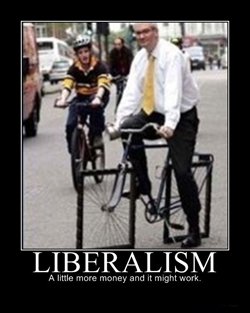
Liberalism really amounts to a fanatical enthusiasm for 19th century fantasies involving the achievement of a Utopian society with no form of unhappiness or inequality, brought into being by the calculative powers of human reason operating through the rule of the collectivist state by scientific experts.
If electing the democratic candidate the liberals rallied behind fails to bring about a completely successful socialist revolution, silencing conservative opposition forever and eliminating capitalism, the market economy, and the economy of scarcity; if the entire population is not promptly converted into accepting the editorial perspective of the New York Review of Books in its entirety; if their president cannot crush the kulaks; then he, too, is going to wind up, rather like Capitalism and American society, being compared to an impossible fantasy yardstick of imaginary perfection and condemned.
Chait is, in essence, perfectly correct, but if one removes doctrinaire Utopian fantasy from the politics of the American left, the philosopher is bound to wonder: what exactly would remain?
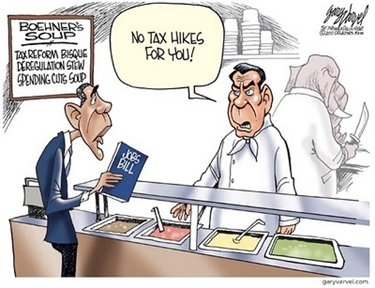
House Speaker John Boehner made it clear in a speech to small business owners at the University of Cincinnati Monday that he is not in sync with the president’s plan to raise the tax rates of the wealthiest Americans.
“Giving the federal government more money would be like giving a cocaine addict more cocaine,” the West Chester Republican told about 100 members of the Goering Center for Family and Private Business at UC’s Alumni Center.
Obama knew perfectly well that the Republican-controlled House would never go along with an any-prospects-of-recovery-killing plan to raise taxes on the only sector of society capable of new investment and new job creation.
What Obama was doing was affirming his commitment to left-wing orthodoxy by embracing class warfare as an attempt to appeal to voters’ worst impulses.
The president unleashes his inner Alinksy this morning with the release of his proposal for massive tax hikes, mostly on high income earners, accounting tricks and childish rhetoric. It is clear he has decided to run hard left in 2012, with all the tiresome cliches that involves.
The plan is a sham of course, an election year set-up just like the absurd demand in the Joint Session of Congress for Stimulus 2.0. This new, new plan isn’t dead upon arrival; it was dead before sending. And everyone knows it. Politico’s Mike Allen details the massive spin put on the highly partisan plan last night by the president’s tap-dancing and desperate team, but no one is fooled. Everything the president ever said about “working across the aisle” is trashed. The Chicago way is in the saddle. It’s the only way he and his advisors know.
The very good news is that the country knows, even if the MSM doesn’t.
From CBS News: “(CBS/AP) WASHINGTON — House Republican leaders say they are rejecting President Barack Obama’s jobs proposals to rebuild schools and blighted neighborhoods, and help keep state and local employees on the job.â€
Oh, come on, CBS, you can do better:
(CBS/AP) WASHINGTON — House Republican leaders say they are rejecting President Barack Obama’s jobs proposals to rebuild schools and blighted neighborhoods, and help keep state and local employees on the job, and cure cancer and help the lame walk again, and find good homes for puppy dogs and kitty cats, and take a sunrise and sprinkle it with dew and cover it with chocolate and a miracle or two, and teach the world to sing in perfect harmony, and grow apple trees and honey bees and snow white turtledoves, and slow the rise of the oceans, and begin to heal our planet.