The Washington Post reports the latest case of European PC insanity.
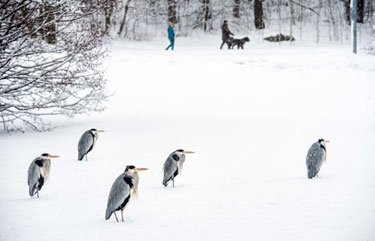
Bird watching has long been a popular and seemingly harmless weekend activity in Sweden. Its innocence, however, came to an abrupt end when many of the country’s bird lovers were suddenly confronted with allegations of racism.
For centuries, it has now been revealed, the Swedish had given birds some names that now could be considered offensive to certain groups. One species, for instance, was called “gypsy bird,” whereas another was named “negro.” The insult “caffer,” which was used by white against blacks in South Africa, also resembled a Swedish bird species called “kaffer.” There were other offensive bird names in Sweden, such as “Hottentot” — apparently inspired by the name of the language of an indigenous southwest Africandem Changi tribe called Khoikhoi, yet also a derogatory term for that tribe.
Despite the prominence of bird watching among Swedes, the existence of these names and others like them had sparked little outrage and publicity until recently. When Sweden’s Ornithological Society completed its first-ever global list of all 10,709 Swedish bird names two weeks ago, the organization also announced some awkward name changes.
In the process of categorizing the names, staffers had raised concerns over some that had a potentially offensive nature. As a result, several of them have now been changed: “negro” bird, for instance, will now be called “black” bird. “When working on the list, it became obvious that some older names no longer were appropriate,” Anders Wirdheim, Communications Officer at the Swedish Ornithological Society told The Washington Post.
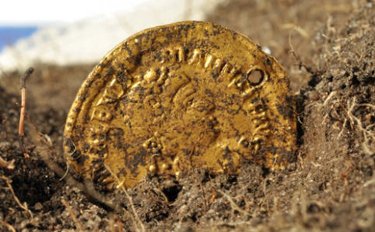
Most recently, a gold Roman solidus was discovered. The coin is thought to have been part of a looted hoard, dropped during the sack of the castle.
Although the sack of the fort and murder of its inhabitants occurred 1500 years ago, local memories cause residents of the fort’s vicinity still to shun the site. Archaeologist Helena Victor stated: “There are still memories 1,500 years later of these events, it’s a dangerous place. Parents tell their children that they can’t play there because it’s a dangerous place. They don’t remember the history but they remember it’s dangerous.”
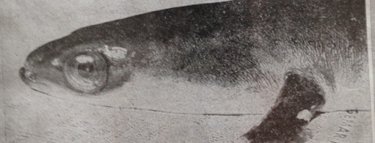
The world’s oldest European eel just died in its home, a well in a southern Swedish fishing town, aged 155. …
In 1859 an 8-year-old Swede by the name of Samuel Nilsson threw the eel into the well. While the act may be reminiscent of children throwing strange objects into toilets in modern times, it was in fact common practice to throw an eel in your well.
Many towns didn’t have public water systems until the 1960s, and eels ate the flies and other creepy crawlies, keeping the house’s water supply clean .
Since its drop into the dark in 1859, the eel has been featured in books and documentaries, and made multiple cameos on Swedish TV.
A gang of angry drunken elk barred a man from entering his home in suburban Stockholm on Tuesday, leaving the frightened homeowner no choice but to call police for help.
“Five drunken elk were threatening a resident who was barred from entering his own home,” read an incident report on the website of the Stockholm police department.
The author of the report confirmed that the homeowner, who lives on the island of Ingarö in Stockholm’s eastern suburbs, was justified in calling the police for help.
“I’m not surprised that he called the police when he was faced with a gang of five drunken elk,” police spokesman Albin Näverberg told The Local.
“They can be really dangerous. They become fearless. Instead of backing away when a person approaches, they move toward you. They may even take a run at you.”
The incident involved four adult elk and one calf, Näverberg explained, all of whom were intoxicated after having eaten fermented apples that had fallen from the homeowner’s apple tree.
“Police who arrived on the scene reported that the animals had been warned that the police were on their way and wisely decided to leave the address,” the report read.
“The elk will have to find somewhere else to get intoxicated.”
The homeowner was instructed by officers to clear his yard of fermented apples in order to avoid any future incidents with drunken elk gangs.
According to Näverberg, Tuesday’s run-in wasn’t the first time drunken and aggressive elk had caused trouble for the homeowner.
“A couple of years ago a single drunken elk chased his wife from the yard into the house. She had to bolt the door,” he said.
Drunken elk are a recurring nuisance for homeowners near Stockholm, explained Näverberg, who estimating that police can receive “dozens” of reports in the autumn when apples and fruit from other trees begins to fall.
“If there is a lot of fermenting fruit, then we get a lot of calls about drunken elk. But most often they’re gone before officers arrive,” he said.
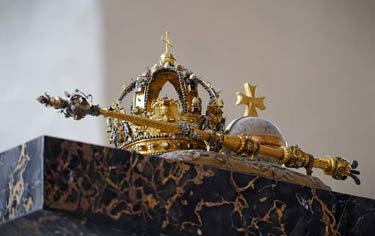
A scepter, a crown and an orb in the form of an apple were stolen from Erik XIV‘s tomb in VästerÃ¥s. The items are priceless funeral regalia from the 1500s. “I am outraged and shocked that it’s such a deliberate crime.” said cathedral chaplain Johan Sköld
A crypt in the church was shattered in Vasteras Cathedral on Friday morning leaving a gaping void in the high marble sarcophagus. Stolen was a unique set of regalia, which was linked to Erik XIV’s half brother John III’s funeral.
Funeral regalia, copies of the normal regalia worn by the Swedish kings, was used at royal funerals and placed in or on the casket.
“It’s a loss for everyone, this is our common heritage. We work hard to improve security, but the objects must also be accessible to all. It is a difficult balancing act.” said John Rothlind, chief curator at the Swedish Church in VästerÃ¥s.
Erik XIV was buried in Vasteras after his death in 1577 with little ceremony and without regalia.
Much later, his remains were moved to a more appropriate tomb. Gustav III at that time arranged that a scepter and a crown of Uppsala, which might have been used in ceremonies at John III‘s funeral, were moved to VästerÃ¥s around the year 1800.
A second set of funeral regalia, in gold, which is also linked to Johan III’s funeral, is still held in Uppsala.
The stolen set was made in the Netherlands in the 1500s, in gilt bronze with silver details. The apple, in gilded wood, was manufactured around 1800.
The three objects were in or on a ?träkudde?, also stolen, adorned with Vasa sheaves.
Additional sets of funeral regalia are in Straengnaes (Charles IX), Uppsala Cathedral (Gustav Vasa), the Royal Armoury in Stockholm (Karl X Gustav) and in Uppsala (John III’s second set).
The small number of readers familiar with Henryk Sienkiewicz’s novel of the 17th Century Swedish Invasion of Poland-Lithuania The Deluge will have some sense of its devastating impact on the country. No one living today, however, realised that Swedish looting included the theft of Polish architecture on a massive scale.
A recent major drought in Poland caused the waters of the River Vistula to recede to levels unprecedented in living memory, revealing tons of architectural masonry looted by the Swedes and loaded onto barges for transport down the river to Gdansk, and thence across the Baltic to Sweden. The invaders’ greed apparently exceeded their navigational judgment, and one or more of the barges sank in the river, possibly as the result of overloading.
Low rainfall over the past few months has brought the Vistula, Poland’s longest river, to its lowest level since regular records began 200 years ago. …
Historians believed that the Swedes who invaded Poland in the 17th century planned to move the looted cargo up the Vistula to Gdansk, where the river joins the Baltic Sea, and from there transport it home. There is still no firm explanation of why the boats sank on the way.
Kowalski said he and his team had so far located up to 10 tonnes of stonework, but this was only the beginning. “The boats had a capacity of 50-60 tonnes (each), so we think that we should find much more,” he said.
Once it has been removed from the river bed and catalogued, the plan is to take the masonry to Warsaw’s Royal Castle, one of the sites from which, historians believe, it was looted by the Swedish invaders.
For now though, the low water levels that revealed the artefacts are hampering efforts to retrieve them. Regular lifting equipment would sink into the mud, but the river is too low for the researchers to bring in floating cranes.
“We need to wait until it gets higher,” Kowalski said.
——————————-
Gość Warszawski [Warsaw’s Guest] has a slideshow
Der Spiegel describes how the Boho-Bolshie lifestyle and philosophy backfired on the late Swedish author Stieg Larsson and his surviving partner Eva Gabrielsson. It turns out that communists not only want the survivorship benefits resulting from the traditional marriage they formerly spurned, they also want the money.
Stieg Larsson, the Swedish author of the Millennium trilogy, only became world-famous after his death in 2004. His long-time companion Eva Gabrielsson is still fighting for her share of the inheritance, but says she no longer plans to finish his fourth book. …
Gabrielsson has to smoke a cigarette now. She lived with Larsson for 32 years. Together, they moved from rural northern Sweden to Stockholm. …
When Larsson felt pleased with a chapter, he would give it Gabrielsson to read. He became increasingly confident in the crime story, until he eventually said that he had 10 books in his head about Salander and the insanity she encounters. But then he died. One day when the elevator in his building was out of order, Larsson had to climb the 197 steps to his office. He had a heart attack when he reached the top. He had just turned 50.
Shortly before his death, Larsson had submitted the third volume in the trilogy to his publisher Norstedts, but not a single book had yet been printed. Today more than 63 million copies of the Millennium trilogy have been sold. …
Gabrielsson and Larsson weren’t just a couple, but also a leftist action group. First they were Maoists and then Trotskyists, voicing their criticism of the Swedish welfare state from a leftist point of view. She was an architect, while he worked for a news agency. They managed to make ends meet, and had no children. Like many Swedes of their generation, they were anti-bourgeois.
In their social circle, while couples may have been monogamous, they didn’t marry. But under Swedish law, a member of an unmarried couple doesn’t inherit anything from his or her deceased partner, no matter how long the couple was together. Blood trumps love, unless a will exists, but Larsson hadn’t written one. For that reason, the rapidly growing proceeds from the sale of the books and the film rights went to two biological relatives, Larsson’s father Erland (his mother Vivianne is dead) and his younger brother Joakim. “The money went to us, but we didn’t ask for it,” says Erland Larsson, 76. …
After Larsson’s death, when his novels suddenly became such a huge success, the widow who isn’t a widow under the law sat down with Erland and Joakim Larsson to discuss what should happen next. An agreement seemed possible. But then attorneys took over the case, and an inheritance war ensued — one in which the Stieg Larsson fan community has participated extensively.
Two camps have since formed in Sweden: the (primarily female) Eva camp, with its own website (www.supporteva.com), and the (primarily male) Larsson camp (www.moggliden.com).
The inheritance dispute is being waged publicly. It culminated when Gabrielsson and Joakim Larsson went on Swedish television to explain their respective positions on the dispute. The widow, invoking a higher form of justice, said that the money had made the two Larssons greedy. Joakim Larsson defended his right to the inheritance and, in his modesty, came across as likeable.