The Vipukirves Leveraxe: a radical new axe design.
This morning, I got an advertising email from AllOutdoor featuring an intriguing new gizmo:
Some crazy Finn has gone and reinvented one of mankind’s oldest tools: the axe. Check out that picture — it doesn’t even look like an axe, but it splits wood like nobody’s business.
The Vipukirves Leveraxe is designed to flip around to the side right after impact and break off pieces of the log. So unlike with a regular axe, you’re encouraged to strike near the sides of the log. It’s also way safer, especially when you include a tire to catch flying pieces of wood.
You can buy them off the Vipukirves website for 193 euros, which right now is over $260.00. Yeah, I kinda want one.
———————————-
———————————-
I notice that the wood getting chopped successfully in the video looks like birch (which figures, they’ve got a lot of birch in Finland). But, how, I wonder, would this axe work on oak? (In Pennsylvania, we burn oak.)
This unusual outage resulted from a disagreement between my personal version of WordPress and my web hosting server’s most recent security updates, intended to defeat the Heartbleed bug.
It’s always entertaining to read about the corporate decisions which lost former industry leading products their place in the sun. Quark used to have a 95% market share.
Anecdotal evidence is not the best way to objectively study anything, but ask anyone what caused them to leave XPress for InDesign. Overwhelmingly, it all boils down to those personal stories of neglect that eventually eroded Quark’s appeal and made a potentially painful transfer to another product the lesser of the evils.
In 2001, Apple released OS X, which felt dog slow on existing hardware. Despite its inclusion of crucial publishing tech like AppleScript and ColorSync, it was definitely not production-ready. But OS 9’s failings are well documented—a bad font in an ad could literally cost you a third of your day dealing with system crashes. OS X’s single promise of Unix-like stability turned its other short-term problems with snappiness into non-issues.
Quark repeatedly failed to make OS X-native versions of XPress—spanning versions 4.1, 5, and 6—but the company still asked for plenty of loot for the upgrades. With user frustration high with 2002’s Quark 5, CEO Fred Ebrahimi salted the wounds by taunting users to switch to Windows if they didn’t like it, saying, “The Macintosh platform is shrinking.” Ebrahimi suggested that anyone dissatisfied with Quark’s Mac commitment should “switch to something else.”
It’s advice people apparently took—just not the way he meant it. It was likely that Quark saw increasing growth in Windows sales as a sign that the Mac publishing market was dwindling. However, what they were probably seeing was new users, not migration to Windows. I’ve heard about Windows-based publishing environments, but I’ve never actually seen one in my 20+ years in design and publishing.
Perhaps this seems like an overstatement, but desktop publishing was invented on the Mac. It would have been hard to find people more rabidly pro-Mac than people who were basically keeping pre-Jobs Apple afloat. So when a revitalized Apple needed all the help it could get, telling Mac designers to switch to Windows was all the excuse these creatives needed to think that the grass was actually greener on the InDesign side. Simply put, this was a crucial nudge for many.
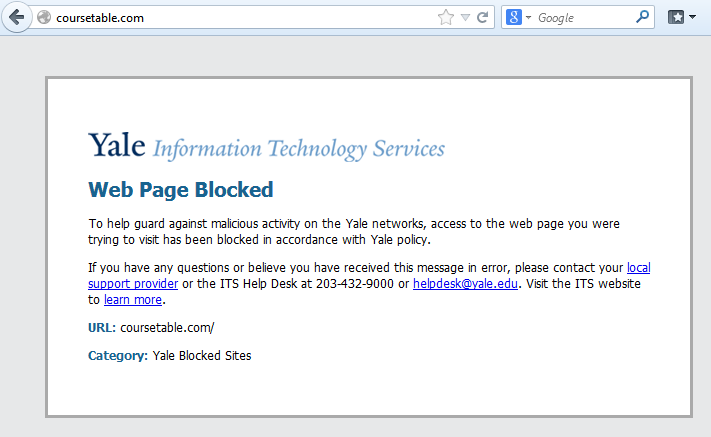
The odious Yale Administration recently responded to the technological progress which transferred the printed-on-paper Course Critique (which my colleagues and I on the Yale Daily News first produced in the Fall of 1967) to a more flexible searchable electronic version on the Internet to tyrannically exercise the university’s power as webhost to censor and shut it down.
One has to shake one’s head over the fact that Yale continues to manage to hire and put power into the hands of people who are both so inclined to misuse power and simultaneously so lame. Dean Dodo who made the decision to take that website down obviously had only the dimmest reptilian understanding of the possibilities of technology and the enterprise and skill of the Yale undergraduate.
In January 2012, two Yale students named Harry Yu and Peter Xu built a replacement to Yale’s official course selection website. They it called YBB+ (Yale Bluebook Plus), a “plus†version of the Yale-owned site, called Yale Bluebook. YBB+ offered different functionality from the official site, allowing students to sort courses by average rating and workload. The official Yale Bluebook, rather, showed a visual graph of the distribution of student ratings as well as a list of written student reviews. YBB+ offered a more lightweight user interface and facilitated easier comparison of course statistics. Students loved it. A significant portion of the student body started using it.
Fast-forward two years. Last Friday (1/10/14), Yale blocked YBB+’s IP address on the school network without warning. When contacted, Yale said that YBB+ infringed upon Yale’s trademark. Harry and Peter quickly removed the Yale name from the site, rebranded it as CourseTable and relaunched. Yale blocked the website again, declaring the website to be malicious activity.
Later that weekend, Yale’s administration told the student developers that the school didn’t approve of the use of its course evaluation data, saying that their website “let students see the averaged evaluations far too easilyâ€. Harry and Peter were told to remove the feature from the CourseTable website or else they would be referred to the school’s punishment committee. …
What if someone made a piece of software that displays Yale’s course evaluation data in a way that Yale disapproves of, while also (1) not infringing on Yale’s copyrights or trademarks, (2) not storing any sensitive data, (3) not scraping or collecting Yale’s data, and (4) not causing damages to Yale’s network or servers? If Yale censors this piece of software or punishes the software developer, it would clearly characterize Yale as an institution where having authority over students trumps freedom of speech.
Guess what? I made it last night.
I built a Chrome Extension called Banned Bluebook. It modifies the Chrome browser to add CourseTable’s functionality to Yale’s official course selection website, showing the course’s average rating and workload next to each search result. It also allows students to sort these courses by rating and workload. This is the original site, and this is the site with Banned Bluebook enabled (this demo uses randomly generated rating values).
Banned Bluebook never stores data on any servers. It never talks to any non-Yale servers. Moreover, since my software is smarter at caching data locally than the official Yale course website, I expect that students using this extension will consume less bandwidth over time than students without it. Don’t believe me? You can read the source code. No data ever leaves Yale’s control. Trademarks, copyright infringement, and data security are non-issues. It’s 100% kosher.
My intent behind Banned Bluebook is to demonstrate two points to Dean Miller and the Yale administration:
If Yale grants students access to data, the university does not have the right to specify exactly how students must view the data.
Censorship through IP blocking and Deep Packet Inspection is not only unethical, it’s also futile.
Don’t the Nazi tools they hire to run Yale even go to the cinema? If Dean Wurmser has seen Josh Wheedon’s “Serenity” (2005), he or she would have heard the line from Mr. Universe: You can’t stop the signal, Mal.
Clay Shirky describes how government IT cannot effectively translate planning into reality, avoids testing, and insists on shunning a phased roll-out approach but then finds itself experiencing exactly that.
It’s certainly true that Federal IT is chronically challenged by its own processes. But the problem with Healthcare.gov was not timeline or budget. The problem was that the site did not work, and the administration decided to launch it anyway.
This is not just a hiring problem, or a procurement problem. This is a management problem, and a cultural problem. The preferred method for implementing large technology projects in Washington is to write the plans up front, break them into increasingly detailed specifications, then build what the specifications call for. It’s often called the waterfall method, because on a timeline the project cascades from planning, at the top left of the chart, down to implementation, on the bottom right.
Like all organizational models, waterfall is mainly a theory of collaboration. By putting the most serious planning at the beginning, with subsequent work derived from the plan, the waterfall method amounts to a pledge by all parties not to learn anything while doing the actual work. Instead, waterfall insists that the participants will understand best how things should work before accumulating any real-world experience, and that planners will always know more than workers.
This is a perfect fit for a culture that communicates in the deontic language of legislation. It is also a dreadful way to make new technology. If there is no room for learning by doing, early mistakes will resist correction. If the people with real technical knowledge can’t deliver bad news up the chain, potential failures get embedded rather than uprooted as the work goes on. …
[Emphasis added:] The vision of “technology†as something you can buy according to a plan, then have delivered as if it were coming off a truck, flatters and relieves managers who have no idea and no interest in how this stuff works, but it’s also a breeding ground for disaster. The mismatch between technical competence and executive authority is at least as bad in government now as it was in media companies in the 1990s, but with much more at stake.
The Oldest College Daily recently advised the Yale community of a potential downside to the use of free University-provided email addresses.
Yale students’ email accounts are subject to search without consent or notification by the University, as outlined in a publicly available but little-publicized document.
Under the University’s Information Technology Acceptable Use Policy, the University maintains the right to access not only employee accounts, but students’ accounts as well. While 55 of 73 students interviewed were unsurprised that the University can monitor their correspondences, few were clear on the specifics under which Yale can search their accounts.
Only three students of 73 interviewed were aware of the specifics of Yale’s policy, with one adding that he learned about the University’s regulations through a class.
“I feel like the University should make clear under what circumstances they consider searching emails,†Sherry Du ’17 said. “The school should do more to publicize this.â€
Most students said they were not taken aback by the policy because the email account is provided by Yale.
Graduate students who came to Yale after working in the corporate world expressed especially little surprise over the policy. Ashlee Tran SOM ’14 said employees at large corporations assume their emails are monitored.
“It doesn’t shock me at all that they can do that,†Acer Xu ’17 said. “It’s Yale email, it’s an internal server.â€
According to its Acceptable Use Policy, several circumstances warrant access to students’ emails: “preserv[ing] the integrity of the IT systems,†complying with “federal, state, or local law or administrative rules,†carrying out “essential business functions of the University,†“preserv[ing] public health and safety†and producing evidence when “there are reasonable grounds to believe that a violation of law or a significant breach of University policy may have taken place.â€
Administrators did not define what actions constitute a significant breach of University policy, though ITS Director of Strategic Communications Susan West described these circumstances as “specific and unusual.â€
For the University to access a student account, two administrators must give their approval: University Provost Benjamin Polak as well as the dean of Yale College or the appropriate graduate or professional school, though deans are allowed to delegate this task.
However, in situations where “emergency access is necessary to preserve the integrity of facilities or to preserve public health and safety,†systems administrators may access an account without approval.
No explicit mention is made in the Undergraduate Regulations of the University’s right to access student accounts, though the Appropriate Use Policy is accessible through a link on page 128 of the 131-page document.
“Preserv[ing] the integrity of the IT systems,†complying with “federal, state, or local law or administrative rules,†carrying out “essential business functions of the University,†“preserv[ing] public health and safety†and producing evidence when “there are reasonable grounds to believe that a violation of law or a significant breach of University policy may have taken place.â€
“They were running the biggest start-up in the world, and they didn’t have anyone who had run a start-up, or even run a business,†said David Cutler, a Harvard professor and health adviser to Obama’s 2008 campaign.
[T]he age of chivalry is gone. That of sophisters, economists, and calculators has succeeded; and the glory of Europe is extinguished forever. —- Edmund Burke
Dan Greenfield observes that no one should be very surprised that the Obamacare web-site failed to work. In this case, it was simply a matter of the Nomenklatura’s characteristic magical thinking attempting to take the place of software engineering in very much the same way the idea of Obamacare itself tries to replace the market with a theoretical determination of what is best by similar great minds.
Our technocracy is detached from competence. It’s not the technocracy of engineers, but of “thinkers” who read Malcolm Gladwell and Thomas Friedman and watch TED talks and savor the flavor of competence, without ever imbibing its substance.
These are the people who love Freakonomics, who enjoy all sorts of mental puzzles, who like to see an idea turned on its head, but who couldn’t fix a toaster.
The ObamaCare website is the natural spawn of that technocracy who love the idea of using modernity to make things faster and easier, but have no idea what anything costs or how it works.
It’s hard to have a functioning technocracy without engineers. A technocracy made in Silicon Valley with its complete disregard for anything outside its own ego zone would be bad enough. But this is a Bloombergian technocracy of billionaires and activists, of people who think that “progress” makes things work, rather than things working leading to progress.
Healthcare.gov showed us that behind all the smoother and shinier designs was the same old clunky government where everything gets done because the right companies hire the right lobbyists and everything costs ten times what it should.
If the government can’t build a health care website, how is it going to actually run health care for an entire country is the obvious question that so many are asking. And the obvious answer is that it will run it the way it ran the website. It will throw wads of money and people at the problem and then look for programs it doesn’t like to squeeze for extra cash.
Cheryl Campbell, senior vice president of CGI Federal, left, testifies on Capitol Hill in Washington on Thursday. CGI will earn at least $290 million from its Obamacare contract to design the site.
Mark Steyn identifies the Canadian Company which got the no-bid contract to build the botched Obamacare web-site. Who knew? They were already famous for their achievements on behalf of the Canadian Government.
CGI is… a Canadian corporate behemoth. Indeed, CGI is so Canadian their name is French: Conseillers en Gestion et Informatique. Their most famous government project was for the Canadian Firearms Registry. The registry was estimated to cost in total $119 million, which would be offset by $117 million in fees. That’s a net cost of $2 million. Instead, by 2004 the CBC (Canada’s PBS) was reporting costs of some $2 billion — or a thousand times more expensive.
Yeah, yeah, I know, we’ve all had bathroom remodelers like that. But in this case the database had to register some 7 million long guns belonging to some two-and-a-half to three million Canadians. That works out to almost $300 per gun — or somewhat higher than the original estimate for processing a firearm registration of $4.60. Of those $300 gun registrations, Canada’s auditor general reported to parliament that much of the information was either duplicated or wrong in respect to basic information such as names and addresses.