Category Archive 'Virginia'
09 Mar 2012
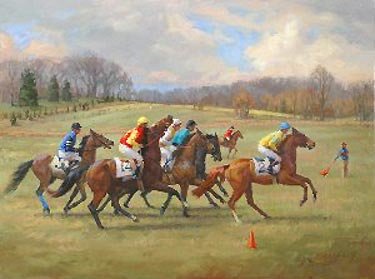
Linda Volrath painting
My apologies. There will not be much blogging for the next two days. I’ll be working as a judge at the Blue Ridge Point-to-Point Races on Saturday and at the Blue Ridge Hunt Hunter Pace on Sunday.
20 Feb 2012


The Northern Neck (click on image for larger version)
David Hackett Fischer (who first traced the pre-Revolutionary influence of four different regions and cultures of Great Britain upon the United States in Albion’s Seed , 1989), in Bound Away: Virginia and the Westward Movement , 1989), in Bound Away: Virginia and the Westward Movement , written with James C. Kelly and published in 2000, identifies another major and distinctive pre-Revolutionary regional American cultural strain: a tradition of elite patriotism most prominently exemplified in George Washington. , written with James C. Kelly and published in 2000, identifies another major and distinctive pre-Revolutionary regional American cultural strain: a tradition of elite patriotism most prominently exemplified in George Washington.
The Northern Neck rapidly developed into a distinctive region of Virginia with a character that was largely defined by Lord Fairfax himself and his friends and agents, who included the Washington, Lee, and Marshall families.
Fairfax liked the country so well that he returned as an immigrant in 1747 and made his permanent home in Virginia. He built himself a long, rambling hunting lodge called Greenway Court and a small stone land office high in the Shenandoah country at the western end of his domain. At the same time he became justice of the peace of all the counties in the Northern Neck, county lieutenant, and commandant of the militia. Lord Fairfax acquiesced in the American Revolution and was treated always with honor both by the people of the Northern Neck and the Virginia General Assembly. He died at Greenway Court in 1781 at the age of eighty-eight.
In the course of his long life, a circle formed around him. Lord Fairfax’s drawing room became a school of manners for young gentlemen of the Northern Neck —among them, many Washingtons, Lees, Marshalls, and others who shared a distinctive set of values and beliefs.
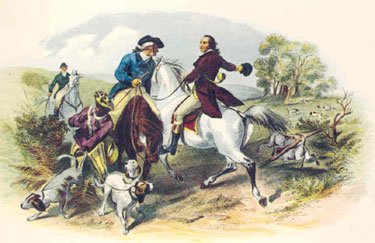
Lord Fairfax Fox Hunting with George Washington, engraving by Henry Bryan Hall, after Felix O. C. Darley, from Washington Irving, Life of George Washington, 1855-1859
The Northern Neck was very much a part of the culture of Virginia, but it gave that culture a special meaning. On this frontier there was little of democracy and nothing of equality, but a strong tradition of service, character, right conduct, and the rule of law.
We have been trained by the materialism of American social science to think of regional culture as a reflex of economic interests and environmental conditions. So it is sometimes, but the culture of the Northern Neck was shaped when it was a frontier, in large degree by the interplay of culture, environment, and the purposes of a single individual. A cultural tradition was planted by Lord Fairfax at Greenway Court. It took root in the fertile soil of the Northern Neck and flowered in the careers of George Washington in the Revolution, Robert E. Lee in the Civil War, and George C. Marshall in World War II.
The values of this tradition were in many ways different from the liberal ideas on which the American republic was founded. Yet this tradition supplied that nation with many leaders who served it in a distinctive way. The Northern Neck was the cradle of their culture, and Lord Fairfax was its founding father.
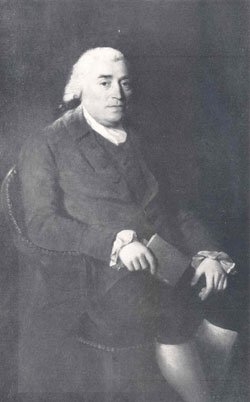
Joshua Reynolds, Thomas Fairfax, Sixth Lord Fairfax of Cameron, Washington Lodge No 22, A. F. & A. M., Alexandria, Virginia.
08 Jan 2012

The National Sporting Library in Middleburg, VA commenced its most recent exhibition, Afield in America: 400 Years of Animal and Sporting Art, 1585 – 1985 last October, just as hunting season was getting into full swing. Karen and I were, naturally, hunting both days every weekend (sometimes during the week as well), so we just never got around to visting the Sporting Library to take in the exhibition.
The closing date is next weekend, and we really didn’t want to miss it. Karen was recovering from the flu. I was feeling unusually arthritic, and the SUV we use for car following was in the shop. What with one thing and another, it seemed clear that the red gods felt we ought to take yesterday off from hunting and go see the sporting art exhibition up in Middleburg.
We set off around 11, and we were only a little over a mile north of our place on the old road to the rocky ford over the Rappahannock, at the crossroad leading to Lord Fairfax’s (later John Marshall’s) home at Leeds Manor, when right across the road (from right to left) dashed a large and handsome red and white foxhound, undoubtedly belonging to the Old Dominion pack.
He was lost, away from the pack, and we considered trying to catch him and give him a lift back to his pack, but he dashed off too quickly out of our path to the west.
We crossed the intersection and proceeded north, and we had only traveled the equivalent of a couple of blocks along the forest-lined road, when there we saw ahead of us, running north on the road, Charlie himself. The fox was, in fact, proceeding ninety degrees away from the direction that dumb hound had been running.
I followed the fox from a distance with our BMW. As he ran on, I noticed that the road was marked abundantly with hoof prints and horse droppings. Old Dominion’s pack, huntsman, and field had clearly extremely recently passed right this way, and Charles was following them.
After about a quarter mile, the fox decided to take to the woods to the east, where he disappeared. Proceeding on another half mile or so, we found Old Dominion’s trucks and horse trailers parked in a field by a barn at Ardmore.
It was clear that the chase had gone right back up the road to the site of the meet, but wherever the field was, it wasn’t very near the fox, who seemed to be doing his best to look for them, following up their tracks from behind.
We drove on toward the sporting art exhibition laughing.
20 Dec 2011
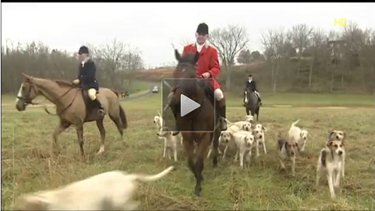
As to how it happens that our own Blue Ridge Hunt was recently filmed hunting at Persimmon Hill by a Korean NBC station for its news coverage. Principals featured included: retired Huntsman Chris Howells (releasing the hounds from the hounds truck), MFH Linda Armbrust and Huntsman Dennis Downing (both briefly commenting), and Charlie (dashing gallantly through the countryside).
1:49 video
14 Dec 2011
We had visitors.
We weren’t hunting ourselves, but the Old Dominion Hunt was meeting nearby and they put one to ground at our place, very near the house. I managed to trap my own dogs in the house, grabbed a camera, and went out and took a few snapshots.
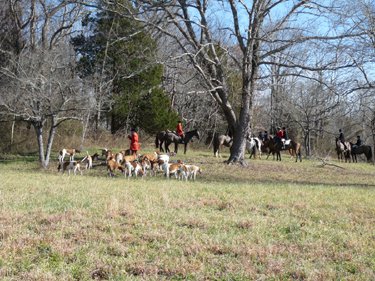
Old Dominion huntsman Gerald Keal sounds his horn to reassemble the pack after Charles James has gone to ground in our woods yesterday. click on picture for larger image. Picture will enlarge again with one more click.
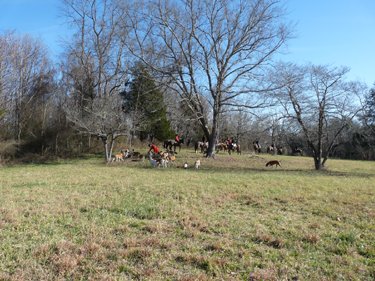
Congratulating the Old Dominion Hounds on a job well done.
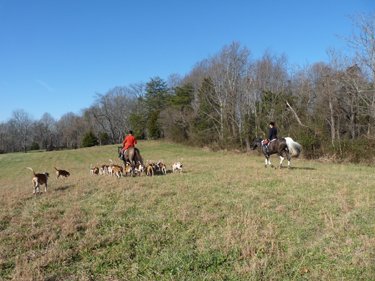
Huntsman, pack, and whip begin moving off west.
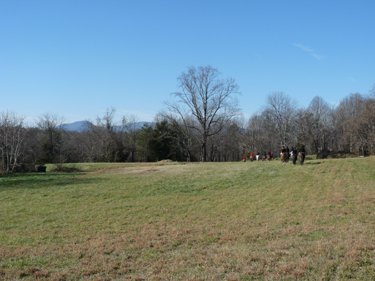
The field follows Gerald and the hounds off into the woods. To the west, you see Fogg Mountain and the Blue Ridge.
05 Nov 2011

Huntsman Dennis Downing and Blue Ridge hounds celebrate putting Reynard to ground at the triumphant conclusion of the 2011 Opening Meet.
The Blue Ridge Hunt’s Opening Meet was actually scheduled for last Saturday, and had to be canceled due to the snowstorm that hammered the East Coast from Maine to Virginia on the weekend preceding Halloween.
So, a week late, hounds met at Mount Hebron (formerly a rental property belonging to George Washington), instead of the traditional Long Branch.
The weather was perfect this time, and despite the adverse circumstance of a full moon last night (inviting foxes to stay up late and party, and miss being hunted due to sleeping in), the Blue Ridge Hounds actually triumphantly put one to ground just off of Locke’s Mill Road in Berryville.
What with one thing and another, we were out from 8 in the morning and only came dragging home at 4:30 in the afternoon (after attending the the post-Opening Meet festivities at Mount Hebron). Not a lot of blogging got done today, but we certainly put the fear of the Blue Ridge hounds into one well deserving fox.
31 Oct 2011
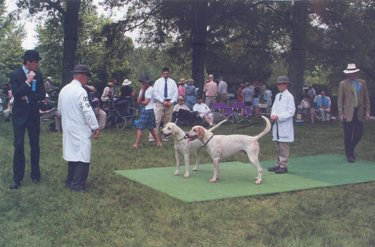
(click on image twice for larger versions)
I make serious efforts to bar my wife from publishing photographs of me at sporting events and in the hunting field, but for some unaccountable reason I do feel a sense of gratification when I find myself accidentally present in a photograph of that kind of event published elsewhere completely independently.
I was, therefore, tickled to find, in the latest Virginia Sportsman, a feature article on last Spring’s Virginia Hound Show, which shows me sitting and leaning on my cane while watching professional huntsman Dennis Downing putting a couple of our own Blue Ridge foxhounds through their paces in the English ring. (My face is hidden behind the elbow of a photographer snapping a picture.)
30 Aug 2011

Hat tip to Vanderleun.
24 Aug 2011

Yesterday afternoon, when the earthquake hit, I was two steps up a rickety flight of stairs in an old warehouse in Remington, Virginia where we’re storing some of the many books we cannot fit into the charming, antique Virginia farmhouse we are currently inhabiting.
I thought someone must be opening an exceptionally violent garage door on the other side of the wall, then began guessing someone was running some piece of heavy machinery nearby in the building. The vibration stopped, and I proceeded upstairs.
I only learned that it was an earthquake when I got back to the car and turned on the radio.
WMAL, 63 AM, the station I listen to El Rushbo on, switched over to full-time broadcasting about this major news event. Sean Hannity never even came on. Instead, Conservative talk radio host Chris Plante was dragged out a pizzeria, where he had been lunching, back to the studio to cover what was essentially a non-event.
Chris and his associates interviewed all sorts of ordinary people, who testified to all of their personal earthquake experiences (typically just as interesting as mine).
My blood ran cold when Chris Plante, the conservative, proceeded in Pavlovian journalistic manner to interview a state legislator from Prince George County about “government’s response.” I would have said, in his position: “Response? What response? There was no actual damage. No injuries. There wasn’t anything anyone needed to do.” But, no. The politico happily bloviated on and on about how each and every level of government bureaucracy, all the “first responders” in particular, turned on every flashing light and siren, and spun their wheels vigorously. Our rulers, guardians, supervisors, and protectors had to justify their existence by seeming to take control, and keeping the rest of us alerted and informed, even if there was nothing in particular to alert us about, beyond potential heavy traffic resulting from government offices releasing their personnel to commute home early.
Even a conservative commentator, like Chris Plante, can be found to behave as a true product of the culture of journalism and officialdom, when push comes shove (even in the case of a minor 5.9 push), the journalist Plante goes running to Big Brother to participate in, and to cover with canine respect, the charade of official expertise gravely protecting us, the helpless public, from all perils and vissiscitudes, even in an instance where there is nothing but the empty semblance of a real event.
Bah, humbug!
Being engaged in something, kind of, sort of, resembling journalism myself, as you can see, I, too, felt obliged to cover the terrible earthquake of 2011, and here from BuzzFeed are 20 photographs of some of the worst damage.
21 Jul 2011

Brigadier General Thomas Jackson was still wearing his blue uniform.
The cannonade of Fort Sumter occurred way back on April 12th. There have occurred a few minor battles in remote locations, but so far the War for Southern Independence or the War to Preserve the Union, depending upon how you look at it, has not amounted to very much. But 150 years ago today the first great battle of the war took place.
I expect they had nicer weather for it that day.
As far back as May, the military high commands of both the Union and the Confederacy had envisioned a climactic battle occurring with a Union advance from Washington to come to grips with Confederate forces along the banks of Bull Run near the railroad junction of Manassas and the Warrenton Pike.
The commanders, for the Union, Brig. Gen. Irvin McDowell, for the Confederacy, Gen. Pierre Gustave Toussaint Beauregard, were both classmates of the West Point Class of 1838. Perhaps therefore it was not surprising that both commanders proposed essentially the same strategy.
Both generals intended to flank the opposing army on the left, roll up its lines, and thereby defeat it. Both generals failed to reckon with the difficulty of achieving complex military evolutions with inexperienced troops and staffs. Had both initiated their attacks at exactly the same time, spectators might have seen the two armies engage and begin to revolve, one around the other, like dancers.
As it happened, McDowell initiated his advance a little earlier, but the Confederacy was to be more favored by fate.
At 9 AM, the tardy Beauregard received a dispatch from a signal officer, reporting that he saw “a body of [Union] troops crossing Bull Run two miles above the Stone Bridge.” He observed both infantry and artillery.
Beauregard was caught unprepared, but as Douglas Southall Freeman observes, in “Lee’s Lieutenants:”
[T]he threat of a Federal turning movement far above the Stone Bridge had been met by the convergence of four small columns [those of Evans, Bee, Hampton, and Jackson]. Each had moved swiftly and to precisely the right point, but none had acted on specific orders or with the full knowledge of the Generals at field headquarters.”
When Beauregard hurried to the front, and arrived atop “an eminence from which was visible a wide range of smoke-covered landscape,’
In front was a long, curving Federal front, ablaze at intervals with musketry fire and artillery. To the right and North… on an adjoining ridge, a short, thin line of Confederate infantry was in action. … To the left… admirably placed behind the crest of the hill, was a waiting Confederate Brigade. Some of its men were lying down; others were in ranks. Near the center of this perfectly aligned Brigade, six field guns were barking viciously at the enemy. In the rear of these troops and streaming backward over the shoulder of the ridge to the North, were broken units that had evidently been in the fight.”
As his men, routed and in panic, fled toward safety and the rear, the desperate Brig. Gen. Barnard Bee attempting to stop their flight, placed himself in their path, and pointed with his sword toward that “perfectly aligned” Brigade. “There,” he cried, “stands Jackson, like a stone wall. Rally behind the Virginians.”
Faced with the approaching victorious Union infantry, Jackson commanded his Brigade to reserve its fire until they approached within 50 yards, then to fire and charge with the bayonet. “And when you charge,” Jackson instructed, “yell like Furies.”
The approaching Northern infantry ranks were shattered by well-aimed fire, and then the strange cry of Southern foxhunters broke from 1700 throats.
Jackson later reported with satisfaction that his Brigade “met the thus far victorious enemy and turned the fortunes of the day.” The Union Army broke into a disorganized mob, abandoning weapons and supplies, and fleeing back to Washington.
Despite the high temperatures, there are being conducted commemorative ceremonies and reenactments today. Washington Post

15 Jun 2011

John W. Whitehead discusses the militarization and American police work and the proliferation of SWAT teams (under enthusiastic federal encouragement), their nationwide systematic overuse, and the dangers and abuses resulting for Americans.
Nationwide, SWAT teams have been employed to address an astonishingly trivial array of criminal activity or mere community nuisances: angry dogs, domestic disputes, improper paperwork filed by an orchid farmer, and misdemeanor marijuana possession, to give a brief sampling. In some instances, SWAT teams are even employed, in full armament, to perform routine patrols.
How did we allow ourselves to travel so far down the road to a police state? While we are now grappling with a power-hungry police state at the federal level, the militarization of domestic American law enforcement is largely the result of the militarization of local police forces, which are increasingly militaristic in their uniforms, weaponry, language, training, and tactics and have come to rely on SWAT teams in matters that once could have been satisfactorily performed by traditional civilian officers. Even so, this transformation of law enforcement at the local level could not have been possible without substantial assistance from on high.
Frequently justified as vital tools necessary to combat terrorism and deal with rare but extremely dangerous criminal situations, such as those involving hostages, SWAT teams–which first appeared on the scene in California in the 1960s–have now become intrinsic parts of local law enforcement operations, thanks in large part to substantial federal assistance. For example, in 1994, the U.S. Department of Justice and the Department of Defense agreed to a memorandum of understanding that enabled the transfer of federal military technology to local police forces. Following the passage of the Defense Authorization Security Act of 1997, which was intended to accelerate the transfer of military equipment to domestic law enforcement departments, local police acquired military weaponry–gratuitously or at sharp discounts–at astonishing rates. Between 1997 and 1999, the agency created by the Defense Authorization Security Act conveyed 3.4 million orders of military equipment to over 11,000 local police agencies in all 50 states. Not only did this vast abundance of military weaponry contribute to a more militarized police force, but it also helped spur the creation of SWAT teams in jurisdictions across the country.
In one of the few quantitative studies on the subject, criminologist Peter Kraska found in 1997 that close to 90 percent of cities with populations exceeding 50,000 and at least 100 sworn officers had at least one paramilitary unit. In a separate study, Kraska determined that, as of 1996, 65 percent of towns with populations between 25,000 and 50,000 had a paramilitary unit, with an additional 8 percent intending to establish one.
While the frequency of SWAT operations has increased dramatically in recent years, jumping from 1,000 to 40,000 raids per year by 2001, it appears to have less to do with increases in violent crime and more to do with law enforcement bureaucracy and a police state mentality. Indeed, according to Kraska’s estimates, 75-80 percent of SWAT callouts are now for mere warrant service. In some jurisdictions, SWAT teams are responsible for servicing 100 percent of all drug warrants issued. A Maryland study, conducted in the wake of a botched raid in 2008 that resulted in the mistaken detainment of Berwyn Heights mayor Cheye Calvo and the shooting deaths of his two dogs, corroborates Kraska’s findings. According to the study, SWAT teams are deployed 4.5 times per day in Maryland with 94 percent of those deployments being for something as minor as serving search or arrest warrants. In the county in which the Calvo raid occurred, more than 50 percent of SWAT operations carried out were for misdemeanors or non-serious felonies.
This overuse of paramilitary forces and increased reliance on military weaponry has inevitably resulted in a pervasive culture of militarism in domestic law enforcement. Police mimicry of the military is enhanced by the war-heavy imagery and metaphors associated with law enforcement activity: the war on drugs, the war on crime, etc. Moreover, it is estimated that 46 percent of paramilitary units were trained by “active-duty military experts in special operations.†In turn, the military mindset adopted by many SWAT members encourages a tendency to employ lethal force. After all, soldiers are authorized to terminate enemy combatants. As Lawrence Korb, a former official in the Reagan Administration, put it, soldiers are “trained to vaporize, not Mirandize.â€
Ironically, despite the fact that SWAT team members are subject to greater legal restraints than their counterparts in the military, they are often less well-trained in the use of force than are the special ops soldiers on which they model themselves. Indeed, SWAT teams frequently fail to conform to the basic precautions required in military raids. For instance, after reading about a drug raid in Missouri, an army officer currently serving in Afghanistan commented:
My first thought on reading this story is this: Most American police SWAT teams probably have fewer restrictions on conducting forced entry raids than do US forces in Afghanistan. For our troops over here to conduct any kind of forced entry, day or night, they have to meet one of two conditions: have a bad guy (or guys) inside actively shooting at them; or obtain permission from a 2-star general, who must be convinced by available intelligence (evidence) that the person or persons they’re after is present at the location, and that it’s too dangerous to try less coercive methods.
Remember, SWAT teams originated as specialized units dedicated to defusing extremely sensitive, dangerous situations. As the role of paramilitary forces has expanded, however, to include involvement in nondescript police work targeting nonviolent suspects, the mere presence of SWAT units has actually injected a level of danger and violence into police-citizen interactions that was not present as long as these interactions were handled by traditional civilian officers.
Hat tip to James Coulter Harberson III.
————————————–

Just last Fall, our generous Department of Homeland Security provided a grant to equip the sheriff’s department at nearby, largely rural (2009 population: 36,472) Warren County in the Shenandoah Valley of Virginia with its own $278,000 8-ton armored personnel carrier, able to protect deputies against .50 caliber machine gun fire, and armed with technology designed to detect chemical, biological, radioactive and explosive material.
When’s the last time you suppose Warren County sheriff’s deputies encountered IEDs, .50 caliber machine gun fire, or poison gas?
The acquisition of the armored vehicle was justified by Lt. Kahle Magalis, head of the Warren County Special Operations team, on the basis of an exchange of gunfire in 2005 by deputies with a bipolar gentleman who went off his meds and began firing a shotgun into some neighboring trailers. The future resident of the funny farm was wounded in the foot and one deputy slightly grazed on the left side of the face by ricocheting birdshot.
According to Magalis, “It hasn’t been that long. It seems like we’re responding to barricaded armed subjects on a more regular basis now than we ever have.” No encounters with barricaded armed subjects in Warren County since that 2005 incident seem to have resulted in shootouts though.
28 May 2011
Blogging will be late to non-existent on Sunday. We’ll be attending the Virginia Foxhound Show at Morven Park all day.
last year’s show
/div>

Feeds
|





