Category Archive 'Yale'
05 Feb 2010


Main courtyard Branford College, Yale University
The Yale University Undergraduate Admissions Office boasts of having set out to “reinvent the dull genre of admission videos… with something… a little different.”
That something turns out to be this generally lame and appalling, faux hip 16:49 musical video, produced in collaboration with undergraduates and recent alumni.
It is intended to appeal to today’s high school students as a take-off on the popular high school musical television series Glee, and was praised by one alumnus on the LinkedIn discussion as “clever, fun and effectively ma[king] the point, without being boringly traditional, pretentious or elitest. (sic)”
Of course, I am myself boringly traditional, pretentious and elitist, so my soul positively writhed in horror at the spectacle of a Yale education being marketed in bad rhymes on the basis of a strange combination of consumerism (a salad bar and grill, college laundramats and gyms), the collegiate architecture of James Gamble Rogers, conformist political correctness (4 “cultural houses,” a sustainable farm), and the mere quantity of organizations and activities.
Somehow or other, Yale’s distinctive identity, described by F. Scott Fitzgerald thusly:
I think of all Harvard men as sissies… and all Yale men as wearing big blue sweaters and smoking pipes.â€
I think of Princeton as being lazy and good-looking and aristocratic — you know, like a spring day. Harvard seems sort of indoors…
And Yale is November, crisp and energetic.”
was wholly overlooked.
Today’s young people are implicitly being expected to decide on their choice of college in much the way they would choose between holiday resorts or apartment complexes, purely on the basis of appearance and amenities. Yale today has no distinctive character or identity at all, it seems. The video has nearly 17 minutes of musical performances (of a sort), and no one ever sings “Bright College Years.”
It was not completely without its moments, however. Near the beginning a motley crowd, obviously made up of Yalies, is sitting there pretending to be parents and prospective students. A fashionably racially diverse admissions officer (played by Kobi Libii) is unctuously answering questions.
He answers an inquiry as to whether all Yale professors teach undergraduates in the affirmative, boasting that all tenured Yale professors teach undergraduates, so that even a freshman might be taking a class from a Nobel Prize winner. At that point, a wife goes “Oooo!” and elbows her husband, an Asperger type sporting a pocket protector, who blinks confusedly a few times in response and who (one strongly suspects) is, in fact, himself one of those very same faculty members just referred to.
22 Jan 2010
And you a law professor!
Anne Althouse is at her best when she is cutting.
—————————————–
Texian, commenting at Breitbart, remarks: The scary part is that four justices think that this does NOT violate the First Amendment. Hat tip to the Barrister.
—————————————–

Bird Dog, at Maggie’s Farm, recommends going to Yale so you can use the Yale Club of New York City, conveniently located on Vanderbilt Avenue right across the street from Grand Central.
It’s easier than that. They even let people who went to Dartmouth and University of Virginia have memberships, and a fair number of clubs in other cities have reciprocal privileges.
It is the cheapest hotel you’d want to stay at in NYC. The second floor lounge is a peaceful refuge where you can read the paper, sip your drink, and watch traffic bustle busily around the PanAm Building out the window. The bar serves generous drinks. Harvard’s New York Club has a larger bar with good big game trophies, but it’s much farther away from the trains and it has a lot fewer rooms to stay in.
—————————————–
In the latest, Jan/Feb 2010, issue of the Yale Alumni Mag, the same chap was eulogized by two classes.
1968:
Don Masters started with us in Woolsey Hall in September 1964, served with distinction as an officer in the 82nd Airborne in Vietnam, and completed his Yale degree in 1972. He practiced law in New York City and in Denver through his career, as well as serving in entrepreneurial and general counsel roles. He was particularly active in the recovery community in the Rocky Mountain region. He loved touring on his motorcycle, and died August 31 at a beautiful location near Salmon, Idaho, doing what he loved.
1972:
On a sad note, I received notification that Don Masters was killed some time ago in a motorcycle accident in a remote part of Idaho. His body was only recently found, and he was buried in Arlington National Cemetery, having served with distinction in Vietnam.
Sounds like someone I would have liked to have known.
08 Jan 2010

Christies will be selling at its New York sale 2287, titled Important American Furniture, Folk Art, Silver & Chinese Export, on January 22nd, lot 157, a Skull and Bones balloting box, along with a membership book dated 1872, the graduation year of the former owner, Edward T. Owen (1850 – 1931).
Owen, after Yale, studied at Gottingen and the University of Paris, and became in 1878 professor of French language and literature at the University of Wisconsin. He taught for one year (1886) at the University of California at Berkeley. Professor Owen was also a successful real estate investor and played a prominent role in creating the park system of Wisconsin’s capital, personally donating significant portions of the city’s parks and drives.
Professor Owen apparently, as a hobby, amassed a very important collection of “lithodoctra,” which he he left to the University of Wisconsin. I am particularly impressed myself, finding the word completely unknown to both Google and the Oxford English Dictionary. Litho is obviously “stone” and doctra “teaching, instruction.” But what on earth are lithodoctra?
Professor Owen’s Bones material includes 50 photographs of members of the Yale Senior Society, including future President William Howard Taft; Morrison Remick White, who later became Chief Justice, and William Maxwell Evarts, who went on to become US Secretary of State.
Yale Daily News
London Times
HuffPo recently linked a 4:49 video allegedly showing a courtyard behind the Society’s High Street tomb and investigating a crawlspace beneath the building.
30 Dec 2009
“I want to go to Princeton,†said Amory. “I don’t know why, but I think of all Harvard men as sissies, like I used to be, and all Yale men as wearing big blue sweaters and smoking pipes.â€
Monsignor chuckled.
“I’m one, you know.â€
“Oh, you’re different — I think of Princeton as being lazy and good-looking and aristocratic — you know, like a spring day. Harvard seems sort of indoors — â€
“And Yale is November, crisp and energetic,†finished Monsignor.
“That’s it.â€
–F. Scott Fitzgerald, Princeton ’17, This Side of Paradise.
Andrew Sullivan will be so proud.
The Yale Freshman Class Council (I don’t think we had one of those in my day) decided to produce a T shirt for the Harvard Game featuring some expression or other of the Yale point of view on the classic athletic rivalry.
There was an opportunity for design suggestions, followed by a vote.
Yale Daily News:
The original design, which won out over five other entries, displayed an F. Scott Fitzgerald quote in the front — “I think of all Harvard men as sissies†— in bold white letters. The back of the long-sleeved, navy blue T-shirt said “WE AGREE†in capital letters, with “The Game 2009†scrawled in script underneath it.
Well, Yale has its own sissies these days, and they are organized and influential.
[T]he term ‘sissies’ is considered offensive and demeaning, and as well as a “thinly-veiled gay slur,†said Julio Perez-Torres ’12, a member of the LGBT Co-op.
After the winning design was announced, FCC President Brandon Levin ’13 said, several students raised concerns about the design to their respective FCC representatives, which they in turn brought to the attention of the FCC Executive Board and Dean of Freshman Affairs Raymond Ou.
The LGBT Co-op first heard about the T-shirts from a member of the Yale College Council, LGBT Co-op Coordinator Rachel Schiff ’10 said. She followed suit by contacting the dean and master of her college — Silliman — to encourage dialogue among the Co-op, administrators and FCC.
Ou said Wednesday that he first heard about the winning T-shirt design when FCC brought the complaints to him. In response, he told the FCC chairs to meet with the concerned students face to face. Shortly after he told FCC to respond to the co-op’s concerns, Ou said, he told Yale College Dean Mary Miller about the issue, and she decided to pull the design.
“What purports to be humor by targeting a group through slurs is not acceptable,†Miller said in an e-mail to the News. …
[The Freshman Class Council] decided to withdraw that design and opt for a different one, featuring a white ‘H’ in the front inside a transluscent white circle, with a white line slashed through it. …
YCC President Jon Wu ’11, who said he has been advising the FCC on the issue, said the problem was that the line of people that approved the shirts did not realize the word “sissies†was offensive.
“None of us realized the connotation,†Wu said in an e-mail to the News. “No member of the Yale community should feel marginalized.â€
The liberal tradition of pluralism and tolerance has evolved into a readiness to swoon and surrender in the face of any complaint or demand for concession by any group traditionally held in contempt.
Why even hold a Harvard game? If Yale cannot take the position that being a sissy is something of a negative, that being weak and cowardly and effeminate is undesirable, on what possible basis can the University justify being so rude and insensitive as to try to injure the feelings of the Harvard community by defeating its team in a violent athletic competition?
Yale’s administration, Freshman Class Council, and certainly its LGBT Co-op ought to draft an immediate letter conceding all future football games and other athletic contests to rival schools, apologize for each and every past expression of animosity and contempt, and humbly beg pardon for all the times in which Yale was crude enough to win.
It is becoming actively embarrassing to be associated with that University.
Hat tip to Robert Shibley at PJM.
18 Oct 2009

Peter Berkowitz discusses prominent cases in recent years of the response to controversy at Duke, Yale, and Harvard, in each of which instances faculty and administrators failed to defend freedom of thought and expression or members of their own community against the excesses of political correctness.
Professors have a professional interest in—indeed a professional duty to uphold—liberty of thought and discussion. But in recent years, precisely where they should be most engaged and outspoken they have been apathetic and inarticulate.
Consider Yale. On Oct. 1, the university hosted Danish cartoonist Kurt Westergaard. His drawing of Muhammad with a bomb in his turban became the best known of 12 cartoons published by the Danish newspaper Jyllands-Posten in September 2005. That led to deadly protests throughout the Muslim world. On the same day, at an unrelated event, Yale hosted Brandeis Prof. Jytte Klausen. Her new book, “The Cartoons that Shook the World,” was subject in August to a last minute prepublication decision by Yale President Richard Levin and Yale University Press to remove not only the 12 cartoons but also all representations of Muhammad, including respected works of art. …
To be sure, Yale’s censorship—the right word because Yale suppressed content on moral and political grounds—raised difficult questions. Can’t rights, including freedom of speech and press, be limited to accommodate other rights and goods? What if reprinting the cartoons and other depictions gave thugs and extremists a new opportunity to inflame passions and unleash violence? Can’t the consequences of the cartoons’ original publication be understood without reproducing them? Weren’t the cartoons really akin, as Yale Senior Lecturer Charles Hill pointed out in a letter to the Yale Alumni magazine, to the depictions of Jews as grotesque monsters that successive American administrations have sought to persuade Arab newspapers to cease publishing? And isn’t it true, as Mr. Hill also observed, that Yale’s obligation to defend free speech does not oblige it to subsidize gratuitously offensive or intellectually worthless speech?
These are good questions—to which there are good answers.
Rights are subject to limits, but a right as fundamental to the university and the nation as freedom of speech and press should only be limited in cases of imminent danger and not in deference to speculation about possible violence at an indeterminate future date. One can’t properly evaluate Ms. Klausen’s contention that the cartoons were cynically manipulated without assessing with one’s own eyes whether the images passed beyond mockery and ridicule to the direct incitement of violence.
Even if the cartoons exhibited a kinship to anti-Semitic caricatures, it would cut in favor of publication: a scholar would be derelict in his duties if he published a work on anti-Semitic images without including examples. And finally, if Yale chooses to publish a rigorous analysis of the Danish cartoon controversy, which affected the national interest and roiled world affairs, then the university does incur a scholarly obligation to include all the relevant information and evidence including the cartoons at the center, regardless of whether they are in themselves gratuitously offensive and intellectually worthless.
The wonder is that Yale’s censorship has excited so little debate at Yale. The American Association of University Professors condemned Yale for caving in to terrorists’ “anticipated demands.” And a group of distinguished alumni formed the Yale Committee for a Free Press and published a letter protesting Yale’s “surrender to potential unknown billigerents” and calling on the university to correct its error by reprinting Ms. Klausen’s book with the cartoons and other images intact. But the Yale faculty has mostly yawned. Even the famously activist Yale Law School has, according to its director of public affairs, sponsored no programs on censorship and the university.
Alas, there is good reason to suppose that in its complacency about threats to freedom on campus the Yale faculty is typical of faculties at our leading universities. In 2006, even as the police had barely begun their investigation, Duke University President Richard Brodhead lent the prestige of his office to faculty members’ prosecution and conviction in the court of public opinion of three members of the Duke lacrosse team falsely accused of gang raping an African-American exotic dancer. It turned out they were being pursued by a rogue prosecutor. To be sure, it was only a vocal minority at Duke who led the public rush to judgment. But the vast majority of the faculty stood idly by, never rising to defend the presumption of innocence and the requirements of fair process. Perhaps Duke faculty members did not realize or perhaps they did not care that these formal and fundamental protections against the abuse of power belong among the conditions essential to the lively exchange of ideas at the heart of liberal education.
Similarly, in 2005, Harvard President Lawrence Summers sparked a faculty revolt that ultimately led to his ouster by floating at a closed-door, off-the-record meeting the hypothesis—which he gave reasons for rejecting only a few breaths after posing it—that women were poorly represented among natural science faculties because significantly fewer women than men are born with the extraordinary theoretical intelligence necessary to succeed at the highest scientific levels. Before he was forced to resign, Mr. Summers did his part to set back the cause of unfettered intellectual inquiry by taking the side of his accusers and apologizing repeatedly for having dared to expose an unpopular idea to rational analysis. Apart from a few honorable exceptions, the Harvard faculty could not find a principle worth defending in the controversy over Mr. Summer’s remarks.
As the controversies at Yale, Duke and Harvard captured national attention, professors from other universities haven’t had much to say in defense of liberty of thought and discussion either. This silence represents a collective failure of America’s professors of colossal proportions. What could be a clearer sign of our professors’ loss of understanding of the requirements of liberal education than their failure to defend liberty of thought and discussion where it touches them most directly?
What indeed?
11 Oct 2009

President A. Bartlett Giamatti, in one of his only too frequent fits of political correctness, banned Yale’s traditional annual game of Bladderball for being an affront to liberal wussiness in 1982.
In previous years, individual Yale students and impromptu teams representing residential colleges, undergraduate organizations, and imaginary or facetious combinations celebrated the weekend of the Dartmouth game by battling on the Old Campus, a large quadrangle surrounded by the freshman dormitories, to keep aloft and move a 6 foot (1.8 meter) leather ball in no particular direction.
The Bladderball game was a pure scrimmage lacking specific rules or goals.
The game normally ended when some combination of persons finally succeeded in getting the Bladderball over a fence or out one of the gates of the Old Campus, whereupon a flying wedge of Yale Campus Police would seize possession of the Bladderball and hastily deflate it, terminating that year’s contest.
I recall that, one year, the undergraduate community bested the Campus Cops by successfully moving the Bladderball through New Haven streets for blocks and blocks, finally putting it over the fence into the yard of the residence of the University President on Hillhouse Avenue, as President Brewster cheered them on.
Since there was no actual set of rules or system of scoring, it was traditional for every team to compete in loudest, and earliest, and most preposterous claims of victory.
Student demand seems to have persuaded Richard Levin, the current Yale President, to do the right thing and restore a popular tradition. I noticed disapprovingly, looking at the video, that they seem to be using a lighter, synthetic ball. Still, they did get it out on to the street successfully. And, as is traditional, the team from the Calliopean Society clearly won, while Jonathan Edwards continued to suck.
The Oldest College Daily reports.
9:04 video
Wikipedia entry
After the game, the Wikipedia entry for “bladderball†was edited more than 160 times. The name of the winning college changed constantly until one editor locked the page at 5:51 p.m. because of “excessive vandalism.â€
08 Oct 2009
WorldNetDaily:
Just one week before Michael Savage was scheduled to debate via video link at the Cambridge Union in England, the co-presidents of the two-century-old society informed the top-rated radio host they have canceled the event.
…(T)he invitation from the Cambridge Union Society for the Oct. 15 debate was issued in July after Savage was banned from entering the United Kingdom by Prime Minister Gordon Brown’s government along with Muslim extremists and leaders of hate groups.
In an e-mail today to Savage producer Beowulf Rochlen, Cambridge Union leaders Julien Domercq and Jonathan Laurence wrote, “It is with great regret to inform you of the difficult decision we have taken to cancel the event.”
Domercq and Laurence pointed to problems with the cost and feasibility of setting up the necessary video link, but they also cited “legal issues.”
“We have reconsulted with our counsel, and been informed that there are numerous legal issues with Dr Savage speaking here,” they wrote, “and so because of all of the technical, financial and legal problems involved, we have come to the reluctant conclusion that the event cannot proceed.” …
The July 2 invitation to the debate said the Cambridge Union had been following his case “with great interest” and believed he was “more qualified than anyone to talk about the subject of political correctness in American and Britain.”
The student society at the University of Cambridge wanted Savage to speak for the opposition in a debate titled “This House Believes Political Correctness is Sane and Necessary.”
The society, founded in 1815, has hosted the likes of British Prime Minister Winston Churchill and American presidents Ronald Reagan and Theodore Roosevelt.
The cancellation of speaking appearance by controversial political figures on the right at student debating forums at elite universities as the result of pressure from on high has quite a long tradition.
I don’t think much of Michael Savage, née Weiner, myself, but this sort of thing only ever happens to controversial speakers from the political right. The most loathsome communist, the most extreme anti-humanity environmentalist, the noisiest representative of any kind of leftwing craziness can be allowed to speak on campus. Columbia can even host Mahmoud Ahmedinejad for a speech denouncing the United States.
An invitation to George Wallace to speak at the Yale Political Union was canceled by union officers under direct pressure from Yale President Kingman Brewster in the early 1960s. A decade later, the administration intervened again, forcing the YPU to rescind an invitation to speak to William Shockley. That second time, Yale conservatives determined to test free speech at Yale simply passed the responsibility for the invitation from one captive student organization to another, as the Yale administration continued to try forcing a cancellation. When the event actually was held, leftwing activists prevented Shockley from speaking at all. The embarrassment of a second public address at Yale (the left had also forcibly shut down a speech by General William Westmoreland a bit earlier) prevented from happening by force provoked a serious reexamination of Yale University’s commitment to free speech by the Woodward Committee, which issued a report strongly affirming the principle of Free Expression.
The Woodward Report resulted in Yale being one of relatively few major universities to escape the adoption of politically correct civility codes.
It sounds like the Cambridge Union caved in the face of pressure from the Labour Government rather than from the University. Free expression in Britain is clearly in trouble not merely at the university but at the national level.
06 Oct 2009

Evan R. Goldstein in Chronicle of Higher Education, discusses the infamous behavior of the current Yale Administration which chose to grovel in the direction of bigoted and fanatical primitives out of a classic New England establishment combination of effete cowardice combined with mercenary greed for financial rewards destined to flow from Arab states paying Yale to operate outposts of Western learning in their camel-scented capitals.
They really should have changed Yale’s color from Blue to Chrome Yellow while they were at it.
(Jytte Klaussen, the author of The Cartoons That Shook the World) was informed by John E. Donatich, director of the Yale press, that all illustrations of the Prophet Muhammad would be removed from her forthcoming book out of concern that they might provoke violence. “I threw up my hands,” an obviously incredulous Klausen recalled during a recent interview. Yale’s decision, made public in The New York Times in August, has been heatedly debated. “This misguided action established a dangerous precedent that threatens academic and intellectual freedom around the world,” warned the National Coalition Against Censorship. Cary Nelson, president of the American Association of University Professors, called the press’s action “fundamentally cowardly.” Reza Aslan, a professor of creative writing at the University of California at Riverside, withdrew his blurb from the book.
Klausen is plainly exhausted by the controversy. “It has been hard to see the book being sucked into the same polarization that took place around the cartoons.” She does not support Sarah Ruden, a poet and classicist who has previously published with Yale, who has called for academics to boycott the press. The press has already suffered, Klausen says. “Why pile it on?”
In conversation, it is clear that Klausen is relieved, at last, to be discussing the substance of her book, a detectivelike narrative that turns on this question: How did 12 drawings in a provincial daily newspaper provoke an international crisis? …
when does respect for cultural sensitivities drift into a curb on freedom of speech? What is the proper balance between responsible and free speech? “I don’t think free speech gives you license, particularly not as an academic, to say or print anything you want,” Klausen says. “As academics we have an obligation to speak on the basis of evidence and facts, but with sensitivity to religious precepts. But those precepts—be they Muslim, Christian, or Jewish—can’t dictate what we do.” The removal of the cartoons from her book, she says, violated that commitment to evidence and facts. “Worse,” she adds, “this is historical evidence that has been removed from eyesight.”
18 Aug 2009
I keep these permanently linked from my right column
Christopher Hitchens does not find persuasive the rationale for Yale’s preemptive surrender in removing the Danish Mohammed cartoons, and other images by Dore, Dali, Botticelli, Rodin, &c., from a new Yale University Press book on the Cartoon Jihad allegedly supplied by a panel of “experts.”
We have serious problems with expertise in the elite circles of the contemporary intelligentsia. Its members’ utter and complete lack of both testosterone and common sense tends to preclude the possibility of the combination of mastery of any particular specialized topic with demonstrated skill in the manipulation of words and symbols being associated with sound judgement or manly behavior.
The Aug. 13 New York Times carried a report of the university press’ surrender, which quoted its director, John Donatich, as saying that in general he has “never blinked” in the face of controversy, but “when it came between that and blood on my hands, there was no question.”
Donatich is a friend of mine and was once my publisher, so I wrote to him and asked how, if someone blew up a bookshop for carrying professor Klausen’s book, the blood would be on the publisher’s hands rather than those of the bomber. His reply took the form of the official statement from the press’s public affairs department. This informed me that Yale had consulted a range of experts before making its decision and that “[a]ll confirmed that the republication of the cartoons by the Yale University Press ran a serious risk of instigating violence.”
So here’s another depressing thing: Neither the “experts in the intelligence, national security, law enforcement, and diplomatic fields, as well as leading scholars in Islamic studies and Middle East studies” who were allegedly consulted, nor the spokespeople for the press of one of our leading universities, understand the meaning of the plain and common and useful word instigate. If you instigate something, it means that you wish and intend it to happen. If it’s a riot, then by instigating it, you have yourself fomented it. If it’s a murder, then by instigating it, you have yourself colluded in it. There is no other usage given for the word in any dictionary, with the possible exception of the word provoke, which does have a passive connotation. After all, there are people who argue that women who won’t wear the veil have “provoked” those who rape or disfigure them … and now Yale has adopted that “logic” as its own.
It was bad enough during the original controversy, when most of the news media—and in the age of “the image” at that—refused to show the cartoons out of simple fear. But now the rot has gone a serious degree further into the fabric. Now we have to say that the mayhem we fear is also our fault, if not indeed our direct responsibility. This is the worst sort of masochism, and it involves inverting the honest meaning of our language as well as what might hitherto have been thought of as our concept of moral responsibility.
Last time this happened, I linked to the Danish cartoons so that you could make up your own minds about them, and I do the same today. Nothing happened last time, but who’s to say what homicidal theocrat might decide to take offense now. I deny absolutely that I will have instigated him to do so, and I state in advance that he is directly and solely responsible for any blood that is on any hands. He becomes the responsibility of our police and security agencies, who operate in defense of a Constitution that we would not possess if we had not been willing to spill blood—our own and that of others—to attain it. The First Amendment to that Constitution prohibits any prior restraint on the freedom of the press. What a cause of shame that the campus of Nathan Hale should have pre-emptively run up the white flag and then cringingly taken the blood guilt of potential assassins and tyrants upon itself.
Yale Bans Cartoons, August 13

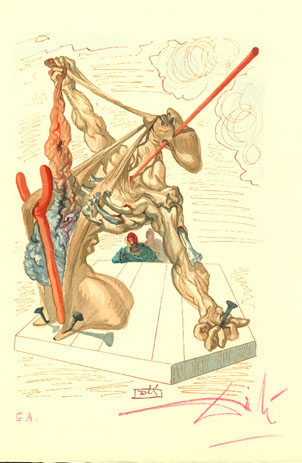
Salvador Dali, The Divine Comedy Suite (Inferno): Mohammed, wood cut, 1952-1964
13 Aug 2009
the oh-so-terrible Danish cartoons
The New York Times reported one of the most shameful and contemptible events in Yale’s three century long history.
Here is one of the richest and most prestigious universities in the civilized world piously turning its back on the core Western principles of open exchange of ideas and freedom of expression in order to avert the violence of primitive bigots and fanatics in their barbaric homelands far from New Haven.
If a fraudulent “artist” wanted to submerge the most sacred symbol of the very Christianity which founded Yale in a jar of urine, they’d happily display it in the Yale Art Gallery. If some bolshevik crackpot wrote a play lovingly fantasizing about the assassination of President George W. Bush (Yale ’68), there’d be no problem performing it at the Yale Rep. But derogating anything pertinent to the amour propre of the genuine inferiors of modern European and American civilized humanity is intolerable because it would be violative of the new ultimate and supreme core principle of liberal modernity, the one inevitably trumping any and all other principles and values: ressentiment.
As long as the barbarian comes in the form of the aggrieved Caliban, blaming his condition and violent behavior on the actions and the contempt of the West, there is no length the cowardly intellectual clerisy of today’s establishment will not go to appease him.
Yale University and Yale University Press consulted two dozen authorities, including diplomats and experts on Islam and counterterrorism, and the recommendation was unanimous: The book, “The Cartoons That Shook the World,†should not include the 12 Danish drawings that originally appeared in September 2005. What’s more, they suggested that the Yale press also refrain from publishing any other illustrations of the prophet that were to be included, specifically, a drawing for a children’s book; an Ottoman print; and a sketch by the 19th-century artist Gustave Doré of Muhammad being tormented in Hell, an episode from Dante’s “Inferno†that has been depicted by Botticelli, Blake, Rodin and DalÃ.
The book’s author, Jytte Klausen, a Danish-born professor of politics at Brandeis University, in Waltham, Mass., reluctantly accepted Yale University Press’s decision not to publish the cartoons. But she was disturbed by the withdrawal of the other representations of Muhammad. All of those images are widely available, Ms. Klausen said by telephone, adding that “Muslim friends, leaders and activists thought that the incident was misunderstood, so the cartoons needed to be reprinted so we could have a discussion about it.†The book is due out in November.
John Donatich, the director of Yale University Press, said by telephone that the decision was difficult, but the recommendation to withdraw the images, including the historical ones of Muhammad, was “overwhelming and unanimous.†The cartoons are freely available on the Internet and can be accurately described in words, Mr. Donatich said, so reprinting them could be interpreted easily as gratuitous.
He noted that he had been involved in publishing other controversial books — like “The King Never Smiles†by Paul M. Handley, a recent unauthorized biography of Thailand’s current monarch — and “I’ve never blinked.†But, he said, “when it came between that and blood on my hands, there was no question.â€

Mattheus van Beveren, Mohammed, leaning on his Koran, Trodden upon by Angels Bearing the Pulpit, Liebefraukirke, Dendermonde, Flanders, late 17th century
12 Mar 2009
[T]here are more than five sexes and only demotic Greek seems to distinguish among them. The sexual provender that lies to hand is staggering in its variety and its profusion. You would never mistake it for a happy place.
–Lawrence Durrell on Alexandria in Justine (1957).
Heather McDonald comments on the antics of Yale’s Administration in catering to the demands of its Gay (in all its permutations) constituency and on the ironies of the contemporary approaches to paideia.
In 2007, at the behest of feminist students, Yale added yet another layer of costly bureaucracy-the Sexual Harassment and Assault Resources and Education Center-to its already generous sexual assault infrastructure. I asked physics professor Peter Parker, convenor of the college’s Sexual Harassment Grievance Board and a sponsor of the new S.H.A.R.E. Center, how many sexual assaults on students there were at Yale. He said that he had “no idea.” (In fact, the number of reported unconfirmed assaults can usually be counted on one hand.) So if students came to the administration demanding a malaria treatment center, would Yale build it without first determining the prevalence of malaria on campus? I asked him. “We didn’t make our judgment based on numbers, but based on concern by students in the community,” he answered.
Faced with such a pliant oppressor, students have to get quite creative in manufacturing new causes of grievance. At the opening ceremonies for the new Office of LGBTQ Resources, junior Rachel Schiff, a coordinator for the LGBT Co-op, complained: “The fact that we don’t actually have a physical space says lots about Yale’s stance towards LGBT life on the ground at a metaphorical level.”…
Today’s solipsistic university… allows students to answer the “Who am I?” question exclusively, rather than inclusively. Identity politics defines the self by its difference from as many other people as possible, so as to increase the underdog status of one’s chosen identity group.
Actually, as far back as the early 1980s, I was startled to learn from undergraduates that the Yale Political Union was not allowed to solicit members by advertising in the prematriculation Freshman mailing packet, but Yale’s LGBT organization was.
Clearly, where I went wrong was in failing to demand a special house provided at university expense, and a special curriculum focused on Redneck Polack Deer Hunter (RPDH) studies.
Hat tip to Scott Drum.
23 Feb 2009

Also from Freddie:
[I]f our scheming entrenched WASP power brokers can’t steal the skulls of centuries-dead American Indian revolutionaries and display them in their inner sanctums… what’s the point?
Earlier posts 1, 2

Some building at Yale
/div>
Feeds
|