Even the very, very moderate and establishmentarian David Brooks has his doubts about the future political prospects of democrats philosophically committed to top-down central planning.
[Medicare] is incredibly popular. Recipients don’t have to think about the costs of their treatment, and they get lots of free money. The average 56-year-old couple pays about $140,000 into the Medicare system over a lifetime and receives about $430,000 in benefits back. The program is also completely unaffordable. Medicare has unfinanced liabilities of more than $30 trillion. The Medicare trustees say the program is about a decade from insolvency.
Some Democrats simply want to do nothing as Medicare careens toward bankruptcy. Last Sunday on “Face the Nation,†for example, Nancy Pelosi said, “I could never support any arrangement that reduced benefits for Medicare.â€
Fortunately, more responsible Democrats are looking for ways to save the system. This is where the philosophical issues come in. They involve questions like: Who should make the crucial decisions? Where does wisdom reside?
Democrats tend to be skeptical that dispersed consumers can get enough information to make smart decisions. Health care is phenomenally complicated. Providers have much more information than consumers. Insurance companies are rapacious and are not in the business of optimizing care.
Given these limitations, Democrats generally seek to concentrate decision-making and cost-control power in the hands of centralized experts. Under the Obama health care law, a team of 15 officials will be created to discover best practices and come up with cost-cutting measures. There will also be a Center for Medicare and Medicaid Innovation in Washington to organize medical innovation. Centralized officials will decide how to set national reimbursement rates.
Republicans at their best are skeptical about top-down decision-making. They are skeptical that centralized experts can accurately predict costs. In 1967, the House Ways and Means Committee projected that Medicare would cost $12 billion by 1990. It actually cost $110 billion. They are skeptical that centralized experts can predict human behavior accurately enough to socially engineer new programs. Medicare’s chief actuary predicted that 400,000 people would sign up for the new health care law’s high-risk pools. In fact, only 18,000 have.
They are skeptical that political authorities can, in the long run, resist pressure to hand out free goodies. They are also skeptical that planners can control the unintended effects of their decisions.
Republicans point out that Medicare has tried to control costs centrally for decades with terrible results. They argue that a decentralized process of trial and error will work better, as long as the underlying incentives are right. They suggest replacing the fee-for-service with a premium support system. Seniors would select from a menu of insurance plans. Their consumer choices would drive a continual, bottom-up process of innovation. Providers could use local knowledge to meet specific circumstances. …
[T]here is no dispositive empirical proof about which method is best — the centralized technocratic one or the decentralized market-based one. Politicians wave studies, but they’re really just reflecting their overall worldviews. Democrats have much greater faith in centralized expertise. Republicans (at least the most honest among them) believe that the world is too complicated, knowledge is too imperfect. They have much greater faith in the decentralized discovery process of the market. …
This basic debate will define the identities of the two parties for decades. In the age of the Internet and open-source technology, the Democrats are mad to define themselves as the party of top-down centralized planning. … [I]f 15 Washington-based experts really can save a system as vast as Medicare through a process of top-down control, then this will be the only realm of human endeavor where that sort of engineering actually works.
The doggies have concluded that the Marine Corps has developed the best camouflage pattern and they now are considering going ahead and simply adopting MARPAT (MARine PATtern) camouflage for use by the US Army, but the Marines have proprietary rights to the pattern and object to sharing uniforms with the Army.
Army officials have said they want soldiers to wear the best possible camouflage — even if that is the MARPAT. But Sergeant Major of the Marine Corps Carlton Kent says don’t count on it.
The Corps owns the rights to MARPAT and wants to retain it for its own use, Kent said late last year. Marine officials said they have no beef with anyone researching and testing MARPAT, but they want Marines distinguished from other service members on the battlefield.
“The main concern for the Marine Corps when it comes to other services testing our patterns is that they don’t exactly mimic them,†said Kent, who is scheduled to retire June 9. “The MARPAT design is proprietary, and it’s important those designs are reserved for Marines. We just need to make sure each of our designs is unique to each service.â€
Brig. Gen. (p) Peter Fuller, the former Program Executive Office Soldier, dismissed the territorial stance. If the pattern proves to be the best, the Army would simply remove the Corps’ signature anchor and move forward, Fuller told Army Times in his last interview as PEO Soldier.
The Corps has always tried to look different. When everyone wore the Battle Dress Uniform, the Marines rolled their sleeves differently. There are no unit patches on their sleeves. They wear different covers and boots.
But the Corps’ efforts to stay unique hit new levels late last year when the Navy — the department to which the Corps belongs — looked to MARPAT to develop its own new uniform. The new working uniform looked similar to MARPAT, but the Navy fielded the desert variant only to about 7,000 personnel assigned either to Naval Special Warfare Command or to units supporting it after Marine officials raised objections that the uniform was too similar to the Corps’.
Anthony Weiner in full denunciatory mode on the House floor.
Victor Davis Hanson welcomes Anthony Weiner to the ever-lengthening list of fallen liberal moralists.
Nemesis is always hot on the trail of hubris, across time and space, and the goddess has been particularly busy in destroying the carefully crafted images of Bono, John Edwards, Timothy Geithner, Al Gore, Eliot Spitzer, Arnold Schwarzenegger, Dominique Strauss-Kahn, Anthony Weiner, and a host of others. What do their tax hypocrisies, sexual indulgences, and aristocratic socialist lifestyles all have in common?
Collectively, they represent a self-appointed or elected global elite that oversees, lectures about — in sanctimonious fashion — the ethical responsibilities of the redistributive state.
——————————
Allahpundit reports that ABC news has been forwarding vindictively to everyone the following video from a little ways back in which Weiner asserts his innocence and defiantly confronts his interviewer. AllahPundit tells us that he himself feels uneasy watching Weiner’s unabashed and brazen dishonesty, that there is about it a disturbing abnormality, a whiff of the Bates Motel… something that makes his skin crawl.
How creepy? Creepy enough that ABC posted this footage (which was recorded a few days ago, of course) just within the past hour and then sent around the link via e-mail. I didn’t go hunting through their archives for it, in other words; they’re pushing it on people tonight themselves because, understandably, they (a) want to atone for having aired this guy’s lies as news last week and (b) presumably want the world to see what an almost pathologically fluid liar he was when cornered. The last 80 seconds of it will have you squirming in your seat — not only the way he claims to be the innocent target of a hoax but his insistence on lecturing the interviewer for assuming the worst, taking care to maintain accusatory eye contact the whole way. It’s genuinely disturbing.
If, like me, you felt bad for him when he choked up at his presser today, spend four minutes watching this. It’ll straighten you right out.
——————————
The New York Post wins the headline-of-the-day award.
——————————
The Anchoress comments on the impact of the Weiner scandal on the press, particularly on Barbara Walters.
To my way of thinking, the saddest part of this story is Barbara Walters devolution; this once-respected newswoman nears the end of her distinguished career by playing as ghastly a non-sequitur as I’ve ever heard, saying (in essence) if Sarah Palin ‘can ride around on her bus,’ Weiner Can Stay in Congress.
When Joy Behar, of all people has to defend Sarah Palin from your bizarrely gratuitous swipe, you know you’ve let your hate lead you too far into Whackyland.
Listen (if you can stand the noise of this show) to Walters talking about how she “knows†Weiner and “knows†his wife, who of course works for Hillary Clinton, whom she also knows.
This is the problem with the mainstream media in a nutshell. They “know†the people they’re supposed to be covering, and they consider themselves “friends†of those people. And it has ruined them. As you listen to Walters, all you see is passionate advocacy; not a newswoman concerned with the truth of a story, but a partisan doing everything she can to divert attention from a story she doesn’t like — even to comparing a private citizen on a bus to a sitting congressman having some sort of cyber-engagement in his office — and championing her “friend.â€
This has never been a nice story, which is why I haven’t written about it until now. But I still am less interested in Weiner than in how the press reacted to this story. Some were willing to believe him, simply because he said they should. Some seemed like they didn’t want to believe him, but didn’t want to not believe him, even more. The usual partisans tried to blame and smear the usual partisans.
We don’t actually have a genuine press any more.
The eruption of the Puyehue volcano in Chile, 870 km. south of Santiago, over the weekend sent a cloud of ash 10 km (6 miles) high complete with volcanic lightning. The combined spectacle provided a field day for photographers.
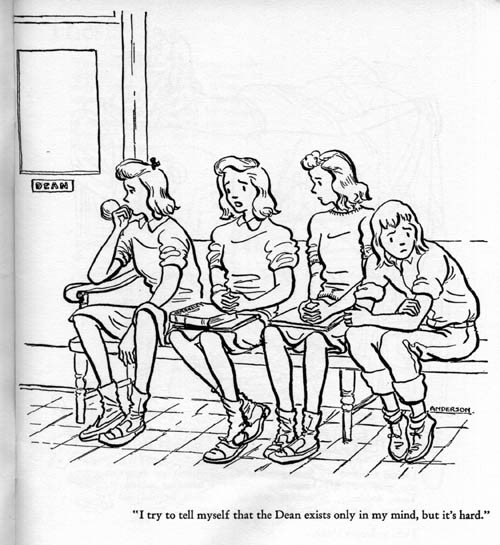
It turns out that the Vassar cartoon sent in by one of our commenters really was set in the 1930s after all.
The source turns out to be a collection of cartoons humorously depicting college life at Vassar by Jean Anderson (1912?-1994) Class of 1933 and (the better documented) Anne Thorburn Cleveland (1916-2009), Class of 1937, published in 1942.
———————————–
———————————–
Anderson and Cleveland published a second collection together, titled Everything Correlates, in 1946. The two 1940s booklets were probably republished as The Educated Woman in Cartoon and Caption in 1960.
Anderson was a classmate at Vassar of Mary McCarthy, who supplied her own version of life at Vassar in her succèss de scandale novel The Group
I remember a classical mural ornamenting “the Madonna of the Smoking Room” Lakey’s suite, featuring the other seven members of the group, attending the goddess Lakey, drawn by the intelligent and witty Helena. I have always assumed that Helena, the detached observer, was intended to represent McCarthy herself, but perhaps I’ve always been wrong. McCarthy’s classmate Jean Anderson, it seems, had just such a talent for cartoon murals.
Cleveland went on to contribute cartoons to Ladies’ Home Journal, Harper’s Bazaar, and other magazines, and published a book of cartoons from the perspective of an American residing in post-war Japan, but eventually abandoned her professional career. She wound up living in Oregon where she created a commune.
Anderson worked as a librarian at Vassar for a number of years, then suddenly resolved on a complete redirection, attended medical school, and became an obstetrician and a pioneer champion of the Lamaze method. She practiced in Manhattan in the late ’50s and early ’60s, then relocated permanently to Amherst, Massachusetts. Dr. Anderson proudly kept copies of her cartoon collections available to entertain patients in her waiting room.
Blogger Shaenon K. Gentry, Vassar 2000, has published several articles on the Cleveland-Anderson cartoons. Gentry, for some reason, fails to notice that Anderson signs her cartoons, and tends to produce the better work. The Gentry articles talk predominantly about Anne Cleveland.
Walter Russell Mead (who has recently been on a roll, producing a series of very intelligent articles) argues that the imminent end of the entitlement era marks as profound a change in the American way of life as the century ago passing of the family farm and the transition to majority employment in towns and cities.
The death of the family farm didn’t kill the American republic for several reasons. First, to some degree Jefferson was wrong and Hamilton was right. A strong manufacturing and financial sector can strengthen democracy under the right conditions; ancient, slave-holding Rome was less like modern capitalist New York and London than Thomas Jefferson thought.
But under American conditions there was something else: the end of the family farm did not mean the rise of a propertyless proletariat in the United States. Bankers like A.P. Giannini made the argument that the thirty year mortgage was a weapon against Marx: if the average American family no longer owned a farm, it could still own a house.
Thanks to home ownership, post-agricultural America remained a land of mass property ownership and that experience continued to inform American political and social values. American neighborhoods are still schools of political engagement; it’s clear who keeps up their property, who takes the lead in community activities, who leads the PTA and who coaches the youth league. Property ownership continues to serve as a political tutor; American voters want better municipal services, and they don’t like high property taxes. They have to think about the relationship between the two in every election, and their experience in local affairs continues to inform their ideas about national policy.
At the same time, the fact that most Americans buy their homes through mortgages, and that they have to keep those payments up or lose the old homestead, teaches responsibility and steady habits. If the farmer didn’t get up at dawn to plow the north forty, there was nothing to eat in the winter. If the suburbanite doesn’t get in the car and head onto the freeway every morning, the bank balance sinks and the repo men will come and take the house away. Home ownership also teaches people about investments and compound interest (although lately it has been giving us a painful introduction to bubbles and downturns).
Both versions of the American Dream had this in common: the farm in the valley and the box in the burbs helped the American people develop the skills and the values necessary for successful republican government.
From this standpoint, suburban America looks like a watered down but still potent blend of the original American farmer’s republic. The inherited values and culture coming to us from the old days plus the still potent force of mass home ownership have kept the United States from retracing the steps of older democracies on their slow decline. So far.
But our consumer republic is clearly in trouble. Economically, as I wrote earlier this week, the model is breaking down. The consumer republic is based on debt and depends on high consumption. We are nearing the limits of that kind of economy. The country’s external debt, the explosive growth of federal debt and the weak balance sheets of consumer households are all pointing in the same direction.
The cultural and social weaknesses of the consumer state are if anything more troubling. While suburbia is not the kind of alienating horror show that Marxist critics make it out to be, it is a less effective school for citizenship and character than the family farm. Daniel Bell wrote about the cultural contradictions of capitalism more than thirty years ago; life in a consumer society does not support the virtues and ideas that a healthy society requires.
More broadly, Huck Finn was right and the Widow Douglass was wrong: a holistic life in which family, work, education, leisure and production are all blended and mixed is healthier than an existence in which every sphere of life is rigidly set off from the others. it is not good for children to work long hours in textile mills; it is also not good for them to grow up without participating in and learning about the productive labor that is such a big part of what it means to be human. Family bonds are weaker now that husbands and wives spend so much less time together and mostly cooperate to spend money rather than working together to make it. The family is less of a unit because the real business of each member of the family takes place in some other environment be it the office, the factory or the school.
The special shape of modern and suburban family life is part of the blue social model I’ve been posting about on this blog and the hollowing out of blue society is increasingly felt within as well as around the contemporary American family. The suburban consumption based nuclear family is increasingly under stress; family budgets and time are increasingly on the edge.
More, the very entitlements most under pressure economically are those that have allowed the multigenerational family to yield to the suburban nuclear idyll. Defined benefit pensions, Social Security, home equity and Medicare allowed older Americans to live independent lives and reduced the need for solidarity between the generations. The generations, like the widow’s vittles, were all cooking in their separate pots. …
The one thing I do know is that change is on its way — more fundamental, more challenging, and also perhaps more exhilarating than many of us are ready for. The health of the American economy is going to require us to move away from the credit card economics of the consumer republic. The health of American society and democracy require that we move beyond the life of the last eighty years.
The Worcester College disciplinary crackdown story inspired one of our readers to forward the cartoon below. JKB describes it as depicting Vassar in the 1930s, but I think it looks more like the 1950s.
Mark Steyn is sharp-tongued as ever on the topic of the week: the latest scandal-mired abrasive, self-righteous, egomanaical, ultra-liberal democrat.
And so it goes after another tumultuous week in American politics. Nearly a third of homeowners are “underwater” – that’s to say, they owe more on their mortgages than the property is worth. Private-sector job growth has all but vanished. The House of Representatives voted not to raise the debt ceiling.
But as the debt ceiling subsides – or, at any rate, stays put – we see the dreary steeple of Anthony Weiner emerging from his Twitpic crotch shot.
For the benefit of the few remaining American coeds Rep. Weiner isn’t following on Twitter, the congressman’s initial position when his groin Tweet went viral was that his Twitter had been hacked. Could happen to anyone. …
Congressman Weiner then retreated from the sinister hacking line, and protested that all this fuss about a mere “prank” involving a “randy photo” (his words) was an “unfortunate distraction” from real issues like raising the debt ceiling. Like Bill Clinton in the Nineties, Rep. Weiner needs to “get back to work for the American people.”
It’s the political class doing all this relentless “work for the American people” that’s turned this country into the brokest nation in the history of the planet, killed the American Dream and left the American people headed for a future poised somewhere between the Weimar Republic and Mad Max. So, if it’s a choice between politicians getting back to work for the American people or Tweeting their privates round the planet, I say, Tweet on, MacDuff.
The Daily Mail reports that Worcester College, Oxford (Rupert Murdoch’s alma mater) is attempting to suppress some undergraduate examination period hijinks.
Worcester College was founded in the 18th century, but incorporates portions of Gloucester College, a Benedictine foundation dating to 1283, dissolved by Henry VIII in 1539.
Undergraduates at Worcester College have been threatened with disciplinary action if they continue removing their tops in the library on Wednesday afternoons.
A group of students calling themselves the Breakfast Club started stripping off in 2009 to brighten up boring revision days.
Up to 40 male and female students became involved in the group action for a 30-minute period between 3pm and 4pm every Wednesday
They carry on their work partly-clothed – some of the girls are even said to have removed their bras.
However high-profile visitors including heads of state regularly visit the library as part of a tour of the university, and there have been a string of complaints.
Librarians sent an email to the college saying the practice was ‘unacceptable’ and ‘a distraction to other readers’.
In their email to students, the library committee warned: ‘While half-naked half-hour may have seemed like a piece of harmless fun, we ask you please to stop this kind of behaviour in the library.
‘If inappropriate behaviour continues, library staff will refer the matter to the Dean.
(or woman) who does not possess the same conventional pop culture familiarity with Longfellow’s poem and Paul Revere’s 18th of April in ’75 ride to warn the Minutemen of Lexington and Concord that the British were coming.
Sarah Palin, unfortunately, in her characteristically more extreme version of the politician trying to bloviate for the media who engages mouth without fully engaging brain, made a syntactical hash of Paul Revere’s ride and laid herself open to accusations by the left that she was astonishingly ill-informed on supposed fine points of America history with which every member of the elite community of fashion is naturally intimately familiar.
A bit painful to watch, but short.
All the glee on the left provoked the learned Professor Jacobson to quote Revere’s actual account, which by one of life’s strange coincidences happened to fit Sarah Palin’s garbled narrative very nicely. It was all just more persiflage, of course. Palin really did misspeak, but the good Professor’s factual rejoinder quite effectively disarmed the smug lefties and drove them into full retreat, muttering unhappily to themselves. Bill Jacobson decisively closed down discussion on this particular incident.
The reality is that Sarah Palin obviously knows approximately as much (or as little) as any typical contemporary American adult about Paul Revere’s ride and the battles of Lexington and Concord. What happened is that Palin tried to combine more than one conceptual thread while distracted, and tied her verbiage into knots. When she is not paying attention, Sarah Palin does not express herself coherently and does not necessarily say what she means to say. Instead, she produces some kind of untidy substitute for what she needed and intended to say, and the result is too commonly a very unsatisfactory and naive sounding failure featuring some form of gaping vulnerability.
Palin is not as glib as many politicians, and she is not as careful as most politicians, so she has a well-recognized tendency to expose herself to this kind of unfavorable interpretation and ridicule from the left.
All politicians are fallible and human, and all politicians are capable of misspeaking when not paying attention, tired, or distracted.
Palin is not unusually ill-informed or even uniquely capable of gaffes. She is just not as cautious and characteristically self-protective as most politicians. There is no doubt, though, that her proclivity toward verbal confusion and gaffes is a serious weakness and a great vulnerability. Her credibility as a presidential candidate rests on her successfully making the effort to overcome these kinds of weaknesses. If Palin isn’t willing or able to improve, she is not going to be nominated.