Watching the video, it seems clear that the photographer could have stood up and, at least briefly thereby, frightened off the elk, and he would very probably then have had time to scurry off and take shelter in one of the nearby cars. It also seemed clear to me that the young elk was frequently very close to starting a really thorough hoof-stomping, antler-poking display of power.
The Knoxville television station reported yesterday that Park authorities sent that elk off to live on a farm, having apparently witnessed more than one incident of “human contact.”
Apparently, park visitors had been feeding him, and antler rubbing and close encounters of the cervine kind may have been his way of saying: “Feed me, Seymour!”
Theodore Dalrymple reflects, in Taki’s magazine, on the modern state’s law enforcement priorities and their deeper meaning.
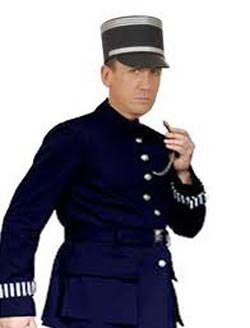
A couple of American filmmakers came to Paris to interview me—it always surprises me that anybody would take so much trouble to interview anybody, let alone me—and decided that the little park opposite my flat, with a pretty little bandstand, would be a good place to do so. They set up the camera, but a few seconds later, before they could ask me a single question, a municipal policeman arrived. They were not allowed to film here without a permit from the mairie of the arrondissement, he said. I explained that these were Americans, come all the way from Texas expressly to interview me. He, a very pleasant and polite man of African origin, phoned his chief to see whether an exception could be made. As I suspected, it could not.
The contrast between the authorities’ alacrity on one hand in preventing innocent filming for a matter of a few minutes (the policeman said authorization was necessary because it might cause a disturbance, and, being kind, I refrained from laughing), and on the other their slow response to a nasty incident that might have ended in murder, was emblematic of the modern state’s capacity to get everything exactly the wrong way around, to ascribe importance to trivia and to ignore the important. There are, of course, many more employment opportunities in trivia, since there is much more that is trivial in the world than is important.
France is not unique in this respect, or even the worst example I know. In London I once parked outside a hotel where I proposed to stay. Parking was forbidden outside, but I stopped only to take my baggage inside. I received a parking ticket within sixty seconds, a miracle of efficiency (I genuinely admired it in a way), though it was perfectly obvious from my car’s open doors that I did not propose to stay long and was only taking my luggage into the hotel. But on another occasion when my wife telephoned the police to inform them that youths were committing arson in our front garden before her very eyes, they had no time to attend to it. A more senior officer, however, did find the time a quarter of an hour later to complain to my wife that she had wasted police time by complaining in the first place.
It often seems, then, as if modern state authorities live in a looking-glass world: What normal people regard as important is for them of no importance, while what they regard as of supreme importance normal people regard as of no importance. For them the respectable are suspect and the suspect respectable. A tweed jacket is a sign of menace, while a broken bottle is a sign of harmless intent.
One must not exaggerate the degree to which official idiocy impinges on our lives. The exaggeration of misery is one of the royal roads to political disaster. Still, I have seen the future, and it is idiocy.
The Obamacare disaster has commentators this morning casting around for new metaphors. The Titanic, The Hindenburg, the Challenger… have all been used.
Dan Greenfield deconstructs Barack Obama’s apology to Americans who will lose their health insurance.
Obama’s non-apology apology “I’m sorry that you’re unhappy” is typical of the passive aggressive apology of the twenty-first [century]. What was once character has become branding. What was once manners has become damage control. …
Obama, Hillary and Sebelius all recite formulaic admissions of responsibility without actually taking any. Hillary was happy to take responsibility for Benghazi, as a verbal statement, without actually accepting political or practical responsibility for any of it. Likewise Sebelius and Obama took responsibility for the ObamaCare website without actually accepting it.
Obama took responsibility and then explained that he doesn’t really know anything about programming so he isn’t responsible. …
This is the innocence of incompetence. Obama isn’t a programmer; he can’t be held responsible for Healthcare.gov. Hillary Clinton isn’t a soldier or even a real diplomat. She can’t be held responsible for Benghazi. Sebelius is a political appointee whose job is to look into the camera with the baffled incomprehension of the professional civil servant. “I don’t know anything. I just work here.”
Obama had boasted that he was a better speechwriter than his speechwriters and a better political director than his political directors. But apparently he’s not a better programmer than his programmers.
Programming is hard work compared to finding ways to arrange new promises and lies around “Let me be clear” which is the twenty-first century version of “Read my lips”. It requires knowing how to do something more than blame the previous programmer or the programming language.
The ideologues are always innocent because it’s always the implementation that fails; not their ideas. It’s why Communism isn’t responsible for the USSR or North Korea going down the tubes. The ideas were solid, but the programmers did a bad job of coding their brilliant economic theories into a working website.
And so we are told once again that Obama is smart. Really, really smart. Despite this fearsome intelligence, there isn’t one thing they can point to abroad or at home that he did well on his own. And that very uselessness shows how smart he is. Any idiot can fix a car, build a website or make a foreign policy work. It takes a real genius to come up with the ideas and sigh in disappointment as everyone else screws them up.
Liberal columnists ponder whether Obama is too smart to be president. By that they mean that he’s much too elevated a being to sit around trying to make things work. His proper role would be theorizing how things should work and then putting those theories in book form.
That is something the left is undeniably good at. It’s like an entire movement of flying car inventors who spend so much time describing why flying cars are the answer that they never bother with the question of whether anyone needs flying cars or how to keep flying cars from crashing into things all the time.
The Wolver Beagles competing in the Beagle Pack Trials at the Institute Farm in Aldie, Virginia, November, 2010. (Photo: Karen L. Myers)
The Wolver Beagles celebrated their hundred anniversary of operation as an organized hunting pack this fall. By my count, Wolver is the fifth oldest beagle pack in the United States, preceded only by the Waldingfield Beagles (founded 1885), the Somerset Beagles (founded 1888, disbanded 1922), the Sir Sister Beagles (founded 1897), and Richard Gambrill’s Vernon Somerset Beagles (founded 1912, disbanded 1953). Only two older beagle packs still survive, and Wolver can additionally boast a more continuous operation under fewer masters than any other beagle pack in America.
Wolver’s colors, displayed on the collar, are buff with light blue piping. Wolver is a private pack, operating out of Middleburg, Virginia and hunting only bitch hounds. Wolver is recognized everywhere as a crack pack, performing typically at a superior level and winning far more than its share of competitions.
Barbara Riggs produced an article on Wolver’s history appearing this week in the Chronicle of the Horse.
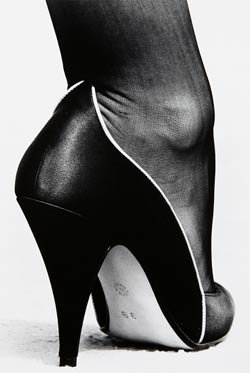
Helmut Newton, Shoe, Monte Carlo, 1983, Gelatin silver print from Private Property Suite I, 1983, printed 1984 in 75 copies.
Camille Paglia follows in the tradition of Susan Sontag and Roland Barthes by producing brilliantly written pieces of high criticism of ordinary elements of contemporary popular culture.
Helmut Newton, whose superb fashion photography was suffused with the perverse world view of his native Weimar Berlin, captured the disturbing complexities of the high heel in Shoe, a picture taken in Monte Carlo in 1983. Here we see the fashionable shoe in all its florid delicacy and dynamic aggression. The stance, with shifted ankle, seems mannish. Is this a dominatrix poised to trample her delirious victim? Or is it a streetwalker defiantly defending her turf? Or a drag queen scornfully pissing in an alley? The shoe, shot from the ground, seems colossal, a pitiless totem of pagan sex cult.
The luxury high heel as status marker is directed not toward men but toward other women—both intimate confidantes and bitter rivals. The high heel in its dazzlingly heraldic permutations (as dramatized in Sex and the City) is beyond the comprehension of most men: only women and gay men can tell the difference between a Manolo Blahnik and a Jimmy Choo. In full disclosure, I never wear these shoes and indeed deplore their horrifying cost at a time of urgent social needs. Nevertheless, I acknowledge and admire the high heel as a contemporary icon and perhaps our canonical objet d’art.
At the Neiman Marcus department store at the King of Prussia Mall in suburban Philadelphia, a visitor ascending the escalator to the second floor is greeted by a vast horizon of welcoming tables, laden with designer shoes of ravishing allure but staggering price tags (now hovering between $500 and $900 a pair but soaring to $6000 for candy-colored, crystal-studded Daffodile pumps by Christian Louboutin). Despite my detestation of its decadence, this theatrical shoe array has for years provided me with far more intense aesthetic surprise and pleasure than any gallery of contemporary art, with its derivative gestures, rote ironies, and exhausted ideology.
Designer shoes represent the slow but steady triumph of the crafts over the fine arts during the past century. They are streamlined works of modern sculpture, wasteful and frivolous yet elegantly expressive of pure form, a geometric reshaping of soft and yielding nature. An upscale shoe department is a gun show for urban fashionistas, a site of ritual display where danger lurks beneath the mask of beauty.