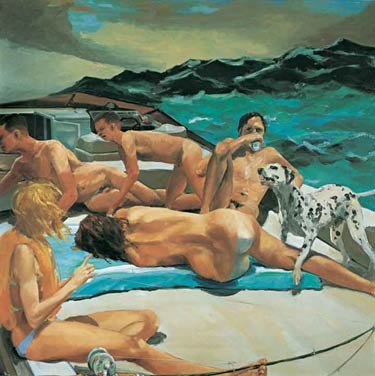
Eric Fischl, The Old Man’s Boat and the Old Man’s Dog, 1982. –Our time’s version of The Raft of the Medusa.
Mark Lila, back in June, published an important essay on contemporary ideology in the New Republic, which I would say misidentifies the contemporary ideology of secular egalitarianism as “Libertarianism.”
The social liberalization that began in a few Western countries in the 1960s is meeting less resistance among educated urban elites nearly everywhere, and a new cultural outlook, or at least questioning, has emerged. This outlook treats as axiomatic the primacy of individual self-determination over traditional social ties, indifference in matters of religion and sex, and the a priori obligation to tolerate others. Of course there have also been powerful reactions against this outlook, even in the West. But outside the Islamic world, where theological principles still have authority, there are fewer and fewer objections that persuade people who have no such principles. The recent, and astonishingly rapid, acceptance of homosexuality and even gay marriage in so many Western countries—a historically unprecedented transformation of traditional morality and customs—says more about our time than anything else.
It tells us that this is a libertarian age. That is not because democracy is on the march (it is regressing in many places), or because the bounty of the free market has reached everyone (we have a new class of paupers), or because we are now all free to do as we wish (since wishes inevitably conflict). No, ours is a libertarian age by default: whatever ideas or beliefs or feelings muted the demand for individual autonomy in the past have atrophied. There were no public debates on this and no votes were taken. Since the cold war ended we have simply found ourselves in a world in which every advance of the principle of freedom in one sphere advances it in the others, whether we wish it to or not. The only freedom we are losing is the freedom to choose our freedoms.
Not everyone is happy about this. The left, especially in Europe and Latin America, wants to limit economic autonomy for the public good. Yet they reject out of hand legal limits to individual autonomy in other spheres, such as surveillance and censorship of the Internet, which might also serve the public good. They want an uncontrolled cyberspace in a controlled economy—a technological and sociological impossibility. Those on the right, whether in China, the United States, or elsewhere, would like the inverse: a permissive economy with a restrictive culture, which is equally impossible in the long run. We find ourselves like the man on the speeding train who tried to stop it by pulling on the seat in front of him.
Yet our libertarianism is not an ideology in the old sense. It is a dogma. The distinction between ideology and dogma is worth bearing in mind. Ideology tries to master the historical forces shaping society by first understanding them. The grand ideologies of the nineteenth and twentieth centuries did just that, and much too well; since they were intellectually “totalizing,†they countenanced political totalitarianism. Our libertarianism operates differently: it is supremely dogmatic, and like every dogma it sanctions ignorance about the world, and therefore blinds adherents to its effects in that world. It begins with basic liberal principles—the sanctity of the individual, the priority of freedom, distrust of public authority, tolerance—and advances no further. It has no taste for reality, no curiosity about how we got here or where we are going. There is no libertarian sociology (an oxymoron) or psychology or philosophy of history. Nor, strictly speaking, is there a libertarian political theory, since it has no interest in institutions and has nothing to say about the necessary, and productive, tension between individual and collective purposes. It is not liberal in a sense that Montesquieu, the American Framers, Tocqueville, or Mill would have recognized. They would have seen it as a creed little different from Luther’s sola fide: give individuals maximum freedom in every aspect of their lives and all will be well. And if not, then pereat mundus.
Libertarianism’s dogmatic simplicity explains why people who otherwise share little can subscribe to it: small-government fundamentalists on the American right, anarchists on the European and Latin American left, democratization prophets, civil liberties absolutists, human rights crusaders, neoliberal growth evangelists, rogue hackers, gun fanatics, porn manufacturers, and Chicago School economists the world over. The dogma that unites them is implicit and does not require explication; it is a mentality, a mood, a presumption—what used to be called, non-pejoratively, a prejudice. Maintaining an ideology requires work because political developments always threaten its plausibility. Theories must be tweaked, revisions must be revised. Since ideology makes a claim about the way the world actually works, it invites and resists refutation. A dogma, by contrast, does not. That is why our libertarian age is an illegible age.
Eric Worrall demonstrates the Heads-I-Win-Tails-You-Lose unfalsifiable character of “climate change” modelling.
If the temperature goes up, this is just what the models predicted – watch out because … …soon it will get a lot worse. link
If the temperature goes down, the deep ocean is swallowing the heat – even though the heat can’t be measured, we know it must be there, because that is what the climate models tell us. Global warming prevails! link
If the global temperature crashes, its because global warming induced melting of arctic ice shut down the ocean currents. link
——————-
If the snow disappears, this is just as models predicted – snowfall is a thing of the past. link
If there is an unusually heavy snowfall, this is just as models predicted – global warming is increasing the moisture content of the atmosphere, which results in increased snow cover. link
——————-
If there is a drought, that is because of global warming. link
Except of course, when global warming causes heavy rainfall. link
——————-
No matter what the observation, no matter how the world changes, we can never falsify alarmist climate theories. Any possible change, any possible observation, can always be explained by anthropogenic global warming. link
Poor Michael Brown was videotaped by a surveillance camera robbing a convenience store, shortly before he was shot by police.
Armed & Dangerous agrees with the general narrative contending that events in Ferguson, Missouri show that American police use too much military equipment and are ill-advisedly trained to employ military tactics, but –beyond all that– he feels obliged to defend police against knee-jerk accusations of racism.
[The] 2% [of the US population composed of black males aged 15 to 25] is responsible for almost all of 52% of U.S. homicides. Or, to put it differently, by these figures a young black or “mixed†male is roughly 26 times more likely to be a homicidal threat than a random person outside that category – older or younger blacks, whites, hispanics, females, whatever. If the young male is unambiguously black that figure goes up, about doubling.
26 times more likely. That’s a lot. It means that even given very forgiving assumptions about differential rates of conviction and other factors we probably still have a difference in propensity to homicide (and other violent crimes for which its rates are an index, including rape, armed robbery, and hot burglary) of around 20:1. That’s being very generous, assuming that cumulative errors have thrown my calculations are off by up to a factor of 6 in the direction unfavorable to my argument.
Now suppose you’re a cop. Your job rubs your nose in the reality behind crime statistics. What you’re going to see on the streets every day is that random black male youths are roughly 20 times more likely to be dangerous to you – and to other civilians – than anyone who isn’t a random black male youth.
Any cop who treated members of a group with a factor 20 greater threat level than population baseline “equally†would be crazy. He wouldn’t be doing his job; he’d be jeopardizing the civil peace by inaction.
Yeah, my all means let’s demilitarize the police. But let’s also stop screaming “racism†when, by the numbers, the bad shit that goes down with black male youths reflects a cop’s rational fear of that particular demographic – and not racism against blacks in general.
Business Insider describes one of the North American finds strikingly resembling Solutrean tools from Western Europe, which suggest the possibility of some Paleolithic settlement of North America from Europe.
Most researchers believe the first Americans crossed the Bering Strait from Siberia about 15,000 years ago and quickly colonized North America. Artifacts from these ancient settlers, dubbed the Clovis culture after one of their iconic archaeological sites in Clovis, New Mexico, have been found from Canada to the edges of North America.
But in 1974, a small wooden scallop trawler was dredging the seafloor, about 230 feet (70 meters) below the sea surface and nearly 60 miles (100 kilometers) off the coastline in the Chesapeake Bay.
“They hit a snag, or a hang, as they like to say, which meant that something pretty heavy was in their net,” said Dennis Stanford, an archaeologist with the Smithsonian Institution in Washington, D.C., who has analyzed the find.
When they pulled up their net, they found the partial skull of a mastodon, a distant cousin of the woolly mammoth that began its slide into extinction about 12,000 years ago, Stanford said. The fishermen also noticed a flaked blade made of a volcanic rock called rhyolite.
The fisherman couldn’t lug the skull back to shore in their tiny wooden boat, so they sawed off the tusks and teeth, tossed the rest overboard and eventually handed portions to the crew as souvenirs. Capt. Thurston Shawn gave the remaining tusk portions, teeth and knife to a relative, who donated the remains to Gwynn’s Island Museum in Virginia. There they sat, unnoticed, for decades.
But while doing his doctoral dissertation, Darrin Lowery, a geologist at the University of Delaware, noticed the teeth and the tusk at the museum. …
By measuring the fraction of radioactive carbon isotopes (elements of carbon with different numbers of neutrons), the team found that the mastodon tusk was more than 22,000 years old.
There was no way to date the blade precisely, but the deft flint-knapping technique used to make it was similar to that found in Solutrean tools, which were made in Europe between 22,000 and 17,000 years ago.
Melting glaciers raised sea levels and submerged that area of the continental shelf about 14,000 years ago, so the knife must have been at least that old, Stanford added.
In addition, both pieces showed characteristic weathering that indicated they were exposed to the air for a while and then submerged in a saltwater marsh, before finally being buried in seawater.
That finding suggested that the two artifacts were possibly from the same environment — such as the marshes found between sand dunes that are often set back from the seashore. That would have been a perfect place for mastodons to find food, Stanford said.
“They like to chew on bushes and more rough shrubbery,” Stanford said.
To Stanford, Lowery and their colleagues, the discoveries suggest that people lived along the East Coast more than 14,000 years ago — potentially thousands of years before the Clovis culture emerged there. These first American colonizers may have even crossed the Atlantic Ocean from Europe, Stanford said.
10-year-old Sonja Moehle found the skeleton of a representative of the extinct Eastern subspecies of Elk (Cervus canadensis canadensis).
Eastern Elk were larger.
The Eastern elk subspecies existed in North America until 1877, when the last known specimen was shot in Pennsylvania. It was noted by scientists as being much larger than the elk species of today, boasting racks as long as six feet in length. Eastern bull elk could stand as tall as 60 inches at the shoulder and weigh more than a thousand pounds.
Not everyone believes they are totally extinct, however. It is suspected that some form of the elk subspecies still lives on—in New Zealand. Former US President Theodore Roosevelt gifted a small herd of elk to New Zealand in 1905. Experts believe that the herd included several individuals of Eastern elk, which may have eventually begun breeding with local animals.
Sonja and her father have started a Kickstarter funding page to raise enough money for DNA-testing of her Elk.
Andrew Sullivan’s little munchkins are manning his blog while the great poof vacations on the Cape. Phoebe Maltz Bovy (who actually gets a byline — you go, girl!) yesterday identified two pieces so notable for thought crime that they may not be quoted or linked.
Piece 1 was a rant contending that “Transphobia is Perfectly Normal” by Gavin MacInnes at Thought Catalog. Bovy says:
I tend to agree with Allen, who writes:
I refuse to link to it—that’s how bad it is. McInnes willfully misgenders all transgender people, Janet Mock included, while pathologizing them as “nuts†and fixating at great length on the state of their genitals. It’s repulsive.
McInnes’ piece doesn’t deserve a formal response.
Yep. McInnes does not simply make an argument about gender identity that falls outside conventional liberal (and, as Allen notes, medical) norms. Such an argument might be buried below what it is he did write, but it’s hard to say, given the muck surrounding any possible substance. I’m also not keen to drive traffic to something odious…
Actually, his editorial is pretty short, and most of it consists of intentionally-colorful-and colloquial rhetoric. But MacInnes does really make one serious argument: the argument that, when you play along with the particular fantasy and encourage all this, you are helping psychologically defective people harm themselves. Quote:
By pretending this is all perfectly sane, you are enabling these poor bastards to mutilate themselves. This insane war on pronouns is about telling people what to do. It may empower you to shut down a school’s computer system because they phrased your gender wrong, but that’s just a game to you. To them, it’s a life-changing event that fucks them up. To fight against transphobia is to justify trannies. To justify trannies is to allow mentally ill people to mutilate themselves. When your actions are getting people mutilated, you’re at war with them.
——————————
The other case of forbidden speech was an August 1 editorial in the Times of Israel (republished here) by Jochanan Gordon, titled “When Genocide is Permissible.”
Gordon’s editorial was quickly removed from the Times of Israel web-site and, a bit later, also taken down from The Five Towns Jewish Times web-site with this explanation:
An article that was posted earlier today on our website dealt with the question of genocide in a most irresponsible fashion. We reject any such notion or discussion associated with even entertaining the possibility of such an unacceptable idea.
The piece should have been rejected out of hand by editors but escaped their proper attention. We reject such a suggestion unequivocally and apologize for the error.
In reality, though, Gordon’s sin consists entirely of his use of the word “genocide.” Gordon was really trying to justify the “disproportionate” Israeli response to Hamas’s rocket attacks. He implicitly (and most unwisely) accepts the accusation that what Israel has been doing in Gaza is a kind of genocide, and then argues that Israel is justified by its right of self defense. He never actually advocates real genocide. He just agrees to term what Israel is already doing “genocide,” and contends that Israel’s actions are necessary and ought to continue. He should have used a different word.
Jim Treacher reports that thanks to Matthew Colbert: “Now You Can Bring The Stifling Joylessness Of Modern Political Life To The Grocery Store.”
Are you worried that at some point in your day, you might unknowingly make a personal decision untainted by any political considerations whatsoever? Afraid that a single penny of your hard-earned money* might go toward someone who doesn’t share your views of the world?
Enter Matthew Colbert, a former campaign and Hill staffer, who has built a new app for smartphones that allows users to scan the barcode of products in the grocery store and immediately find out what political party the company and its employees support…
The app, based on data from Center for Responsive Politics, the Sunlight Foundation and the Institute for State Money in Politics, is the first rollout from Colbert’s new company, “Spend consciously.†It’s [sic] tagline: “Wouldn’t it be great if you could spend how you believed?â€
The goal of the company, he said, is make “every day Election Day†through “spending choices.â€
Daniel McCarthy, over at the American Conservative, argues that if you want liberalism and democracy, you are going to need an Empire capable of “by upholding a relatively un-Hobbesian global security environment.”
In the 19th century, the United States enjoyed the advantages of an international security environment propitious to liberalism and democracy without having to incur the costs of empire necessary to sustain those conditions. America could be liberal without having to be imperial—although the Indians, Mexicans, and Filipinos might well disagree. Beginning with World War II, however, if America wished to remain liberal and democratic, it would have to become imperial in many of the ways Britain had been—including playing a leading role in Europe and on the oceans. Indeed, America would have to do much of what the British Empire had done in the previous century on an even larger scale.
The efflorescence of liberal democracy in the latter half of the 20th century—the growth of international trade and support for democracy and human rights to the point where the total package appeared to be the “End of Historyâ€â€”was not a spontaneous, natural development. It was driven by U.S. prestige and power. Germany is now deeply committed to political liberalism, and Japan may in some respects be more consumerist than the U.S. itself. But these states were, of course, remade by the U.S. after World War II.
This is not to say there aren’t genuinely local traditions of liberalism or democracy to be found among America’s allies, nor that American arms can simply transform any other kind of regime into a liberal and democratic one: the apparent success of nation-building in Japan and Germany owed as much to the threat that the Soviet Union posed to those states as to anything America did. The Germans and Japanese had the most urgent incentive imaginable to make their newly liberal and democratic constitutions work—because aligning with the U.S. was the only insurance they could buy against being annexed by the Soviet empire instead.
There is a crucial difference between the Napoleonic, land-empire mentality that wants to revolutionize other states—a mentality taken to extremes by the Soviets and exhibited with considerable fervor by many neoconservatives and liberal hawks today—and the example set by Britain in the 19th century, which was a liberal but not revolutionary world power and encouraged liberalization mostly though indirect means: via trade, culture, and above all, by upholding a relatively un-Hobbesian global security environment.
Liberal anti-imperialists today, whether libertarian or progressive, make the same mistakes Britain’s pacifists and America’s interwar noninterventionists once did: they imagine that the overall ideological complexion of the world, as determined by the state most capable of projecting power, need not affect their values and habits at home. They believe that liberalism is possible without empire.