I’ll come clean, Prior, when we measured up that copy of the eastern transept at Fountains Abbey for you, we didn’t take into account that your church is kind of a completely different width.
Is this going to be a problem?
Well when we put the vault on there might be a teensy teensy mistake.
Is anyone going to notice?
We’ll carve a ring of really nice angels to cover it up.
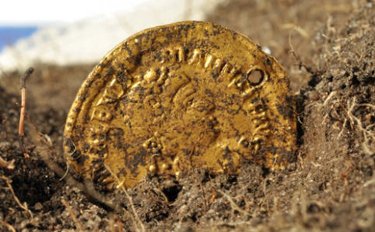
Most recently, a gold Roman solidus was discovered. The coin is thought to have been part of a looted hoard, dropped during the sack of the castle.
Although the sack of the fort and murder of its inhabitants occurred 1500 years ago, local memories cause residents of the fort’s vicinity still to shun the site. Archaeologist Helena Victor stated: “There are still memories 1,500 years later of these events, it’s a dangerous place. Parents tell their children that they can’t play there because it’s a dangerous place. They don’t remember the history but they remember it’s dangerous.”
Franz Liszt’s La Campanella S. 141 (1851) is performed by Valentina Lisitsa. Sviatoslav Richter and Arturo Benedetti Michelangeli were renowned for preferring to play on Bösendorfers.
Unknown artist, King Richard III, late 16th century, National Portrait Gallery.
Chemical analysis of the bones and teeth of the skeleton found beneath the Leicester parking lot seems to confirm its identity as the remains of Richard III, the last Plantagenet king of England.
According to a study performed by the British Geological Survey and researchers at the University of Leicester, the king changed location and diet early in his childhood, and then, when he was crowned king 26 months before his death at the Battle of Bosworth, started eating a richer diet associated with his change in status. …
The team analysed the isotopes found in three locations of King Richard III’s skeleton: his teeth, his femur, and his rib. Each showed elements related to geographical location, pollution, and diet: strontium, nitrogen, oxygen, carbon, and lead. As teeth and bones continue to change and develop throughout life, the team was able to map specific elements to locations and time frames.
According to his teeth, Richard III had moved away from Fotheringhay Castle in Northampshire by the time he was seven, to an area of higher rainfall, older rocks and a different diet to what was available in his birthplace.
According to his femur — which shows an average of the last 15 years before death — Richard moved back to England’s east sometime in his adolescence or young adulthood, and his diet changed to match that of the high aristocracy.
It is his rib that shows his later life. Typically, the ribs renew themselves quickly, so it only represents the last two to five years of life. It was in this period that Richard III’s diet changed the most — although the differences between femur and rib could indicate a relocation, Richard III did not move away from England’s east.
The elements found in his rib suggests an increase in his diet of freshwater fish and birds — such as swan, crane, heron, and egret — which were popular choices for royal banquets. It also suggests that he was drinking more wine. Both these changes reinforce that food and drink — and, in particular, types of food and drink — were very important indicators of social status in England in the Middle Ages.
Thomas Hobbes has a little fun imagining a future very different from the present.
The triumph of the Recovery was marked most clearly by the burning of the Episcopal bishop of Maine.
She was not a particularly bad bishop. She was in fact typical of Episcopal bishops of the first quarter of the 21st century: agnostic, compulsively political and radical, and given to placing a small idol of Isis on the altar when she said the Communion service. By 2055, when she was tried for heresy, convicted, and burned, she had outlived her era. By that time only a handful of Episcopalians still recognized female clergy, it would have been easy enough to let the old fool rant out her final years in obscurity.
The fact that the easy road was not taken, that Episcopalians turned to their difficult duty of trying and convicting, and the state upheld its unpleasant responsibility of setting torch to faggots, was what marked this as an act of Recovery. I well remember the crowd that gathered for the execution, solemn but not sad, relieved rather that at last, after so many years of humiliation, of having to swallow every absurdity and pretend we liked it, the majority had taken back the culture. No more apologies for the truth. No more “Yes, buts†on upholding standards. Civilization had recovered its nerve. The flames that soared above the lawn before the Maine State House were, as the bishopess herself might have said, liberating.