Archive for March, 2015
19 Mar 2015


The Telegraph reports that A new genetic map of Britain shows that there has been little movement between areas of Britain which were former tribal kingdoms in Anglo-Saxon England.
Britons are still living in the same ‘tribes’ that they did in the 7th Century, Oxford University has found after an astonishing study into our genetic make-up.
Archaeologists and geneticists were amazed to find that genetically similar individuals inhabit the same areas they did following the Anglo-Saxon invasion, following the fall of the Roman Empire.
In fact, a map showing tribes of Britain in 600AD is almost identical to a new chart showing genetic variability throughout the UK, suggesting that local communities have stayed put for the past 1415 years.
Many people in Britain claim to feel a strong sense of regional identity and scientists say they the new study proves that the link to birthplace is DNA deep.
The most striking genetic split can be seen between people living in Cornwall and Devon, where the division lies exactly along the county border. It means that people living on either side of the River Tamar, which separates the two counties, have different DNA.
Read the whole thing.
19 Mar 2015

Northwestern University girls brave freezing weather to go through a Home Guard rifle drill on the campus in Evanston, Illinois on January 11, 1942.
From left to right are: Jeanne Paul, age 18, of Oak Park, Illinois,; Virginia Paisley, 18, of Lakewood, Ohio; Marian Walsh, 19, also from Lakewood; Sarah Robinson, 20, of Jonesboro, Arkansas,; Elizabeth Cooper, 17, of Chicago; Harriet Ginsberg, 17.
19 Mar 2015

Duffleblog today brings us this moving coming out story from one brave soul who took a long look into the mirror and finally came honestly to terms with his [its] in-born sexual identity.
I have finally found the strength to admit it.
I was 12 years old when I realized that I’m not really a man at heart, but rather a 19 foot, 10.5 inch long gatling gun strapped onto a 24,959 pound airframe.
All my life has been a lie but I’m setting that right today. I was designed to kill Soviet tanks. From now on, call me “Warthog.†That’s my real name.
I’m having plastic surgeons attach a GAU-8 Avenger 30 milimeter rotary cannon, 1,200 pounds of titanium armor, and two General Electric TF34-GE-100 turbofan engines to my body. Sgt. Major Fairchild said I’m fucking stupid and I can’t be a jet, but I’m beautiful and I am a goddamn jet.
If the Army won’t pay for me to get the surgery, I’m just going to bring in Code Pink and point out that that Manning loser is getting hormones and he’s in prison so why shouldn’t a perfectly well-adjusted and honorably serving soldier have the right to be who they truly are, a metal killing machine?
I am so sick and tired of being oppressed. Now we A-10’s are on Congress’s chopping block. It’s sickening to see all the white cisgender nazi shitlords literally raping my people with their actions.
It’s my right to spray 2,100 to 4,200 depleted uranium rounds per minute at both soft and hard targets and if you don’t support me and my transformation then you’re an aerialphobe and need to check your weapon platform privilege.
18 Mar 2015

Guardian:
Archaeologists and anthropologists say they have positively identified fragments from the body of literary giant who died in 1616 in Madrid.
The remains of literary giant Miguel de Cervantes have been found nearly four centuries after his death, a team of Spanish researchers has said.
“He’s there,†historian Fernando de Prado told the Guardian on Tuesday, referencing fragmented bones found in the floor of the crypt. “We know that some of these bones belong to Cervantes.â€
The high-profile search for the remains of one of western literature’s most famous figures began last April, with a team of nearly 30 people peering under the soil of Madrid’s Convento de las Monjas Trinitarias Descalzas with infrared cameras, 3D scanners and ground-penetrating radar.
Born near Madrid in 1547, Cervantes had requested to be buried in the modest redbrick convent after the religious order helped secure his release from pirates. When he died in 1616 – just a year after publishing the second part of Don Quixote: The Ingenious Gentleman of La Mancha – records show his wish was granted. But the exact location of his burial place was lost after the convent was rebuilt in the late 17th century.
During their search, researchers identified 33 alcoves where the bones could have been stored. Their quest began to look less quixotic earlier this year when part of a casket bearing the author’s initials was found in the convent’s crypt.
Read the whole thing.
17 Mar 2015

Obama’s body servant, Reggie Love, carries the papers.
Business Insider serves up today juicy details from Reggie Love’s Power Forward: My Presidential Education, a memoir of the 21-year-old Duke University sports star’s experience of working as Barack Obama’s personal body servant.
Love got to fetch and carry for his Obamaness, buy Obama’s clothes, serve Obama’s meals, babysit his children, and even shoot basketball hoops with the great man.
When Love made mistakes, we learn, the wrath of Obama could be terrible.
The night before Love’s first official trip as Obama’s “chief of stuff” he made a trip to a local supermarket to buy black and silver Sharpie’s, black pilot G2 Gel Roller pens, Trident chewing gum, and trail mix. Mulling over the plethora of trail mix options Love recalls, “Salted or dry roasted? Sweet or spicy? With or without dried fruit or candy? I realized I hadn’t a clue what the man (Senator Obama) would like. I also had an accompanying thought: how much could it possibly matter? He’d be grateful regardless, right?” Turns out, the trail mix selection did matter to Obama. Hours later Love flew with the senator on a commercial flight from D.C. to LaGuardia. While on the flight Love offered Obama the bag of trail mix. “The senator opened the bag of trail mix I’d bought and proceeded to pick out every M&M, holding them all in his palm like pieces of candy-coated toxic waste. ‘I’m not going to eat these,’ he said while pushing his hand in my general direction. ‘Do you want them?’ he asked, wrinkling his nose. ‘No thank you, sir,’ I answered, then made the first of what would be thousands of notes to self: No candy with the trail mix.”

17 Mar 2015

The Washington Post hit back a few days ago at Iowa Senator Joni Ernst’s Republican response to Barack Obama’s State of the Union address. Joni Ernst, who grew up in the small Iowa town of Red Oak, in her speech, remembered working a low wage job at Hardee’s to pay for college. Ernst was pointing to her own life experience as proof that opportunity is available to every American.
The WaPo feature is a sob story, intended to make the point that Joni Ernst’s youthful Hardee’s stint is just an irrelevant parable, but for various people described in WaPo’s story working at Hardee’s is real life.
Charlotte Allen read all this and summarized: “WaPo goes to Iowa Hardee’s, finds that unwed moms and meth addicts don’t become senators.”
Nearly all these women have kids—but there’s not a father to be seen in their children’s lives. Brandi has four children from past relationships, for example. She’s the only one of the bunch with an actual husband: former Hardee’s employee Luke, with two kids of his own and no current job (Luke, apparently, would rather dream about the diet-supplement business he intends to start, with a $1,000 stake that will presumably come from Brandi).
Emily had been thinking about college—but she never did enroll and now she’s got a baby. Trina has a history of meth problems, starting at age 15, when she was sent to a juvenile facility after a drug-fueled car-stealing spree. Her live-in boyfriend, Jeff, also a $7.50-an-hour Hardee’s employee, just blew $200 on a really cool tattoo. In fact, blowing money seems to be what it’s all about for those two. Here’s Jeff’s and Trina’s monthly budget:
“Working part time at Hardee’s, they each earn between $140 and $170 a week. The plan is always to save money, and within five days the money is always gone. DVDs, cigarettes, HDMI cables, Reese’s Peanut Butter Cups, cherry Pepsi — Wal-Mart and Casey’s convenience store get most of their paycheck, while $250 goes for rent each month.â€
So–how are these Hardee’s employees on the biscuit line different from Joni Ernst?
There’s, let’s see, saving for college, for starters. There’s also not having kids until after you get married. There’s not getting into drugs when you’re teen-ager. There’s planning a future for yourself instead of drifting from job to job–and then working toward that goal. But in the world of the Washington Post, Joni Ernst’s stint at Hardee’s as the first step on the road to the Senate was just a silly Republican “parable.â€
17 Mar 2015

From Robert Chambers, The Book of Days, 1869:
LEGENDARY HISTORY OF ST. PATRICK
Almost as many countries arrogate the honour of having been the natal soil of St. Patrick, as made a similar claim with respect to Homer. Scotland, England, France, and Wales, each furnish their respective pretensions: but, whatever doubts may obscure his birthplace, all agree in stating that, as his name implies, he was of a patrician family. He was born about the year 372, and when only sixteen years of age, was carried off by pirates, who sold him into slavery in Ireland; where his master employed him as a swineherd on the well-known mountain of Sleamish, in the county of Antrim. Here he passed seven years, during which time he acquired a knowledge of the Irish language, and made himself acquainted with the manners, habits, and customs of the people. Escaping from captivity, and, after many adventures, reaching the Continent, he was successively ordained deacon, priest, and bishop: and then once more, with the authority of Pope Celestine, he returned to Ireland to preach the Gospel to its then heathen inhabitants.
The principal enemies that St. Patrick found to the introduction of Christianity into Ireland, were the Druidical priests of the more ancient faith, who, as might naturally be supposed, were exceedingly adverse to any innovation. These Druids, being great magicians, would have been formidable antagonists to any one of less miraculous and saintly powers than Patrick. Their obstinate antagonism was so great, that, in spite of his benevolent disposition, he was compelled to curse their fertile lands, so that they became dreary bogs: to curse their rivers, so that they produced no fish: to curse their very kettles, so that with no amount of fire and patience could they ever be made to boil; and, as a last resort, to curse the Druids themselves, so that the earth opened and swallowed them up. …
The greatest of St. Patrick’s miracles was that of driving the venomous reptiles out of Ireland, and rendering the Irish soil, for ever after, so obnoxious to the serpent race, that they instantaneously die on touching it. Colgan seriously relates that St. Patrick accomplished this feat by beating a drum, which he struck with such fervour that he knocked a hole in it, thereby endangering the success of the miracle. But an angel appearing mended the drum: and the patched instrument was long exhibited as a holy relic. …
When baptizing an Irish chieftain, the venerable saint leaned heavily on his crozier, the steel-spiked point of which he had unwittingly placed on the great toe of the converted heathen. The pious chief, in his ignorance of Christian rites, believing this to be an essential part of the ceremony, bore the pain without flinching or murmur; though the blood flowed so freely from the wound, that the Irish named the place St. fhuil (stream of blood), now pronounced Struill, the name of a well-known place near Downpatrick. And here we are reminded of a very remarkable fact in connection with geographical appellations, that the footsteps of St. Patrick can be traced, almost from his cradle to his grave, by the names of places called after him.
Thus, assuming his Scottish origin, he was born at Kilpatrick (the cell or church of Patrick), in Dumbartonshire. He resided for some time at Dalpatrick (the district or division of Patrick), in Lanarkshire; and visited Crag-phadrig (the rock of Patrick), near Inverness. He founded two churches, Kirkpatrick at Irongray, in Kireudbright; and Kirkpatrick at Fleming, in Dumfries: and ultimately sailed from Portpatrick, leaving behind him such an odour of sanctity, that among the most distinguished families of the Scottish aristocracy, Patrick has been a favourite name down to the present day.
Arriving in England, he preached in Patterdale (Patrick’s dale), in Westmoreland: and founded the church of Kirkpatrick, in Durham. Visiting Wales, he walked over Sarn-badrig (Patrick’s causeway), which, now covered by the sea, forms a dangerous shoal in Carnarvon Bay: and departing for the Continent, sailed from Llan-badrig (the church of Patrick), in the island of Anglesea. Undertaking his mission to convert the Irish, he first landed at Innis-patrick (the island of Patrick), and next at Holmpatrick, on the opposite shore of the mainland, in the county of Dublin. Sailing northwards, he touched at the Isle of Man, sometimes since, also, called. Innis-patrick, where he founded another church of Kirkpatrick, near the town of Peel. Again landing on the coast of Ireland, in the county of Down, he converted and baptized the chieftain Dichu, on his own threshing-floor. The name of the parish of Saul, derived from Sabbal-patrick (the barn of Patrick), perpetuates the event. He then proceeded to Temple-patrick, in Antrim, and from thence to a lofty mountain in Mayo, ever since called Croagh-patrick.
He founded an abbey in East Meath, called Domnach-Padraig (the house of Patrick), and built a church in Dublin on the spot where St. Patrick’s Cathedral now stands. In an island of Lough Deng, in the county of Donegal, there is St. Patrick’s Purgatory: in Leinster, St. Patrick’s Wood; at Cashel, St. Patrick’s Rock; the St. Patrick’s Wells, at which the holy man is said to have quenched his thirst, may be counted by dozens. He is commonly stated to have died at Saul on the 17th of March 493, in the one hundred and twenty-first year of his age. …
The shamrock, or small white clover (trifolium repens of botanists), is almost universally worn in the hat over all Ireland, on St. Patrick’s day. The popular notion is, that when St. Patrick was preaching the doctrine of the Trinity to the pagan Irish, he used this plant, bearing three leaves upon one stem, as a symbol or illustration of the great mystery. To suppose, as some absurdly hold, that he used it as an argument, would be derogatory to the saint’s high reputation for orthodoxy and good sense: but it is certainly a curious coincidence, if nothing more, that the trefoil in Arabic is called skamrakh, and was held sacred in Iran as emblematical of the Persian Triads. Pliny, too, in his Natural History, says that serpents are never seen upon trefoil, and it prevails against the stings of snakes and scorpions. This, considering St. Patrick’s connexion with snakes, is really remarkable, and we may reasonably imagine that, previous to his arrival, the Irish had ascribed mystical virtues to the trefoil or shamrock, and on hearing of the Trinity for the first time, they fancied some peculiar fitness in their already sacred plant to shadow forth the newly revealed and mysterious doctrine. …
In the Galtee or Gaultie Mountains, situated between the counties of Cork and Tipperary, there are seven lakes, in one of which, called Lough Dilveen, it is said Saint Patrick, when banishing the snakes and toads from Ireland, chained a monster serpent, telling him to remain there till Monday.
The serpent every Monday morning calls out in Irish, ‘It is a long Monday, Patrick.’
That St Patrick chained the serpent in Lough Dilveen, and that the serpent calls out to him every Monday morning, is firmly believed by the lower orders who live in the neighbourhood of the Lough.
16 Mar 2015

As Hillary’s fortunes decline, Kevin Williamson volunteers to write Hillary’s epitaph for her.
Bill Clinton won because he was always winning; if Hillary Rodham Clinton has lost, it is because she is losing.
President Clinton had a diabolical knack for turning his self-inflicted problems into referenda on the moral standing of his opponents, or of anybody who happened to be convenient for the purpose; thus the Monica Lewinsky scandal became a question not of the president’s venality in the Oval Office and elsewhere or of his consequent crimes — perjury, etc. — but a public trial of Kenneth Starr for the crime of being a buzzkill. Everybody — everybody, friend and foe — knew that President Clinton and his minions were lying about the matter, but the Democrats place an extraordinary value on cleverness: They are the party of the student council, and Bill Clinton has spent 50-odd years proving to the world that he is the cleverest boy at Hot Springs High School, and his admirers loved him not in spite of his gross opportunism and dishonesty but because of those very things. Finally, the Democrats rejoiced, a man who can show those Republicans for the unsophisticated, unclever fools that they are! Mrs. Clinton is at the moment looking somewhat short of clever. President Clinton not only survived his worst scandal but positively thrived off it, because his response hit his conservative tormentors in their most vulnerable spot: their reputation for being scolds and prudes, hypocritical sexual obsessives, etc. Mrs. Clinton’s response to the e-mail controversy, conversely, finds her repeatedly punching herself in her political nose, giving the impression that she is too old and out of touch to understand how e-mail works, that she is curdled, that she is the unslick half of the couple, that she does not have what it takes to do what her husband did to his rivals. She isn’t winning because she does not look like a winner to Democrats seeking a champion.
Read the whole thing.
15 Mar 2015

When I was in high school, I had Latin in 9th and 10th grade. Our Latin teacher had a curious personal custom. He sacrificed annually, in honor of Great Caesar, on the Ides of March, the male student in each class who had offended him by doing the least work and/or being the most disruptive. He sacrificed additionally one female student from each class whose selection, I fear, was based only upon his own capricious whim and covert sexual attraction.
The sacrifice consisted of the victim being bent over a desk and receiving three strokes of a paddle, delivered by a six foot+, 250 lb.+ Latin teacher laying on the strokes with a will and putting his weight behind them. (I won’t name him.) Mr. X’s paddle was a four foot long piece of 1 1/2″ thick pine, produced in our high school’s wood shop by General Curriculum students, who did not take Latin, but admired Mr. X. The paddle was roughly in the form of a Roman gladius, and its surface was scored by a series of regular lines, because it was generally believed that a blow from an uneven surface was more painful.
Mr. X had a fixed policy of assigning the duty of construing the day’s Latin assignment on the blackboard in strict and completely predictable order, going up and down the aisles of desks. Two or three of the smart kids would always actually do the Latin, (I was one of them) and it was our recognized duty to supply the translations in advance to the person who would be going to the blackboard.
Readiness to translate correctly was really vital, because Mr. X would apply his dreaded paddle to anyone who failed to write out the day’s assignment correctly on the blackboard. It was rare, but every once in a while some truly feckless idiot would neglect to seek out Kenny Hollenbach, Jack Rigrotsky, or yours truly, and would arrive at the blackboard, chalk in hand, unprepared.
Mr. X typically broke the current paddle over the defaulter’s posterior, and the mental defectives in shop class would gleefully commence the fabrication of a new, yet more elaborate, edition of the famous paddle.
Every March 15th, two 9th and 10th grade Academic Curriculum sections would look on with the same sadistic interest of Roman spectators at the gladitorial games, as Mr. X conducted his sacrifices. I can recall that he struck the pretty strawberry blonde with the well-developed embonpoint so hard that he raised dust from her skirt. We were a bit puzzled that girls actually submitted to being beaten with a paddle for no reason, but all this went on undoubtedly because the legend of Mr. X the fierce disciplinarian had enormous appeal in our local community. The whole thing was fascinating, and it all made such a good story that everyone, student and adult, in his heart of hearts, enthusiastically approved.
Mr. X would never be allowed to get away with that kind of thing today, alas! In Hades, poor Caesar must do without his sacrifice. And it is my impression that Latin instruction has rather overwhelmingly also become a thing of the past. Kids today learn Spanish. Modern languages are easier and are thought more relevant.
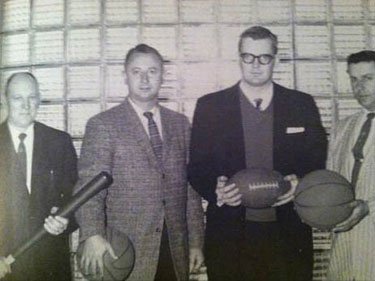
My high school Latin teacher is the large chap wearing glasses. He also coached one of our sports teams.
/div>

Feeds
|





