Archive for June, 2016
15 Jun 2016


Gersh Kuntzman undoubtedly looks just like this.
Gersh Kuntzman, reporting for the hoplophobic New York Daily News, wound up psychically-scarred with a bruised shoulder and suffering from Post-Traumatic Stress Syndrome after test-firing an AR-15.
What is it like to fire an AR-15? It’s horrifying, menacing and very very loud.
It feels like a bazooka — and sounds like a cannon.
One day after 49 people were killed in the Orlando shooting, I traveled to Philadelphia to better understand the firepower of military-style assault weapons and, hopefully, explain their appeal to gun lovers.
But mostly, I was just terrified. …
I’ve shot pistols before, but never something like an AR-15. Squeeze lightly on the trigger and the resulting explosion of firepower is humbling and deafening (even with ear protection).
The recoil bruised my shoulder. The brass shell casings disoriented me as they flew past my face. The smell of sulfur and destruction made me sick. The explosions — loud like a bomb — gave me a temporary case of PTSD. For at least an hour after firing the gun just a few times, I was anxious and irritable.
Read the whole thing.
I will grant Mr. Kuntzman that ARs are noisy, but Goodness Gracious, Mercy Me! they shoot the .223 cartridge, a minutely-modified version of the old .222 Remington, a center-fire cartridge introduced in 1950 as a less noisy groundhog shooting cartridge offered as a less-powerful alternative to the .220 Swift and the .22-250 Remington.
Kuntzman ought to try shooting an African big game rifle sometime, or one of those super-handguns custom-made by John Linebaugh that fires the equivalent of an elephant round from a standard-size revolver. The last time I fired my .500 Linebaugh I found a large lump had developed at the base of my thumb. I wondered at the time if it was going to be a permanent souvenir, but it gradually went away.
Back in the old days, when men were men and not metrosexual bed-wetters, Sir Samuel Baker was renowned for using a black-powder 2-bore rifle on dangerous game. The 2-bore designation means that the gun fired a ball weighing a half pound of lead.
Kuntzman (2016) shot an Ar-15 firing a 63 grain .223″ diameter bullet at 900+ feet-per-second.
Samuel Baker (1866) used to shoot a two-bore firing an 8 ounce, 3500 grain 1.326″ diameter bullet at 1500 feet per second. So much has humanity declined in a century and a half.

Sir Samuel Baker, KCB, FRS, FRGS (1821-1893)
15 Jun 2016
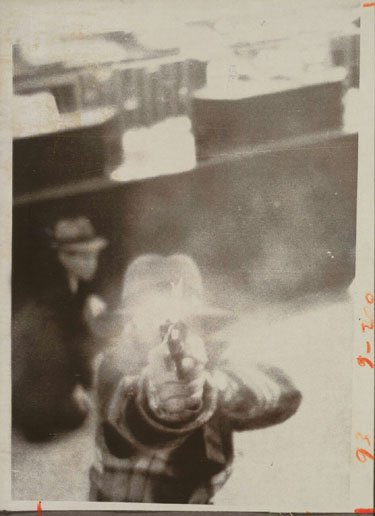
A bank robber aiming at a security camera. Cleveland, March 8, 1975, The Metropolitan Museum of Art.
That is a sawed-off double-barrel shotgun he’s aiming, too.
15 Jun 2016
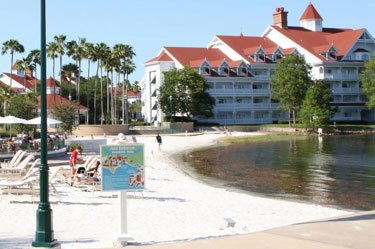
Man-made lagoon at Disney World where a two-year-old boy was dragged into by an alligator yesterday.
New York Post:
The 2-year-old boy who was dragged by an alligator on the shores of Disney’s upscale Grand Floridian Resort & Spa remained missing early Wednesday — as authorities continued their desperate search for the tragic tot.
Jeff Williamson of the Florida Fish and Wildlife Conservation Commission said additional personnel would be deployed to assist in the search-and-rescue operation.
“Right now we’re going to bring in some fresh eyes and continue with the search,†Williamson said, the Orlando Sentinel reported. “Prepare for the worst, hope for the best.â€
The boy, who was vacationing with his family of five from Nebraska, was on the shoreline of the Seven Seas Lagoon on Tuesday night when the gator — estimated to be between 4 and 7 feet long — attacked him.
His dad tried to pry him loose from the animal but was unable to, Orange County Sheriff Jerry Demings said.
“As a father, as a grandfather, we’re going to hope for the best in these circumstances, but based on my 35 years of law enforcement experience, we know we have some challenges ahead of us,†Demings said, the paper reported.
Whole thing.
14 Jun 2016

Yale in the 1960s
Uncle Rick explains the differences between college education in the Pre-Revolutionary 1960s and what goes on at colleges today.
Long ago, before 1965 say, college was understood to be for the intelligent and academically prepared among the young, who would one day both provide leadership for the country and set the tone of society. Perhaps ten percent, but no more than twenty percent, of high-school graduates were thought to have any business on a campus.
It was elitist and deliberately so. Individuals and groups obviously differed in character and aptitude. The universities selected those students who could profit by the things done at universities.
Incoming freshmen were assumed to read with fluency and to know algebra cold. They did, because applicants were screened for these abilities by the SATs. These tests, not yet dumbed down, then measured a student’s ability to handle complex ideas expressed in complex literate English, this being what college students then did.
There were no remedial courses. If you needed them, you belonged somewhere else. The goal of college was learning, not social uplift.
Colleges were a bit stodgy, a bit isolated from the world, and focused on teaching. Most had not adopted the grand-sounding title of “university.†Professors were hired for a few years to see whether they worked out with the expectation that if they did, they would get tenure. At schools I knew, “publish or perish†did not exist. The students, almost entirely white and with the cultural norms associated with that condition, were well behaved within the limits imposed by late adolescence.
The purpose of college was the making of cultivated men and women who would understand the world to the extent that it has proved willing to be understood. This meant the liberal arts. “Liberal†didn’t mean “lefty†or “nice.†It implied a broad grounding in languages, literature, history, the sciences, mathematics, economics, philosophy, and art and music.
The emphasis was on “broad.†For example, if the student took a reasonably rigorous course called “A Survey of Art from Classical Antiquity to the Present,†he—or, most assuredly she—could go into any museum or archaeological site in the Western world, and know what he was seeing. In discussions of politics or literature he would not feel like an orphaned guttersnipe and, having a basis in most fields, could rapidly master any that proved of importance or interest.
There was of course, the young being the young, parallel interest in beer, the other sex, and the usual foolishness that we geezers remember with fondness.
That is how things were. Then came what are roughly called the Sixties, actually the late Sixties and early Seventies.
They changed everything.
Read the whole thing.
Hat tip to Karen L. Myers.

Yale today
13 Jun 2016
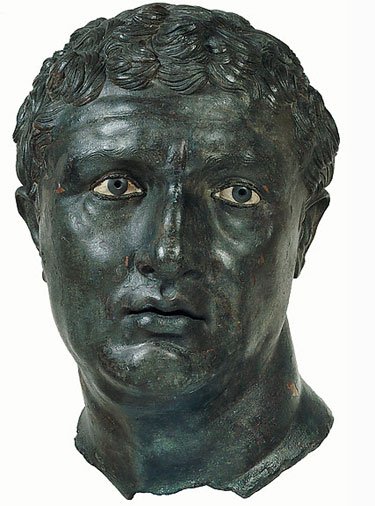
Portrait of a Man from Delos, Bronze, c. 100 B.C., National Archaeological Museum, Athens.
G.W. Bowersock (a leading authority on Hellenistic Art), in the New York Review of Books, recommends emulating Turgenev and taking in the Metropolitan Museum’s current Pergamon-Hellenistic Art exhibition.
In January 1880 the great Russian novelist Ivan Turgenev, author of Fathers and Sons and one of the most cosmopolitan Russian writers of the time, was visiting Berlin, when he paid a visit to the Altes Museum. What he saw there not only made a profound impression upon him personally but marked the beginning of a momentous transformation in European understanding of the art and culture of the ancient Mediterranean world. …
Visitors to the Metropolitan Museum’s current exhibition devoted to Pergamon and the Hellenistic kingdoms of antiquity can now recapture Turgenev’s excitement and exaltation, even though what is on display inevitably corresponds only in part to what he saw. Almost all the reliefs in 1880 had arrived in Berlin within the previous two years, after the opening of German excavations at the site in 1878. Over the decades that followed they were incorporated into a reconstruction of the Pergamon altar that has long been one of the glories of the Pergamon Museum in Berlin.
That museum is currently undergoing renovation, and this has allowed many of its objects, though obviously not the altar itself or most of the reliefs, to be lent to New York. The reliefs in New York are panels that show the birth and infancy of Heracles’ son Telephus, who was the mythical founder of the city. The Telephus reliefs come from the inner walls of the colonnade at the top of the altar, and so the Gigantomachy frieze has to be appreciated through photographs. But the curators of the exhibition have successfully combined the loans from Berlin with major pieces from many other collections so as to provide a wide-ranging exploration of the art and culture of the so-called Hellenistic world. This is the international milieu in which Pergamon shone brightly and to which Rome was much indebted.
Hellenistic culture is often misunderstood and confused with Hellenic (or Greek) culture. Yet it is very different, though related. It is a culture that derives from the conquests of Alexander the Great, who, under the inspiration of his teacher Aristotle, brought the legacy of classical Greece across Asia Minor, the Middle East, and India. The Metropolitan Museum has not only created a visual effect that would inspire a modern Turgenev, but it has given Hellenistic art, which lies between the art of classical Greece and that of Rome, the prominence it amply deserves.
Photos of Objects Being Exhibited
Exhibition catalog (cheaper at Amazon): Pergamon and the Hellenistic Kingdoms of the Ancient World
13 Jun 2016

David Remnick, in the New Yorker, contemplated the horror show that is the 2016 election slate. He got off one particularly good line, summing up the perspective of NeverTrumpers:
[T]hose who reject Trump as some noxious combination of Father Coughlin and Ethelred the Unready.
Read the whole thing.
12 Jun 2016

Morning Call:
Allentown police confirmed local officials corralled an alligator around 7 p.m. Friday after hours tracking it through the Lehigh Canal. On Saturday morning, the reptile was on its way to a preserve in the Poconos.
Travis Benitez, 18, spotted the 31/2-foot gator while fishing in the canal. The teen said he’s been fishing in the canal since he was 7 years old and “never saw anything like that in my life.”
The gator prompted lots of activity. Police got a call around noon. City officials called for assistance from reptile and wildlife experts and tried to get the alligator to the bank. Keith Galvin of Galvin Wildlife Control of the Lehigh Valley tried to hook the alligator, which he says is a humane way to get the reptile out of the water.
“It won’t hurt him, he has alligator skin,” he said as he tried to capture the gator.
The rescue operation proved to be challenging because of the dense seaweed-like grass lining the water. Also, the alligator blended in with the canal with only its eyes rising above the water.
When a fisherman spotted an alligator in the Lehigh Canal in Allentown earlier this month, it made for a few tense hours as authorities tried to corral the carnivore. Keith E. Galvin Sr., of Galvin Wildlife Control in Upper Macungie Township, eventually was successful in hooking the gator and then turned it over to a reptile preserve in the Poconos.
A plastic crate, typically used to carry a large dog, was ready for the gator once it was corralled.
While Allentown won’t be confused for the Florida Everglades, there have been alligators captured in the waters of the Queen City in the past.
In September 2009, Allentown police, a city fire marshal and animal control officers captured a 6-foot alligator — believed to be the biggest ever found in the Lehigh Valley — sunning itself on the bank of the Jordan Creek
In the Spring of last year, an alligator was sighted in the Monongahela River in Western Pennsylvania.
11 Jun 2016
From Matthew Johnson on Facebook:


(Apologies for the hard-to-read images. They won’t enlarge or sharpen better. Facebook images are small.)
/div>

Feeds
|