Archive for 2016
29 May 2016

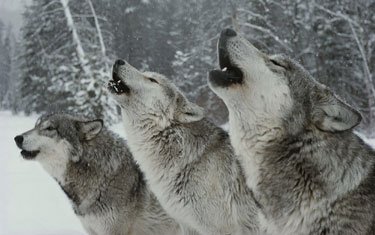
Holly Root-Gutteridge studies wolf dialects.
After hundreds of hours listening to thousands of wolves for my PhD, the difference between howls was obvious. The voice of a Russian wolf was nothing like that of a Canadian, and a jackal was so utterly different again that it was like listening to Farsi and French. I believed that there must be geographic and subspecies distinctions. Other researchers had made this proposition before, but no one had put together a large enough collection of howls to test it properly. …
Studies since the 1960s have shown that the howls that have haunted our dreams for centuries can tell us a lot about the particular wolf vocalising. Like humans, each wolf has its own voice. Each pack also shares howl similarities, making different families sound distinct from each other (wolves respond more favourably to familiar howls). This much we knew. What we didn’t know was whether the differences seen between packs were true of subspecies or of species, and if an Indian wolf howl would be distinct from a Canadian one.
More questions follow. If howls from different subspecies are different, do the howls convey the same message? Is there a shared culture of howl-meanings, where an aggressive howl from a European wolf means the same thing as an aggressive howl of a Himalayan? And can a coyote differentiate between a red wolf howling with aggressive intent and one advertising the desire to mate? Even without grammar or syntax, howls can convey intent, and if the shape of the howl changes enough while the intent remains constant, the foundations of distinctive culture can begin to appear. … Our canine voice collection represented was one of the most comprehensive ever.
We compared howls across 13 different subspecies and species of coyotes, dogs, wolves and jackals (collectively known as canids).
We then stretched all the howls to the same length, using a process called dynamic time warping, to compare the changes in the tune without including the tempo it was played at. We found that each species had its own favourite howl shape, a preferred set of changes to their howls to raise and drop the pitch, but that they also used howl shapes preferred by other species, and varied the shapes as they pleased. The species were like music bands with preferred styles of playing, whether riff-filled like jazz or the pure tones of classical, but were flexible in what they actually played at any given time. So while they had a favourite style, the tune itself varied.
Like musicians, the wolves were influenced by their forebears in the genre, and species shared traits with other canids that were closer to them geographically and genetically. An Eastern grey wolf, recorded in the US, sounded more like a North Carolinian red wolf than a European wolf, and an African jackal sounded quite different again. Small and delicate compared with their cousins the European wolves, golden jackals have high, rising howls, running up and down the scales in bravura performances of control and speed, but with less variation in overall shape, whereas the European wolves used a slower style of deep and steady long notes ending in falls that seem to drift away into the night. New Guinea singing dogs earned their names with a large vocal repertoire and a wide selection of howl shapes. While sometimes the different species achieved crossovers to other shapes, most had a style that dominated their repertoires.
Read the whole thing.
29 May 2016

University of Cambridge Research:
A new app which tries to guess your regional accent based on your pronunciation of 26 words and colloquialisms will help Cambridge academics track the movement and changes to English dialects in the modern era.
Along with colleagues from the universities of Zurich and Bern, Cambridge’s Adrian Leemann has developed the free app English Dialects (available on iOS and Android) which asks you to choose your pronunciation of 26 different words before guessing where in England you’re from.
The app, officially launched today on the App Store and Google Play, also encourages you to make your own recordings in order to help researchers determine how dialects have changed over the past 60 years. The English language app follows the team’s hugely successful apps for German-speaking Europe which accumulated more than one million hits in four days on Germany’s Der Spiegel website, and more than 80,000 downloads of the app by German speakers in Switzerland.
“We want to document how English dialects have changed, spread or levelled out,†said Dr Leemann, a researcher at Cambridge’s Department of Theoretical and Applied Linguistics. “The first large-scale documentation of English dialects dates back 60-70 years, when researchers were sent out into the field – sometimes literally – to record the public. It was called the ‘Survey of English Dialects’. In 313 localities across England, they documented accents and dialects over a decade, mainly of farm labourers.â€
The researchers used this historical material for the dialect guessing app, which allows them to track how dialects have evolved into the 21st century.
“We hope that people in their tens of thousands will download the app and let us know their results – which means our future attempts at mapping dialect and language change should be much more precise,†added Leemann. “Users can also interact with us by recording their own dialect terms and this will let us see how the English language is evolving and moving from place to place.â€
The app asks users how they pronounce certain words or which dialect term they most associate with commonly-used expressions; then produces a heat map for the likely location of your dialect based on your answers.
For example, the app asks how you might say the word ‘last’ or ‘shelf’, giving you various pronunciations to listen to before choosing which one most closely matches your own. Likewise, it asks questions such as: ‘A small piece of wood stuck under the skin is a…’ then gives answers including: spool, spile, speel, spell, spelk, shiver, spill, sliver, splinter or splint. The app then allows you to view which areas of the country use which variations at the end of the quiz.
It also asks the endlessly contentious English question of whether ‘scone’ rhymes with ‘gone’ or ‘cone’.
Read the whole thing.
28 May 2016

Heber City, Utah
KPCW
28 May 2016

The Shrieking Student confronting Master Christakis last November.
We saw this week the sad denouement of last Fall’s Great Halloween Costume Controversy at Yale.
The very liberal Master of Silliman College and his equally liberal wife and co-Master, were publicly denounced and vilified early last November for Mrs. Christakis’s daring to question the dictate on the vital issues of Halloween costuming laid down by Yale’s “Intercultural Affairs Committee,” a 13-member group of administrators from the Chaplain’s Office, campus cultural centers, and other campus organization. That committee urged students to be careful of the cultural implications of their Halloween costumes and to avoid trespassing upon the tender sensitivities of officially-recognized victim groups via the use of feathered headdresses, turbans, “war paint,†or blackface, all cases of inappropriate “cultural appropriation and/or misrepresentation.â€
Co-Master Erika Christakis responded two days later, the night before Halloween with her own email, based on her professional expertise as a child development specialist, questioning the appropriateness of the university policing students’ choices of Halloween costumes:
I don’t wish to trivialize genuine concerns about cultural and personal representation, and other challenges to our lived experience in a plural community. I know that many decent people have proposed guidelines on Halloween costumes from a spirit of avoiding hurt and offense. I laud those goals, in theory, as most of us do. But in practice, I wonder if we should reflect more transparently, as a community, on the consequences of an institutional (which is to say: bureaucratic and administrative) exercise of implied control over college students.
Christakis raised free speech and expression issues and then inquired philosophically:
Is there no room anymore for a child or young person to be a little bit obnoxious… a little bit inappropriate or provocative or, yes, offensive? American universities were once a safe space not only for maturation but also for a certain regressive, or even transgressive, experience; increasingly, it seems, they have become places of censure and prohibition.
Demonstrations ensued, an open letter denouncing Erika Christakis’s email was signed by hundreds and hundreds of students and faculty, Nicholas Christakis was confronted and abused by “the shrieking student,” Yale Dean Holloway was confronted and scolded by a crowd of students of color, demonstrators demanded the Yale Administration apologize and meet a long laundry list of demands, including the dismissal of both Christakises.
The University declined to fire the Christakises, and affirmed that they continued to have its support. But, Erika Christakis quit teaching at Yale last December, and her husband Nicholas announced soon thereafter that he would be taking a sabbatical for the Spring Semester.
On Wednesday this week, the Yale Daily News reported that, all that solid Administration support notwithstanding, what do you know? the Christakises will never be coming back.
Months after a controversial email helped spur sustained student protests last fall, Nicholas and Erika Christakis will step down as head and associate head of Silliman College, effective this July.
In a Wednesday afternoon email to the Silliman community, Nicholas Christakis announced that he submitted his resignation to University President Peter Salovey last week. The couple drew national attention last fall when a Halloween weekend email from Erika Christakis defending students’ rights to wear culturally appropriative costumes sparked outrage on campus.
At the time, many students and alumni called for the couple to resign their roles at the helm of Silliman College, arguing that the two could no longer serve as effective leaders of a college community designed to create a home for undergraduates. But others said their removal would constitute a serious blow to free speech on college campuses.
In his resignation announcement, Nicholas Christakis emphasized the importance of open intellectual debate, a stance which caused controversy last fall as many students argued that the emphasis on free speech came at the cost of student wellbeing and safety.
“We have great respect for every member of our community, friend and critic alike,†Nicholas Christakis wrote. “We remain hopeful that students at Yale can express themselves and engage complex ideas within an intellectually plural community. But we feel it is time to return full-time to our respective fields of public health and early childhood education.â€
The Foundation for Individual Rights in Education noted that Yale’s fidelity to its own supposed ironclad commitment to Free Speech seems to be less than ironclad in actual practice.
Now both professors have stepped down. The “glowing promises†… in Yale’s famed Woodward Report, which assures students and faculty members that they are free to “think the unthinkable, discuss the unmentionable, and challenge the unchallengeable†and states that “[a]mong the College’s most cherished principles is its commitment to freedom of expression.â€
With the Christakises’ resignation, it’s clear that Yale’s ability to live up to its public promise to provide an environment that fosters free and robust debate has been called into sharp question.
———————————————————
It is probably some Yale irate alumn who has singled out the shrieking student on Facebook for revenge.

28 May 2016

Henri Lebasque, Boat on the Marne, 1905, private collection
/div>

Feeds
|