17 Mar 2017
Everybody Wants to Be Irish On St. Patrick’s Day
Galway Girl, Ireland, St. Patrick's Day, Thai Tims

Including these cute Thai kids.
|
Archive for March, 2017
17 Mar 2017
Everybody Wants to Be Irish On St. Patrick’s DayGalway Girl, Ireland, St. Patrick's Day, Thai TimsIncluding these cute Thai kids. 17 Mar 2017
St. Patrick’s DayHagiography, Ireland, St. Patrick, St. Patrick's Day, Traditions
From Robert Chambers, The Book of Days, 1869: LEGENDARY HISTORY OF ST. PATRICK Almost as many countries arrogate the honour of having been the natal soil of St. Patrick, as made a similar claim with respect to Homer. Scotland, England, France, and Wales, each furnish their respective pretensions: but, whatever doubts may obscure his birthplace, all agree in stating that, as his name implies, he was of a patrician family. He was born about the year 372, and when only sixteen years of age, was carried off by pirates, who sold him into slavery in Ireland; where his master employed him as a swineherd on the well-known mountain of Sleamish, in the county of Antrim. Here he passed seven years, during which time he acquired a knowledge of the Irish language, and made himself acquainted with the manners, habits, and customs of the people. Escaping from captivity, and, after many adventures, reaching the Continent, he was successively ordained deacon, priest, and bishop: and then once more, with the authority of Pope Celestine, he returned to Ireland to preach the Gospel to its then heathen inhabitants. The principal enemies that St. Patrick found to the introduction of Christianity into Ireland, were the Druidical priests of the more ancient faith, who, as might naturally be supposed, were exceedingly adverse to any innovation. These Druids, being great magicians, would have been formidable antagonists to any one of less miraculous and saintly powers than Patrick. Their obstinate antagonism was so great, that, in spite of his benevolent disposition, he was compelled to curse their fertile lands, so that they became dreary bogs: to curse their rivers, so that they produced no fish: to curse their very kettles, so that with no amount of fire and patience could they ever be made to boil; and, as a last resort, to curse the Druids themselves, so that the earth opened and swallowed them up. … The greatest of St. Patrick’s miracles was that of driving the venomous reptiles out of Ireland, and rendering the Irish soil, for ever after, so obnoxious to the serpent race, that they instantaneously die on touching it. Colgan seriously relates that St. Patrick accomplished this feat by beating a drum, which he struck with such fervour that he knocked a hole in it, thereby endangering the success of the miracle. But an angel appearing mended the drum: and the patched instrument was long exhibited as a holy relic. … When baptizing an Irish chieftain, the venerable saint leaned heavily on his crozier, the steel-spiked point of which he had unwittingly placed on the great toe of the converted heathen. The pious chief, in his ignorance of Christian rites, believing this to be an essential part of the ceremony, bore the pain without flinching or murmur; though the blood flowed so freely from the wound, that the Irish named the place St. fhuil (stream of blood), now pronounced Struill, the name of a well-known place near Downpatrick. And here we are reminded of a very remarkable fact in connection with geographical appellations, that the footsteps of St. Patrick can be traced, almost from his cradle to his grave, by the names of places called after him. Thus, assuming his Scottish origin, he was born at Kilpatrick (the cell or church of Patrick), in Dumbartonshire. He resided for some time at Dalpatrick (the district or division of Patrick), in Lanarkshire; and visited Crag-phadrig (the rock of Patrick), near Inverness. He founded two churches, Kirkpatrick at Irongray, in Kireudbright; and Kirkpatrick at Fleming, in Dumfries: and ultimately sailed from Portpatrick, leaving behind him such an odour of sanctity, that among the most distinguished families of the Scottish aristocracy, Patrick has been a favourite name down to the present day. Arriving in England, he preached in Patterdale (Patrick’s dale), in Westmoreland: and founded the church of Kirkpatrick, in Durham. Visiting Wales, he walked over Sarn-badrig (Patrick’s causeway), which, now covered by the sea, forms a dangerous shoal in Carnarvon Bay: and departing for the Continent, sailed from Llan-badrig (the church of Patrick), in the island of Anglesea. Undertaking his mission to convert the Irish, he first landed at Innis-patrick (the island of Patrick), and next at Holmpatrick, on the opposite shore of the mainland, in the county of Dublin. Sailing northwards, he touched at the Isle of Man, sometimes since, also, called. Innis-patrick, where he founded another church of Kirkpatrick, near the town of Peel. Again landing on the coast of Ireland, in the county of Down, he converted and baptized the chieftain Dichu, on his own threshing-floor. The name of the parish of Saul, derived from Sabbal-patrick (the barn of Patrick), perpetuates the event. He then proceeded to Temple-patrick, in Antrim, and from thence to a lofty mountain in Mayo, ever since called Croagh-patrick. He founded an abbey in East Meath, called Domnach-Padraig (the house of Patrick), and built a church in Dublin on the spot where St. Patrick’s Cathedral now stands. In an island of Lough Deng, in the county of Donegal, there is St. Patrick’s Purgatory: in Leinster, St. Patrick’s Wood; at Cashel, St. Patrick’s Rock; the St. Patrick’s Wells, at which the holy man is said to have quenched his thirst, may be counted by dozens. He is commonly stated to have died at Saul on the 17th of March 493, in the one hundred and twenty-first year of his age. … The shamrock, or small white clover (trifolium repens of botanists), is almost universally worn in the hat over all Ireland, on St. Patrick’s day. The popular notion is, that when St. Patrick was preaching the doctrine of the Trinity to the pagan Irish, he used this plant, bearing three leaves upon one stem, as a symbol or illustration of the great mystery. To suppose, as some absurdly hold, that he used it as an argument, would be derogatory to the saint’s high reputation for orthodoxy and good sense: but it is certainly a curious coincidence, if nothing more, that the trefoil in Arabic is called skamrakh, and was held sacred in Iran as emblematical of the Persian Triads. Pliny, too, in his Natural History, says that serpents are never seen upon trefoil, and it prevails against the stings of snakes and scorpions. This, considering St. Patrick’s connexion with snakes, is really remarkable, and we may reasonably imagine that, previous to his arrival, the Irish had ascribed mystical virtues to the trefoil or shamrock, and on hearing of the Trinity for the first time, they fancied some peculiar fitness in their already sacred plant to shadow forth the newly revealed and mysterious doctrine. … In the Galtee or Gaultie Mountains, situated between the counties of Cork and Tipperary, there are seven lakes, in one of which, called Lough Dilveen, it is said Saint Patrick, when banishing the snakes and toads from Ireland, chained a monster serpent, telling him to remain there till Monday. The serpent every Monday morning calls out in Irish, ‘It is a long Monday, Patrick.’ That St Patrick chained the serpent in Lough Dilveen, and that the serpent calls out to him every Monday morning, is firmly believed by the lower orders who live in the neighbourhood of the Lough. 16 Mar 2017
Good Customer ServiceBarrett Firearms Manufacturing, M107 Barrett Rifle, USMC
16 Mar 2017
Just “A Vast Slave Society”Harvard, Isaac Royall, Liberal Guilt, Racial Politics, Ressentiment, Slavery, Ta-Nehisi Coates
Harvard Magazine reports that Harvard recently invited professional race-baiter Ta-Nehisi Coates to deliver the keynote address at a day-long liberal guiltfest over the century-and-a-half extinct institution which (regrettably) brought Coates’ ancestors to American shores. The above 19th century daguerrotype served as poster-image for the conference because the wicked and nefarious naturalist Louis Agassiz, while working at Harvard, had caused that image to be captured for use in his studies of taxonomy and human etiology. That racist bastard Agassiz working in the first half of the 19th century (Can you imagine?) actually took the differences in skin color and physiognomy exhibited in this image as evidence supporting a significant taxonomic distinction between Sub-Saharan Africans and Europeans. The audience of Harvards trembled guiltily on their seats as Ta-Nehisi Coates demanded reparations, telling his open-mouthed listeners that “We talk about enslavement as if it were a bump in the road. And I tell people: it’s the road. It’s the actual road.â€
Read the whole thing. 15 Mar 2017
Near Lake OntarioLake Ontario, New York State, Weather
Photo of ice-covered house forwarded on Facebook by John Kucko, an anchor at WROC in Rochester, NY. 15 Mar 2017
Ides of MarchIdes of March, J.W. Cooper High School, Julius Caesar, Latin, Rome, The Region
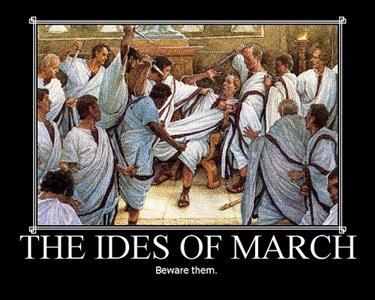
When I was in high school, I had Latin in 9th and 10th grade. Our Latin teacher had a curious personal custom. He sacrificed annually, in honor of Great Caesar, on the Ides of March, the male student in each class who had offended him by doing the least work and/or being the most disruptive. He sacrificed additionally one female student from each class whose selection, I fear, was based only upon his own capricious whim and covert sexual attraction. The sacrifice consisted of the victim being bent over a desk and receiving three strokes of a paddle, delivered by a six foot+, 250 lb.+ Latin teacher laying on the strokes with a will and putting his weight behind them. (I won’t name him.) Mr. X’s paddle was a four foot long piece of 1 1/2″ thick pine, produced in our high school’s wood shop by General Curriculum students, who did not take Latin, but admired Mr. X. The paddle was roughly in the form of a Roman gladius, and its surface was scored by a series of regular lines, because it was generally believed that a blow from an uneven surface was more painful. Mr. X had a fixed policy of assigning the duty of construing the day’s Latin assignment on the blackboard in strict and completely predictable order, going up and down the aisles of desks. Two or three of the smart kids would always actually do the Latin, (I was one of them) and it was our recognized duty to supply the translations in advance to the person who would be going to the blackboard. Readiness to translate correctly was really vital, because Mr. X would apply his dreaded paddle to anyone who failed to write out the day’s assignment correctly on the blackboard. It was rare, but every once in a while some truly feckless idiot would neglect to seek out Kenny Hollenbach, Jack Rigrotsky, or yours truly, and would arrive at the blackboard, chalk in hand, unprepared. Mr. X typically broke the current paddle over the defaulter’s posterior, and the mental defectives in shop class would gleefully commence the fabrication of a new, yet more elaborate, edition of the famous paddle. Every March 15th, two 9th and 10th grade Academic Curriculum sections would look on with the same sadistic interest of Roman spectators at the gladitorial games, as Mr. X conducted his sacrifices. I can recall that he struck the pretty strawberry blonde with the well-developed embonpoint so hard that he raised dust from her skirt. We were a bit puzzled that girls actually submitted to being beaten with a paddle for no reason, but all this went on undoubtedly because the legend of Mr. X the fierce disciplinarian had enormous appeal in our local community. The whole thing was fascinating, and it all made such a good story that everyone, student and adult, in his heart of hearts, enthusiastically approved. Mr. X would never be allowed to get away with that kind of thing today, alas! In Hades, poor Caesar must do without his sacrifice. And it is my impression that Latin instruction has rather overwhelmingly also become a thing of the past. Kids today learn Spanish. Modern languages are easier and are thought more relevant.
————————– An annual post in memory of my Latin teacher. 14 Mar 2017
Establishmentarians Love “Hamilton” Because They Really Don’t Know Much About Hamilton"Hamilton" the Musical, Alexander Hamilton, American History, Community of Fashion, Inadvertent Irony, Ron Chernow
Matt Stoller explores all the multiplicitous ironies of the chattering class’s embrace of the hip hop musical about the fellow John Adams described as “the bastard brat of a Scots peddler.”
Read the whole thing. 14 Mar 2017
Impeachara2016 Election, Donald Trump, Liberal MeltdownUnhappy liberals need medication. Welcome to
NEVER YET MELTED
Another Right-Wing Web Aggregator and Purveyor of Unpopular Opinions
 David Zincavage contact: jdz@usa.net blog advertising is good for General Bullmoose and good for the USA. 


Feeds
|