Archive for April, 2017
11 Apr 2017


Tom Simon takes a pretty successful poke at Annie Proulx in the course of a lengthy attack on pretentious literary modernism. Yay, Papa Hemingway! Boo! Jimmy Joyce!
This mania for stylistic weirdness, enforced by the blocking troops of Modernist criticism, led in the end to a situation where even quite ordinary newspaper reviewers would shout praise for the ‘experimental’ brilliance of bad prose rather than admit to the nudity of the reigning monarch. One of the reigning monarchs of the nineties was Annie Proulx, who was extravagantly lauded for the following sentence in Accordion Crimes. A woman has just had her arms chopped off by sheet metal, and this is how Proulx describes it:
She stood there, amazed, rooted, seeing the grain of the wood of the barn clapboards, paint jawed away by sleet and driven sand, the unconcerned swallows darting and reappearing with insects clasped in their beaks looking like mustaches, the wind-ripped sky, the blank windows of the house, the old glass casting blue swirled reflections at her, the fountains of blood leaping from her stumped arms, even, in the first moment, hearing the wet thuds of her forearms against the barn and the bright sound of the metal striking.
Every story is a conversation between writer and reader, even though the writer is effectively deaf and seldom hears what the reader is saying. Here is a rough transcript of the conversation as it transpires in the passage above:—
Proulx. My character is stunned. Absolutely gobsmacked. Don’t I do a wonderful job of telling you how gobsmacked she is? She’s not just amazed, she’s rooted.
Reader. I don’t think that’s how people react to having their arms chopped off.
P. Now if I were one of these hack commercial writers, I’d talk about her. But see how cleverly I do everything by indirection! See how poetic I am! The barn is built of clapboards, you see—
R. I don’t care about the clapboards. This woman is bleeding to death!
P. And you can see the wood grain because the paint has all been worn off, but I wouldn’t put it that way, oh no, I’m a Writer, I am. So I said to myself, what’s a better action verb to use in this place? Why, chewed, of course! But that’s not poetic enough for me, because I’m a Special Snowflake, I am. So I changed it to jawed instead. Isn’t that original? Aren’t I clever? Look at meeee!
R. I don’t think that word means what you think it means. It doesn’t mean chew; it means to natter on endlessly, just like you’re doing now. Now will you stifle it and get on with the story?
P. Now I describe the swallows, and they’re so ironic, because they’re unconcerned, don’t you see? And they’re just carrying on about their business, darting out of sight and coming back—
R. All this while that poor woman’s arms are flying through the air? They must be miles away by now.
P. That’s not my point. My point is that they’re catching insects, don’t you see, and the insects are like moustaches! Isn’t that clever? Only a Writer could have come up with that simile! Look at meee!!
R. I think you’re mistaking me for someone who cares.
P. And then I describe the rest of the scene, and I’m just as clever about that, and the windows don’t just make reflections, they make swirled blue reflections, because I’m a Writer, I am, and look at me being all impressionist!
R. I think I’m going to skip on a bit.
P. Spoilsport! All right, I’ll get in a bit about my character, since you seem so anxious for me to be all boring and nasty and commercial and stick to the silly old point. What do you think I am, the six o’clock news? So her blood is spurting, no, that’s too ordinary, leaping from her stumped arms—
R. You mean from the stumps of her arms. ‘Stumped’ means something completely different. It has to do with not having a clue, hint, hint.
P. I’m a Writer, I am, and you can tell because I don’t let myself be limited by your silly old bourgeois rules. Her stumped arms, I said, and I’m sticking to it. And then she hears the wet thuds of her forearms—
R. Ewwww.
P. —against the barn, and then the sheet metal hits, and it’s not just the sound of it hitting, it’s the bright sound, because only a Writer would use something as nifty as synaesthesia to put her point across. See? I know about synaesthesia! I’m smart! Look at me! LOOK AT MEEEEEE!!!!
R. If you don’t get on with the story, I’m going to say the Eight Deadly Words.
P. (momentarily taken aback) Which are?
R. ‘I don’t care what happens to these people.’ I mean, if you’re going to stand there jawing (see, I used the word correctly) about swallows and moustaches and swirly blue windows, while the woman you have just mutilated is bleeding her life away — well, if you care as little as that about your own characters, I don’t see why I should give a damn. You haven’t even noticed that she’s in pain!
P. (angrily) This isn’t about her. This is about me! Me, meee, wonderful ME!! Damn you, why aren’t you looking at ME!!!
Of course this conversation is ruthlessly suppressed in the New York Times review by Walter Kendrick, who singled out that very sentence, in all its scarlet and purple excess, as ‘brilliant prose’. B. R. Myers was kinder to Proulx, if only in the interest of brevity:
The last thing Proulx wants is for you to start wondering whether someone with blood spurting from severed arms is going to stand rooted long enough to see more than one bird disappear, catch an insect, and reappear, or whether the whole scene is not in bad taste of the juvenile variety.
The sad truth, I am afraid, is that self-consciously ‘literary’ writers do not write to be read; they write to impress the critics, and if their ambitions are particularly lofty, to have their books made required reading for hapless English majors. Then the English majors, or a depressingly large percentage of them, buy into the pernicious notion that this self-regarding drivel really is ‘brilliant prose’ — and, still more, that brilliancy of prose is the primary and sufficient purpose of literature — and the whole sorry swindle is perpetuated for another generation.
Proulx’s star has more or less fallen since Myers launched his attack, but the sentence cult goes on.
RTWT
Hat tip to Karen L. Myers.
11 Apr 2017

Writing in Everyday Feminism, “Raging Bisexual” Emily Zak explains that Googles and Yahoos do not recreate themselves in the out-of-doors as much as white folks, and it’s all your fault!
Ambreen Tariq runs Brown People Camping, an Instagram account that promotes diversity in public lands. She says she can feel like an outsider hiking and camping as a Muslim woman of color and immigrant.
“I felt like I had to establish myself – ‘Yeah, I’m a camper, I’m a hiker’ – that other people don’t do as much because they don’t have to question their belonging in that space,†Tariq tells Outside.
“Not only did I not have an authentic background doing activities in the outdoors, but my family didn’t do it, and I don’t have the legacy of being connected to a piece of land because we were always moving.â€
We need to acknowledge outdoor recreation’s lack of diversity and inclusion.
Without understanding what’s keeping folks home, we blame oppressed individuals for “not taking initiative,†rather than addressing what may be preventing them from participating in certain activities.
To encourage people to take their own adventures, we might say well-meaning things like, “Anybody can do this if they’re motivated enough.â€
This can be inspirational to someone who has the resources and leisurely time to explore the outdoors and needs a kick in the butt to do so. However, the message can be draining for folks who are raring to explore, but can’t.
We forget that society’s hierarchies of race, gender identity, sexual orientation, body size, and economic class don’t magically disappear in the forest. We deny that society actively discourages millions from playing outside, possibly stopping budding conservation activists.
As Tariq notes, “The more of us who can connect to it, the more we can protect it together.â€
Here are a few barriers that marginalize people have to overcome to experience nature.
1. You Need Equipment
Our society treats nature as something we can enjoy independent of capitalism.
Theoretically, we go there to escape, and all we need are some sturdy shoes and maybe a sleeping bag.
The reality is more complicated. In the United States, outdoor recreation is a $646 billion industry. Open the pages of outdoor magazines, and you’ll find $150 trail running shoes, $500 tents and $4,000 mountain bikes.
We’ve created a culture of elitism around the outdoors, led by wealthy gear heads.
The Minnesota Land Trust’s Hansi Johnson, who’s white, recalls how he used to see people wearing jeans and flannel cross-country skiing growing up – a rare sight today.
Even if folks push past mainstream narratives and seek more affordable gear, cost is still a factor for low-income people.
If deals on used equipment or borrowing from a friend aren’t feasible in someone’s area, gear for a no-frills camping trip can still cost $500. Forget the cost of a car and gas to get to the campsite.
While do-it-yourself fixes for gear do exist – anybody else try cooking on a beer can camp stove? – they’re not universally known outside of backpacking circles. Ditto on cheap gear websites.
Those who make outdoor activities cheap often have a support system behind them.
As a freelancer with a college education, I’m perpetually broke, not poor. I couldn’t camp comfortably if I didn’t have the gear my parents gifted me back in high school.
No wonder 40% of participants in outdoor activities make $75,000-plus salaries a year.
The paradox that being poor is expensive is true: If you want to participate in a no-cost outdoor activity, you need to have money to invest in the gear initially.
This system reveals deeply entrenched classism. Ignoring it isn’t going to make it go away.
2. Outdoor Gear Doesn’t Fit Everyone
Cost is just one hurdle. Outdoor gear needs to fit.
Fitness culture overall reeks of fat-shaming, for one, which is reflected in workout clothing offerings.
Ultra-marathoner and cross-country coach Mirna Valerio says on Fat Girl Running that she struggles to find functional, flattering outfits that don’t pinch or cost a lot. In fact, most sportswear goes up to just a size twelve.
For those who’d prefer cycling: Only last year did anyone think to build a bike for someone who’s heavier than 300 pounds.
As with disability access, if the equipment isn’t readily available, people aren’t as likely to think that the outdoors are theirs to explore.
If we truly believe that everyone should be outside, we need to hold companies accountable for their limited views on body size.
3. Access to Natural Spaces Is Tangled in Historic Privilege and Oppression
In principle, public lands belong to all of us. In reality, select people get to enjoy it.
Carolyn Finney, geographer and author of Black Faces, White Spaces, explains about how national parks contribute to a larger story about who we are as a country, which historically excludes Black folks.
On Tavis Smiley, a PBS show hosted by Tavis Smiley, Finney reminds us that people of color do have a connection to natural spaces, but some of that land was stolen from them:
†…whether it’s the 400,000 acres of land that were originally given to freed enslaved Africans and then taken away, whether it’s all the native people that had to be removed from land in order for the Homestead Act to make sense, and then give it to European immigrants so that they could have their own plot of land.â€
Finney continues, “This is part of the legacy of who we are and our issues of land and ownership and connection.â€
Today, 80% of communities of color live “in areas where the proportion of remaining natural area is lower than the state average.†According to a study in the American Journal of Preventative Medicine, low-income neighborhoods are four and a half times less likely to have recreation facilities like parks in some states.
Furthermore, what we consider “untouched wilderness†is anything but.
As Kimberly Fanshier notes for Everyday Feminism, this concept centers around white people’s perspective and erases Indigenous populations who lived there for centuries before.
Many national parks and public lands were built on colonized lands. Even US National Parks reflect colonialism, where white leaders ignored Indigenous people in the area to establish.
Our society leverages natural spaces as a tool for capitalism and colonialism, while at the same time touted them as apolitical, free, and pure.
It goes on.
Personally I thought urban minorities do a pretty good job of stealing other people’s bicycles, so why wouldn’t they be adequately equipped for mountain biking?
10 Apr 2017

SFGate:
Researchers at the San Diego Natural History museum recently discovered a new species and genus of spider in the hills of Baja California, called Califorctenus cacahilensis.
While traipsing through the a mine in the hills of Baja California, Michael Wall and Jim Berrian struck gold. Skittering across the abandoned mine shaft was a beast that would send most people running.
The entomologists instead ran toward the creature – a whopping spider the size of a baseball – and captured it for analysis. With juicy fangs, a hairy yellow abdomen and legs for miles, the arachnid was certainly a looker, but neither of the scientists could classify it.
Back in their lab at the San Diego Natural History Museum, the researchers had a eureka moment. Upon corroborating with Mexican entomologist and southern spider expert Maria Jimenez, the scientists confirmed that they had discovered a new species and genus. They named it Califorctenus cacahilensis, after the Sierra Cacahilas mountain ranges where it was first found.
“Discovering a species in entomology and arachnology is not terribly unusual,” said Berrian, who published the findings in Zootaxa last month. “There might be another 2-2.5 million species of undiscovered insects and spiders.”
Finding such a large spider in a place once roamed by humans, however, is a scientific triumph of sorts.
10 Apr 2017

Silver ring in the form of a snake.
Live Science:
A rare silver ring shaped like a snake that wraps around the finger hints at the great wealth of the people who lived at Cataractonium.
Construction work to upgrade Britain’s longest road into a major highway has revealed a treasure trove of rare artifacts from one of the earliest and wealthiest Roman settlements in the country.
The findings include ancient shoes, cups, a rare silver ring, keys, a high-relief glass bowl and an elaborately carved amber figurine, archaeologists with the public group Historic England announced yesterday (April 6).
Archaeologists uncovered the artifacts in North Yorkshire along the A1, which stretches 410 miles (660 kilometers) from London to Edinburgh, Scotland, during a major project to improve the existing roadway.
“It is fascinating to discover that nearly 2,000 years ago, the Romans were using the A1 route as a major road of strategic importance and using the very latest technological innovations from that period to construct the original road,” Tom Howard, project manager at the government agency Highways England, said in a statement.
Indeed, the newly found artifacts include a plumb bob used to build straight roads, which was likely utilized in the construction of Dere Street, a Roman road following the course of the A1, the researchers said.
The excavations have also led to the discovery of a major Roman settlement at Scotch Corner, one of the best-known junctions in the country.
Taking its name from an old Roman road called Scots Dyke, Scotch Corner links Scotland with England and the east coast with the west coast.
Right there, the archaeologists with the professional consultant group Northern Archaeological Associates unearthed the remains of a large settlement dating back to A.D. 60, thus predating settlements in York and Carlisle by 10 years.
The discovery proves that the Romans “possibly began their territorial expansion into northern England a decade earlier than previously thought,” according to Historic England.
The settlement at Scotch Corner was unusually large compared to others in northern England, and stretched over 4,600 feet (1,400 meters) from north to south — roughly the length of 13 football fields positioned end to end, according to Historic England.
Artifacts unearthed there suggest that the people who lived at Scotch Corner were rather wealthy. High-status imported items include the figure of a toga-clad actor carved from a block of amber, which is believed to have been made in Italy during the first century A.D.
“A similar example was found at Pompeii. Nothing like this has ever before been found in the U.K.,” representatives with Historic England said.
The archaeologists unearthed more than 1,400 clay fragments of molds used for making gold, silver and copper coins, thus making the site the largest known and most northerly example of coin production ever found in Europe, the researchers said. Those findings suggest that the settlement might have served as a sophisticated industrial and administrative center, the archaeologists said.
“It shows that the Romans were carrying out significant industrial activity in this part of England and potentially producing coins of high value,” Historic England representatives said in the statement.
But it was a short-lived glory. The settlement was occupied for just two to three decades. Its demise seems to coincide with the rise of Catterick, a town south of Scotch Corner known by the Romans as Cataractonium.
Finds at Catterick abounded. The archaeologists unearthed several well-preserved leather shoes, along with large sheets of leather, perhaps used for producing clothes. The artifacts suggest that Cataractonium was an important leatherworking center that likely supported the Roman military, the archaeologists said.
A rare silver ring shaped like a snake, which wraps around the finger, and a number of keys of various sizes suggest that the people who lived in Cataractonium were wealthy and that they locked up their valuable possessions, the archaeologists suggested.
Moreover, the many styli (Roman pens) and a pewter inkpot found at the site indicate that most of these ancient people were able to read and write, the researchers said.
“The sheer amount of exceptional objects found on this road scheme has been extraordinary,” Neil Redfern, principal inspector of ancient monuments at Historic England, said in the statement. “This project has given us a unique opportunity to understand how the Romans conducted their military expansion into northern England and how civil life changed under their control.”
Photos
09 Apr 2017

Carl LaFong:
The Golden Gate bridge was built in two years by men with slide rules who smoked Lucky Strikes and used racial epithets. Today it takes our enlightened and fabulously diverse society 4 years to paint it. You tell me if we’re better off.
09 Apr 2017
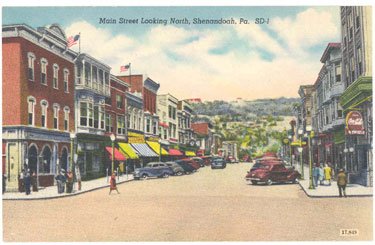
North Main Street, Shenandoah, Pennsylvania, just a bit before my time. It still looked just like this when I was a boy.
Cornell Economic historian Louis Hyman strokes his chin in the New York Times, points out to the rest of us peons the economic realities that everybody already knows, and then assures Red State Trump supporters who prefer small towns to the metropolis that they can do just fine after all.
We need merely get used to doing without buildings, streets, theaters, bars, and churches, and make ourselves comfortable in electronic neighborhoods on Internet social media, while making a good living marketing our quaint custom handicrafts to the international luxury market on-line.
Isn’t it easy to solve these things from your departmental office at Cornell?
Throughout the Rust Belt and much of rural America, the image of Main Street is one of empty storefronts and abandoned buildings interspersed with fast-food franchises, only a short drive from a Walmart.
Main Street is a place but it is also an idea. It’s small-town retail. It’s locally owned shops selling products to hardworking townspeople. It’s neighbors with dependable blue-collar jobs in auto plants and coal mines. It’s a feeling of community and of having control over your life. It’s everything, in short, that seems threatened by global capitalism and cosmopolitan elites in big cities and fancy suburbs.
Mr. Trump’s campaign slogan was “Make America Great Again,†but it could just as easily have been “Bring Main Street Back.†Since taking office, he has signed an executive order designed to revive the coal industry, promised a $1 trillion infrastructure bill and continued to express support for tariffs and to criticize globalism and international free trade. “The jobs and wealth have been stripped from our country,†he said last month, signing executive orders meant to improve the trade deficit. “We’re bringing manufacturing and jobs back.â€
But nostalgia for Main Street is misplaced — and costly. Small stores are inefficient. Local manufacturers, lacking access to economies of scale, usually are inefficient as well. To live in that kind of world is expensive.
This nostalgia, like the frustration that underlies it, has a long and instructive history. Years before deindustrialization, years before Nafta, Americans were yearning for a Main Street that never quite existed. . . . The fight to save Main Street, then as now, was less about the price of goods gained than the cost of autonomy lost. . . .
To save Main Street, state lawmakers in the 1930s passed “fair trade†legislation that set floors for retail prices, protecting small-town manufacturers and retailers from big business’s economies of scale. These laws permitted manufacturers to dictate prices for their products in a state (which is where that now-meaningless phrase “manufacturer’s suggested retail price†comes from); if a manufacturer had a price agreement with even one retailer in a state, other stores in the state could not discount that product. As a result, chain stores could no longer demand a lower price from manufacturers, despite buying in higher volumes.
These laws allowed Main Street shops to somewhat compete with chain stores, and kept prices (and profits) higher than a truly free market would have allowed. At the same time, workers, empowered by the National Labor Relations Act of 1935, organized the A. & P. and other chain stores, as well as these buttressed Main Street manufacturers, so that they also got a share of the profits. Main Street — its owners and its workers — was kept afloat, but at a cost to consumers, for whom prices remained high.
But this world was unsustainable. It unraveled in the 1960s and 1970s, as fair trade laws were repealed, manufacturers discovered overseas suppliers and unions came undone. On Main Street, prices came down for shoppers, but at the same time, so did wage growth. Main Street was officially dead.
It’s worth noting that the idealized Main Street is not a myth in some parts of America today. It exists, but only as a luxury consumer experience. Main Streets of small, independent boutiques and nonfranchised restaurants can be found in affluent college towns, in gentrified neighborhoods in Brooklyn and San Francisco, in tony suburbs — in any place where people have ample disposable income. Main Street requires shoppers who don’t really care about low prices. The dream of Main Street may be populist, but the reality is elitist. “Keep it local†campaigns are possible only when people are willing and able to pay to do so.
In hard-pressed rural communities and small towns, that isn’t an option. This is why the nostalgia for Main Street is so harmful: It raises false hopes, which when dashed fuel anger and despair. President Trump’s promises notwithstanding, there is no going back to an economic arrangement whose foundations were so shaky. In the long run, American capitalism cannot remain isolated from the global economy. To do so would be not only stultifying for Americans, but also perilous for the rest of the world’s economic growth, with all the attendant political dangers. …
Many rural Americans, sadly, don’t realize how valuable they already are or what opportunities presently exist for them. It’s true that the digital economy, centered in a few high-tech cities, has left Main Street America behind. But it does not need to be this way. Today, for the first time, thanks to the internet, small-town America can pull back money from Wall Street (and big cities more generally). Through global freelancing platforms like Upwork, for example, rural and small-town Americans can find jobs anywhere in world, using abilities and talents they already have. A receptionist can welcome office visitors in San Francisco from her home in New York’s Finger Lakes. Through an e-commerce website like Etsy, an Appalachian woodworker can create custom pieces and sell them anywhere in the world.
Americans, regardless of education or geographical location, have marketable skills in the global economy: They speak English and understand the nuances of communicating with Americans — something that cannot be easily shipped overseas. The United States remains the largest consumer market in the world, and Americans can (and some already do) sell these services abroad.
09 Apr 2017

I’d been wondering how our isolationist friends in the Alt-Right are reacting to Trump bombing Syria. So, last night, I went looking for responses from all the usual suspects.
It was Vox Day, who had linked international populist right reactions (via the Telegraph):
Many former Donald Trump supporters have turned on the President after his decision to retaliate against the Assad regime for its chemical weapons attack.
Nigel Farage, Milo Yiannopoulos Katie Hopkins, right-wing vlogger Paul Joseph Watson, Ukip leader Paul Nuttall and Ukip donor Arron Banks are among the Trump supporters who have been disappointed by their hero.
Mr Farage said: “I am very surprised by this. I think a lot of Trump voters will be waking up this morning and scratching their heads and saying ‘where will it all end?’
American right-wing commentator Ann Coulter, who campaigned for Donald Trump, wrote: “Those who wanted us meddling in the Middle East voted for other candidates.
“Trump campaigned on not getting involved in Mideast. Said it always helps our enemies & creates more refugees. Then he saw a picture on TV.”
and the irate Zman:
Yesterday, the alt-right and even many seasoned geezers like me took a body blow when Trump abandoned everything he said over the last two years and embraced the idiocy of yet another war in the Middle East. Not only is he embracing the lunacy of the traitorous neocons, he is risking war with Russia. His “reason†for condemning himself to ruin is that his daughter got the sads over seeing pictures of dead kids in Syria. She takes to twitter over this latest agit-prop and in a day daddy is launching missiles at Assad.
The United States has no interest in Syria. There are no good guys to back. There’s no “solution†to what ails that part of the world, short of another flood. Syria is a mess because it is full of Syrians. The only sane policy is to make sure it remains full of Syrians. Let them kill each other there, not in Paris or Portland. If the Russians want to build their pipeline there and pay the price for it, good for them. If the Saudis want to stop them, best of luck with it. This is not an American problem. It is their problem. Let them own it.
Vox Day himself is also agin’ all that “Neocon” policeman-of-the-world humanitarian-intervention stuff.
For the record, I am totally opposed to US involvement in the Middle East. However, as a student of military history, I am also not inclined to leap to criticize strategy on the basis of a single limited tactical strike. War is coming, but not necessarily where everyone assumes it will be or at the behest, and in the interest, of the neocons.
Vox is clearly saving his ammunition for RaHoWa [Racial Holy War] or the reconquest of seceded leftist California.
/div>

Feeds
|