The Guardian reports on an interesting new discovery concerning Stonehenge.
An ancient myth about Stonehenge, first recorded 900 years ago, tells of the wizard Merlin leading men to Ireland to capture a magical stone circle called the Giants’ Dance and rebuilding it in England as a memorial to the dead.
Geoffrey of Monmouth’s account had been dismissed, partly because he was wrong on other historical facts, although the bluestones of the monument came from a region of Wales that was considered Irish territory in his day.
Now a vast stone circle created by our Neolithic ancestors has been discovered in Wales with features suggesting that the 12th-century legend may not be complete fantasy.
Its diameter of 110 metres is identical to the ditch that encloses Stonehenge and it is aligned on the midsummer solstice sunrise, just like the Wiltshire monument.
A series of buried stone-holes that follow the circle’s outline has been unearthed, with shapes that can be linked to Stonehenge’s bluestone pillars. One of them bears an imprint in its base that matches the unusual cross-section of a Stonehenge bluestone “like a key in a lock”, the archaeologists discovered.
Mike Parker Pearson, a professor of British later prehistory at University College London, told the Guardian: “I’ve been researching Stonehenge for 20 years now and this really is the most exciting thing we’ve ever found.”
The evidence backs a century-old theory that the nation’s greatest prehistoric monument was built in Wales and venerated for hundreds of years before being dismantled and dragged to Wiltshire, where it was resurrected as a second-hand monument.
Geoffrey had written of “stones of a vast magnitude” in his History of the Kings of Britain, which popularised the legend of King Arthur, but which is considered as much myth as historical fact.
Parker Pearson said there may well be a “tiny grain” of truth in his account of Stonehenge: “My word, it’s tempting to believe it … We may well have just found what Geoffrey called the Giants’ Dance.”
The discovery will be published in Antiquity, the peer-reviewed journal of world archaeology, and explored in a documentary on BBC Two on Friday presented by Prof Alice Roberts
Some people think they prove both superior taste and financial acumen by modestly wearing only Timex watches. Other people look suspiciously at a man’s wrist and conclude that he never had any serious money if they don’t see a big name wristwatch Rolex or better. Younger people these days commonly don’t even wear watches. They get the time from their smartphones.
Then, there is also out there a small, very rich element that is fascinated by horology and that collects watches costing more than most people’s houses.
Crown and Caliber discusses some of the over-the-top timepieces built specifically to appeal to that rechercher market. I think it’s worth watching because it makes you feel good to see hideously expensive objects you couldn’t possibly afford that you actually don’t want.
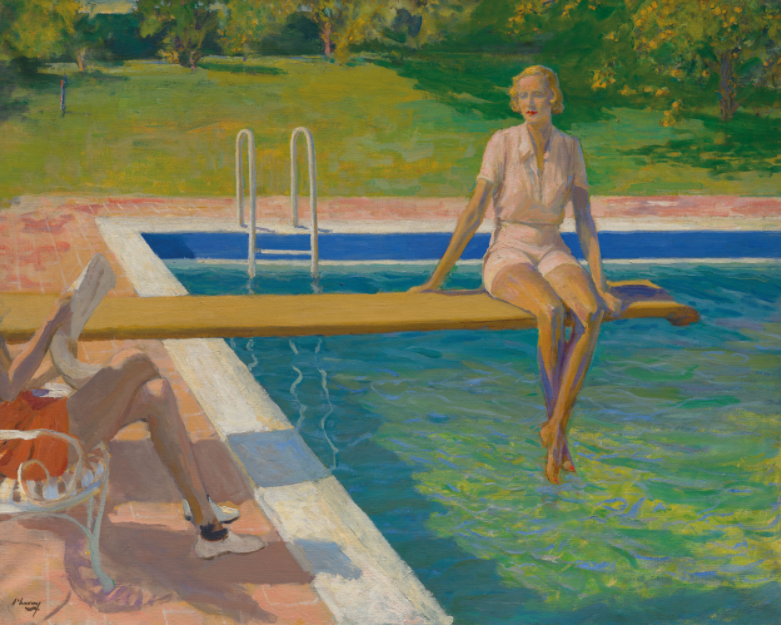
Lavery had of course, already painted Doris Castlerosse’s portrait in 1933 when her marriage to Valentine Browne, Viscount Castlerosse, was already under strain. Having visited the Kenmare estate in 1913 to portray Lady Dorothy, the viscount’s sister, the Laverys were already well-known to the Castlerosse family. It is certainly the case that following their marriage in 1928, the two couples met socially (Mosley, 1956, p. 99). During a sitting however, Doris is reported to have asked the painter, ‘If I were divorced, it would not make any difference, would it, Sir John?’ Lavery’s diplomatic reply is unrecorded, but his wife, Hazel, was known to admire Doris’s ability to survive ‘rebuffs and unpopularity’ – the ‘same qualities as Ramsay MacDonald’ (George Malcolm Thomson, Lord Castlerosse, His Life and Times, 1973, Weidenfeld and Nicolson, pp. 110-111). A columnist of the period provided a vivid pen-portrait of Lady Castlerosse in the following terms:
‘She is well turned-out with no exaggeration. She has no habits. She does not pick the varnish off her fingernails. She does not twist her ring around her finger. She does not smoke cigarettes. She does not drink champagne. She does not disdain bad language. She makes full use of the common idiom in her speech’ (Mosley, 1956, p. 108; quoting from The Daily Express, 12 July 1932).
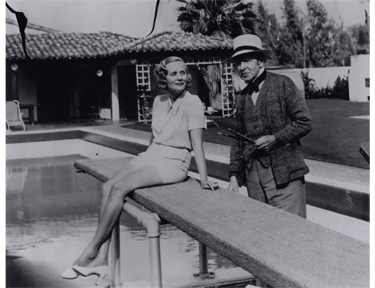
Born Doris Delevingne (1900-1942), daughter of a French lace and silk importer, Lady Castlerosse rose to fame in the twenties when sharing a flat with the actress, Gertrude Lawrence. She was regarded as a ‘gold-digger’ even though her husband, a failed banker, turned gossip columnist for the Sunday Express, had little money. At the time of her first sittings to Lavery she was having an affair with Randolph Churchill. Reports of a dalliance with his father, Winston, are complemented by his two portraits of Doris (David Coombs and Minnie S Churchill, Sir Winston Churchill, His Life and His Paintings, 2011, Ware House Publishing, cat. nos C152 & C158). In Hollywood in 1938, around the time she was sitting to Lavery on this second occasion, she was attending premieres and social events with Mr and Mrs Fred Astaire, Moira Shearer and Darryl Zanuck. Meeting the eighty-two-year-old painter in January 1938, at Palm Springs was likely, nevertheless, to have been a moment of calm in an otherwise full Hollywood diary.
Sittings in which the ‘model’s dais … was the spring-board’, were conducted by the pool at the Moroccan-style villa. Lavery composed the picture from two sketches using his portable easel. …
When revealed to the public, Lavery’s model, ‘pretty and very young-looking’, her legendary legs dangling over the pool, was almost carefree. Although she wears white court shoes in the photographs as The Sketch noted, the artist ‘has not forgotten to record the gay-lacquered toe-nails of Lady Castlerosse in his bathing portrait of her’ (‘What Every Woman Wants To Know’, The Sketch, 4 May 1938, p. 224). And as a master stroke, the artist includes the legs of the unseen, unidentified companion on the left of the canvas. A contemporary photograph which has recently come to light, indicates that these also belong to Castlerosse, snapped wearing a hairnet, shorts and plimsoles, during a break between the sittings (alternative theories, one advanced by Katharine FitzGerald, suggesting that the unseen observer was ‘a film director’, or another, that the legs belong to Doris’s brother, can be discounted).
Beside her, the present canvas is in progress and we can see that the ornate white garden chair, originally in the background, has been removed and adroitly placed under the figure reading, in place of the ugly wooden lounger. Lavery was clearly aware of the universal admiration for the famous Castlerosse limbs and secretly pays his own tribute, by painting them not once, but twice.
And of course, he had painted swimming pools before, in Florida and on the Riviera. The setting fascinated him. Art lovers today regard David Hockney as the ‘owner’ of Californian pool imagery. It may come as a surprise to some to discover that an aged Irish painter shared his enthusiasm and acted as its precedent.
More than a catbird hates a cat,
Or a criminal hates a clue,
Or an odalisque hates the Sultan’s mates,
That’s how much I love you.
I love you more than a duck can swim,
And more than a grapefruit squirts,
I love you more than commercials are a bore,
And more than a toothache hurts.
As a shipwrecked sailor hates the sea,
Or a juggler hates a shove,
As a hostess detests unexpected guests,
That’s how much you I love.
I love you more than a wasp can sting,
And more than the subway jerks,
I love you truer than a toper loves a brewer,
And more than a hangnail irks.
I love you more than a bronco bucks,
Or a Yale man cheers the Blue.
Ask not what is this thing called love;
It’s what I’m in with you.
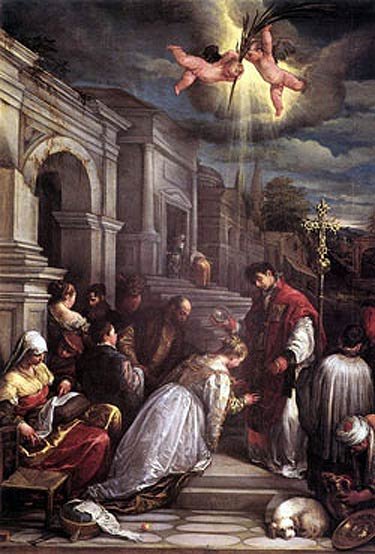
Jacopo Bassano, St Valentine Baptizing St Lucilla, 1575, oil on canvas, Museo Civico, Bassano del Grappa
The popular customs associated with Saint Valentine’s Day undoubtedly had their origin in a conventional belief generally received in England and France during the Middle Ages, that on 14 February, i.e., half way through the second month of the year, the birds began to pair. Thus in Chaucer’s Parliament of Foules we read:
For this was sent on Seynt Valentyne’s day
Whan every foul cometh ther to choose his mate.
For this reason the day was looked upon as specially consecrated to lovers and as a proper occasion for writing love letters and sending lovers’ tokens. Both the French and English literatures of the fourteenth and fifteenth centuries contain allusions to the practice. Perhaps the earliest to be found is in the 34th and 35th Ballades of the bilingual poet, John Gower, written in French; but Lydgate and Clauvowe supply other examples. Those who chose each other under these circumstances seem to have been called by each other their Valentines.
In the Paston Letters, Dame Elizabeth Brews writes thus about a match she hopes to make for her daughter (we modernize the spelling), addressing the favoured suitor:
And, cousin mine, upon Monday is Saint Valentine’s Day and every bird chooses himself a mate, and if it like you to come on Thursday night, and make provision that you may abide till then, I trust to God that ye shall speak to my husband and I shall pray that we may bring the matter to a conclusion.
——————————————–
From Robert Chambers, The Book of Days, 1869: Feast Day: St. Valentine, priest and martyr, circ. 270.
ST. VALENTINE’S DAY
Valentine’s Day is now almost everywhere a much degenerated festival, the only observance of any note consisting merely of the sending of jocular anonymous letters to parties whom one wishes to quiz, and this confined very much to the humbler classes. The approach of the day is now heralded by the appearance in the print-sellers’ shop windows of vast numbers of missives calculated for use on this occasion, each generally consisting of a single sheet of post paper, on the first page of which is seen some ridiculous coloured caricature of the male or female figure, with a few burlesque verses below. More rarely, the print is of a sentimental kind, such as a view of Hymen’s altar, with a pair undergoing initiation into wedded happiness before it, while Cupid flutters above, and hearts transfixed with his darts decorate the corners. Maid-servants and young fellows interchange such epistles with each other on the 14th of February, no doubt conceiving that the joke is amazingly good: and, generally, the newspapers do not fail to record that the London postmen delivered so many hundred thousand more letters on that day than they do in general. Such is nearly the whole extent of the observances now peculiar to St. Valentine’s Day.
At no remote period it was very different. Ridiculous letters were unknown: and, if letters of any kind were sent, they contained only a courteous profession of attachment from some young man to some young maiden, honeyed with a few compliments to her various perfections, and expressive of a hope that his love might meet with return. But the true proper ceremony of St. Valentine’s Day was the drawing of a kind of lottery, followed by ceremonies not much unlike what is generally called the game of forfeits. Misson, a learned traveller, of the early part of the last century, gives apparently a correct account of the principal ceremonial of the day.
‘On the eve of St. Valentine’s Day,’ he says, ‘the young folks in England and Scotland, by a very ancient custom, celebrate a little festival. An equal number of maids and bachelors get together: each writes their true or some feigned name upon separate billets, which they roll up, and draw by way of lots, the maids taking the men’s billets, and the men the maids’: so that each of the young men lights upon a girl that he calls his valentine, and each of the girls upon a young man whom she calls hers. By this means each has two valentines: but the man sticks faster to the valentine that has fallen to him than to the valentine to whom he is fallen. Fortune having thus divided the company into so many couples, the valentines give balls and treats to their mistresses, wear their billets several days upon their bosoms or sleeves, and this little sport often ends in love.’
St. Valentine’s Day is alluded to by Shakespeare and by Chaucer, and also by the poet Lydgate (who died in 1440).
The origin of these peculiar observances of St. Valentine’s Day is a subject of some obscurity. The saint himself, who was a priest of Rome, martyred in the third century, seems to have had nothing to do with the matter, beyond the accident of his day being used for the purpose. Mr. Douce, in his Illustrations of Shakespeare, says:
“It was the practice in ancient Rome, during a great part of the month of February, to celebrate the Lupercalia, which were feasts in honour of Pan and Juno. whence the latter deity was named Februata, Februalis, and Februlla. On this occasion, amidst a variety of ceremonies, the names of young women were put into a box, from which they were drawn by the men as chance directed. The pastors of the early Christian church, who, by every possible means, endeavoured to eradicate the vestiges of pagan superstitions, and chiefly by some commutations of their forms, substituted, in the present instance, the names of particular saints instead of those of the women: and as the festival of the Lupercalia had commenced about the middle of February, they appear to have chosen St. Valentine’s Day for celebrating the new feast, because it occurred nearly at the same time.”
—————————————————-
February 14th, prior to 1969, was the feast day of two, or possibly three, saints and martyrs named Valentine, all reputedly of the Third Century.
The first Valentine, legend holds, was a physician and priest in Rome, arrested for giving aid to martyrs in prison, who while there converted his jailer by restoring sight to the jailer’s daughter. He was executed by being beaten with clubs, and afterwards beheaded, February 14, 270. He is traditionally the patron of affianced couples, bee keepers, lovers, travellers, young people, and greeting card manufacturers, and his special assistance may be sought in conection with epilepsy, fainting, and plague.
A second St. Valentine, reportedly bishop of Interamna (modern Terni) was also allegedly martyred under Claudius II, and also allegedly buried along the Flaminian Way.
A third St. Valentine is said to have also been martyred in Roman times, along with companions, in Africa.
Due to an insufficiency of historical evidence in the eyes of Vatican II modernizers, the Roman Catholic Church dropped the February 14th feast of St. Valentine from its calendar in 1969.
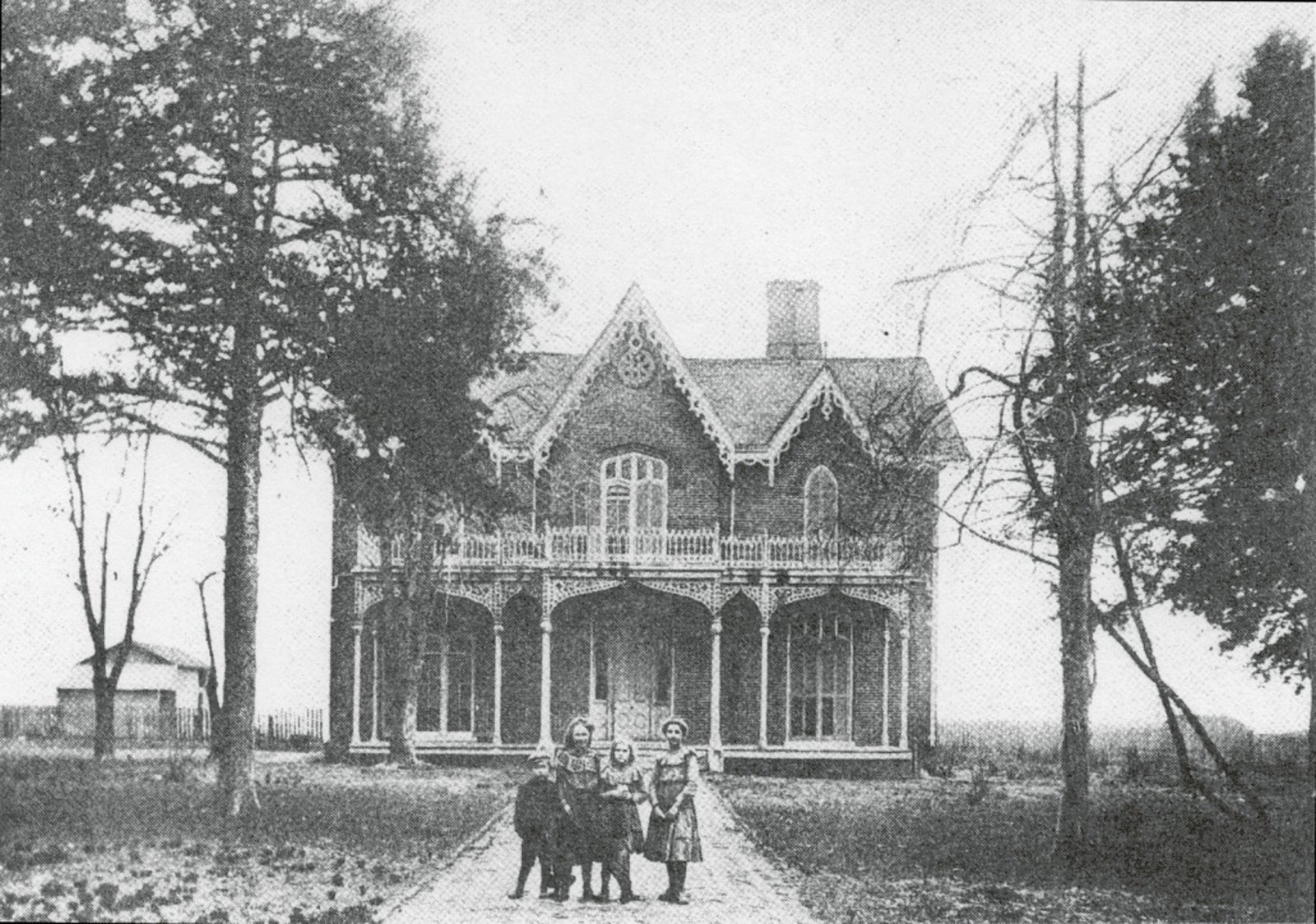
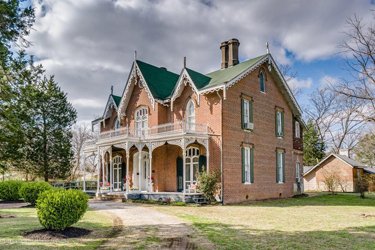
Very old photograph of Cedarhurst from Mrs. N.D. Deupree’s “Some Historic Homes of Mississippi,” from Publications of the Mississippi Historical Society, Vol. VII (1903).
Cedarhurst and Airliewood are both located on Salem Avenue and were constructed of brick in the late 1850s. The houses incorporate features promoted by A. J. Downing in his books concerned with appropriate architecture and landscaping for country houses. Downing considered the Tudor Gothic style ‘. . . to be the most convenient and comfortable, and decidedly most picturesque and striking style, for country residences of the superior class.”[Andrew J. Downing, A Treatise on the Theory and Practice of Landscape Gardening Adapted to North America with a View to the Improvement of Country Residences, C.M. Saxon & Company, New York,1857, pp. 400-401.] Evidently Gen. US Grant thought the houses were to be a superior class also because when he came to Holly Springs in 1862 he selected Airliewood for his headquarters, Cedarhurst for General Ord and Walter Place for Mrs. Grant.
Cedarhurst and Airliewood are picturesque, with their high-pitched roofs broken by decorative gables that are embellished with fanciful bargeboards and accented with finials and penants. The tall, paired, octagonal chimneys are considered a major part of the Gothic design and are sharp contrast to the simple chimneys of Greek revival houses.
The repetition of the pointed arch in the fenestrations underscores the fact that the houses are Gothic. The pointed arch is achieved in Cedarhurst by shaped bricks whereas labels or hoods emphasize the pointed arch on Airliewood. According to Downing “. . . the windows in the best Tudor mansions, affect a great variety of forms and sizes. . .” [Ibid., 398.] Both Cedarhurst and Airliewood meet this qualification as they have single, double, and bay windows. The front windows on the principal floor extend to the floor.
CEDARHURST
In addition to the Gothic features already mentioned, Cedarhurst is trimmed with octagonal colonettes, pointed-arch tracery, and a balustrade — all cast by the local antebellum industry — the Jones, McIlwaine, and Company foundry. The tall trees of holly, cedar and other varieties are in harmony with the vertical lines of the building.
Cedar Hearst was built for Dr. Charles Bonner, a Pennsylvanian of Irish descent who married Mary Wilson of Holly Springs. The house is frequently referred to as the home of Sherwood Bonner, the second child of the Charles Bonners, who became a writer of Southern dialect stories and secretary to the American poet Henry Wadsworth Longfellow.
Catherine Sherwood Bonner had strong feelings for her home place. She frequently referred to the house in her correspondence with Longfellow. [Jean Nosser Biglane, An Annotated and Indexed Edition of the Letters of Sherwood Bonner, M.A. thesis, Mississippi State University, 1972.] On October 31, 1877, she wrote from Holly Springs to Henry Wadsworth Longfellow in Cambridge, Mass.:
Did I ever tell you what a beautiful home mine was? The places not well-kept up now, but nothing can take away the grander of the old trees, or make the flowers less fragrant. The wide gallery in front is all overrun with Madeira vine; it is in full blossom now, and we sit on the porch every evening in the moonlight, talking of the past days that its aromatic sweetness, more than anything else seems to recall.
Sherwood Bonner returned to Holly Springs to care for her father and brother who died on September 9, 1878 during the yellow fever epidemic. In November, 1878, Ms. Bonner wrote to Longfellow concerning cleaning the house after the epidemic: “You know all the carpets have to be taken up, the rooms fumigated, the walls calcimined, and everything thoroughly aired. It is an immense undertaking.” In the same letter she wrote: “I do not know what I shall do. There is some talk of a division of property. I know that my father would wish that I should keep the house we love so well; yet I know I should be so unhappy here, shut in with sorrow; and it is so large house for my Aunty, Helena, and myself. I cannot bear to give it up; and yet I want a home in Boston. In December she wrote: “I had hoped to leave Holly Springs before Xmas; but I’m detained here by business matters. It breaks my heart afresh to be here at the time that has never failed of happiness, in the home that always threw open its hospitable doors to welcome Christmas guests.” On April 18, 1879: “We are all here together in the old home. Aunty has made up her mind that she cannot live away from it, so she will stay here for the present at least.”
By August 7, 1881, Sherwood Bonner was faced with the possibility of having to sell her home at a public auction if she did not pay her brother-in-law $1500 for her sister’s share of the house. She wrote to Mr. Longfellow:
It is cruel but he is determined — Of course it will be sold at an utter sacrifice — as things always are forced sale — and we must see this beautiful home go. For myself I would be reckless enough to make no effort to save it — but there is Aunty’s old age and Lillian’s future to be considered. All the cares of the world seemed to crowd upon me — and I am alone. My attorney strongly advises me to close with his offer — saying it is absolutely securing me at a small sums a very fine and valuable property — and that he can borrow the money for me for long term of years. But you can imagine how I shrink from incurring such a debt. I should have to mortgage my part of the plantation — and in the case of my death it would be sold. And this is where our only income comes from. The house is nothing but a white elephant. I have asked time to consider and I lay the matter before you, because I know you will help me to some extent. If I could pay them a certain part of the sum, I should be willing to borrow a smaller sum. I shall have three hundred dollars in a week or so, from the Lippincott’s — so there is a beginning. And I’m trying as well as I can, for the perturbation of my soul, to complete a Harper story, though not to fetch one hundred more — And you will help me, will you not to save my home — to secure for myself a retreat for my ruined life where I may die with dignity . . .
Mr. Longfellow wrote that he would send the money after the middle of the month. He died before fulfilling his promise; however, Miss Alice Longfellow, his daughter, sent the “generous gift” to Miss Bonner.
Sherwood Bonner died of cancer in Holly Springs on July 22, 1883. Her daughter Lillian sold the house around the turn of the century to Mr. W. A. Belk. Cedarhurst is now owned and occupied by Mrs. Fred M. Belk, Sr.
–Mary Wallace Crocker, Historic Architecture of Mississippi, University Press of Mississippi, Jackson, 1973, pp. 166-168.
The Oregon Department of Education (ODE) recently encouraged teachers to register for training that encourages “ethnomathematics” and argues, among other things, that White supremacy manifests itself in the focus on finding the right answer.
An ODE newsletter sent last week advertises a Feb. 21 “Pathway to Math Equity Micro-Course,” which is designed for middle school teachers to make use of a toolkit for “dismantling racism in mathematics.” The event website identifies the event as a partnership between California’s San Mateo County Office of Education, The Education Trust-West and others.
Part of the toolkit includes a list of ways “white supremacy culture” allegedly “infiltrates math classrooms.” Those include “the focus is on getting the ‘right’ answer,” students being “required to ‘show their work,'” and other alleged manifestations.
“The concept of mathematics being purely objective is unequivocally false, and teaching it is even much less so,” the document for the “Equitable Math” toolkit reads. “Upholding the idea that there are always right and wrong answers perpetuate objectivity as well as fear of open conflict.”
The ODE, led by Colt Gill, confirmed the letter to Fox News. ODE Communications Director Marc Siegel also defended the “Equitable Math” educational program, saying it “helps educators learn key tools for engagement, develop strategies to improve equitable outcomes for Black, Latinx, and multilingual students, and join communities of practice.”
People quickly learned that brown bears don’t like social media photo-ops, during a release in Iraq yesterday.
Six Syrian brown bears were saved from captivity recently. After saving the bears, organizers of a wildlife conservation project in the Kurdistan region of northern Iraq attempted to release the bears back into the wild. The group invited a cast of journalists, photographers, and spectators to watch the event. But the bears weren’t having it.
Just moments after the cages were opened, the bears charged the crowd. This was the third release planned by the organization. According to one of the event’s lead organizers, Blend Prevkani, reporters were also attacked by three bears during a release at the same location in 2018. So, either that location is cursed or organizers need to learn that large, chaotic crowds scare bears.
John Hinderaker has a really spectacular horror story of official stupidity, petty tyranny, and self-importance.
This is the most infuriating news story I have read in a while, and it comes, surprisingly, from the New York Times. The protagonist is Dr. Hasan Gokal, a Houston physician. He had a limited quantity of the Moderna covid vaccine to distribute, and rather than throw some of it away, he found qualified patients to receive it. For that, he was fired from his job and criminally prosecuted.
The Texas doctor had six hours. Now that a vial of Covid-19 vaccine had been opened on this late December night, he had to find 10 eligible people for its remaining doses before the precious medicine expired. In six hours.
Scrambling, the doctor made house calls and directed people to his home outside Houston. Some were acquaintances; others, strangers. A bed-bound nonagenarian. A woman in her 80s with dementia. A mother with a child who uses a ventilator.
After midnight, and with just minutes before the vaccine became unusable, the doctor, Hasan Gokal, gave the last dose to his wife, who has a pulmonary disease that leaves her short of breath.
For his actions, Dr. Gokal was fired from his government job and then charged with stealing 10 vaccine doses worth a total of $135 — a shun-worthy misdemeanor that sent his name and mug shot rocketing around the globe.
Dr. Gokal was charged by a Democratic Party prosecutor in Houston. The charge was so absurd that it was dismissed by a disbelieving judge, but the prosecutor “vowed to present the matter to a grand jury.”
You should read the whole story, if you can get past the Times paywall. (Protip: clear your cache of Times cookies.) This is another sign of the times:
The officials maintained that he had violated protocol and should have returned the remaining doses to the office or thrown them away, the doctor recalled. He also said that one of the officials startled him by questioning the lack of “equity” among those he had vaccinated.
“Equity” doesn’t mean what you probably think it does. “Evil” is a pretty good shorthand translation.
“Are you suggesting that there were too many Indian names in that group?” Dr. Gokal said he asked.
Exactly, he said he was told.
In today’s fallen world, being fired and charged with a crime is by no means the end of the ordeal:
On Jan. 21, about two weeks after the doctor’s termination, a friend called to say that a local reporter had just tweeted about him. At that very moment, one of his three children answered the door to bright lights and a thrust microphone. Shaken, the 16-year-old boy closed the door and said, “Dad, there are people out there with cameras.”
This was how Dr. Gokal learned that he had been charged with stealing vaccine doses.
Harris County’s district attorney, Kim Ogg, had just issued a news release that afternoon with the headline: “Fired Harris County Health Doctor Charged With Stealing Vial Of Covid-19 Vaccine.”
The next person who needs to be fired is Harris County’s District Attorney.
David Solway may have hit upon the reason that totalitarian intolerance and left-wing grievance politics have risen to a level of power and influence no one would ever have predicted: The country mysteriously got a lot stupider.
Recent studies have reported a worrisome decline in IQ scores in Western nations over the last decades, a reversal of the once-hopeful Flynn Effect (named after the late philosopher and psychologist James R. Flynn) which posited a growth in cognitive abilities for much of the 20th Century. Now the Flynn Effect seems to have reversed, leading to predictions of a general dumbing down of selective populations. Other studies report that IQ erosion is not confined to this century but that IQ has dropped by an average of 14.1 percent over the last century. As Evan Horowitz writes for NBC News, “A range of studies using a variety of well-established IQ tests and metrics have found declining scores across Scandinavia, Britain, Germany, France and Australia.”
Horowitz argues that the plummet in cognitive abilities “could not only mean 15 more seasons of the Kardashians, but also… fewer scientific breakthroughs, stagnant economies and a general dimming of our collective future.” Flynn himself, who did the original research on the eponymous effect, has stated that “The IQ gains of the 20th century have faltered.” Flynn’s more optimistic Are We Getting Smarter: Rising IQ in the Twenty-First Century was published in 2012; his subsequent findings led in an opposite direction.