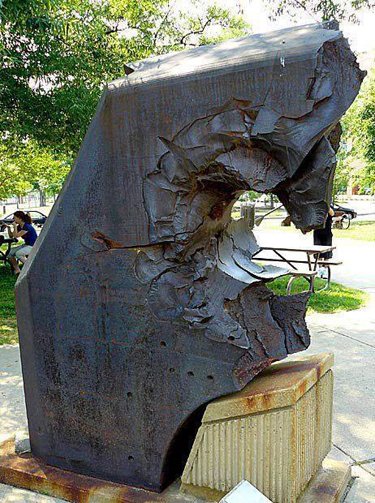
26″ (66cm) Class “A” (Yamato-Class) Main Armament Turret Face (Port) Plate.
This section of armor plate was meant for use on an 18″ Main Gun Turret on a Yamato class battleship and was found at the Kure Naval Base in Japan after the end of WWII then brought back to the US for testing.
This plate section was originally intended for IJN SHINANO, the third Japanese YAMATO-Class super-battleship, which was converted into an aircraft carrier instead, and sunk on its way to final fitting out yard by a U.S. submarine.
The damage is the result of the impact of a 16″ US armor piercing naval shell during ballistic testing 16 October 1946 at the Naval Proving Ground in Dahlgreen, VA.
This plate is now on display at the U.S. Navy Memorial Museum at the Washington Navy Yard, Washington, DC, just in front of the old Gun Factory building.
But it strikes a chord. When I was a little kid, pre-school, I was allowed to adopt as a toy a huge old Damascus 10 gauge double-barreled shotgun. Only one hammer worked. My parents knew perfectly well that I had no way of getting any 10 gauge ammunition, and the gun was a junker that would probably have blown up if anybody actually tried firing it. My neighborhood gang and I treated it in our games as a cannon and we’d wheel it around on a flexible flyer wagon. We eventually played that old junker into pieces.
Victor Davis Hanson notes that times of crisis tend to make one wonder about where exactly the merit in the American Meritocracy resides.
In a sophisticated society under lockdown, is it more existentially valuable to know how to fix a toilet, replace a circuit breaker, or change a tire, or to be a New York fashion designer, a Hollywood actor, or a corporate merger lawyer? At 9 p.m., when you go downtown in need of a critical prescription, are you really all that furious that a law-abiding citizen who has a gun and concealed permit is also in line—or would you be more relieved that gun control laws might ensure that his ilk never enters an all-night pharmacy?
So who is important and who not?
We were often told globalized elites on the coast were the deserved 21st-century winners, while the suckers and rubes in-between had better learn coding or head to the fracking fields.
But who now is more important than the trucker who drives 12-hours straight to deliver toilet paper to Costco? Or the mid-level manager of Target who calibrates supply and demand and is on the phone all day juggling deliveries before his store opens? Or the checker at the local supermarket who knows that the hundreds of customers inches away from her pose risks of infection, and yet she ensures that people walk out with food in their carts? The farmworker who is on the tractor all night to ensure that millions of carrots and lettuce don’t rot? The muddy frackers in West Texas who make it possible that natural gas reaches the home of the quarantined broker in Houston? The ER nurse on her fifth coronavirus of the day who matter-of-factly saves lives?
Do we really need to ask such questions of whether the presence of the czar for diversity and inclusion at Yale is missed as much as the often-caricatured cop on patrol at 2 a.m. in New Haven?
Do social justice student protestors who surround and heckle the politically suspicious now in ones and twos also scream in the faces of the incorrect plumber who unclogs their locked-down apartment drain?
The virus has reminded us again, but in an unorthodox fashion, that the world is bifurcated by the degreed versus the non-college educated, rural versus urban, sophisticates in opposition to supposed rubes—and the dichotomy has been telling. I don’t suppose Rick Wilson will go on CNN again to do his fake-Okie accent to ridicule the supposed unwashed, who deliver his food and energy, as viewers might wonder what exactly was his expertise.
Will multibillionaire Mike Bloomberg really convince anyone that a farmer operates by simplistic rote, and someone like himself is critical to America—one who censored the politically incorrect reporting of his own journalists while he schemed to find ways to capitalize Chinese Communist-owned companies with western currencies—at huge multi-billion-dollar profits to himself?
When your refrigerator goes out under quarantine and your supplies begin to rot, do you really need another rant from Rep. Maxine Waters (D-Calif.)—or do you rather need a St. Michael Smith and St. Uriel Mendoza to appear out of nowhere as the archangels from Home Depot to wheel up and connect a new one?
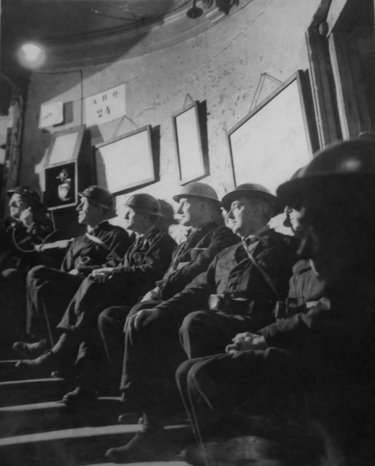
Members of the St. Paul’s Watch at one of the advance locations around the Cathedral.
During the German Blitz, civilian volunteers, many in old age, risked their lives to protect London’s St. Paul’s Cathedral from bombs and fire. One such volunteer who served in the St. Paul’s Watch left a diary (alas! long out-of-print, expensive, and scarce). link
Arthur Butler was a melancholic, artistic man, a retired architect known for his slightly rambling way of speaking. On the night of April 16, 1941, when a bomb fell through the roof of St. Paul’s, London, he was high on the cathedral’s dome, wearing a flashlight on a belt around his waist, looking at the fires reflected in the Thames, far below. Butler liked the shadows on nights like these, cast from strange angles by falling flares. He had enjoyed the bursts of artillery in the previous war too, flashing orange over the trenches, when he was young. Now, flames crept into crimson smoke, as buildings burned white, then red, then orange. Many were skeletal, from earlier raids. It was a “weird and terrible loveliness,†Butler recalled. As planes flew closer – “silly screaming dragons,†he wrote – there was a crescendo of anti-aircraft fire. Memories overcame him. Fire engine bells rang in the distance.
Isolated amongst ruins, the German planes seemed to seek out St. Paul’s. It was, according to Butler, “the very heart of London and the symbol of it,†apparently defiant and certain. In his long out-of-print diary, which was published in 1942 as Recording Ruin, he called it a “sacred place as a race.†(I recently found a copy in a secondhand store and thought it looked interesting.) A church had stood here since the year 604, and cathedrals had been built, and destroyed by fire, ever since. The present St. Paul’s was begun in 1675, and it was still the city’s tallest building. During the war, it took on huge psychological significance. At the end of 1940, two weeks before Butler began writing his diary, the Daily Mail printed what would become the most famous photograph of the Blitz, with the dome rising from smoke, beneath the headline: “War’s Greatest Picture: St. Paul’s Stands Unharmed.†(The same photograph was reprinted in German newspapers, to suggest London’s destruction.) During the worst raids, Winston Churchill himself ordered fire fighters to protect St. Paul’s, passing needier buildings.
Inside the cathedral that April night, as Butler watched the buildings burn, a single red light hung from the underside of the dome. Water sometimes pooled beneath it, blown in through shattered windows. The high altar lay ruined, destroyed in the raid featured in the Daily Mail’s “unharmed†photograph, a tangle of scaffold supporting the arch above. The little remaining stained glass glowed from the fires outside, picking out a mechanism of pulleys and gantries, designed to lower the injured from the upper floors. Butler liked the cathedral most this way, icy blue and painterly in the moonlight, the white stone whiter somehow, the shadows rich and dark, with just a hint of red. Dim flashlights could be seen scurrying around the Whispering Gallery, and down the mile or so of cathedral corridors. A dozen men, mostly middle-aged or elderly, carried sandbags and water pumps, hurrying to the incendiaries that rattled on the lead roofs, like coals falling from a scuttle. Water ran down the staircases hidden in the hollow walls, as women carried up cups of tea.
Each night, a shift of these volunteers, known as St. Paul’s Watch, guarded the cathedral. Many, like Butler, had been architects, and had fought in World War I. Shortly before the Blitz began, the Dean of St. Paul’s advertised for help, hoping former architects might familiarize themselves most easily with the cathedral’s labyrinthine plans, and perhaps cared enough to risk their lives for it. Two hundred and eighty people put their names forward. They were issued overalls and tin hats, and given training on explosive incendiaries, delayed action bombs and parachute mines. They walked through tear gas, to prepare for what might come.
Alongside the architects, there were minor canons and elderly gentlemen of the Choir, Red Cross workers, and members of the Women’s Royal Voluntary Service. There were university professors, and students of medicine and theology and music. John Betjeman, the future Poet Laureate, volunteered, with Post Office workers, and members of foreign governments in exile. “A cross-section of English society,†the Dean wrote in his account of the war, “essential, yet unobtrusive, vital but anonymous.†Some would find their evenings empty after the war, with nothing to do, feeling old again.
Before their shift began, those on duty prayed the same prayer at the Watch headquarters in the cathedral Crypt – “lighten our darkness, we beseech thee, O Lord; and by thy great mercy defend us from all perils and dangers of this night†– and listened to the news on the wireless. Many felt the hand of God protected them. One volunteer routinely circled the exterior of the dome, reciting the Lord’s Prayer. Each wore a gold pin on their left breast, decorated with crossed swords. A friend of Butler’s had once laughed at his badge, when he wore it to a dinner party. “I suppose it’s the same as displaying emotion and is therefore not done,†he recalled.
“We are not just battling the virus, but also conspiracy theories,†a spokesman for the Wuhan Institute of Virology has said. “Conspiracy theories do nothing but create fear, rumors, and prejudice.â€
He was trying to squash an idea that has been growing in popularity ever since the 2019-nCoV Coronavirus outbreak began: that his Virology Lab, at the heart of Wuhan, might be responsible.
In a way, he was right. In a time of crisis, the last thing anyone would want to do is spread fear — especially if it’s based on nothing but a baseless rumor.
But when you start looking into those claims that the epidemic that’s already infected almost 250,000 people across the world started in a Wuhan Virology Lab, it starts looking like something other than a conspiracy theory. It starts looking like an explanation that holds up unnervingly well — and that, if we take the time to look into it, could help prevent something similar from happening again.
The official story is that 2019-nCoV started in a seafood market in Wuhan. Unclean animals sold there were carrying the virus, Chinese scientists have suggested, and, as a result, some unlucky shoppers ended up becoming patient zeros for a global crisis.
You’ve probably already heard that explanation before, and there’s a good chance you’ve accepted it as a fact — but there are some glaring problems with it.
For one thing, the first patients with 2019-nCoV have no connection to the market whatsoever. They lived nearby, and they appear to have spread the disease to people who went there — but the real patient zeros never actually stepped foot inside of it.
Also, 2019-nCoV is believed to have originated in bats — and this was a seafood market. Nobody was selling bats inside of this market. Bats just aren’t something people in Wuhan normally eat.
Even China’s scientists have started backing away from this theory. To quote one directly:
“It seems clear that [the] seafood market is not the only origin of the virus… But to be honest, we still do not know where the virus came from.â€
A lot of people have pointed to the Wuhan Institute of Virology, which is just a 30 minutes drive for the seafood market. But if that’s not close enough for you, there’s another lab that researches bat coronaviruses that’s even closer: The Wuhan Center for Disease Control & Prevention.
It’s not just on the other side of town. It’s on the other side of the street.
Harvard2thebighouse takes on Nature magazine’s claim that the Wuhan Virus could not possibly have been deliberately manufactured in a Communist Chinese Biological Weapons Laboratory.
Maybe you shouldn’t blindly believe everything you read? Even if the source has a pretty solid reputation?
Nature magazine has censored over 1,000 articles at the request of the Chinese government over the past several years. And it seems pretty clear that their recent article, “The proximal origin of SARS-CoV-2†is just one more example of their influence. China bought off the head of Harvard’s chemistry department, you don’t think they could buy off run-of-the-mill research scientists scrambling for tenure and funding and publication? It’s absolutely horrific that so many scientists and researchers are taking part in what’s really clearly a disinformation campaign orchestrated by the Chinese Communist Party, and willfully spreading a smokescreen about something that’s already killed thousands and is projected to kill millions more across the planet.
And while the mainstream corporate media mindless regurgitates claims from the Chinese government that are falsifiable with the simplest of google searches, allowing the public to be lulled into a false sense of security and complacency, and Reddit rapidly censors and moderates anything that might indicate that this virus leaked from a Chinese lab and so the Chinese government is to blame for this pandemic – sites like ZeroHedge, that have been at the forefront of keeping the lines of investigation open, have been banished from Twitter and marginalized.
The Delahaye 145 that Dreyfus drove in the 1938 Pau Grand Prix.
“In the 1930s, Adolf Hitler funded the most powerful racing program in the world. An American heiress, a Jewish driver, and a struggling French automaker banded together to defeat them on the racetrack.” Road and Track.
In 1933, the newly-elected leader of Germany, Adolf Hitler, announced that the Third Reich would dominate the Grand Prix. After the government poured funds into Mercedes and Auto Union, their top drivers Rudi Caracciola and Bernd Rosemeyer swept the field in their supercharged Silver Arrow race cars.
Triumph over the Nazis promised redemption for all of them. If it was to happen, the opening race of the new formula Grand Prix season in 1938 would provide their best chance.
When something truly unnerving arrives, like a global pandemic, America serves up just the right pitch of high-octane, Hollywood disaster-flick pandemonium to make the whole thing a bit zanier and more camp. The world depends on us for that. We invented the genre. China may have unleashed a deadly and mysterious new virus but Americans have long infected the planet with our sense of drama.
That’s what we do. Americans are in the business of entertainment, not only with our films, but our politics, vapid celebrities, and gregarious displays of mass hysteria when a crisis hits. Or, when there’s no crisis at all — like a vote recount, a sex scandal, or the release of a new iPhone — America remains Earth’s favorite reality TV show.
We can’t help it. We’re exhibitionists by nature and a highly theatrical, expressive people. When a camera is rolling, average Americans, more than other nationalities, know the game, and we’re ready to perform. Local news stations across the US provide the world with its greatest viral video stars. If you doorstep a stranger in Possum Gulch, Arkansas, at a Gristedes on the Upper West Side, or outside a housing project in Nashville, Tennessee, chances are you’re going to meet a real character who’s eager to put on a show. We’re that way off camera, as well. I recall, in my early twenties, living in a cramped London flat with four Brits and three Americans. If we all were gathered in the common room the Brits would sit back, utterly amused, and watch the Americans interact, as though we were a sitcom. ‘You’re like an episode of Friends’, one said. ‘You’re like cartoon characters’, another said. We know, thanks!
Antique un-PC ad showing Uncle Sam, holding a proclamation and a domestically-made product, kicking the Chinese out of the United States.
Andrew A. Michta also thinks that China’s behavior has been bad enough and her responsibility for the current international pandemic so great that all this should result in a complete reordering of our economic relationship with China.
It won’t be easy or painless, but the role China has played in exacerbating the fallout from the coronavirus crisis ought to force Americans to fundamentally reconsider the relationship.
I flew back from Washington DC to Munich just a day before the travel embargo from the Schengen zone to the United States came into effect. As I watched anxious gate agents, tense flight attendants, and passengers eyeing each other with suspicion, I could not help but think that what I was witnessing was the beginning of a radical recompilation of the mistaken notions that for the past three decades have shaped U.S. and European economic policy, and indirectly, international security. The idea that the People’s Republic of China can become a responsible stakeholder in the international community—that it can “be like usâ€â€”is being laid to rest behind the masked faces of petrified Westerners scurrying through airports to get home.
Amidst the 24/7 breathless media coverage and calls for politicians to “do something,†one fundamental question still needs to be addressed forthrightly and in the open: Who did this to us and what to do to prevent it from happening again?
The question about assigning agency and blame is pretty straightforward to answer: The communist Chinese state, which for more than three decades has been draining capital and knowledge from the West, benefiting from our greed and myopia, has just let loose a virus that in the coming months is about to effectively paralyze Europe and the United States and bring severe pain, both human and economic on the world. The “eruption at a wet market†explanation for the virus has to be questioned until we know the full story, if for no other reason than the fact that Beijing suppressed data for two months when the coronavirus first appeared, and even to this day refuses to come clean as to exactly what happened. Indeed, the Chinese Communist Party (CCP) is now spinning propaganda stories that both seek to somehow pin the blame on the United States, and that try to frame their bungling, denial-ridden, heavy-handed reaction as some kind of model for the world.
As a result of all this, the West is now shutting down, at least for a while. The ultimate cost to the world, in terms of new government debt, failed businesses, and human lives and suffering, is difficult to quantify at this point. But there are indications that the fallout from the Wuhan Virus could be transformative.
We must acknowledge our own complicity in what is now unfolding. The belief that globalization, through the radical centralization of market networks, was the unavoidable path forward has been exposed as a grave, near-delusional miscalculation. The offshoring by corporations of supply chains to China has not only eviscerated communities that were previously reliant on manufacturing jobs, but has also brought with it an unprecedented level of vulnerability and fragility to our economies. The populist revolts that have wracked Western democracies for the past several years are in part rooted in the pain that these dislocations have caused. Worse yet, for the past three decades, this offshoring process has favored an adversary that is determined to replace us as the hub of global economic and military power and place itself at the new normative center of the world.
Should the fallout from the Wuhan Virus prove to be as damaging as it looks like it might be, the first casualty should be China’s quest to become the premier manufacturing center for the world.Should the fallout from the Wuhan Virus prove to be as damaging as it looks like it might be, the first casualty should be China’s quest to become the premier manufacturing center for the world. Few corporations will want to again risk being caught in a situation where their entire supply chain has been locked into one country—much less a palpably hostile dictatorship. The subsequent era will, I hope, be one of strategic reconsolidation, with a special focus on onshoring critical supply chains that have been moved to China. Even the siren song of potentially-vast consumer markets in China may end up being more than offset by the trauma we are about to face.
As the dust settles, the United States should be taking a hard look at streamlining our federal and state regulatory framework, tax structure, and all other outstanding obstacles in order to encourage U.S. businesses to come back home.