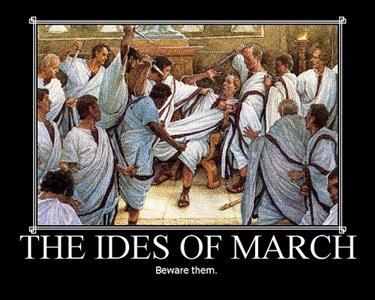
When I was in high school, I had Latin in 9th and 10th grade. Our Latin teacher had a curious personal custom. He sacrificed annually, in honor of Great Caesar, on the Ides of March, the male student in each class who had offended him by doing the least work and/or being the most disruptive. He sacrificed additionally one female student from each class whose selection, I fear, was based only upon his own capricious whim and covert sexual attraction.
The sacrifice consisted of the victim being bent over a desk and receiving three strokes of a paddle, delivered by a six foot+, 250 lb.+ Latin teacher laying on the strokes with a will and putting his weight behind them. (I won’t name him.) Mr. X’s paddle was a four foot long piece of 1 1/2″ thick pine, produced in our high school’s wood shop by General Curriculum students, who did not take Latin, but admired Mr. X. The paddle was roughly in the form of a Roman gladius, and its surface was scored by a series of regular lines, because it was generally believed that a blow from an uneven surface was more painful.
Mr. X had a fixed policy of assigning the duty of construing the day’s Latin assignment on the blackboard in strict and completely predictable order, going up and down the aisles of desks. Two or three of the smart kids would always actually do the Latin, (I was one of them) and it was our recognized duty to supply the translations in advance to the person who would be going to the blackboard.
Readiness to translate correctly was really vital, because Mr. X would apply his dreaded paddle to anyone who failed to write out the day’s assignment correctly on the blackboard. It was rare, but every once in a while some truly feckless idiot would neglect to seek out Kenny Hollenbach, Jack Rigrotsky, or yours truly, and would arrive at the blackboard, chalk in hand, unprepared.
Mr. X typically broke the current paddle over the defaulter’s posterior, and the mental defectives in shop class would gleefully commence the fabrication of a new, yet more elaborate, edition of the famous paddle.
Every March 15th, two 9th and 10th grade Academic Curriculum sections would look on with the same sadistic interest of Roman spectators at the gladitorial games, as Mr. X conducted his sacrifices. I can recall that he struck the pretty strawberry blonde with the well-developed embonpoint so hard that he raised dust from her skirt. We were a bit puzzled that girls actually submitted to being beaten with a paddle for no reason, but all this went on undoubtedly because the legend of Mr. X the fierce disciplinarian had enormous appeal in our local community. The whole thing was fascinating, and it all made such a good story that everyone, student and adult, in his heart of hearts, enthusiastically approved.
Mr. X would never be allowed to get away with that kind of thing today, alas! In Hades, poor Caesar must do without his sacrifice. And it is my impression that Latin instruction has rather overwhelmingly also become a thing of the past. Kids today learn Spanish. Modern languages are easier and are thought more relevant.
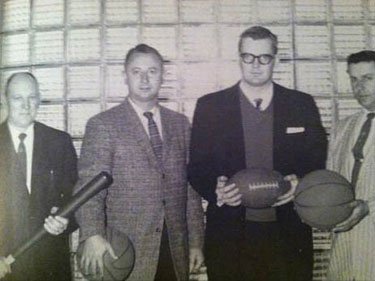
My high school Latin teacher is the large chap wearing glasses. He also coached one of our sports teams.
Matt Stoller explores all the multiplicitous ironies of the chattering class’s embrace of the hip hop musical about the fellow John Adams described as “the bastard brat of a Scots peddler.”
Before it was even written, the play was nurtured at the highest levels of the political establishment. While working through its material, Miranda road-tested song lyrics at the White House with President Obama. When it was performed, Obama, naturally, loved it. Hamilton, he said, “reminds us of the vital, crazy, kinetic energy that’s at the heart of America.†Michelle Obama pronounced it the best art she had ever seen.
The first couple’s comments were just the leading edge of a cultural explosion of praise. Actress Kerry Washington called it “life changing.†Lena Dunham said, “If every kid in America could see Hamilton they would thirst for historical knowledge and then show up to vote.†Saturday Night Live featured a sketch wherein Lorne Michaels begged guest host Miranda for Hamilton tickets (“I can do a matinee!â€). It’s perhaps harder to list celebrities who haven’t seen Hamilton than those who have. And in Washington, D.C., politicians who haven’t seen the show are considered uncool.
Admiration for the play crossed the political spectrum. Conservative pop-historian Niall Ferguson opened up a book talk, according to one witness on Twitter, “with a rap set to music inspired by Hamilton.†Former secretaries of the treasury praised it, from Tim Geithner to Jack Lew to Hank Paulson. So did Dick Cheney, prompting Obama to note that the wonder of the play was perhaps the only thing the two men agreed on. Trevor Noah asked if Bernie Sanders, who had just seen the play, ran for president just so he would be able to get tickets. Rahm Emanuel, the mayor of Chicago and former White House chief of staff, raised eyebrows by jetting off to New York City to see a performance of Hamilton the night after Chicago teachers went on strike.
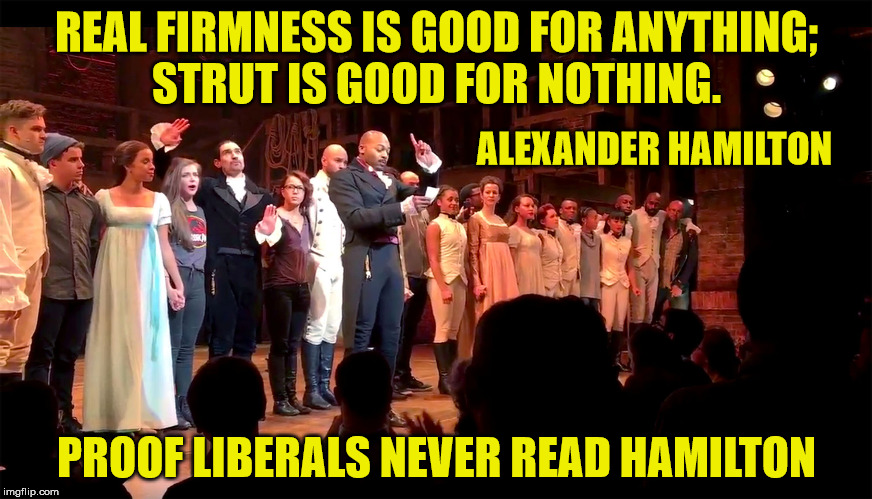
It’s not just that Hamilton is about a founding father, and thus inherently making statements about who we are as a culture. It’s become a status symbol within the Democratic establishment, offering them the chastened consolation that they might still claim solidarity with the nascent American democracy of the eighteenth century that’s stubbornly eluded them in the present-day political scene. Hillary Clinton quoted the play in her speech accepting the Democratic nomination, and told a young voter, “I’ve seen the show three times and I’ve cried every time—and danced hard in my seat.†The play has become a political football in the era of Trump. When Trump’s vice president, Mike Pence, saw the show, one of the cast members read him a special note, written by Miranda and several cast members, asking Pence to protect all of America. Hamilton cast members helped lead the Women’s March in Chicago to protest Trump’s inauguration. Right-wing website Breitbart has a hostile mini-Hamilton beat, noting that the play’s producers specifically requested non-white actors to fill the cast.
And after Trump won, Hamilton became a refuge. Journalist Nancy Youssef tweeted she overheard someone at the Pentagon say, “I am reaffirming my belief in democracy by listening to the Hamilton soundtrack.â€
What’s strange about all of this praise is how it presumes that Alexander Hamilton was a figure for whom social justice and democracy were key animating traits. Given how Democrats, in particular, embraced the show and Hamilton himself as a paragon of social justice, you would think that he had fought to enlarge the democratic rights of all Americans. But Alexander Hamilton simply didn’t believe in democracy, which he labeled an American “disease.†He fought—with military force—any model of organizing the American political economy that might promote egalitarian politics. He was an authoritarian, and proud of it. …
[I]t’s useful to recognize that Hamilton the play is not the real story of Alexander Hamilton; rather, as historian Nancy Isenberg has noted, it’s a revealing parable about the politics of the finance-friendly Obama era. The play is based on Ron Chernow’s eight-hundred-page 2004 biography of Hamilton. Chernow argues that “Hamilton was an abolitionist who opposed states’ rights, favored an activist central government, a very liberal interpretation of the Constitution and executive rather than legislative powers.†Hamilton, he notes, “sounds . . . like a modern Democrat.†The abolition arguments are laughably false; Hamilton married into a slaveholding family and traded slaves himself. But they are only part of a much broader obfuscation of Hamilton’s politics. …
Hamilton had tremendous courage, insight, and brilliance. He is an important Founder, and not just because he structured early American finance. His life sheds light on some deep-rooted anti-democratic forces that have always existed in America, and in particular, on Wall Street. Much of the far-reaching contemporary Hamilton PR offensive is connected to the Gilder Lehman Institute, which is financed by bankers who back the right-wing Club for Growth and American Enterprise Institute (and support Hamilton’s beloved gold standard). Robert Rubin in 2004 started the Hamilton Project at the Brookings Institution, which laid out the framework for the Obama administration’s financial policies. Chernow has made millions on books fawning over J. P. Morgan, the Warburg financial family, and John D. Rockefeller. And thanks largely to the runaway success of Hamilton the musical, Chernow is now, bizarrely, regarded as a court historian of American democracy in the mold of Arthur Schlesinger Jr.
The Library of Congress American English dialect recordings include a two-part interview with the late dean of the Big-Bore gun writers Elmer Keith himself. The gravel-voiced Keith was 82-years-old and living in Salmon, Idaho at the time.
If you ever worked with someone Swiss or had a Swiss employee. you probably noticed that he was extraordinarily stubborn and opinionated and a trifle moody. The Swiss are different. Just look at their electrical plug.
Buzzfeed points out 25 examples of Swiss differentness.
This photo of a chap in the uniform of Brazil’s PolÃcia Militar do Distrito Federal (PMDF) holding a strange super long revolver has been appearing recently on social media. On the wall behind him is what looks like the coat of arms of a municipality, but I have not been able to identify it. The photograph seems to have originated from one of those Russian-language “cool photo” sites that publishes images entirely without captions or explanations.
Robert Tracinski explains why repealing Obamacare is such an uphill battle. When you replace Conservatism with Populist Nationalism, you’re lacking the necessary conviction to oppose the Welfare State.
If you want to know why Republicans have bogged down, notice one peculiar thing about the Obamacare debate so far. It’s not really a debate over Obamacare, it’s a debate over Medicaid. That’s because Obamacare mostly turned out to be a big expansion of Medicaid. The health insurance exchanges that were supposed to provide affordable private health insurance (under a government aegis) never really delivered. They were launched in a state of chaos and incompetence, and ended up mostly offering plans that are expensive yet still have high deductibles. Rather than massively expanding the number of people with private insurance, a lot of the effect of Obamacare was to wreck people’s existing health care plans and push them into new exchange plans.
Ah, but what about all those people the Democrats are claiming were newly covered under Obamacare? A lot of them—up to two-thirds, by some estimates—are people who were made newly eligible for a government health-care entitlement, Medicaid. But shoving people onto Medicaid is not exactly a great achievement, since it is widely acknowledged to be a lousy program.
Conservative health care wonk Avik Roy explains why: “[T]he program’s dysfunctional 1965 design makes it impossible for states to manage their Medicaid budgets without ratcheting down what they pay doctors to care for Medicaid enrollees. That, in turn, has led many doctors to stop accepting Medicaid patients, such that Medicaid enrollees don’t get the care they need.†Partly as a result, a test in Oregon found no difference in health outcomes between those with access to Medicaid and those without.
Then again, a massive expansion of Medicaid fits perfectly with the preferences of the welfare statist’s boosters: lousy free stuff from the government is better than good stuff you pay for yourself.
Yet notice this hits a big Republican weak spot, one I suspect Obamacare’s promoters knew about all along. Obamacare just boils down to an expansion of an old, existing, traditional government entitlement—and Republicans are lousy at rolling back traditional entitlements. …
Democrats create new entitlements, then Republicans reform them. Democrats get all the credit for showering us with benefits, and Republicans accept the role of the mean-spirited accountants who tell us we just can’t afford it. …
[As to the existing bill:] Pradheep Shanker sums it up nicely when he describes the Obamacare replacement bill as a piece of legislation with no ideological point of view.
My biggest complaint about this bill is that there really is no governing philosophy in its writing. It neither pleases conservatives nor moderates. It makes half measures to increasing patient choice, but retains taxes such as the Cadillac tax, while at the same time maintaining the employer based health insurance system. It doesn’t maximize federal support for the poor, nor does it fully adopt the free market…. The muddle created by the GOP here makes it very difficult to make a sound, concise argument regarding specifically what their goal is.
That makes sense, in a way. It’s a bill with no governing philosophy for a party and a president who have no governing philosophy.
Andrew Sullivan takes time off from crying over the election of Donald Trump to identify and explain the new religion that has taken charge on elite campuses all over the country.
Intersectionality†is the latest academic craze sweeping the American academy. On the surface, it’s a recent neo-Marxist theory that argues that social oppression does not simply apply to single categories of identity — such as race, gender, sexual orientation, class, etc. — but to all of them in an interlocking system of hierarchy and power. At least, that’s my best attempt to define it briefly. But watching that video helps show how an otherwise challenging social theory can often operate in practice.
It is operating, in Orwell’s words, as a “smelly little orthodoxy,†and it manifests itself, it seems to me, almost as a religion. It posits a classic orthodoxy through which all of human experience is explained — and through which all speech must be filtered. Its version of original sin is the power of some identity groups over others. To overcome this sin, you need first to confess, i.e., “check your privilege,†and subsequently live your life and order your thoughts in a way that keeps this sin at bay. The sin goes so deep into your psyche, especially if you are white or male or straight, that a profound conversion is required.
Like the Puritanism once familiar in New England, intersectionality controls language and the very terms of discourse. It enforces manners. It has an idea of virtue — and is obsessed with upholding it. The saints are the most oppressed who nonetheless resist. The sinners are categorized in various ascending categories of demographic damnation, like something out of Dante. The only thing this religion lacks, of course, is salvation. Life is simply an interlocking drama of oppression and power and resistance, ending only in death. It’s Marx without the final total liberation.
It operates as a religion in one other critical dimension: If you happen to see the world in a different way, if you’re a liberal or libertarian or even, gasp, a conservative, if you believe that a university is a place where any idea, however loathsome, can be debated and refuted, you are not just wrong, you are immoral. If you think that arguments and ideas can have a life independent of “white supremacy,†you are complicit in evil. And you are not just complicit, your heresy is a direct threat to others, and therefore needs to be extinguished. You can’t reason with heresy. You have to ban it. It will contaminate others’ souls, and wound them irreparably.
And what I saw on the video struck me most as a form of religious ritual — a secular exorcism, if you will — that reaches a frenzied, disturbing catharsis. When Murray starts to speak, the students stand and ritually turn their backs on him in silence. The heretic must not be looked at, let alone engaged. Then they recite a common liturgy in unison from sheets of paper. Here’s how they begin: “This is not respectful discourse, or a debate about free speech. These are not ideas that can be fairly debated, it is not ‘representative’ of the other side to give a platform to such dangerous ideologies. There is not a potential for an equal exchange of ideas.†They never specify which of Murray’s ideas they are referring to. Nor do they explain why a lecture on a recent book about social inequality cannot be a “respectful discourse.†The speaker is open to questions and there is a faculty member onstage to engage him afterward. She came prepared with tough questions forwarded from specialists in the field. And yet: “We … cannot engage fully with Charles Murray, while he is known for readily quoting himself. Because of that, we see this talk as hate speech.†They know this before a single word of the speech has been spoken.