19 Apr 2015
Economic and Social Classes Today
Class Warfare, Classes

Economic Classes
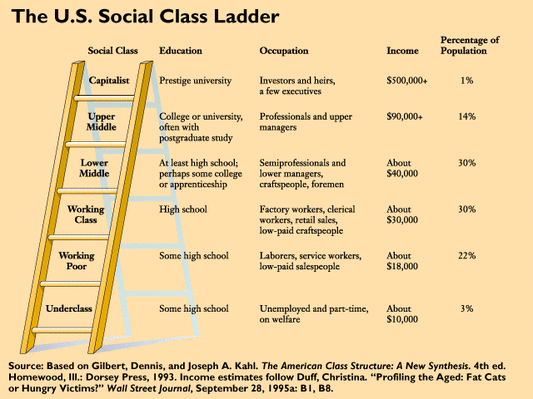
Devon Helton has an excellent, really-nails-it column discussing the realities of the complex class structure in contemporary America. He differentiates social from economic classes. Here’s a bit of his tale upon the plebs:
Sixty years ago a pleb might live in a tight-knit, urban, ethnic community. The neighborhood would have very low crime, safe schools, and strong churches. Censorship laws promoted family values in movies and on TV. The upper class would live blocks away from the lower class. In ensuing decades, a combination of demographic changes, “urban renewal” projects, and legal changes rocked this world. The great migration brought into the city a poor, uneducated African-American population from the south. This migrant population had a much higher rate of criminal behavior. Housing projects and forced integration mixed this population into the ethnic white enclaves. Legal changes made policing much less effective. Crime in these neighborhoods rose dramatically. Court rulings and policy changes stripped public school teachers of tools to discipline unruly children.
After these changes, the only way a person could avoid a high-crime neighborhood was to move to a neighborhood where the underclass cannot afford to live. If a parent wants to send their kid to a school where class is not continually interrupted by underclass children, they must send their kid to a school with no underclass children. That means they must buy a home in a school district where the underclass are priced out. Parents use the coded, politically correct language of “finding a neighborhood with good schools.” But in reality, school spending, pedagogy, and teacher qualification do not differ much between the underclass inner city and suburban neighborhoods. What parents are really doing is “finding a neighborhood with good students”.
Schools no longer view instilling traditional morality and character as part of their mission. The Hays code that guided movie censorship is long gone. As a result, parents must take on the full burden of controlling their children’s media intake. Parents must live in neighborhoods where the other parents uphold the same values, otherwise their children will pick up the wrong values from their friends.
Some plebs manage to work extra hard, stress finances to the max, and buy their way into a classier neighborhood. But they will live on the edge – a layoff or furlough could bankrupt them. Their landlord will boot them right back into the underclass neighborhood.
Many plebs cannot afford to exit the underclass neighborhood. They live in neighborhoods with high crime, drug dealers on the street, and wild schools. They might get mugged on the street. Their children may end up falling into drugs or a gang. Their daughter might follow her friends and get knocked up at 17. The pleb who remains in the underclass neighborhood lives in constant danger of falling into the underclass.
Read the whole thing.
Hat tip to Vanderleun.
18 Apr 2015
Scythe versus Brushcutter
Agriculture, Gardening, Tools
Sometimes the old ways are better.
Via Twisted Sifter.
17 Apr 2015
Animals Looking at Food
Cats, Cute Animals, Dogs, Photography

Sad and Useless has a pretty good collection of photos to waste time smiling over.
16 Apr 2015
British Celeb Tweets Attack on Utah Huntress, Death Threats Follow
Anti-Hunting, Giraffe, Hunting, Photography, Rebecca Francis, Ricky Gervais, Twitter
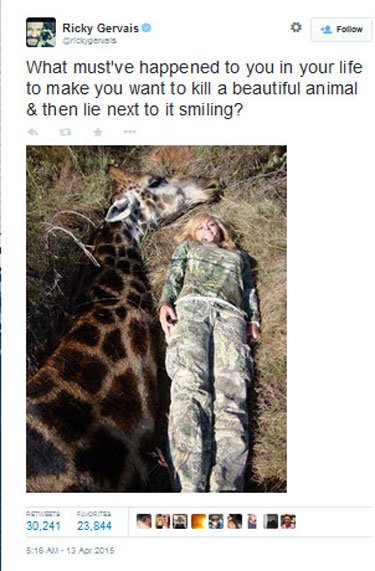
British celebrity (I’d never heard of him) Ricky Gervais recently unleashed an international avalanche of personal abuse and even death threats at Utah huntress Rebecca Francis by a post on Twitter attacking her for taking a photograph of herself lying next to a trophy giraffe.
Hunting Life alerted Ms. Francis, who explained:
When I was in Africa five years ago I was of the mindset that I would never shoot a giraffe. I was approached toward the end of my hunt with a unique circumstance. They showed me this beautiful old bull giraffe that was wandering all alone. He had been kicked out of the herd by a younger and stronger bull. He was past his breeding years and very close to death. They asked me if I would preserve this giraffe by providing all the locals with food and other means of survival. He was inevitably going to die soon and he could either be wasted or utilized by the local people. I chose to honor his life by providing others with his uses and I do not regret it for one second. Once he was down there were people waiting to take his meat. They also took his tail to make jewelry, his bones to make other things, and did not waste a single part of him.”
In our contemporary world, any hunting trophy photograph, particularly a photo featuring a female hunter, can be relied upon to provoke passionate outrage on the part of the herd of urban douches who’ve been conditioned by entertainment industry Nature pimps to wallow in emotional self-indulgence over wild animals and who have grown to believe that meat is normally grown hydroponically on supermarket shelves.
NY Daily News story