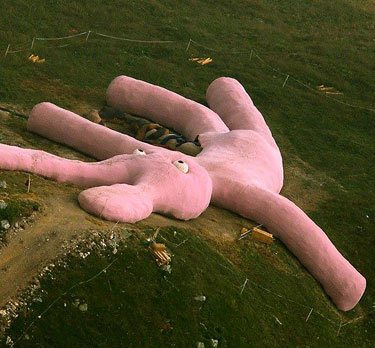
In 2005, a group of artists in Italy built a giant 200-foot-long plushie rabbit in the countryside, and just left it there. It’s been there ever since.
Cornelius van Harlaam, Bathsheba at her toilet, 1594, Rijksmuseum
The leftist morons at the fine arts blog Hyperallergic are applauding the large-scale re-titling of art works at Amsterdam’s Rijksmuseum on the basis of political correctness. From the viewpoint of the contemporary fashionable leftist, the existence of a Christian European point of view constitutes ipso facto an insult and an affront to the Hottentots and Mussulmen, and the fashionable leftist is on their side, not ours.
If you’re browsing the digital collection of Amsterdam’s Rijksmuseum, you might come across a 1594 painting by Cornelisz van Haarlem, “Bathsheba at her Toilet,†picturing “the beautiful Bathsheba†bathing outside the castle of King David. And you might wonder what year it is when you see this jarringly racist phrase in the painting’s description: “Because Bathsheba’s maidservant is black, the subtly erotic painting takes on an exotic tinge.â€
It’s just one example of the offensive and dated language that peppers the museum’s descriptions of its artworks. Soon, though, racially charged language — including words like “negro†and “Mohamadden,†a Victorian word for Muslims since it was assumed they followed Mohammad like Christians followed Jesus — will be removed from some 220,000 titles and descriptions in the Rijksmuseum’s online catalogue of images, to be replaced by more neutral terms. The project, called “Adjustment of Colonial Terminology,†is spearheaded by 12 curators in the Rijksmuseum’s history department. It’s been in planning stages for several years, but has only gotten off the ground in the past month.
“The Rijksmuseum thinks it’s very important to give descriptions of our collections in a neutral way, using correct, up-to-date language and from a neutral perspective,†curator Eveline Sint Nicolaas tells Hyperallergic. “We no longer want to make use of terms that reflect a Eurocentric way of looking at people or historic moments, or that are considered discriminatory because the used terms refer to race in a negative way, or contain terms that go back to colonial times. If it’s unnecessary, they will no longer refer to skin color.â€
The project has been met with plenty of opposition from people who think it’s an example of historical revisionism, censorship, or political correctness gone too far. “Some people are afraid we are ‘whitewashing’ history or throwing away historical information that belongs to the object,†Sint Nicolas says. Those include Sir Nicholas Serota, director of the Tate, who commented on the Rijkmuseum’s decision by saying Tate’s galleries would not be following suit by “censoring†artworks. But “nothing is erased,†Sint Nicolaas says. The Rijksmuseum argues that critics of this project don’t understand its nuances, or the art historical and colonial context that led to such descriptions being written in the first place. The updates simply provide visitors with a neutral lens through which to view historical artworks, instead of the biased lens created by Rijksmuseum administrations of the past.
Eveline Sint Nicolaas ought to be fired by the museum’s directors on the basis of her intellectual treason and anti-European bigotry, and then sent off to try to get a job curating works of art for the African Negroes in their jungles. When she fails to find any art to curate or any museums to curate them in, she can next try persuading the fanatical followers of the prophet Mahound to stop destroying art works and to tolerate representational art. And good luck to her!
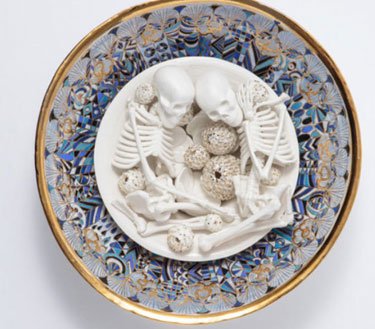
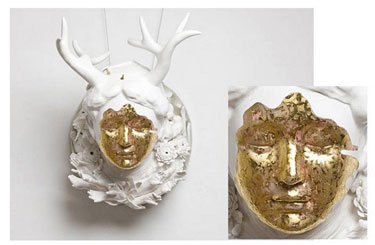
Yunhee Lee is a very popular young ceramic artist still in her twenties. Straight out of university, Lee has been invited to numerous exhibitions in and outside Korea, many of which has seen her artworks do extremely well. Lee is currently a resident artist at Clayarch Gimhae Museum, as part of its initiative to support creative and experimental artists. In 2013 Gyeonggi International Ceramic Biennale, she was selected as one of 20 ‘Hot Rookies’ artists, which included young talents from around the world including China, US, Germany, France, and Spain. Lee calls herself a collector: collector of common stories around her, regarding people’s insatiable desires, fears, anxieties and the cure they search and find to overcome them. She takes note of these ‘curing processes’ and bring them to life with her hands using clay as a medium. Layers of variously sized units and the splendid patterns and colors have created a beautifully delicate and refined artwork that has come to define Lee’s artistic style.
South Korean artist Lee Yun Hee creates narrative ceramic pieces inspired by literature and story telling. She uses both Western and Eastern influences, creating a style of her own that is striking, unique and undoubtably contemporary. Her work is fragile and flawless, almost creating an aura of effortlessness. She uses her work to reflect upon stories of everyday people; their struggles, fears, hopes, and anxieties. Yet, most importantly to her, she is truly interested in documenting their “cures†— the sort of “up from below†type stories that end with a protagonist who has had the strength and endurance to overcome a difficult task. For example, her piece La Divina Commedia, reinterprets the classic 14th century poem by Dante. In her version, she depicts a young girl’s search for truth. She explains the tale behind the piece in an interview with Brilliant 30. She states,
“there was once a girl that received an oracle, telling her future. The knowledge, the predestined desire and insecurity left her troubled. In search of happiness and peace, she embarked on a journey. Along the way, she encountered many obstacles; but at the end, she discovered the peace she has been striving for…By overcoming anxiety and suppressing desire, the girl reaches a state of ultimate peace.â€
Her work acts as windows into her own version of a fairy tale; she is able to re-create morality stories within her own framework. She refers to her self as a collector— she takes influence from everything she sees. She explains, “I have been keen on collecting images since I was a child. I would rather cut out the pictures from cartoons than read them. Even the encyclopedia wasn’t safe. These processes have had more influence than anything else on my background as an artist.â€
Lee Yun Hee’s work is mystical and fantastic. Though balancing modern, classic, Eastern, and Western styles, she has creating an epic body of art that is honest, profound, and truly unique.
Art critic and cultural commentator Brian Sewell deservedly received one of the Telegraph‘s celebrated obituary tributes.
Brian Sewell, the loquacious art critic and broadcaster known for his acerbic wit, has passed away at the age of 84. He had been suffering from cancer.
He was an award-winning contributor to the Evening Standard and presented a series of travelogues for Channel 5, as well as often appearing on panel shows such as Have I Got News for You.
He was known as the UK’s “most controversial art critic”, and would openly criticise those who he deemed worthy of it, once calling Damian Hirst “f—–g dreadful” and stating that Banksy “should have been put down at birth”. …
n 1994, 35 figures from the art world, including Bridget Riley, George Melly and Maureen Paley, signed a letter to the Evening Standard attacking Sewell for “homophobia”, “misogyny”, “demagogy”, “hypocrisy”, “artistic prejudice”, “formulaic insults” and “predictable scurrility”.
This was followed up by a counter-letter in support of Sewell, signed by 20 other art figures. …
He maintained his negative opinions about female artists throughout his life. “The art market is not sexist,” he said in interview with The Independent in 2008. “The likes of Bridget Riley and Louise Bourgeois are of the second and third rank. There has never been a first-rank woman artist. Only men are capable of aesthetic greatness. Women make up 50 per cent or more of classes at art school. Yet they fade away in their late 20s or 30s. Maybe it’s something to do with bearing children.”
He was also a vocal critic of the Turner Prize, calling it an “annual farce†and its nominees “a sad little band of late labourers in the exhausted pastures of international conceptual artâ€.
But it was not only art that he was scornful of. Despite being bisexual himself (though he preferred the term “queer”), he also spoke out about gay marriage, saying, “The recent institution of civil partnerships seemed to be the final necessary reform… Why, then, do they and lesbians demand the right to marry? Indeed, how many of us have made that demand? One in 20? One in 10?… But every minority has within it a core of single-issue politicians and protesters who are never satisfied and always ask for more, and homosexuals, both male and female, are no exception.”
———————–
There was a time when homosexuals naturally gravitated to the upper class lifestyle, adopted an arch reactionary perspective, and were champions of high culture and civilization. Brian Sewell’s negative commentary on a masked ball in Venice could easily have been delivered by Brideshead Revisited‘s Anthony Blanche.
Taylor Clark, in California Sunday Magazine, has a helluva story about a still-ongoing treasure hunt arranged for his own amusement by a colorful millionaire art dealer.
Five years ago, a legendary art dealer left his home in Santa Fe, traveled to an undisclosed location somewhere in the Rocky Mountains, and hid a 42‑pound chest filled with priceless treasure.
In the summer of 1988, not long after doctors removed his cancer-plagued right kidney… late one night, Fenn had an idea… He would stuff a treasure chest with glittering valuables, write a clue-laden poem that would point to its location, and then march out to his favorite spot on earth to take some pills and lie in eternal repose with the gold, like a doomed conquistador in an Indiana Jones movie. All he needed was someone to write and publish the book in which he’d place the poem. “Because there was no point in hiding it if no one knew I hid it,†Fenn said.
“Forrest told me the idea at lunch one day,†recalled the bestselling author Douglas Preston, a longtime friend and one of the first writers Fenn approached. “His plan was to inter himself with the treasure, so that anyone who found it could essentially rob his grave. I said, ‘God, Forrest, that’s a terrific story — ​you’re the guy who’s going to take it with you!’†Still, Preston didn’t go for the idea… and neither did any of the other writers. “I think they didn’t like the idea of me dying out in the trees someplace,†Fenn said.
Fenn’s failure to launch this scheme was no great disappointment, however, for the simple reason that his cancer treatment worked. Yet he couldn’t let go of his treasure idea. He held on to the chest he’d bought, an ornate bronze lockbox, and spent years filling it. Fenn tinkered with its contents constantly, aiming to create a stash that would dazzle anyone who opened it: gold coins, Ceylon sapphires, ancient Chinese carved-jade faces, Alaskan gold nuggets the size of chicken eggs — some of these items coming from his own private collection, others acquired just to add to the hoard.
For the next 20 years, Fenn kept the chest in a vault in his Santa Fe home, covered with a red bandanna. Occasionally, he’d test out its amazement quotient on friends, who tended to view the whole thing as just another amusing Fennian lark. Certainly, few of them expected he’d actually hide it. For one thing, the man was a born raconteur who readily admitted to embellishing his stories. For another, the treasure was worth a fortune — seven figures, most likely — and not even Fenn was crazy enough to just give something like that away. And after so many years of talk, if he was really going to do it, wouldn’t he have done it already?
Then, sometime around 2010, Fenn did it. Without even telling his wife, Peggy, he slipped out and squirreled away his chest — to which he’d added a miniature autobiography, sealed with wax in an olive jar — somewhere in the wilds of the Rockies. It took him two trips from his car to get all of the treasure to the hiding spot, because it weighed 42 pounds and he was in the neighborhood of his 80th birthday by then. For a while, Fenn kept what he’d done secret. His own daughters didn’t find out about it until he self-published his memoir, The Thrill of the Chase, complete with the poem he’d spent years refining.
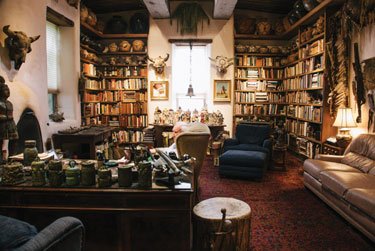
The author serves up an anecdote from his first meeting with Fenn, which illustrates beautifully that grand eccentric’s philosophic approach to collecting historical artifacts.
I tell you what,†Fenn said at the end of our first afternoon together, hoisting himself up from the leather sofa. “I’ll give you a treat.†He shuffled over to one of the floor-to-ceiling bookcases that line his library and pulled out an old green bottle that I recognized immediately from Too Far to Walk, one of the nine other books he’s written.
“This is the Jackie Kennedy brandy,†I said, startled.
In June of 1984, Fenn lodged Kennedy in the guesthouse of his gallery, where she was a model visitor. “A lot of people stayed at my guesthouse, and she’s the only one who left my cleaning lady a $50 tip and a two-page handwritten letter,†he told me. When Kennedy departed, she left behind a mostly empty bottle of Korbel brandy, which now enjoys pride of place next to Fenn’s Air Force medals. In the past 30 years, he has offered sips from the bottle to only two people. He unscrewed its top and extended it to me.
“Now, you take a big swig, I’m gonna punch you out,†he warned.
I held the bottle for a moment, hesitating. Wasn’t this, in its way, a piece of American history? I took the tiniest volume of liquid that could plausibly be called a sip into my mouth, held it for a moment, and swallowed.
“So, do you feel different now?†Fenn asked.
I couldn’t say that I did. History tasted pretty much exactly like old brandy. Yet for the rest of my life, I’d be able to say I shared a drink with Jackie Kennedy.
“See, when I look at you taking a sip of this, I would think of you feeling like you’re on a different plateau,†Fenn said, grinning. “Because you’re part of it now. Instead of being a spectator, you’re a player.â€
Alexey Kondakov, an artist based in Kiev, Ukraine, has created a series of Photoshopped images demonstrating how the gods and characters of antiquity portrayed in classical paintings would look if they appeared alongside us in contemporary settings. leenks