Scott Grannis calculates just how much economic growth we’ve lost, for some unknown reason, over the course of the last six years.
Real GDP growth in the first quarter was weaker than expected (0.2% vs. 1.0%), but it wasn’t much of a surprise. It’s now been almost six years that the economy has managed only meager growth—about 2 ¼% per year on average. As a result, by my calculations, real GDP is a little over 10% below its long-term trend potential. That’s more than $2 trillion in lost income every year, and it’s getting worse. …
The chart above compares the level of real GDP to a long-term trend growth rate of 3.1%. This confirms once again that we are stuck in the slowest recovery ever. It’s my belief that the persistence of slow growth is largely the result of bad policies, though demographics likely plays a part too. Corporate profits have been very strong, but business investment has been very weak. Without new investment and risk-taking, we are not going to see a pickup in productivity which is, at the end of the day, what drives stronger growth and higher living standards. Investment has been weak probably because marginal tax rates and regulatory burdens have increased significantly in the past six years. In a sense, and expansion of government has suffocated the private sector.
Things are not going to change much for the better until policies become more pro-growth.
Whether the persistence of relatively weak growth is a reason for the Fed to continue to keep short-term interest rates extraordinarily low is one of the key questions of our time. I don’t see how low interest rates stimulate investment or enhance productivity. Only private initiatives can do that.
On the bright side, if policies do become more favorable, there is tremendous upside potential to look forward to. Closing the GDP gap would be nothing short of exhilarating.
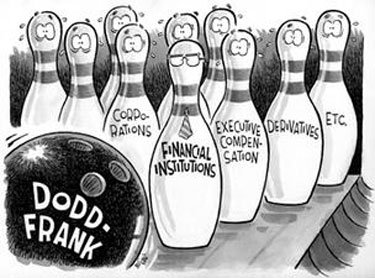
Douglas Holtz-Eakin attempts to calculate the impact of the 2010 Dodd–Frank Wall Street Reform and Consumer Protection Act (Dodd-Frank) on the growth of the economy.
What did Dodd-Frank do to the effective tax rate on banks? Consider, first, the burden of complying with the new regulations. The American Action Forum’s analysis of the Federal Register indicates that the cumulative burden (including the market value of paperwork hours for compliance) is roughly $14.8 billion annually. Notice that after-tax income in the presence of the burden is:
[rL – C – Burden](1-tB)
where r is interest on loans (L), C is the cost of acquiring funds and other operations, and tB is the tax rate on banks. Suppose that instead of a burden, the same after-tax income was generated by simply raising the tax rate to t’. Then, by definition:
[rL – C – Burden](1-tB) = [rL – C](1-t’)
[which] can be re-arranged to yield:
t’ = tB + (1-tB)[Burden/(rL-C)]
To put some empirical meat on [this], the Federal Deposit Insurance Corporation’s (FDIC) Quarterly Banking Profile (QBP) provides information on taxes ($67.5 billion) and net income ($151.2 billion) that permit one to compute an initial tax rate of 31 percent. Using the AAF burden data and (11) yields an increase to 37.8 percent from compliance burdens.
A similar approach can be used to transform the roughly 2 percentage point rise in the leverage ratio of the banking sector (from 7.5 to 9.5 percent) from 2008 to 2014 into a rise in the effective tax rate. The banking sector responded to Dodd-Frank by holding more equity capital, thus require it to have greater earnings to meet the market rate of return – the same impact as raising taxes. In this case, the higher leverage ratio translates into a further increase in the effective tax rate to 40.3 percent, for a total rise of 9.2 percent.
Collecting results, the impact on economic growth is a decline in the per capital growth rate of 0.059 percentage points annually. Is this a big deal? Consider lowering the growth rate in the Congressional Budget Office baseline projections by exactly this amount between 2016 and 2025. The lower rate of economic growth translates into a total loss of $895 billion in GDP or $3,346 for every member of the working age (16 and older) population over those 10 years.
Hillary Clinton’s remarkable denial that corporations create jobs in the course of a campaign speech for Martha Coackley in Massachusetts last Friday produced sufficient mockery and loud guffaws that Hillary was yesterday at pains to revise and extend her remarks.
Hillary Clinton tried her best on Monday to walk back her controversial economic body-slam from a speech on Friday, explaining away her claim that it’s not ‘corporations and businesses that create jobs.’
The talking point three days later: ‘So-called trickle-down economics has failed. I short-handed this point the other day, so let me be absolutely clear about what I’ve been saying for a couple of decades.â€
“Our economy grows when businesses and entrepreneurs create good-paying jobs here in America and workers and families are empowered to build from the bottom up and the middle out – not when we hand out tax breaks for corporations that outsource jobs or stash their profits overseas.’
But the damage has been done. Conservatives have a new rally cry – ‘Don’t let anybody tell you that it’s, you know, corporations and businesses that create jobs,’ she said – and campaign consultants will have a new advertisement drawn up if Clinton runs for president in 2016.
————————-
————————–
Alinsky-ite propagandists like Hillary decry the idea that limiting the percentage of a nation’s economic wealth confiscated and squandered by government leaves more capital available for investment and increases the likelihood that that nation’s economy will grow, and socialists smear the notion that a growing economy raises all boats by applying the derisive term “trickle-down economics.”
When people like Hillary sneer at the idea of capitalistic growth as “trickle-down economics,” they are, in fact, shamelessly denying the obvious history of their own country, the same history which Hillary herself lived through a significant piece of, right along with the rest of us.
Just compare the condition of a working-class family a hundred years ago with the condition of a similiarly-situated family today. In 1914, chances are that a working class family used an outhouse, lighted their home with a kerosene lamp, heated their home with the cookstove in the kitchen, owned no automobile, and (obviously) did not enjoy air-conditioning or computers. It’s actually pretty amazing all the stuff that has trickled down from the once-upon-a-time point when they either constituted fabulous luxuries available only to the rich, or were not yet even existing at all, to becoming routine features of the life of practically everyone.
It was remarked with a certain amount of bemusement, back in 1991, during the Los Angeles Rodney King riots, that, in America, when the poor riot, they leave air-conditioned homes, with computers and color televisions behind, and get in their cars to drive downtown in order to riot.
So-called “trickle-down economics” may not be as speedy in results as rubbing a magic lamp and making a wish, but that kind of economics really has, over just a few generations, made ordinary people richer in many ways than kings and emperors used to be.
The alternative to “trickle-down economics”, of course, is socialism. There are plenty of well-known examples as to just how effective in promoting general economic well-being all the best exemplars of Hillary Clinton’s preferred Robin Hood “Steal-from-the-rich-and-give-to-the-poor” economic philosophy have proven: Argentina, Cuba, North Korea, the late Soviet Union.
Appearing on Friday at a Boston rally in support of behind-9-points-in-the polls Democrat gubernatorial candidate Martha Coakley at the Park Plaza Hotel, Hillary Clinton dismissed the idea that businesses create jobs. I guess Hillary must simply be projecting her family’s life experience, that all wealth is derived from politics, onto universal reality.
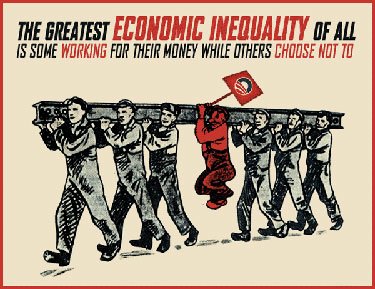
Kevin Williamson wrote a terrific essay debunking the standard communist propaganda about inequality purveyed by Paul Krugman.
I live in the same city as Donald Trump, so the existence of rich people with toxic taste is not exactly a Muppet News Flash for me. But poor people are not poor because rich people are rich, nor vice versa. Very poor people are generally poor because they do not have jobs, and taking away Thurston Howell III’s second yacht is not going to secure work for them. Nobody has ever been able to satisfactorily answer the question for me: How would making Donald Trump less rich make anybody else better off?
There is, obviously, one direct answer to that question, which is that making Trump less rich by seizing his property and giving it to somebody else would make the recipients better off, and that is true. But the Left does not generally make that straightforward argument for seizing property. Rather, they treat “inequality†as though it were an active roaming malice on the economic landscape, and argue that incomes are stagnant at the lower end of the range because too great a “share of national income†— and there’s a whole Burkina Faso’s worth of illiteracy in that phrase — went to earners at the top. It simply is not the case that if Lloyd Blankfein makes a hundred grand less next year, then there’s $100,000 sitting on shelf somewhere waiting to become part of some unemployed guy in Toledo’s “share of the national income.†Income isn’t a bag of jellybeans that gets passed around.
Further, if your assumption here is that this is about redistribution, then you should want the billionaires’ incomes to go up, not down: The more money they make, the more taxes they pay, and the more money you have to give to the people you want to give money to, e.g., overpaid, lazy, porn-addicted bureaucrats.
Limitations on immigration (not required by National Security) are nothing other than a species of Protectionism, a way of limiting labor market competition.
Funeral of my grandmother’s brother, Joseph Skarnulis, killed in Tunnel Ridge Colliery, Mahanoy City, Pennsylvania, October 6, 1905. While crossing the breast to see if the manway was open, a fall of coal caught him, killing him instantly. My Aunt Rose (born 1901 — died 1988) is the little girl at the head of the coffin. My Aunt Ann (born 1900 — died 2000) is the little girl peeping over the coffin to her left. My grandmother, Martha, is the lady with the big hat cut in half by the break in the photo. My grandfather, George Zincavage, is the fellow with the droopy mustache to her right.
Commenter Chris writes:
1. We control our border. If we cannot do this what’s the point of being a nation
“Controlling our borders” is a slogan. In reality, the United States has thousands and thousands of miles of border passing through uninhabited, empty wilderness which any really determined person can cross. We can’t control those borders completely because the economic cost of doing so would be ridiculous and the benefit trivial. We can’t control our borders perfectly for the same reason nobody can conquer Afghanistan: It would be a tremendous waste of money, so no one is ever going to do it.
Some loons want to built a barbed wire fence all the way from the Gulf of Mexico to the Pacific. What a noxious symbol of statist irrationality and inhumanity that would be! We’d have our own Berlin Wall, but enormously longer, where we could shoot people for trying to come here in order to better their lives, instead of for trying to escape.
2. We DO NOT implement Amnesty. What point is having laws on the books if we’re going to abrogate them whenever we please?
The problem with this argument is that existing immigration rules embody no real principles, serve no specific purposes, and reflect no real national consensus. They represent only this particular edition of bureaucratic modification cobbled together during a period of national confusion and bitter political division.
Why should anybody give a rat’s rear end if somebody else violates a basically unprincipled, ill-considered, and fundamentally pointless regulation? Personally, I want to see my lawn mowed, my roof fixed, and the world’s work in general done as well and as economically as possible. I don’t really care about the genealogy or national origin of the guy cutting my grass or picking the apples I buy. If the steak I buy at the local Bistro is more affordable because the busboy and the guy washing the dishes snuck into the country to take those jobs, I think that’s just great, and I wish those Hispanic gentlemen the best.
3. Deport those illegals involved in Criminal activity.
I can go along with that one, though I’d personally prefer no laws on the books criminalizing victimless crimes.
4. Prosecute any company paying less than minimum wage to their employees (not sure that’s even an issue)
If I were on the Supreme Court, I’d write you a ruling explaining why government interference with voluntary contracts between one American or one business entity an another are unconstitutional and are economically deleterious to society. There is no such thing as a just price other than a price voluntarily agreed to between to parties. The imposition of fixed pricing by law represents the illegitimate intrusion of governmental force on behalf of one party to the injury of another and of the whole of the rest of society.
Do those 4 things there won’t be a need for amnesty, because in a generation everyone here illegally will be eligible for some form of legal immigration, either through anchor babies, marriage etc.
My wife immigrated here from Canada. We got caught in the 86 amnesty legalization surge and a process that took 3 months ended up taking 3 years because of the volume of illegals that gained legal status. That’s BS of the first order that!
This has nothing to do with race but with FAIRNESS. What you are advocating is unfair to those that cannot run, jump, or swim the border. Why should Hispanic illegals get any preferential treatment? Get in line if you want to come here…. everyone else had to.
This is the Michelle Malkin argument. The problem with it is that compliance with unprincipled and essentially useless regulations really benefits nobody. What we ought to want is what’s good for the country. What’s good for the country is the free flow of willing and affordable labor and all benefits of a continued population increase comprised of the most dedicated, energetic, and ambitious citizens of foreign lands. I want my lawn mowed. I want my fruit and vegetables picked. I want low-skill jobs done cheap. I don’t care if the guy doing them said “Simon says” or stood in the proper line or filled out the right forms.
Even my 9th great grandfather that came over from Wales in 1658.
He stood in line to get here in 1658? I do not understand what you mean.
Kristian Niemietz argues that political correctness constitutes what economists call “a positional good,” i.e., one differentiating you from others and defining your place in the social hierarchy.
PC-brigadiers behave exactly like owners of a positional good who panic because wider availability of that good threatens their social status. The PC brigade has been highly successful in creating new social taboos, but their success is their very problem. Moral superiority is a prime example of a positional good, because we cannot all be morally superior to each other. Once you have successfully exorcised a word or an opinion, how do you differentiate yourself from others now? You need new things to be outraged about, new ways of asserting your imagined moral superiority.
You can do that by insisting that the no real progress has been made, that your issue is as real as ever, and just manifests itself in more subtle ways. Many people may imitate your rhetoric, but they do not really mean it, they are faking it, they are poseurs (here’s a nice example). You can also hugely inflate the definition of an existing offense (plenty of nice examples here.) Or you can move on to discover new things to label ‘offensive’, new victim groups, new patterns of dominance and oppression.
If I am right, then Political Correctness is really just a special form of conspicuous consumption, leading to a zero-sum status race. The fact that PC fans are still constantly outraged, despite the fact that PC has never been so pervasive, would then just be a special form of the Easterlin Paradox.
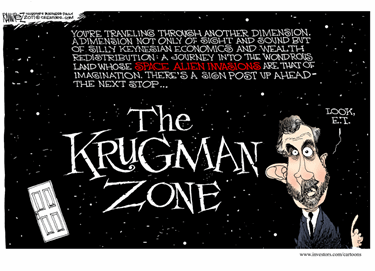
Dan Greenfield complains of being attacked by Paul Krugman: the same Paul Krugman, who has done for economics what Erich Von Daniken did for space exploration.