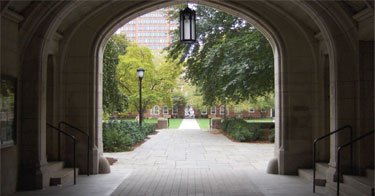
Current Head of Silliman College: Laurie Santos, Harvard ’97 A.B psychology & biology, ’03 Ph.D. psychology.
A Yale alumn I know from Silliman (I was in Berkeley myself) passes along an email:
Excerpt below from actual email I received from actual grown-up in an important position at a once-prestigious Ivy League university (“HoC Santos,” who is the new don’t-call-it-Master of Silliman). Am I just old and out of it, or is it fundamentally undignified for someone in that sort of role to adopt the tone of a perky 19-year-old sorority social-events chair at some perfectly-okay state university somewhere out in flyover country?
“Our first ever Sing-Along will take you back to the days of flannel clothing, huge scrunchies and boy bands. It will be the ultimate celebration of all things ‘90s! From the Britney to Backstreet Boys, with plenty of Alanis and Nirvana mixed in, this is how we Sillimanders do it, even as we smell like teen spirit cuz we’re livin’ la vida loca.8-9:30pm in Silliflicks. Word to your mutha.”
There was no email, not even any PCs, back when I was an undergraduate at Yale. In those days, all Yale Residential College Masters were middle-aged White Anglo-Saxon Protestant males and distinguished scholars. In Silliman’s case, the Master was one Elias Clark, a law professor with a background which included Yale and Andover and WWII military service.
Somehow, I cannot really picture Master Clark sending out to the Silliman Salamanders of my day a mimeograph announcement of a college shindig celebrating the music and pop stars of the 1950s couched in the Beatnik vernacular of Maynard G. Krebs. Still less, his screwing up and inadvertently forwarding such a missive to graduated alumni.
Professor Santos may very likely have been specifically chosen to make the Snowflakes of Color of Silliman College feel safer from improper Halloween costuming and more comfortable and at home there, which we all learned last year is the most essential function of the heads of Yale residential colleges.
Former Associate Masters Nicholas and Erika Christakis fell afoul of diverse student sensivities, when La Christakis responded to an admonitory Intercultural Affairs Council email edict warning students sternly against such Halloween transgressions as wearing blackface, sombreros, or turbans with a skeptical email of her own wondering aloud about the propriety and necessity of such politically correct pronunciamentos.
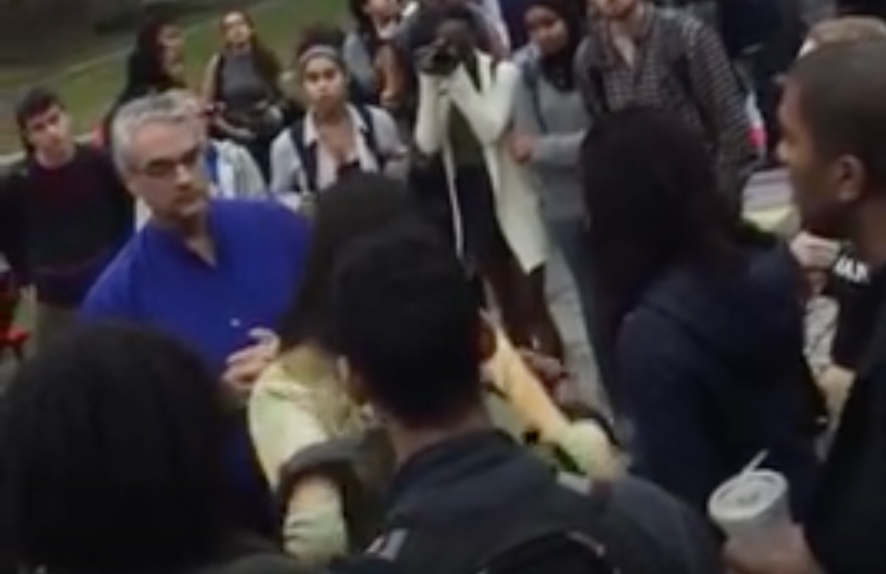
In response to Erika Christakis’s chin-stroking email, students went absolutely wild. Nicholas Christakis was confronted, shouted down, told he was not doing his job properly, and urged to resign. An African-American dean was similarly mobbed and lectured on his responsibility to be on the side of his own people. There were marches, one of which occurred at Midnight and featured the delivery of some pretty outrageous demands to the timid Yale President Peter Salovey at his house on Hillhouse Avenue.
The Yale Administration announced that it was firmly behind the free speech rights of the Christakises, which announcement was followed by Erika’s rapid departure in under a month, immediately thereafter by husband Nicholas’s departure on sabbatical, and finally (surprise! surprise!) by the announcement of his resignation during the summer. Yale was ever so solidly behind them. Adieu! Christakises and Adieu! the title of Master itself.
President Salovey previously announced that Yale would pay $50 million in Danegeld for more privileged-victim-group faculty recruitment and development (aka remedial education) and whatever else our contemporary Danes might desire. Yale’s concessions and surrenders will be continuing.
Master of Silliman College 1962-1981, Charles Elias “Eli” Clark, Andover ’39, Yale ’43 B.A. American history, Army Air Corps pilot 1944-1945, Yale Law ’47, Yale M.A. ’58.
Can’t imagine why they’d do that, except that it seems to be happening to a lot of people for no obvious reason. It’s as if, despite assurances to the contrary, Twitter is out to silence voices it disagrees with or something.
Sorry, blocking the interstate is dangerous, and trapping people in their cars is a threat. Driving on is self-preservation, especially when we’ve had mobs destroying property and injuring and killing people. But if Twitter doesn’t like me, I’m happy to stop providing them with free content. …
I don’t even know that this is why I was suspended, as I’ve heard nothing from Twitter at all. They tell users and investors that they don’t censor, but they seem awfully quick to suspend people on one side of the debate and, as people over at Twitchy note, awfully tolerant of outright threats on the other.
Twitter can do without me, as I can certainly do without Twitter.
Infuriating. Who do they think they are? I’d like to see massive retaliatory hacking, denial of service attacks, and mobs armed with pitchforks and torches besieging these douchebags’ offices.
————————————–
Glenn Reynolds’ tweet was obviously intended as a quip, expressing frustrated indignation at the form of protest, blocking highways, that has recently become popular. Twitter censors took advantage of its dark humor to strike an exaggerated moralizing pose and punish the person whose politics they do not like.
But, really, faced with a crowd of racially-chauvinist rioters from the inner city criminal class getting through the blockers by threatening to run them down would simply be the most prudent course of action.
The very liberal Master of Silliman College and his equally liberal wife and co-Master, were publicly denounced and vilified early last November for Mrs. Christakis’s daring to question the dictate on the vital issues of Halloween costuming laid down by Yale’s “Intercultural Affairs Committee,” a 13-member group of administrators from the Chaplain’s Office, campus cultural centers, and other campus organization. That committee urged students to be careful of the cultural implications of their Halloween costumes and to avoid trespassing upon the tender sensitivities of officially-recognized victim groups via the use of feathered headdresses, turbans, “war paint,†or blackface, all cases of inappropriate “cultural appropriation and/or misrepresentation.â€
Co-Master Erika Christakis responded two days later, the night before Halloween with her own email, based on her professional expertise as a child development specialist, questioning the appropriateness of the university policing students’ choices of Halloween costumes:
I don’t wish to trivialize genuine concerns about cultural and personal representation, and other challenges to our lived experience in a plural community. I know that many decent people have proposed guidelines on Halloween costumes from a spirit of avoiding hurt and offense. I laud those goals, in theory, as most of us do. But in practice, I wonder if we should reflect more transparently, as a community, on the consequences of an institutional (which is to say: bureaucratic and administrative) exercise of implied control over college students.
Christakis raised free speech and expression issues and then inquired philosophically:
Is there no room anymore for a child or young person to be a little bit obnoxious… a little bit inappropriate or provocative or, yes, offensive? American universities were once a safe space not only for maturation but also for a certain regressive, or even transgressive, experience; increasingly, it seems, they have become places of censure and prohibition.
Demonstrations ensued, an open letter denouncing Erika Christakis’s email was signed by hundreds and hundreds of students and faculty, Nicholas Christakis was confronted and abused by “the shrieking student,” Yale Dean Holloway was confronted and scolded by a crowd of students of color, demonstrators demanded the Yale Administration apologize and meet a long laundry list of demands, including the dismissal of both Christakises.
The University declined to fire the Christakises, and affirmed that they continued to have its support. But, Erika Christakis quit teaching at Yale last December, and her husband Nicholas announced soon thereafter that he would be taking a sabbatical for the Spring Semester.
On Wednesday this week, the Yale Daily News reported that, all that solid Administration support notwithstanding, what do you know? the Christakises will never be coming back.
Months after a controversial email helped spur sustained student protests last fall, Nicholas and Erika Christakis will step down as head and associate head of Silliman College, effective this July.
In a Wednesday afternoon email to the Silliman community, Nicholas Christakis announced that he submitted his resignation to University President Peter Salovey last week. The couple drew national attention last fall when a Halloween weekend email from Erika Christakis defending students’ rights to wear culturally appropriative costumes sparked outrage on campus.
At the time, many students and alumni called for the couple to resign their roles at the helm of Silliman College, arguing that the two could no longer serve as effective leaders of a college community designed to create a home for undergraduates. But others said their removal would constitute a serious blow to free speech on college campuses.
In his resignation announcement, Nicholas Christakis emphasized the importance of open intellectual debate, a stance which caused controversy last fall as many students argued that the emphasis on free speech came at the cost of student wellbeing and safety.
“We have great respect for every member of our community, friend and critic alike,†Nicholas Christakis wrote. “We remain hopeful that students at Yale can express themselves and engage complex ideas within an intellectually plural community. But we feel it is time to return full-time to our respective fields of public health and early childhood education.â€
The Foundation for Individual Rights in Education noted that Yale’s fidelity to its own supposed ironclad commitment to Free Speech seems to be less than ironclad in actual practice.
Now both professors have stepped down. The “glowing promises†… in Yale’s famed Woodward Report, which assures students and faculty members that they are free to “think the unthinkable, discuss the unmentionable, and challenge the unchallengeable†and states that “[a]mong the College’s most cherished principles is its commitment to freedom of expression.â€
With the Christakises’ resignation, it’s clear that Yale’s ability to live up to its public promise to provide an environment that fosters free and robust debate has been called into sharp question.
———————————————————
It is probably some Yale irate alumn who has singled out the shrieking student on Facebook for revenge.
This video made by a 16-year-old Bibi Wilhaim tells German elites that they have destroyed Germany with their policy of admitting Third World primitives. She calls on the men of Germany to protect their women and children from Muslim attacks. Facebook is apparently censoring her video as “hate speech.”
Things have reached a pretty pass when even ultra-liberal Atlantic columnists are shocked and appalled by the expectations and behavior of student activists.
With world-altering research to support, graduates who assume positions of extraordinary power, and a $24.9 billion endowment to marshal for better or worse, Yale administrators face huge opportunity costs as they parcel out their days. Many hours must be spent looking after undergraduates, who experience problems as serious as clinical depression, substance abuse, eating disorders, and sexual assault. Administrators also help others, who struggle with financial stress or being the first in their families to attend college.
It is therefore remarkable that no fewer than 13 administrators took scarce time to compose, circulate, and co-sign a letter advising adult students on how to dress for Halloween, a cause that misguided campus activists mistake for a social-justice priority. …
This year, we seem afraid that college students are unable to decide how to dress themselves on Halloween,†she wrote. “I don’t wish to trivialize genuine concerns about cultural and personal representation, and other challenges to our lived experience in a plural community. I know that many decent people have proposed guidelines on Halloween costumes from a spirit of avoiding hurt and offense. I laud those goals, in theory, as most of us do. But in practice, I wonder if we should reflect more transparently, as a community, on the consequences of an institutional (bureaucratic and administrative) exercise of implied control over college students.â€
It’s hard to imagine a more deferential way to begin voicing her alternative view. And having shown her interlocutors that she respects them and shares their ends, she explained her misgivings about… telling college kids what to wear on Halloween. …
When I was in college, a position of this sort taken by a faculty member would likely have been regarded as a show of respect for all students and their ability to think for themselves. She added, “even if we could agree on how to avoid offense,†there may be something lost if administrators try to stamp out all offense-giving behavior. …
In her view, students would be better served if colleges showed more faith in their capacity to work things out themselves, which would help them to develop cognitive skills. “Nicholas says, if you don’t like a costume someone is wearing, look away, or tell them you are offended. Talk to each other. Free speech and the ability to tolerate offence are hallmarks of a free and open society,†she wrote. “But—again, speaking as a child development specialist—I think there might be something missing in our discourse about … free speech (including how we dress) on campus, and it is this: What does this debate about Halloween costumes say about our view of young adults, of their strength and judgment? In other words: Whose business is it to control the forms of costumes of young people? It’s not mine, I know that.â€
That’s the measured, thoughtful pre-Halloween email that caused Yale students to demand that Nicholas and Erika Christakis resign their roles at Silliman college. That’s how Nicholas Christakis came to stand in an emotionally charged crowd of Silliman students, where he attempted to respond to the fallout from the email his wife sent.
Watching footage of that meeting, a fundamental disagreement is revealed between professor and undergrads. Christakis believes that he has an obligation to listen to the views of the students, to reflect upon them, and to either respond that he is persuaded or to articulate why he has a different view. Put another way, he believes that one respects students by engaging them in earnest dialogue. But many of the students believe that his responsibility is to hear their demands for an apology and to issue it. They see anything short of a confession of wrongdoing as unacceptable. In their view, one respects students by validating their subjective feelings.
Notice that the student position allows no room for civil disagreement.
Given this set of assumptions, perhaps it is no surprise that the students behave like bullies even as they see themselves as victims.
The Future of Free Speech: Threats in Higher Education and Beyond. U.S. Senator Ben Sasse will deliver the evening keynote address. Other speakers will include Professor Charles Hill, Dr. Geoffrey Kabaservice, Roger Kimball, Professor Jytte Klausen,Greg Lukianoff, Anne Neal, Dr. James Piereson,Professor Bradley A. Smith, James Taranto, Professor Noël Valis, Kevin D. Williamson, and Nathaniel Zelinsky.
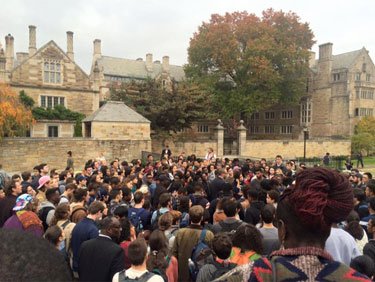
Inadvertent comedy department: (above) Former master of (the soon to be re-named) Calhoun College & Edmund S. Morgan Professor of African American Studies, now the first black Dean of Yale College, Jonathan Holloway found himself confronted yesterday on the cross campus, in front of Yale’s Sterling Library by hundreds of beneficiaries of Affirmative Action (just like himself) demanding “additional black faculty, racial sensitivity training for freshmen and the dismissal of administrators viewed as racially inattentive.”
Indignation over microaggressions at Yale rose to the boiling point this week because Silliman College Associate Master Erica Christakis responded to an admonitory pre-Halloween email from the Intercultural Affairs Council — a group of administrators from the cultural centers, Chaplain’s Office and other campus organizations — sent to the undergraduate student body warning against wearing Halloween costumes which could be interpreted as belittling or offensive: no sombreros, no blackface, no turbans.
The Oldest College Daily reports that Christakis responded with an email of her own, which
defended students’ rights to wear potentially offensive costumes as an expression of free speech, arguing that the ability to tolerate affront is one of the hallmarks of a free and open society. Her email compared adults selecting costumes to children playing dress up, and she asserted that imagination should be encouraged and not constrained.
“Is there no room anymore for a child or young person to be a little bit obnoxious … a little bit inappropriate or provocative or, yes, offensive?†Christakis, who assumed the position of associate master of Silliman this fall, wrote. “American universities were once a safe space not only for maturation but also for a certain regressive, or even transgressive, experience; increasingly, it seems, they have become places of censure and prohibition.â€
A Silliman student, Ryan Wilson ’17, drafted a letter in response, ultimately signed by “740 undergraduates, graduate students, alumni, faculty and even students from other universities… telling Christakis that her ‘offensive’ email invalidates the voices of minority students on campus. The letter, posted Friday night, state[d] that Christakis misrepresented the Intercultural Affairs Committee’s call for sensitivity as ‘censure’.”
After confronting Dean Holloway, a portion of the crowd went after Associate Master Erica Christakis’ husband:
A heated crowd of students encircled Nicholas Christakis after 3 p.m. and accused him of racism and insensitivity, with many in attendance demanding an apology for the email statement, which admonished the censure of Halloween costumes deemed culturally appropriating. They also criticized Erika Christakis’ behavior during an open forum hosted at the Afro-American Cultural House Wednesday night — in particular, her attempt to leave the room before speaking or answering questions directed toward her.
“I apologize for causing pain, but I am not sorry for the statement,†Nicholas Christakis told the crowd. “I stand behind free speech. I defend the right for people to speak their minds.â€
The gathering quickly became tense and confrontational after his response. Several students screamed at Christakis and called him “disgusting.â€
The suffering of Yale students of color at the sight of certain Halloween costumes was evidently quite considerable.
Students at Thursday’s protest said the e-mail ignored the way people of color experience such insensitive characterizations, and they recounted how students have faced threats of physical violence when they have questioned their classmates’ costume choices.
“There was so much coded language in that e-mail that is just disrespectful,†said Ewurama Okai, a junior.
Several students in Silliman said they cannot bear to live in the college anymore. “They can’t stay in the master’s house,†one student said.
Thursday evening, students were drafting a formal letter calling for the removal of Christakis and his wife from their roles in Silliman. …
Some students said they believe the problem is broader, in that many Yale faculty members are unequipped to talk to black students.
Isaiah Genece, a junior, said he has never had a black professor at Yale. Nearly a dozen black students described the experience of being the sole black person in a class, and the unequal responsibilities foisted on them to speak on behalf of their race.
The university’s commitment to faculty diversity has come under heightened scrutiny since Elizabeth Alexander, a prominent black poet and essayist, announced her plans to leave Yale for Columbia. This week the university announced a $50 million, five-year initiative to enhance the diversity of the faculty.
Another student, Dianne Lake, tied anger over the Halloween e-mail to recent debate about the title “master†used for the heads of the school’s residential colleges, asking: “Why do Yale students call these administrators master? The world is watching.â€
———————————–
50 years of racially-based favoritism have led to what? Certainly not to genuine equality of intellectual maturity, independence, and self respect. Not to gratitude and appreciation either. All the special recruiting, the very-heavy-thumb-on-the-scales Affirmative Action admissions, the invention and establishment of cultural identity academic departments and majors, all the specially-motivated faculty and administrative appointments, the university-provided-and-funded cultural houses, all that is not enough.
Student representatives of privileged and protected groups want more privilege, more protection, and feel entitled to demand that the University Administration wave a magic wand and change reality so that Yale’s illustrious faculty (mostly selected on the basis of real achievement) will feature still more conspicuous representation of their own group. Meanwhile, the Yale Administration ought to get busy establishing a totalitarian regime enforcing a punitive system of speech and thought control calculated to ensure that no member of a protected group ever experiences an affront (however subjective).
Robert Tracinski argues that all the talk in contemporary universities controlled by the left about “safe spaces” and “trigger warnings” demonstrates the kind of alarm among herds of herbivores manifested in the immediate build up to an extinction event.
At the beginning of the year, I speculated that we may have reached “Peak Leftism,†the point at which the left has achieved such uniform control of the commanding heights of the culture that they have no place to go but down. Their mania for soft ideological conformity suggests a mechanism for this decline. They are growing so accustomed to living in an ideological “safe space†that they will no longer understand what it means to debate their positions, much less how to win the debate.
The most powerful historical precedent for this is the totalitarian creed of the Soviet Union—a dogma imposed, not just by campus censors or a Twitter mob, but by gulags and secret police. Yet one of the lessons of the Soviet collapse is that the ideological uniformity of a dictatorship seems totally solid and impenetrable—right up to the moment it cracks apart. The imposition of dogma succeeds in getting everyone to mouth the right slogans, even as fewer and fewer of them understand or believe the ideology behind it.
This is the Paradox of Dogma. To return to the question we started with: if you try to shut down public debate, is this a way of ensuring that you win—or an admission that you have already lost? The answer is: both. It might ensure that you win in the short term. But over the long term, it abandons the field to those who do believe in ideological debate.
James Taranto explains the ironies implicit in Jonathan Chait’s recent assumption of the mantle of defender of freedom of thought against the leftist forces of Political Correctness in his article in New York magazine. Chait has himself played the PC card against conservatives far too many times. And then Taranto comes up with the best line of the week:
The obvious thing to say about Jonathan Chait’s battle against the left is that we’re rooting for casualties.
Australia’s first libertarian senator has some harsh words for “anti discrimination leftists†who wish to crack down on free speech.
An anti free speech social Democrat named Gary Burns in Australia got a firm rebuke when he wrote to senator David Leyonjhelm about how Australia’s multiculturalism is the law. Leyonjhelm responded harshly, saying “Go fuck yourself you communist turd.â€
Australia has free speech codes, not a First Amendment like the United States. People can be prosecuted for offending others. It’s pretty disgusting and sad, but this exchange is a thing of beauty. Praise to Senator Leyonjhelm for his guts!
The New York Daily News and Gateway Pundit both comment upon just how conspicuous was the absence of major representatives of the Obama Administration at the Paris march against Islamic terrorism.
It was an international rally against terror.
Over 50 world leaders were in attendance.
But no Obama.
The Obama administration sent three representatives to Michael Brown’s funeral in Ferguson, Missouri.
But only the Ambassador to France made the historic anti-terror march in Paris today.
Attorney General Eric Holder was in Paris but was not seen at the march.