Category Archive 'Government'
18 Jul 2014


Old-fashioned (now illegal) plastic gas can with built-in vent.
Jeffrey Tucker discusses in loving detail one prominent example of the countless ways in which government regulation has impacted the lives of just about every American.
[Y]esterday, [I ran out of gas and] had to get a can of gas from the local car shop. I started to pour it in. But, hmmm, this is strange. The nozzle doesn’t quite go in. I tilted it up and tried to jam it in.
I waited. Then I noticed gas pouring all down the side of the car. So I pulled it out and experimented by pouring it on the ground. There was some weird contraption on the outside and it wasn’t clear how it worked.
I poured more and more on the ground. Some got on my shoe. Some got on my hands. Some got on my suit.
Gas was everywhere really — everywhere but in the tank. It was a gassy mess. If someone had lit a match, I would have been a goner.
Finally I turned out the crazy nozzle thing a few times. It began to drip in a slightly coherent direction so I jammed it in. I ended up putting about one cup of gas in, started my car and made it to the gas station.
I’m pretty sure gas cans used to work. Yes. It was a can. It had a spout. It had a vent hole on the other side. You stuck in the spout and tipped. You never saw the gas.
Then government “fixed†the gas can. Why? Because of the environmental hazards that come with spilled gas. You read that right. In other words, the very opposite resulted. Now you cannot buy a decent can anywhere. You can look forever and not find a new one.
Instead you have to go to garage sales. But actually people hoard old cans. There is a burgeoning market in kits to fix the can.
The whole trend began in (wait for it) California. Regulations began in 2000, with the idea of preventing spillage. The notion spread and was picked up by the EPA, which is always looking for new and innovative ways to spread as much human misery as possible.
An ominous regulatory announcement from the EPA came in 2007: “Starting with containers manufactured in 2009… it is expected that the new cans will be built with a simple and inexpensive permeation barrier and new spouts that close automatically.â€
The government never said “no vents.†It abolished them de facto with new standards that every state had to adopt by 2009. So for the last five years, you have not been able to buy gas cans that work properly. They are not permitted to have a separate vent. The top has to close automatically. There are other silly things now, too, but the biggest problem is that they do not do well what cans are supposed to do. …
Never heard of this rule? You will know about it if you go to the local store. Most people buy one or two of these items in the course of a lifetime, so you might otherwise have not encountered this outrage.
Yet let enough time go by. A whole generation will come to expect these things to work badly. Then some wise young entrepreneur will have the bright idea, “Hey, let’s put a hole on the other side so this can work properly.†But he will never be able to bring it into production. The government won’t allow it because it is protecting us! ….
There is no possible rationale for these kinds of regulations. It can’t be about emissions really, since the new cans are more likely to result in spills. It’s as if some bureaucrat were sitting around thinking of ways to make life worse for everyone, and hit upon this new, cockamamie rule.
These days, government is always open to a misery-making suggestion. The notion that public policy would somehow make life better is a relic of days gone by. It’s as if government has decided to specialize in what it is best at and adopt a new principle: “Let’s leave social progress to the private sector; we in the government will concentrate on causing suffering and regress.†…
Ask yourself this: If they can wreck such a normal and traditional item like this, and do it largely under the radar screen, what else have they mandatorily malfunctioned? How many other things in our daily lives have been distorted, deformed and destroyed by government regulations?
If some product annoys you in surprising ways, there’s a good chance that it is not the invisible hand at work, but rather the regulatory grip that is squeezing the life out of civilization itself.
Read the whole thing.
Air conditioners which don’t cool as well as their predecessors made 60 years ago, toilets that won’t flush, automobiles without spare tires which cost more than the house you grew up in… the list of products of federal regulatory intervention to make the world a better place is long, and it keeps growing.
28 Apr 2014

Dave Carter, at Ricochet, saw in the the federal stand-off at the Bundy Ranch a near-miss repeat of the Sand Creek Massacre of 1864, and argues that burgeoning federal power and the militarization of police and federal agencies guarantees sooner-or-later the application of excessive and deadly force by government to American citizens.
Many in the governing class, in both parties, have made their choice and that is to govern against the consent of the governed. Many American citizens, awakening to the heavy hand of a government which now dictates almost everything they purchase, produce, or sell, taxing them into oblivion, telling them which doctors and health plans they may or may not keep, regulating the content of everything they consume, touch, wear, breathe or drive, and whose agents and enforcement officials are becoming increasingly belligerent and thuggish, are making their choices as well. It is time for those who wear the badge, those who wear the uniform, and those who are increasingly ordered to act against their own countrymen to make their choice and take a stand.
H. L. Mencken said that:
It is the invariable habit of bureaucracies, at all times and everywhere, to assume…that every citizen is a criminal. Their one apparent purpose, pursued with a relentless and furious diligence, is to convert the assumption into a fact. They hunt endlessly for proofs, and, when proofs are lacking, for mere suspicions. The moment they become aware of a definite citizen, John Doe, seeking what is his right under the law, they begin searching feverishly for an excuse for withholding it from him.
The question, for those who are ordered to aim a sniper’s rifle at a rancher, necessarily becomes one of whom to serve? The people or the directorate?
02 Feb 2014

Joshua M. Brown, aka The Reformed Broker, at Business Insider, deplores the judgement of whoever decided on this year’s Super Bowl location.
This Sunday, Super Bowl XLVIII (48) will be played in an open-air stadium, built atop a New Jersey swamp, in 2 degree weather, while pretending it’s actually taking place in New York.
I don’t know what confederacy of dunces within the NFL thought this was a good idea. It might be the worst idea. It’s shaping up to be the saddest Super Bowl ever.
For starters, it’s certainly going to be the coldest. Weather guys are talking about 2 to 7 degrees. Ticket prices are dropping by thousands of dollars. People are trying to get rid of their seats rather than sit through the pain of a sub-arctic February night outdoors. Not to mention the shlep. If it snows that day, the highways and byways between NY and NJ will become so impassable you’ll need to leave your family permanently and start a new one somewhere around Teaneck Township off of the I-80.
As far as the pre-game festivities, if there were ever a city that couldn’t give a f*** about something the rest of the country is excited about, it’s New York City. Specifically Manhattan. When the Super Bowl hits other cities, like Miami or New Orleans, all the stops are pulled out and the week-long party literally takes over the town. The locals get into the spirit, businesses play it up and people from around the country (along with their tourism dollars) are welcomed warmly. …
The two main focal points for the [“New York”] pre-game “party†are located at Times Square and Herald Square. There are two places in Manhattan that no native New Yorker will ever set foot in, for any reason, ever: Times Square and Herald Square. I know people who’ve quit jobs or broken up relationships because their route involved traipsing through either of these places. Times Square is essentially a petting zoo New Yorkers have set up so that they can see real-live Americans up-close in a protected environment and maybe feed them something. Herald Square, the triangle anchored by Macy*s, is what your town’s main strip mall would look like if they were to airlift unnavigable crowds and an aggressive traffic snarl right smack in front of it and slather the pavement in a gauzy layer of perma-grime and chewed gum.
Read the whole thing.
———————————-
And it’s not only the weather, the characteristic obnoxia of New Yorkers, and the lack of suitable locations to party in Manhattan that represent unpleasant aspects of the situation. If you choose to attend, you are going to have the endemic chickenshit fascism of rustbucket Northeastern governments to put up with as well.
CNS Sports warns:
It doesn’t matter if you’ve dropped thousands of dollars on tickets. It doesn’t matter if you’ve traveled 3,000 miles to get there. And it doesn’t matter if you offer to shovel the snow that’s sure to come to the Meadowlands.
You will not be allowed to tailgate at Super Bowl XLVIII. Unless you literally stay inside your car while you do it.
“You will be allowed to have food in your car and have drink in your car,” game committee CEO Al Kelly said during a Monday news conference. “And provided you’re in the boundaries of a single parking space, you’ll be able to eat or drink right next to your car. However, you’re not going to be able to take out a lounge chair, you’re not going to be able to take out a grill, and you’re not going to be able to take up more than one parking space. And it’ll all be watched very carefully.” …
Don’t even think about hiring a taxi or limo to drop you off at the front gates. If a car doesn’t have a parking pass, it won’t get near the stadium.
“Nobody’s going to be dropped off by black car,” Kelly said. “You can have a black car, a green car, a white car, a red car as long as you have parking, and the car needs to stay on the premises the entire time.”
Oh and by the way, there are only 13,000 parking spots for the use of fans.
Don’t even think about walking to the Super Bowl either.
“You can get your hotel to drop you off at one of the New Jersey Transit locations or get the shuttle to take you to a Fan Express location, but you cannot walk,” Smith said.
-Here’s one thing you can do. Take public transportation, or as ESPN New York explains, you can take a charter bus called the Fan Express, “which will cost $51 and pick up and drop off passengers at nine locations around the region.”
If it snows, it’s every man for himself. Hunger Games style.
23 Jan 2014

Ol’ Remus predicts what life will soon be like here on the farm.
There’s a rabid raccoon circling your livestock.
You go to your gun safe and enter your sixty-digit code, press the fingerprint-verification pad, put your eye to the retina reader, wait for the Instant Background Check, open the safe and get out the .22 single shot rifle, unlock the child safety lock and remove it, install the bolt in the rifle, take two rounds of ammo from your legal nine round supply, chamber the legal maximum of one round, enter the serial numbers of both rounds and their removal time on your web-based log. You close the gun safe, reactivate all the security and run out the door.
You dispatch said rabid raccoon. He was moving slow.
Back to the gun safe, enter your code, fingerprint pad, retina reader, open the safe, remove the bolt and store it, reinstall the child safety lock and replace the rifle, log the replacement time, verify the serial numbers of the expended rounds and close the gun safe. Then down to the State Police to turn in the fired cases, get fingerprinted, get a blood test and have an ankle bracelet installed.
Next day an official container arrives. You take the required raccoon parts from your freezer and the twelve-page notarized incident report, attach photos, an annotated map, your blood test results, the standard request for two rounds to be credited to your ammo allotment, and send it all in. Your ankle bracelet won’t be removed and your gun safe won’t be reopened until the incident report is approved. It’s just common sense.
Your case involves the taking of a cute animal for non-game purposes and so it wends its way through local, county, state and federal law enforcement agencies. A hearing is scheduled requiring your presence at a city three hundred and eighty miles away. Your name is now on the no-fly list so you drive. You make your case to the review board.
Read the whole thing.
Hat tip to Vanderleun.
30 Dec 2013
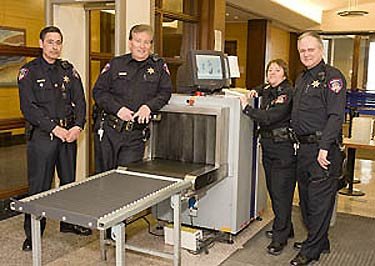
Try walking into a government building these days, and you’ll meet them.
In one of his best essays, Dan Greenfield, last year, explains how far we have come from the free country invented by the framers. Today’s America is a socialist, paternalist, dirigiste, thoroughly-regulated bureaucracy and police state, in which your personal habits and bank account are public property and in which you need to be searched regularly.
The average American still holds the fanciful belief that, if he isn’t annoying anyone, he should be left alone. To the people running his country, this is as bizarre and unworkable as Phrenology or the Geocentric theory or handing out universal health care without also compelling everyone to buy it.
This is not a nation where people are left alone anymore. This is a nation where they are hounded from the moment they are born until the moment they die by the arms of a regulatory state run by men and women weaned on Cleaver, Alinsky, Fourier, Marx, Wells and countless others. This is a nation where, accordingly, being left alone is the greatest of luxuries.
It takes a lot of money to be left alone. Regulatory space is much more expensive than physical space, and buying it requires investing in lobbyists, fundraisers and lawyers. If you make the right payoffs, then you can buy the privilege of being left alone, exempted from regulations, going uninspected and protected against the agents of the state. But once you do that, you are no longer neutral. You have bought yourself the privilege of not being considered the problem; instead, you have become part of the solution for the people you are paying off.
The Americans bushwacked by ObamaCare, the scam artist’s dream of a tax paid to a third-party in exchange for benefits accrued to a fourth party, still thought they had the freedom to take the middle, to despise meddling politicians in both parties, ignore most things the government did, while living their own lives. They had seen their savings devalued, their homes seized, their lives bedeviled by a thousand regulations, but they still thought that it was possible to take a middle-ground, to reject the solutions by asserting that they are not the problem.
They did not understand that in Cleaverland, in Alinskytown and in Obamaville—no one opts out. Either you volunteer of you get drafted. Raise your hand or you will be called on anyway. Not volunteering to be part of their agenda means that you are the problem.
You, sitting right there in your chair, watching these words move across your screen, are the problem. A problem 311,591,917 human souls strong. You eat too much or you don’t pay enough taxes, you drive your car too often, you haven’t bought solar panels for your roof, you browse extremist websites when you should be browsing government informational sites for tips on how to do or not do all of the above. But most of all… you still don’t understand what a great problem you are for the people running this country into the ground between the Atlantic and the Pacific. They keep trying to solve you, but you don’t go away.
There is no neutrality when dealing with people who reject the very concept of neutrality. Who draw everyone into the long columns of their spreadsheets and catch everyone in their spider’s web. There is no middle ground with people who don’t believe there is a middle ground, who believe that every human on earth is part of the problem and can only opt out of being the problem by joining up with them and following their directives.
That is what we are up against. We confront the Great Solvers of the Human Problem who are determined to arrange everyone and everything to their liking. They began by controlling everything that people did. Now, they have moved on to controlling what people don’t do. If you live, if you breathe, if you stir, move your muscles, track moving objects with your eyes, then there are obligations imposed on you.
ObamaCare is one of the final declarations that there is no opting out. Even if you don’t drive, own a home, own a business, own a dog, or do one of the infinite things that bring you into mandatory contact with the apparatus of your local, semi-local, trans-local, national or global government, you are committed to a task from maturity to death. Your mission is to obtain health insurance, and, in a system in which you become the ward of the government as soon as you taste air, it is the price that you pay for being alive.
In a free country, you are not obligated to do things simply for the privilege of breathing oxygen north of the Rio Grande and south of Niagara Falls. But this isn’t a free country anymore; this is a country in which you get things for free. And there is a big difference between those two things.
15 Dec 2013
 
Peter Blair contends that popular fiction written for young people is prone to channel directly from the culture’s psyche. The replacement of the Harry Potter series in the bestseller list with Hunger Games books may indicate that the popular attitude toward authority has grown increasingly negative.
The Hunger Games and Harry Potter are among the two most successful and influential cross-media franchises in recent decades. The books were widely read, the movies widely watched, and the arrival of a new book or movie in the series was a big cultural moment. When pop culture objects become as wildly popular as these two series, they often take on a greater importance and resonance than those who occasioned them intended. We can only speculate, but in light of the enduring success of the latest Hunger Games movie, Catching Fire, it’s possible to read the evolution between these two series as a sort of hardening of heart toward government that reflects the increasing anger Americans feel towards political authority.
21 Nov 2013

Clay Shirky describes how government IT cannot effectively translate planning into reality, avoids testing, and insists on shunning a phased roll-out approach but then finds itself experiencing exactly that.
It’s certainly true that Federal IT is chronically challenged by its own processes. But the problem with Healthcare.gov was not timeline or budget. The problem was that the site did not work, and the administration decided to launch it anyway.
This is not just a hiring problem, or a procurement problem. This is a management problem, and a cultural problem. The preferred method for implementing large technology projects in Washington is to write the plans up front, break them into increasingly detailed specifications, then build what the specifications call for. It’s often called the waterfall method, because on a timeline the project cascades from planning, at the top left of the chart, down to implementation, on the bottom right.
Like all organizational models, waterfall is mainly a theory of collaboration. By putting the most serious planning at the beginning, with subsequent work derived from the plan, the waterfall method amounts to a pledge by all parties not to learn anything while doing the actual work. Instead, waterfall insists that the participants will understand best how things should work before accumulating any real-world experience, and that planners will always know more than workers.
This is a perfect fit for a culture that communicates in the deontic language of legislation. It is also a dreadful way to make new technology. If there is no room for learning by doing, early mistakes will resist correction. If the people with real technical knowledge can’t deliver bad news up the chain, potential failures get embedded rather than uprooted as the work goes on. …
[Emphasis added:] The vision of “technology†as something you can buy according to a plan, then have delivered as if it were coming off a truck, flatters and relieves managers who have no idea and no interest in how this stuff works, but it’s also a breeding ground for disaster. The mismatch between technical competence and executive authority is at least as bad in government now as it was in media companies in the 1990s, but with much more at stake.
Read the whole thing.
Hat tip to the Dish.
18 Nov 2013
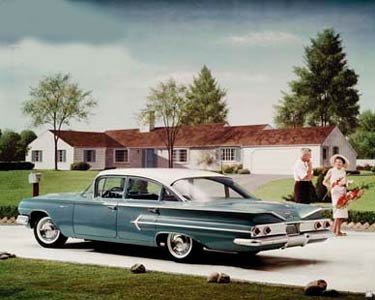
The 1960 Chevrolet Bel Air was a no frills model which cost a mere $2500.
My dad bought one of the above Chevrolets brand new in 1960. He eventually passed it along to me and it was still running in 1971 with 150,000 and I got something like $500 for it when I sold it upon returning to Yale.
In the pre-WWII period, you could go to Morris Garages (MG) in Oxford, England and have a custom automobile, your choice of engine, your choice of body run up for you.
Eric Peters explains how it came about that today’s automobiles cost more than working men’s houses did when I was a boy, and why buyers’ choices shrink every year. Our most recent BMW came lacking any sort of spare tire whatsoever. Someone in the federal bureaucracy decided that you could always just phone for roadside assistance when you got a flat and thought that eliminating the spare tire would reduce automobile’s rolling weight and save energy. “So let it be written, so let it be done.” Auto companies, like BMW, happily clicked their heels, fell into line, and stopped providing spare tires.
In this economy, can anyone seriously doubt that there is a market for simple, reliable – and inexpensive – transportation?
In any case, why not let the market operate? Why not allow (god, how I hate that term) Tata or Cherry (or whomever) to offer their basic, low-cost cars for sale here – and see whether people are interested?
You and I know why this will not be allowed, of course. Precisely because people would buy such cars – and that would impose pressure on the industry at large to simplify their offerings, too – and reduce the cost.
Can’t have that.
It is critical to keep people perpetually in debt. Why allow them to buy a new $6,000 car outright – or pay it off in two or three years (as was common once – and within living memory of any person older than 40) when you can effectively force them to buy a $30,000 car (the average price paid for a new vehicle as of last year) and sign them up for 5 or 6 years of payments? And force them to spend $1,000 annually to insure it, too?
That’s the truth of the thing.
It’s not about “safety†– or any other such altruistic palaver.broke picture
It is about power – control.
And, of course, money.
I’ve written about air bags before. Classic example, so worth repeating. They were first put on the market – in the early-mid 1970s by both GM and Chrysler – as optional equipment that people could buy. Or not.
Most people chose not to buy.
Not because they were cavalier risk junkies – as people such as myself are often characterized by the Air Bag Nazis. But simply because the cost of the air bags was prohibitive. They added as much to the bottom line price of a car (this is back in the ’70s) as air conditioning did – and AC was just about the most expensive option you could buy in those days.
So, they failed in the marketplace. Which is why the car companies worked with the government to see them made mandatory. Now you cannot say no to air bags. And to many other “features†you may not want in a car. These features are not necessarily bad. The question is – or ought to be: Can you afford them? Many people cannot. Hence the now-common six-year payment plan. Soon – count on it – to be expanded to seven years.
Then eight. …
The problem is most people are not outraged about this. They don’t seem to mind being told what they’ll buy – nor how much they’ll pay for it. They’d probably be annoyed if their next door neighbor marched over one day and told them they had to drive this type of car – and weren’t going to be allowed to drive that type of car. Their first reaction would be open-mouthed bewilderment. Their second reaction would be: Who the hell do you think you are? And then: Get the hell off my property – and mind your own business.
Right?
And yet, most people will accept the same damn thing when it’s done at once or twice remove, by “regulation†and in a city, far, far away.
Read the whole thing.
11 Oct 2013

They had three years to build it. They spent $634,320,919, more than it cost to build Facebook. They were able to build the Pentagon in just under one year and four months (11 September 1941 — 15 January 1943) for half the cost. And it was still dysfunctional a week after its scheduled opening.
Digital Trends described the fiasco:
The site itself, which apparently underwent major code renovations over the weekend, still rejects user logins, fails to load drop-down menus and other crucial components for users that successfully gain entrance, and otherwise prevents uninsured Americans in the 36 states it serves from purchasing healthcare at competitive rates – Healthcare.gov’s primary purpose. The site is so busted that, as of a couple days ago, the number of people that successfully purchased healthcare through it was in the “single digits,†according to the Washington Post.
And our liberal friends believe we ought to be happy to turn over our healthcare choices, and a one sixth portion of the American economy, to the same government which demonstrably could not even satisfactorily develop a website in three years?
30 Jul 2013

Three contractors are bidding to fix a broken fence at the White House. One is from Chicago, another is from Tennessee, and the third is from Minnesota. All three go with a White House official to examine the fence.
The Minnesota contractor takes out a tape measure and does some measuring, then works some figures with a pencil. “Well,” he says, “I figure the job will run about $900. $400 for mater…ials, $400 for my crew, and $100 profit for me.”
The Tennessee contractor also does some measuring and figuring, then says, “I can do this job for $700. $300 for materials, $300 for my crew, and $100 profit for me.”
The Chicago contractor doesn’t measure or figure, but leans over to the White House official and whispers, “$2,700.”
The official, incredulous, says, “You didn’t even measure like the other guys! How did you come up with such a high figure?”
The Chicago contractor whispers back, “$1000 for me, $1000 for you, and we hire the guy from Tennessee to fix the fence.”
“Done!” replies the government official.
And that, my friends, is how Government works today.
21 Jun 2013
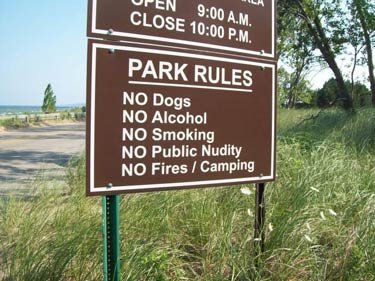
Christopher Taylor commenting on a long rap on Control by the late William Burroughs.
This has been a building concern and certainty for me, that liberty and civilization are incompatible. That the more comforts, ease, and safety you get from civilization, the more liberty you must surrender. That the first casualty of civilization are the virtues that enabled the civilization to build and prosper to begin with. That the social contract moves too far into the shared benefits and safety and too far away from the liberty all men are born to, as time goes on.
A hundred years ago you might have been shot for suggesting you couldn’t build a campfire on the beach. Now people are surprised you can even attempt it. A hundred years ago all you needed to start a business up was the ambition and cash to do so, now you can’t even begin to plan it without consulting the government for permission, licensing, and tribute paid to the proper authorities.
We’ve become so steeped in this life, we don’t even notice what would have caused John Adams to go berserk.
Via Vanderleun.
Your are browsing
the Archives of Never Yet Melted in the 'Government' Category.
/div>

Feeds
|





