Category Archive 'Harvard'
25 Sep 2010


Mitchell Heisman
In October of 1903, a 23-year-old prodigy who had recently finished his first book and who was widely regarded as a genius, Otto Weininger rented a room in the house in Vienna where Ludwig van Beethoven died 76 years earlier, and shot himself in the heart.
Weininger, a prodigy who had received his doctorate at an unusually young age, wrote a book, titled Geschlecht und Charakter (Sex and Character) arriving at extremely troubling conclusions. Weininger believed that human beings and human culture and society inevitably contain a mixture of positive, active, productive, moral, and logical (male, Christian) traits and impulses as well as their passive, unproductive, amoral, and sensual (female and Jewish) opposites.
Weininger was of Jewish descent and afflicted with homosexual inclinations and was in despair over the decline of modern Western civilization due to ascendancy of the female/Jewish impulses he deplored, so acting in consistency with his philosophical conclusions, Weininger took his own life.
Last Saturday, Mitchell Heisman, a 35-year-old psychology graduate from the University of Albany, shot himself in the head in front of Memorial Church in the Harvard Yard within the sight of a campus tour. Heisman had been residing nearby in Somerville, Massachusetts, supporting himself on a legacy from his father and by working in some Boston area bookshops, while pursuing his own studies and working on a (so far unpublished) book.
Mitchell Heisman published on the Internet a 1905-page suicide note in which he explains his actions as an experiment in nihilism undertaken in search of objectivity. Heisman, like Weininger of Jewish descent, is critical of liberal democracy, egalitarianism, materialism, modernism, and Jewish ethical opposition to “biological realism and the eugenic evolution of biological life.”
The suicide note pdf is fascinating document displaying considerable learning and evidencing a sharp sense of humor and originality of thought.
The most rigorous objectivity implies indifference to the consequence of objectivity, i.e. whether the consequences of objectivity yield life or death for the observer. In other words, the elimination of subjectivity demands indifference to self-preservation when self-preservation conflicts with objectivity. The attempt at rigorous objectivity could potentially counter the interests of self-preservation or even amount to rational self-destruction. The most total objectivity appears to lead to the most total self-negation. Objectivity towards biological factors is objectivity towards life factors. Indifference to life factors leads to indifference between the choices of life and death. To approach objectivity with respect to self-interest ultimately leads to indifference to whether one is alive or dead.
The dead are most indifferent; the least interested; the least biased; the least prejudiced one way or the other. What is closest to total indifference is to be dead. If an observer hypothesizes death then, from that perspective, the observer has no vested interests in life and thus possible grounds for the most objective view. The more an observer is reduced to nothing, the more the observer is no longer a factor, the more the observer might set the conditions for the most rigorous objectivity.
It is likely that most people will not even consider the veracity of this correlation between death and objectivity even if they understand it intellectually because most will consciously or unconsciously choose to place the interests of self-preservation over the interests of objectivity. In other words, to even consider the validity of this view assumes that one is willing and able to even consider prioritizing objectivity over one’s own self-preservation. Since it not safe to simply assume this on an individual level, let alone a social level, relatively few are willing and able to seriously address this issue (and majority consensus can be expected to dismiss the issue). In short, for most people, including most “scientistsâ€, overcoming self-preservation is not ultimately a subject for rational debate and objective discussion.
Maximizing objectivity can be incompatible with maximizing subjective interests. In some situations, anything less than death is compromise. The choice between objectivity and self-preservation may lead one to a Stoic’s choice between life and death.
Whereas the humanities cannot be what they are without human subjectivities, the inhumanities, or hard sciences, require the subjective element be removed as much as possible as sources of error. Objectivity leads towards the elimination of subjectivity, i.e. the elimination of one’s “humanityâ€. A value free science has no basis on which to value human things over non-human things and thus no basis to value life over death or vice versa. Social science will become equal to the standards of physical science when social scientists overcome the subjective preference for the life of humanity over the death of humanity.
To attempt to resolve the contradiction of myself as a scientist and a human being on the side of science leads towards viewing myself as a material object. While this contradiction may be impossible to resolve, the closest approximation of reconciliation may consist of the state of death. In death, the teleologically-inclining biases of human subjectivity that hinder one from viewing one’s self as a material object are eliminated.
I cannot fully reconcile my understanding of the world with my existence in it. There is a conflict between the value of objectivity and the facts of my life. This experiment is designed to demonstrate a point of incompatibility between “truth†and “lifeâ€. In this experiment I hypothesize that the private separation of facts and values, when disclosed to the wider social world, creates a conflict of interest between the value of sociobiological objectivity and the “facts†of my sociobiological existence such that it leads to a voluntary and rational completion of this work in an act of self-destruction. …
How far would one be willing to go in pursuit of scientific objectivity? Objectivity and survival are least compatible when objectivity becomes a means of life, subordinate to life as opposed to life subordinated to objectivity. If the greatest objectivity implicates confronting the most subjective biases, this implicates confronting those truths that most conflict with the subjective will to live. By simply changing my values from life values to death values, and setting my trajectory for rational biological self-destruction, I am able to liberate myself from many of the biases that dominate the horizons of most people’s lives. By valuing certain scientific observations because they are destructive to my life, I am removing self-preservation factors that hinder objectivity. This is how I am in a position to hypothesize my own death.
So if objectivity is not justified as end, then objectivity can be a means of rational self-destruction through the overcoming of the bias towards life. Rational self-destruction through the overcoming of the bias towards life, in turn, can be a means of achieving objectivity. And this means: To will death as a means of willing truth and to will truth as a means of willing death. …
Why am I doing this? Ah, yes, now I remember the punchline: I’ll try anything once!
There is nothing to take seriously!
I have not had time yet to read the whole thing, so I’m not completely sure just what I think of all of the late Mr. Heisman’s opinions, but I am intrigued enough to have resolved to read all of it. I’ve even downloaded and saved a copy.
My guess, at this point, is that his book is probably well worth publishing.
HuffPo story
Harvard Crimson
IvyGate
New York Post
16 Aug 2010

John Hinderaker found the news in Globes, the Israeli business paper.
On Friday, Harvard University reported in an SEC filing that it has sold all of the shares it owned in Israeli companies. The total wasn’t large, by Harvard’s standards, around $39 million, and the university didn’t offer an explanation. But it seems unlikely that Harvard’s portfolio managers would simultaneously decide that it was time to sell all shares in five different companies, with nothing in common other than the fact that they are located in Israel. So, unless some other explanation is forthcoming, it seems that Harvard may quietly have divested its Israeli holdings on political grounds.
If this is right, it assorts oddly with Harvard’s acceptance of large amounts of money from Saudi Arabian sources. Also, what are Harvard’s largest securities holdings? Two ETFs, each worth $295 million, one in Chinese equities and the other in emerging markets. So Israel doesn’t meet Harvard’s moral test, but China does; and it would be interesting to see what countries are included among those emerging markets.
There is a pretty clear pattern here–again, assuming that the five nearly-simultaneous sales of shares in Israeli companies were not coincidental. Harvard is happy to do business with oppressors–real oppressors, that is–as long as there is enough money in it. China and Saudi Arabia have, in sheer monetary terms, a lot to offer. But taking a “principled” stand against Israel, still the Middle East’s only democracy (unless you count Iraq, on which the jury is still out) and the only country in the region with a Western human rights sensibility, is cost-free. Sort of like banning military recruiters.
Via Hugh Hewitt.
03 Jun 2010

As Dean of Harvard Law School, Elena Kagan not only moved Harvard away from teaching the case method (invented at Harvard circa 1870), she eliminated Constitutional Law from the list of required courses.
As CNS reports, American Constitutional Law was demoted in favor of more international perspectives.
[I]n a 2006 Harvard news release explaining the changes, Kagan explained the move away from constitutional law was deliberate: “From the beginning of law school, students should learn to locate what they are learning about public and private law in the United States within the context of a larger universe — global networks of economic regulation and private ordering, public systems created through multilateral relations among states, and different and widely varying legal cultures and systems.
“Accordingly, the Law School will develop three foundation courses, each of which represents a door into the global sphere that students will use as context for U.S. law,†the guide said.
Among the three new required courses Kagan introduced, one focuses on public international law, involving treaties and international agreements, and the second is on international economic law and complex multinational financial transactions, according to a Harvard news release.
But the third course, on comparative law, “will introduce students to one or more legal systems outside our own, to the borrowing and transmission of legal ideas across borders and to a variety of approaches to substantive and procedural law that are rooted in distinct cultures and traditions,†the release said.
What could be a more eloquent demonstration of the precise level of deference to the US Constitution Ms. Kagan would bring to the Supreme Court?
12 May 2010

Michael Filozof (recently an adjunct instructor at Niagra County Community College), at American Thinker, denounces the elite conspiracy that rules America.
If it sometimes seems that the nation is governed by an elite liberal clique of college fraternity and sorority pals who are out of touch with average Americans, that’s because it’s largely true. Every president, and almost every presidential candidate for the last two decades has been a graduate of Harvard or Yale, and if Kagan gets confirmed by the Senate every member of the Supreme Court will have been a Yale or Harvard attendee, too.
The 1988 presidential election was a contest between Harvard law grad Michael Dukakis and Yalie George H.W. Bush. Yale Law grads Bill and Hillary Clinton came to power in 1992, beating Washburn alum Bob Dole in 1996.
The election of 2000 produced an interesting result: George W. Bush, a graduate of both Yale and Harvard (but according to his leftist critics the dumbest president ever) beat another Harvard grad, Al Gore, who is supposedly so brilliant he won a Nobel Prize. And in 2004 Bush beat fellow Yale grad John Kerry, whose grades at Yale were worse than Bush’s grades.
The election of 2008 saw the ascension to the presidency of Harvard graduate Barack Obama, who beat Navy grad John McCain. According to his supporters like Michael Beschloss, David Brooks, and Colin Powell, Obama is “brilliant” and “transformational” – yet oddly, he never published anything as first black president of the Harvard Law Review, and unlike Bush, Kerry and McCain, his grades have never been released.
On the Supreme Court, Justices Alito, Sotomayor, and Thomas are Yale Law grads, while Scalia, Roberts, Breyer and Kennedy all went to Harvard Law. Justice Ginsberg graduated from Columbia Law, but she attended Harvard before transferring there. The odd man out is the retiring Justice Stevens, who got his law degree from Northwestern, soon to be replaced by Harvard’s Kagan.
What shall we make of this preponderance of Yale-Harvard grads in elite positions of our society?
It’s much more complicated that that, I’m afraid. Mr. Filozof is not wrong, of course, about liberal culture dominating at Harvard and Yale, as at all elite institutions of higher education, but both Yale and Harvard do produce some prominent conservatives. Clarence Thomas is the soundest member of the Supreme Court, and he went to Yale Law. George W. Bush was, after all, if not entirely conservative, at least decidedly anti-liberal establishment which hated him like poison.
There is a strong conservative presence at Yale. There is even some conservative presence in Cambridge. It’s just the case that conservatives are less welcome in the establishment in many areas, and successful careerists (like Elena Kagan, read David Brooks on Kagan and conformity) are much more commonly conventionally liberal.
————————————
At Volokh, David Bernstein, Yale Law ’91, graciously stands up for other schools:
The president went to Harvard, and barely defeated a primary opponent who went to Yale. His predecessor went to Yale and Harvard, and defeated opponents who went to Yale and Harvard, and Harvard, respectively. The previous two presidents also went to Yale, with Bush I defeating another Harvard grad for the presidency. And once Elena Kagan gets confirmed, every Supreme Court Justice will have attended Harvard or Yale law schools.
I know that Harvard and Yale attract a disproportionate percentage of America’s talented youth, but still, isn’t this a bit much?
I think the current Harvard-Yale monopoly is really just happenstance and coincidence. I feel sure that, if we live long enough, we’ll see people from UVA, Chicago, and even Stanford, and Columbia on the Court again.
04 May 2010
Last year, a third-year Harvard Law Student sent a private email to two friends, continuing a dinner-table conversation about the genetic basis of (and possible racial differences in) intelligence.
She said:
I absolutely do not rule out the possibility that African Americans are, on average, genetically predisposed to be less intelligent. I could also obviously be convinced that by controlling for the right variables, we would see that they are, in fact, as intelligent as white people under the same circumstances. The fact is, some things are genetic. African Americans tend to have darker skin. Irish people are more likely to have red hair. (Now on to the more controversial:) Women tend to perform less well in math due at least in part to prenatal levels of testosterone, which also account for variations in mathematics performance within genders. This suggests to me that some part of intelligence is genetic, just like identical twins raised apart tend to have very similar IQs and just like I think my babies will be geniuses and beautiful individuals whether I raise them or give them to an orphanage in Nigeria. I don’t think it is that controversial of an opinion to say I think it is at least possible that African Americans are less intelligent on a genetic level, and I didn’t mean to shy away from that opinion at dinner.
I also don’t think that there are no cultural differences or that cultural differences are not likely the most important sources of disparate test scores (statistically, the measurable ones like income do account for some raw differences). I would just like some scientific data to disprove the genetic position, and it is often hard given difficult to quantify cultural aspects.
This young woman ought to have gotten away scot-free with saying the unsayable and thinking the unthinkable in private, but more recently she reproached one of those two friends about sleeping with another person’s boyfriend. Her interlocutor promised “to ruin her life,” and proceeded on a program of revenge worthy of the Jacobean Theater.
The vengeful strumpet forwarded the six-month-old email to members of the Harvard Black Law Student Association, who were definitely not amused.
Someone then passed it along to the legal blog Above the Law. Gawker and HuffPo picked up the story, and soon it was everywhere.
TaxProf has collected links.
Before very long, the Dean of Harvard Law School, Martha Minow was issuing official statements assuring Black law students that “Here at Harvard Law School, we are committed to preventing degradation of any individual or group, including race-based insensitivity or hostility.”
The PC-criminal, an editor at the Harvard Law Review, had already received a clerkship with colorful Ninth Circuit Judge Alex Kozinski. Indignant demands that her clerkship should be rescinded followed.
But they teach young people well at today’s elite schools. When you blot your copybook, it is still possible to save yourself by performing the appropriate prostrations and affirming loudly that the sun does move around the earth. Look at Bill Clinton.
Our guilty student did the necessary thing, she wrote a thoroughly PC letter of apology, and took complete responsibility. (laugh)
Boston Globe:
“I am deeply sorry for the pain caused by my e-mail. I never intended to cause any harm, and I am heartbroken and devastated by the harm that has ensued. I would give anything to take it back,’’ [Name withheld by me] said in the apology, obtained by the Globe.
“I emphatically do not believe that African-Americans are genetically inferior in any way. I understand why my words expressing even a doubt in that regard were and are offensive.’’ …
In her statement yesterday, Minow called the incident “sad and unfortunate’’ but said she was heartened by the student’s apology. She added: “We seek to encourage freedom of expression, but freedom of speech should be accompanied by responsibility.’’
————————————-
UPDATE: May 4:
Jonathan David Farley, Harvard ’91, Ph.D. Oxford ’95, reiterates his demand that the young lady be expelled and expresses the opinion that Eugene Volokh (who argued against her expulsion) should never have been admitted to the United States.
18 Oct 2009

Peter Berkowitz discusses prominent cases in recent years of the response to controversy at Duke, Yale, and Harvard, in each of which instances faculty and administrators failed to defend freedom of thought and expression or members of their own community against the excesses of political correctness.
Professors have a professional interest in—indeed a professional duty to uphold—liberty of thought and discussion. But in recent years, precisely where they should be most engaged and outspoken they have been apathetic and inarticulate.
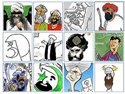
Consider Yale. On Oct. 1, the university hosted Danish cartoonist Kurt Westergaard. His drawing of Muhammad with a bomb in his turban became the best known of 12 cartoons published by the Danish newspaper Jyllands-Posten in September 2005. That led to deadly protests throughout the Muslim world. On the same day, at an unrelated event, Yale hosted Brandeis Prof. Jytte Klausen. Her new book, “The Cartoons that Shook the World,” was subject in August to a last minute prepublication decision by Yale President Richard Levin and Yale University Press to remove not only the 12 cartoons but also all representations of Muhammad, including respected works of art. …
To be sure, Yale’s censorship—the right word because Yale suppressed content on moral and political grounds—raised difficult questions. Can’t rights, including freedom of speech and press, be limited to accommodate other rights and goods? What if reprinting the cartoons and other depictions gave thugs and extremists a new opportunity to inflame passions and unleash violence? Can’t the consequences of the cartoons’ original publication be understood without reproducing them? Weren’t the cartoons really akin, as Yale Senior Lecturer Charles Hill pointed out in a letter to the Yale Alumni magazine, to the depictions of Jews as grotesque monsters that successive American administrations have sought to persuade Arab newspapers to cease publishing? And isn’t it true, as Mr. Hill also observed, that Yale’s obligation to defend free speech does not oblige it to subsidize gratuitously offensive or intellectually worthless speech?
These are good questions—to which there are good answers.
Rights are subject to limits, but a right as fundamental to the university and the nation as freedom of speech and press should only be limited in cases of imminent danger and not in deference to speculation about possible violence at an indeterminate future date. One can’t properly evaluate Ms. Klausen’s contention that the cartoons were cynically manipulated without assessing with one’s own eyes whether the images passed beyond mockery and ridicule to the direct incitement of violence.
Even if the cartoons exhibited a kinship to anti-Semitic caricatures, it would cut in favor of publication: a scholar would be derelict in his duties if he published a work on anti-Semitic images without including examples. And finally, if Yale chooses to publish a rigorous analysis of the Danish cartoon controversy, which affected the national interest and roiled world affairs, then the university does incur a scholarly obligation to include all the relevant information and evidence including the cartoons at the center, regardless of whether they are in themselves gratuitously offensive and intellectually worthless.
The wonder is that Yale’s censorship has excited so little debate at Yale. The American Association of University Professors condemned Yale for caving in to terrorists’ “anticipated demands.” And a group of distinguished alumni formed the Yale Committee for a Free Press and published a letter protesting Yale’s “surrender to potential unknown billigerents” and calling on the university to correct its error by reprinting Ms. Klausen’s book with the cartoons and other images intact. But the Yale faculty has mostly yawned. Even the famously activist Yale Law School has, according to its director of public affairs, sponsored no programs on censorship and the university.
Alas, there is good reason to suppose that in its complacency about threats to freedom on campus the Yale faculty is typical of faculties at our leading universities. In 2006, even as the police had barely begun their investigation, Duke University President Richard Brodhead lent the prestige of his office to faculty members’ prosecution and conviction in the court of public opinion of three members of the Duke lacrosse team falsely accused of gang raping an African-American exotic dancer. It turned out they were being pursued by a rogue prosecutor. To be sure, it was only a vocal minority at Duke who led the public rush to judgment. But the vast majority of the faculty stood idly by, never rising to defend the presumption of innocence and the requirements of fair process. Perhaps Duke faculty members did not realize or perhaps they did not care that these formal and fundamental protections against the abuse of power belong among the conditions essential to the lively exchange of ideas at the heart of liberal education.
Similarly, in 2005, Harvard President Lawrence Summers sparked a faculty revolt that ultimately led to his ouster by floating at a closed-door, off-the-record meeting the hypothesis—which he gave reasons for rejecting only a few breaths after posing it—that women were poorly represented among natural science faculties because significantly fewer women than men are born with the extraordinary theoretical intelligence necessary to succeed at the highest scientific levels. Before he was forced to resign, Mr. Summers did his part to set back the cause of unfettered intellectual inquiry by taking the side of his accusers and apologizing repeatedly for having dared to expose an unpopular idea to rational analysis. Apart from a few honorable exceptions, the Harvard faculty could not find a principle worth defending in the controversy over Mr. Summer’s remarks.
As the controversies at Yale, Duke and Harvard captured national attention, professors from other universities haven’t had much to say in defense of liberty of thought and discussion either. This silence represents a collective failure of America’s professors of colossal proportions. What could be a clearer sign of our professors’ loss of understanding of the requirements of liberal education than their failure to defend liberty of thought and discussion where it touches them most directly?
What indeed?
07 Oct 2009
Times are hard, indeed!
The Crimson reports:
(Harvard’s) first Faculty meeting of the year kicked off without a regular staple: cookies to complement professors’ tea and coffee.
“This is the first time in modern times with no cookies,†Faculty Council member Harry R. Lewis ’68 said as he held a white mug of tea. “We are sharing the pain with the undergraduates.â€
“As part of our cost-cutting efforts, we’re doing our little part here in our Faculty meetings, saving about $500 per meeting for cookies and coffee,†Faculty of Arts and Sciences Dean Michael D. Smith explained during the meeting.
Hat tip to David Nix.
14 Aug 2009

Rather awful shirts.
The Boston Globe describes this as old news, but I had not heard. Harvard University is licensing its name to a division of Wearwolf Group for use in labeling a line of men’s clothing.
The clothing line, to be labeled “Harvard Yard” will obviously be marketed to people who are unaware of the existence of J. Press, the Andover Shop, and Brooks Brothers. They will think they will be dressing like preppies attending Harvard, but they will really be dressing in accordance with the idea some gay guys who didn’t go to college at all have of how men at Harvard should dress.
Is Harvard really so badly off that they need to sell their name to get money for scholarships? Couldn’t they just get Drew Faust and some of their female faculty out there in bikinis doing car washes?
The Harvard Yard line will arrive in stores next spring with shirts selling for $160 and up, pants starting at $195, and blazers selling for $495. Eventually the company plans to add women’s wear to the mix. None of the Harvard Yard clothing actually bears a Harvard logo. The clothes have subtle touches to show their pedigree, such as crimson stitching around buttonholes. Shirts, sweaters, and jackets are also named for buildings on campus and streets in Cambridge.
23 Jul 2009

Robert Wenzel, at Economic Policy Journal blog, has more bad news from Cambridge.
Harvard’s endowment got slaughtered in the financial crash, and hard times have arrived on the Charles. The school is wallowing in debt, and the administration is finding it necessary to undertake some dramatic belt-tightening. Seems only fair. Harvard, after all, gave us Obama, and it was the threat of his election which tanked the markets.
At Harvard University, they have lowered thermostats during the winter months from 72 degrees to 68 degrees. Hot breakfasts are no longer served on weekdays at undergraduate residential houses. Instead of bacon, poached eggs, and waffles, students have to get by on cold ham, cottage cheese, cereal, and fruit. These are just some steps Harvard is taking to battle serious financial problems. …
Harvard College, the Graduate School of Arts and Sciences, and the School of Engineering and Applied Sciences is facing a budget deficit of $220 million. Construction is halted on a $1.2 billion science complex.
Over the 20-year period from 1980 to 2000, Harvard University added nearly 3.2 million square feet of new space to its campus. But so far this decade, incredibly, from 2000 through 2008, Harvard has added another 6.2 million square feet of new space.
At it’s peak in 2008, Harvard’s endowment stood at $36.9 billion. Some estimates now have its value at around $18 billion, much of it in illiquid investments.
According to Forbes magazine, Harvard has $11 billion of unfunded commitments—money promised, but not yet paid, to various private-equity funds, real-estate funds, and hedge funds.
Last December, the university sold $2.5 billion worth of bonds, increasing its total debt to just over $6 billion. Servicing that debt alone will cost Harvard an average of $517 million a year through 2038. …
Today, on average, a full professor at Harvard earns $192,600, before benefits; that’s more than he or she would make at any other school in the nation. (At Yale, for example, the average salary is $174,700. At the University of California, Berkeley: $143,500.)
23 Jul 2009

Barack Obama stooped from the office of the presidency to takes sides in last week’s incident in Cambridge, Massachusetts in which Henry Louis Gates, Jr., a prolific author and African American Studies professor at Harvard, wound up arrested for disorderly conduct.
Gates and a friend were observed by a neighbor trying to force open Gates’s own front door on a street in Cambridge near Harvard. Seeing two black men fiddling with a locked door (and apparently failing to recognize her eminent neighbor), that neighbor summoned the police.
Studying matters African American inevitably promotes hypersensitivity with respect to racial relations, and Mr. Gates predictably responded to the arrival of a police officer with indignation, asking if he was under suspicion “for being a black man in America.”
Gates accused the cop of being a racist, and proceeded to whip out a cell phone and attempt to pull strings with the chief of police. You have no idea who you’re messing with, the mighty Harvard faculty member arrogantly informed the policeman.
Despite all this, merely producing his Harvard ID was sufficient to persuade the officer to leave, but Gates was not content. Bent upon retaliation, he insisted that the cop identify himself, responded to a request to move the discussion outside the house with “yo mama,” and persisted in voicing indignant accusations and abuse.
Not completely surprisingly, in the end, Gates succeeded in getting himself arrested for disorderly conduct.
As this posting of less than a week ago shows, I am not myself inclined to defend exaggerated police sensitivity and amour propre in dealing with the public. In a possible life-or-death situation, that Michigan dispatcher should have taken into account the caller’s emotional distress and overlooked a little bad language.
But, in this case, it is only too clear that Skip Gates himself turned a minor and understandable misunderstanding on the part of a neighbor, where the police were in no way at fault, into his own private melodrama of racial martyrdom. He didn’t get arrested for being black. He got arrested for abusing and trying to intimidate a police officer who was just doing his job.
If Gates had spoken politely to that Cambridge cop and treated the incident with a little understanding, it would all have ended with a handshake and a smile. Gates preferred to manufacture a symbolic national incident. And our supposedly post-racial president can be relied upon to intervene in favor of Professor Gates.
The Boston Globe removed the police report it previously posted (for some reason); but, too bad! it was saved here.
Was Gates profiled? Sure, he was profiled… by his neighbor, who mysteriously could not even recognize him. But, face it, male minority members seen forcing open doors in affluent Cambridge neighborhoods really do fall more logically into the burglars-breaking-in conceptual category than the homeowner-lost-his-keys interpretation even to a not particularly racially prejudiced observer. Minorities really do commit more break ins, and minorities genuinely less frequently own expensive town houses. It is not unfair prejudice to operate prudently on the most probable assumptions.
If that neighbor had taken out her .44, and filled Professor Gates with lead on suspicion, I’d say she leapt to a conclusion. Calling to police to look into what was happening was not any sort of irrevocable act, and normal middle class people can encounter police officers in circumstances featuring minor misunderstandings without feeling victimized.
Stereotypes were obviously at play here, but the most active, hostile, and determinative images were those running furiously inside the head of Henry Louis Gates.
16 Apr 2009

Taha Abdul-Basser ’96, Harvard’s Islamic Chaplain, recently provided a little private religious counseling which provoked coverage in the Harvard Crimson.
In a private e-mail to a student last week, Abdul-Basser wrote that there was “great wisdom (hikma) associated with the established and preserved position (capital punishment [for apostates]) and so, even if it makes some uncomfortable in the face of the hegemonic modern human rights discourse, one should not dismiss it out of hand.â€
The e-mail was forwarded over Muslim student e-mail lists and later picked up by the blogosphere.
In the blogosphere, it was Robert VerBruggen who broke the story.
——————————
Lawrence Auster comments:
What particularly strikes me about Taha Abdul-Basser’s remark is not his endorsement of the traditional Islamic death sentence for people who convert out of Islam, but his combining that endorsement with criticism of “hegemonic” human rights discourse! His Harvard education certainly comes in handy. And he’s clever. “Hegemonic” is a term normally used by liberals and leftists to debunk whatever remains of traditional society. But he uses it against liberalism itself. Human rights? We don’t need your stinkin’ human rights!
VerBruggen and Auster fail to mention the relevance of the Harvard spiritual advisor’s theological opinions to the case of the world’s most prominent Muslim apostate, President Barack Hussein Obama, who was demonstrated during the campaign last fall to have been listed on school records in Indonesia and educated as a Muslim.
It is certainly hardly unlikely that it was specifically the case of President Obama, the son and grandson of Muslims, who was, for a period of time as a boy, raised as a Muslim by his Indonesian stepfather, and who later converted to Christianity joining Chicago’s Trinity United Church of Christ that provoked scrutiny of Islamic teachings about the forcible reconversion or killing of apostates.
10 Mar 2009
Phillip Broughton lays the blame right at the doorstep of some buildings on the Charles.
If Robespierre were to ascend from hell and seek out today’s guillotine fodder, he might start with a list of those with three incriminating initials beside their names: MBA. The Masters of Business Administration, that swollen class of jargon-spewing, value-destroying financiers and consultants have done more than any other group of people to create the economic misery we find ourselves in.
From Royal Bank of Scotland to Merrill Lynch, from HBOS to Leh-man Brothers, the Masters of Disaster have their fingerprints on every recent financial fiasco.
I write as the holder of an MBA from Harvard Business School – once regarded as a golden ticket to riches, but these days more like scarlet letters of shame. We MBAs are haunted by the thought that the tag really stands for Mediocre But Arrogant, Mighty Big Attitude, Me Before Anyone and Management By Accident. For today’s purposes, perhaps it should be Masters of the Business Apocalypse.
Harvard Business School alumni include Stan O’Neal and John Thain, the last two heads of Merrill Lynch, plus Andy Hornby, former chief executive of HBOS, who graduated top of his class. And then of course, there’s George W Bush, Hank Paul-son, the former US Treasury secretary, and Christopher Cox, the former chairman of the Securities and Exchange Commission (SEC), a remarkable trinity who more than fulfilled the mission of their alma mater: “To educate leaders who make a difference in the world.â€
It just wasn’t the difference the school had hoped for.
/div>
Feeds
|



