Qaisar Mahmood, a Muslim born in Pakistan, is the new head of the Swedish National Heritage Board. This is an extremely anomalous appointment, since he readily admits that he has not read anything about Sweden’s cultural heritage. But his new job is not really about preserving and protecting Sweden’s cultural heritage and historical sites at all.
Qaisar Mahmood, who once rode his motorcycle around Sweden in an apparently failed attempt to discover what being Swedish consisted of, is using his position as head of the Swedish National Heritage Board not to highlight and celebrate that heritage, but to downplay Sweden’s cultural heritage and history, and to create a false narrative that will help compel Swedes to accept mass Muslim migration. He says he doesn’t want simply to alert people to Viking artifacts and the like, but to use Sweden’s history to “create the narrative†that will make Muslim migrants “part of something.â€
We have already seen how that works. Remember the fake news story about the Viking burial cloth bearing the word “Allah� Last October, a Swedish researcher gained international headlines by claiming that burial costumes from Viking graves dating back to the ninth and tenth centuries had been found to be inscribed with the name “Allah.†The intent of this was obvious: to convince Swedes that Islam had always been a part of Sweden, all the way back to the days of the Vikings, and so they should not be concerned about the mass Muslim migration that was now bringing Sweden unprecedented rape and other crime rates. Islam has always been a part of Sweden! Stop opposing mass Muslim migration!
The Viking burial cloths didn’t really feature the name “Allah†at all, as Stephennie Mulder, an associate professor of Medieval Islamic art and archaeology at the University of Texas at Austin, proved shortly thereafter, but by then the damage had been done. The idea had entered, however dimly, the popular consciousness: the Vikings were really Muslims. Islam is Swedish. Sweden was Islamic before it was Christian. The Muslim migrants are Swedes.
The “Allah†Viking burial cloth propaganda offensive was one manifestation of what Qaisar Mahmood and others like him are doing. There is no Muslim history in Sweden, but Qaisar Mahmood is working to change the very idea of cultural heritage and fabricate fictions about a historical Muslim presence in Sweden in order to advance his political and sociological agenda.
Qaisar Mahmood, as a Pakistani, of course has no Swedish heritage of his own. His admitted lack of knowledge of Swedish heritage and history ought to have disqualified him from his position, but this is how Sweden is obliterating itself and committing cultural and national suicide. After all, Swedes appointed Qaisar Mahmood to this position. It is Swedish leaders who want to destroy Swedish cultural and national identity.
Tintoretto, Presentation of Jesus at the Temple, 1550-1555, Gallerie dell Accademi, Venice
From Robert Chambers, The Book of Days, 1869:
From a very early, indeed unknown date in the Christian history, the 2nd of February has been held as the festival of the Purification of the Virgin, and it is still a holiday of the Church of England. From the coincidence of the time with that of the Februation or purification of the people in pagan Rome, some consider this as a Christian festival engrafted upon a heathen one, in order to take advantage of the established habits of the people; but the idea is at least open to a good deal of doubt. The popular name Candlemass is derived from the ceremony which the Church of Rome dictates to be observed on this day; namely, a blessing of candles by the clergy, and a distribution of them amongst the people, by whom they are afterwards carried lighted in solemn procession. The more important observances were of course given up in England at the Reformation; but it was still, about the close of the eighteenth century, customary in some places to light up churches with candles on this day.
At Rome, the Pope every year officiates at this festival in the beautiful chapel of the Quirinal. When he has blessed the candles, he distributes them with his own hand amongst those in the church, each of whom, going singly up to him, kneels to receive it. The cardinals go first; then follow the bishops, canons, priors, abbots, priests, &c., down to the sacristans and meanest officers of the church. According to Lady Morgan, who witnessed the ceremony in 1820:
‘When the last of these has gotten his candle, the poor conservatori, the representatives of the Roman senate and people, receive theirs. This ceremony over, the candles are lighted, the Pope is mounted in his chair and carried in procession, with hymns chanting, round the ante-chapel; the throne is stripped of its splendid hangings; the Pope and cardinals take off their gold and crimson dresses, put on their usual robes, and the usual mass of the morning is sung.’
Lady Morgan mentions that similar ceremonies take place in all the parish churches of Rome on this day.
It appears that in England, in Catholic times, a meaning was attached to the size of the candles, and the manner in which they burned during the procession; that, moreover, the reserved parts of the candles were deemed to possess a strong supernatural virtue:
‘This done, each man his candle lights,
Where chiefest seemeth he,
Whose taper greatest may be seen; And fortunate to be,
Whose candle burneth clear and bright: A wondrous force and might
Both in these candles lie, which if At any time they light,
They sure believe that neither storm Nor tempest cloth abide,
Nor thunder in the skies be heard, Nor any devil’s spide,
Nor fearful sprites that walk by night,
Nor hurts of frost or hail,’ &c.
The festival, at whatever date it took its rise, has been designed to commemorate the churching or purification of Mary; and the candle-bearing is understood to refer to what Simeon said when he took the infant Jesus in his arms, and declared that he was a light to lighten the Gentiles. Thus literally to adopt and build upon metaphorical expressions, was a characteristic procedure of the middle ages. Apparently, in consequence of the celebration of Mary’s purification by candle-bearing, it became customary for women to carry candles with them, when, after recovery from child-birth, they went to be, as it was called, churched. A remarkable allusion to this custom occurs in English history. William the Conqueror, become, in his elder days, fat and unwieldy, was confined a considerable time by a sickness. ‘Methinks,’ said his enemy the King of France, ‘the King of England lies long in childbed.’ This being reported to William, he said, ‘When I am churched, there shall be a thousand lights in France !’ And he was as good as his word; for, as soon as he recovered, he made an inroad into the French territory, which he wasted wherever he went with fire and sword.
At the Reformation, the ceremonials of Candlemass day were not reduced all at once. Henry VIII proclaimed in 1539:
‘On Candlemass day it shall be declared, that the bearing of candles is done in memory of Christ, the spiritual light, whom Simeon did prophesy, as it is read in. the church that day.’
It is curious to find it noticed as a custom down to the time of Charles II, that when lights were brought in at nightfall, people would say—’ God send us the light of heaven!’ The amiable Herbert, who notices the custom, defends it as not superstitious. Some-what before this time, we find. Herrick alluding to the customs of Candlemass eve: it appears that the plants put up in houses at Christmas were now removed.
Down with the rosemary and bays,
Down with the mistletoe;
Instead of holly now upraise
The greener box for show.
The holly hitherto did sway,
Let box now domineer,
Until the dancing Easter day
Or Easter’s eve appear.
The youthful box, which now hath grace
Your houses to renew,
Grown old, surrender must his place
Unto the crisped yew.
When yew is out, then birch comes in,
And many flowers beside,
Both of a fresh and fragrant kin’,
To honour Whitsuntide.
Green rushes then, and sweetest bents,
With cooler oaken boughs,
Come in for comely ornaments,
To re-adorn the house.
Thus times do shift; each thing in turn does hold;
New things succeed, as former things grow old.’
The same poet elsewhere recommends very particular care in the thorough removal of the Christmas garnishings on this eve:
‘That so the superstitious find
No one least branch left there behind;
For look, how many leaves there be
Neglected there, maids, trust to me,
So many goblins you shall see.’
He also alludes to the reservation of part of the candles or torches, as calculated to have the effect of protecting from mischief:
‘Kindle the Christmas brand, and then
Till sunset let it burn,
Which quenched, then lay it up again, Till Christmas next return.
Part must be kept, wherewith to tend
The Christmas log next year;
And where ‘tis safely kept, the fiend Can do no mischief there.’
Considering the importance attached to Candlemass day for so many ages, it is scarcely surprising that there is a universal superstition throughout Christendom, that good weather on this day indicates a long continuance of winter and a bad crop, and that its being foul is, on the contrary, a good omen. Sir Thomas Browne, in his Vulgar Errors, quotes a Latin distich expressive of this idea:
‘Si sol splendescat Maria purificante,
Major erit glacies post festum quam fait ante;
which maybe considered as well translated in the popular Scottish rhyme:
If Candlemass day be dry and fair,
The half o’ winter’s to come and mair;
If Candlemass day be wet and foul,
The half o’ winter’s gave at Yule.’
In Germany there are two proverbial expressions on this subject: 1. The shepherd would rather see the wolf enter his stable on Candlemass day than the sun; 2. The badger peeps out of his hole on Candlemass day, and when he finds snow, walks abroad; but if he sees the sun shining, he draws back into his hole. It is not improbable that these notions, like the festival of Candlemass itself, are derived from pagan times, and have existed since the very infancy of our race. So at least we may conjecture, from a curious passage in Martin’s Description of the Western Islands. On Candlemass day, according to this author, the Hebrideans observe the following curious custom:
The mistress and servants of each family take a sheaf of oats and dress it up in women’s apparel, put it in a large basket, and lay a wooden club by it, and this they call BrÃd’s Bed.; and then the mistress and servants cry three times, “BrÃd is come; BrÃd is welcome!†This they do just before going to bed, and when they rise in the morning they look among the ashes, expecting to see the impression of BrÃd’s club there; which, if they do, they reckon it a true presage of a good crop and prosperous year, and the contrary they take as an ill omen.
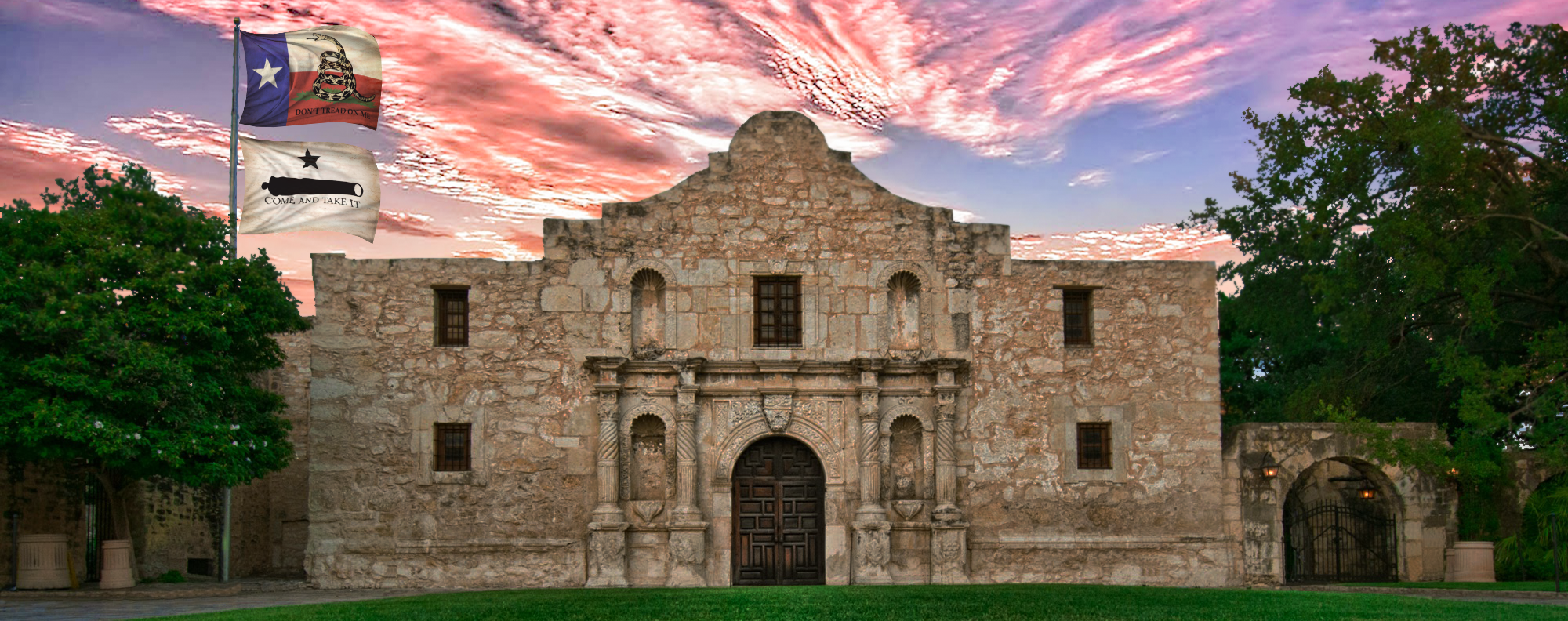
The plan to ‘reimagine’ the Alamo is well underway… and it’s a giant load of crap.
A plan to restore and ‘reimagine’ the Alamo been in the works for some years, and it’s not just a sprucing up of the place.
It’s a whole new ‘reimagined’ Alamo that won’t focus on the battle that the site is known for.
The Master Planner of the project, George Skarmeas, said, ‘We cannot single out one moment in time.’ …
The Master Plan includes items that cover 300 years of history but will focus on the diversity of cultures of the area. The plan includes being ‘inclusive’ by ‘telling all sides of the military story’.
To St. Stephen, the Proto-martyr, as he is generally styled, the honour has been accorded by the church of being placed in her calendar immediately after Christmas-day, in recognition of his having been the first to seal with his blood the testimony of fidelity to his Lord and Master. The year in which he was stoned to death, as recorded in the Acts of the Apostles, is supposed to have been 33 A.D. The festival commemorative of him has been retained in the Anglican calendar.
A curious superstition was formerly prevalent regarding St. Stephen’s Day—that horses should then, after being first well galloped, be copiously let blood, to insure them against disease in the course of the following year. In Barnaby Googe’s translation of Naogeorgus, the following lines occur relative to this popular notion:
Then followeth Saint Stephen’s Day, whereon doth every man
His horses jaunt and course abrode, as swiftly as he can,
Until they doe extremely sweate, and then they let them blood,
For this being done upon this day, they say doth do them good,
And keepes them from all maladies and sicknesse through the yeare,
As if that Steven any time tooke charge of horses heare.’
The origin of this practice is difficult to be accounted for, but it appears to be very ancient, and Douce supposes that it was introduced into this country by the Danes. In one of the manuscripts of that interesting chronicler, John Aubrey, who lived in the latter half of the seventeenth century, occurs the following record: On St. Stephen’s Day, the farrier came constantly and blouded all our cart-horses.’ Very possibly convenience and expediency combined on the occasion with superstition, for in Tusser Redivivus, a work published in the middle of the last century, we find this statement: ‘About Christmas is a very proper time to bleed horses in, for then they are commonly at house, then spring comes on, the sun being now coming back from the winter-solstice, and there are three or four days of rest, and if it be upon St. Stephen’s Day it is not the worse, seeing there are with it three days of rest, or at least two.’
In the parish of Drayton Beauchamp, Bucks, there existed long an ancient custom, called Stephening, from the day on which it took place. On St. Stephen’s Day, all the inhabitants used to pay a visit to the rectory, and practically assert their right to partake of as much bread and cheese and ale as they chose at the rector’s expense. On one of these occasions, according to local tradition, the then rector, being a penurious old bachelor, determined to put a stop, if possible, to this rather expensive and unceremonious visit from his parishioners. Accordingly, when St. Stephen’s Day arrived, he ordered his housekeeper not to open the window-shutters, or unlock the doors of the house, and to remain perfectly silent and motionless whenever any person was heard approaching. At the usual time the parishioners began to cluster about the house. They knocked first at one door, then at the other, then tried to open them, and on finding them fastened, they called aloud for admittance. No voice replied. No movement was heard within. ‘Surely the rector and his house-keeper must both be dead!’ exclaimed several voices at once, and a general awe pervaded the whole group. Eyes were then applied to the key-holes, and to every crevice in the window-shutters, when the rector was seen beckoning his old terrified housekeeper to sit still and silent. A simultaneous shout convinced him that his design was understood. Still he consoled himself with the hope that his larder and his cellar were secure, as the house could not be entered. But his hope was speedily dissipated. Ladders were reared against the roof, tiles were hastily thrown off, half-a-dozen sturdy young men entered, rushed down the stairs, and threw open both the outer-doors. In a trice, a hundred or more unwelcome visitors rushed into the house, and began unceremoniously to help themselves to such fare as the larder and cellar afforded; for no special stores having been provided for the occasion, there was not half enough bread and cheese for such a multitude. To the rector and his housekeeper, that festival was converted into the most rigid fast-day they had ever observed.
After this signal triumph, the parishioners of Drayton regularly exercised their ‘privilege of Stephening’ till the incumbency of the Rev. Basil Wood, who was presented to the living in 1808. Finding that the custom gave rise to much rioting and drunkenness, he discontinued it, and distributed instead an annual sum of money in proportion to the number of claimants. But as the population of the parish greatly increased, and as he did not consider himself bound to continue the practice, he was induced, about the year 1827, to withhold his annual payments; and so the custom became finally abolished. For some years, however, after its discontinuance, the people used to go to the rectory for the accustomed bounty, but were always refused.
In the year 1834, the commissioners appointed to inquire concerning charities, made an investigation into this custom, and several of the inhabitants of Drayton gave evidence on the occasion, but nothing was elicited to shew its origin or duration, nor was any legal proof advanced skewing that the rector was bound to comply with such a demand. Many of the present inhabitants of the parish remember the custom, and some of them have heard their parents say, that it had been observed:
‘As long as the sun had shone,
And the waters had run.’
In London and other places, St. Stephen’s Day, or the 26th of December, is familiarly known as Boxing-day, from its being the occasion on which those annual guerdons known as Christmas-boxes are solicited and collected. For a notice of them, the reader is referred to the ensuing article.
CHRISTMAS-BOXES
The institution of Christmas-boxes is evidently akin to that of New-year’s gifts, and, like it, has descended to us from the times of the ancient Romans, who, at the season of the Saturnalia, practiced universally the custom of giving and receiving presents. The fathers of the church denounced, on the ground of its pagan origin, the observance of such a usage by the Christians; but their anathemas had little practical effect, and in process of time, the custom of Christmas-boxes and New-year’s gifts, like others adopted from the heathen, attained the position of a universally recognised institution. The church herself has even got the credit of originating the practice of Christmas-boxes, as will appear from the following curious extract from The Athenian Oracle of John Dunton; a sort of primitive Notes and Queries, as it is styled by a contributor to the periodical of that name.
Q. From whence comes the custom of gathering of Christmas-box money? And how long since?
A. It is as ancient as the word mass, which the Romish priests invented from the Latin word mitto, to send, by putting the people in mind to send gifts, offerings, oblations; to have masses said for everything almost, that no ship goes out to the Indies, but the priests have a box in that ship, under the protection of some saint. And for masses, as they cant, to be said for them to that saint, &c., the poor people must put in something into the priest’s box, which is not to be opened till the ship return. Thus the mass at that time was Christ’s-mass, and the box Christ’s-mass-box, or money gathered against that time, that masses might be made by the priests to the saints, to forgive the people the debaucheries of that time; and from this, servants had liberty to get box-money, because they might be enabled to pay the priest for masses—because, No penny, no paternoster—for though the rich pay ten times more than they can expect, yet a priest will not say a mass or anything to the poor for nothing; so charitable they generally are.’
The charity thus ironically ascribed by Dunton to the Roman Catholic clergy, can scarcely, so far as the above extract is concerned, be warrantably claimed by the whimsical author himself. His statement regarding the origin of the custom under notice may be regarded as an ingenious conjecture, but cannot be deemed a satisfactory explanation of the question. As we have already seen, a much greater antiquity and diversity of origin must be asserted.
This custom of Christmas-boxes, or the bestowing of certain expected gratuities at the Christmas season, was formerly, and even yet to a certain extent continues to be, a great nuisance. The journeymen and apprentices of trades-people were wont to levy regular contributions from their masters’ customers, who, in addition, were mulcted by the trades-people in the form of augmented charges in the bills, to recompense the latter for gratuities expected from them by the customers’ servants. This most objectionable usage is now greatly diminished, but certainly cannot yet be said to be extinct. Christmas-boxes are still regularly expected by the postman, the lamplighter, the dustman, and generally by all those functionaries who render services to the public at large, without receiving payment therefore from any particular individual. There is also a very general custom at the Christmas season, of masters presenting their clerks, apprentices, and other employees, with little gifts, either in money or kind.
St. Stephen’s Day, or the 26th of December, being the customary day for the claimants of Christmas-boxes going their rounds, it has received popularly the designation of Boxing-day. In the evening, the new Christmas pantomime for the season is generally produced for the first time; and as the pockets of the working-classes, from the causes which we have above stated, have commonly received an extra supply of funds, the theatres are almost universally crowded to the ceiling on Boxing-night; whilst the ‘gods,’ or upper gallery, exercise even more than their usual authority. Those interested in theatrical matters await with consider-able eagerness the arrival, on the following morning, of the daily papers, which have on this occasion a large space devoted to a chronicle of the pantomimes and spectacles produced at the various London theatres on the previous evening.
In conclusion, we must not be too hard on the system of Christmas-boxes or handsets, as they are termed in Scotland, where, however, they are scarcely ever claimed till after the commencement of the New Year. That many abuses did and still do cling to them, we readily admit; but there is also intermingled with them a spirit of kindliness and benevolence, which it would be very undesirable to extirpate. It seems almost instinctive for the generous side of human nature to bestow some reward for civility and attention, and an additional incentive to such liberality is not infrequently furnished by the belief that its recipient is but inadequately remunerated otherwise for the duties which he performs. Thousands, too, of the commonalty look eagerly forward to the forth-coming guerdon on Boxing-day, as a means of procuring some little unwonted treat or relaxation, either in the way of sight-seeing, or some other mode of enjoyment. Who would desire to abridge the happiness of so many?
Born: Jesus Christ, Saviour of the world; Sir Isaac Newton, natural philosopher, 1642, Woolsthorpe, near Grantham; Johann Jacob Reiske, oriental scholar, 1716, Zorbig, Saxony; William Collins, poet, 1720, Chichester; Richard Person, Greek scholar, 1759, East Ruston, Norfolk.
and my wife, Karen.
Feast Day: St. Eugenia, virgin and martyr, about 257. St. Anastasia, martyr, 304. Another St. Anastasia.
Christmas Day
The festival of Christmas is regarded as the greatest celebration throughout the ecclesiastical year, and so important and joyous a solemnity is it deemed, that a special exception is made in its favour, whereby, in the event of the anniversary falling on a Friday, that day of the week, under all other circumstances a fast, is transformed to a festival.
That the birth of Jesus Christ, the deliverer of the human race, and the mysterious link connecting the transcendent and incomprehensible attributes of Deity with human sympathies and affections, should be considered as the most glorious event that ever happened, and the most worthy of being reverently and joyously commemorated, is a pro-position which must commend itself to the heart and reason of every one of His followers, who aspires to walk in His footsteps, and share in the ineffable benefits which His death has secured to mankind. And so though at one period denounced by the Puritans as superstitious, and to the present day disregarded by Calvinistic Protestants, as unwarranted by Scripture, there are few who will seriously dispute the propriety of observing the anniversary of Christ’s birth by a religious service. …
Towards the close of the second century, we find a notice of the observance of Christmas in the reign of the Emperor Commodus; and about a hundred years afterwards, in the time of Dioclesiaun an atrocious act of cruelty is recorded of the last named emperor, who caused a church in Nicomedia, where the Christians were celebrating the Nativity, to be set on fire, and by barring every means of egress from the building, made all the worshippers perish in the flames. Since the, end of the fourth century at least, the 25th of December has been uniformly observed as the anniversary of the Nativity by all the nations of Christendom.
Thus far for ancient usage, but it will be readily comprehended that insurmountable difficulties yet exist with respect to the real date of the momentous event under notice. Sir Isaac Newton, indeed, remarks in his Commentary on the Prophecies of Daniel, that the feast of the Nativity, and most of the other ecclesiastical anniversaries, were originally fixed at cardinal points of the year, without any reference to the dates of the incidents which they commemorated, dates which, by the lapse of time, had become impossible to be ascertained. Thus the Annunciation of the Virgin Mary was placed on the 25th of March, or about the time of the vernal equinox; the feast of St. Michael on the 29th of September, or near the autumnal equinox; and the birth of Christ and other festivals at the time of the winter-solstice. Many of the apostles’ days –such as St. Paul, St. Matthias, and others– were determined by the days when the sun entered the respective signs of the ecliptic, and the pagan festivals had also a considerable share in the adjustment of the Christian year.
To this last we shall shortly have occasion to advert more particularly, but at present we shall content ourselves by remarking that the views of the great astronomer just indicated, present at least a specious explanation of the original construction of the ecclesiastical calendar. As regards the observance of Easter indeed, and its accessory celebrations, there is good ground for maintaining that they mark tolerably accurately the anniversaries of the Passion and Resurrection of our Lord, seeing that we know that the events themselves took place at the period of the Jewish Passover. But no such precision of date can be adduced as regards Christmas, respecting which the generally received view now is, that it does not correspond with the actual date of the nativity of our Saviour. One objection, in particular, has been made, that the incident recorded in Scripture, of shepherds keeping watch by night on the plains of Bethlehem, could not have taken place in the month of December, a period generally of great inclemency in the region of Judea.
Though Christian nations have thus, from an early period in the history of the church, celebrated Christmas about the period of the winter-solstice or the shortest day, it is well known that many, and, indeed, the greater number of the popular festive observances by which it is characterized, are referable to a much more ancient origin. Amid all the pagan nations of antiquity, there seems to have been a universal tendency to worship the sun as the giver of life and light, and the visible manifestation of the Deity. Various as were the names bestowed by different peoples on this object of their worship, he was still the same divinity. Thus, at Rome, he appears to have been worshipped under one of the characters attributed to Saturn, the father of the gods; among the Scandinavian nations he was known under the epithet of Odin or Woden, the father of Thor, who seems after-wards to have shared with his parent the adoration bestowed on the latter, as the divinity of which the ‘sun was the visible manifestation; whilst with the ancient Persians, the appellation for the god of lights was Mithras, apparently the same as the Irish Mithr, and with the Phoenicians or Carthaginians it was Baal or Bel, an epithet familiar to all students of the Bible.
Concurring thus as regards the object of worship, there was a no less remarkable uniformity in the period of the year at which these different nations celebrated a grand festival in his honour. The time chosen appears to have been universally the season of the New Year, or, rather, the winter-solstice, from which the new year was frequently reckoned. This unanimity in the celebration of the festival in question, is to be ascribed to the general feeling of joy which all of us experience when the gradual shortening of the day reaches its utmost limit on the 21st of December, and the sun, recommencing his upward course, announces that mid-winter is past, and spring and summer are approaching. On similar grounds, and with similar demonstrations, the ancient pagan nations observed a festival at mid-summer, or the summer-solstice, when the sun arrives at the culminating point of his ascent on the 21st of June, or longest day.
By the Romans, this anniversary was celebrated under the title of Saturnalia, or the festival of Saturn, and was marked by the prevalence of a universal license and merry-making. The slaves were permitted to enjoy for a time a thorough freedom in speech and behavior, and it is even said that their masters waited on them as servants. Every one feasted and rejoiced, work and business were for a season entirely suspended, the houses were decked with laurels and evergreens, presents were made by parents and friends, and all sorts of games and amusements were indulged. in by the citizens. In the bleak north, the same rejoicings had place, but in a ruder and more barbarous form. Fires were extensively kindled, both in and out of doors, blocks of wood blazed in honour of Odin and Thor, the sacred mistletoe was gathered by the Druids, and sacrifices, both of men and cattle, were made to the savage divinities. Fires are said, also, to have been kindled at this period of the year by the ancient Persians, between whom and the Druids of Western Europe a relationship is supposed to have existed.
In the early ages of Christianity, its ministers frequently experienced the utmost difficulty in inducing the converts to refrain from indulging in the popular amusements which were so largely participated in by their pagan countrymen. Among others, the revelry and license which characterized the Saturnalia called for special animadversion. But at last, convinced partly of the inefficacy of such denunciations, and partly influenced by the idea that the spread of Christianity might thereby be advanced, the church endeavored to amalgamate, as it were, the old and new religious, and sought, by transferring the heathen ceremonies to the solemnities of the Christian festivals, to make them subservient to the cause of religion and piety. A compromise was thus effected between clergy and laity, though it must be admitted that it proved anything but a harmonious one, as we find a constant, though ineffectual, proscription by the ecclesiastical authorities of the favorite amusements of the people, including among others the sports and revelries at Christmas.
Ingrafted thus on the Romani Saturnalia, the Christmas festivities received in Britain further changes and modifications, by having superadded to them, first, the Druidical rites and superstitions, and then, after the arrival of the Saxons, the various ceremonies practiced by the ancient Germans and Scandinavians. The result has been the strange medley of Christian and pagan rites which contribute to make up the festivities of the modern Christmas. Of these, the burning of the Yule log, and the superstitions connected with the mistletoe have already been described under Christmas Eve, and further accounts are given under separate heads, both under the 24th and 25th of December.
The name given by the ancient Goths and. Saxons to the festival of the winter-solstice was Jul or Yule, the latter term forming, to the present day, the designation in the Scottish dialect of Christmas, and preserved also in the phrase of the ‘Yule log.’ Perhaps the etymology of no term has excited greater discussion among antiquaries. Some maintain it to be derived from the Greek, συλσι, or, ισυλσς, the name of a hymn in honor of Ceres; others say it comes from the Latin jubilum, signifying a time of rejoicing, or from its being a festival in honour of Julius Caesar; whilst some also explain its meaning as synonymous with ol or oel, which in the ancient Gothic language denotes a feast, and also the favorite liquor used on such occasion, whence our word ale. But a much more probable derivation of the term in question is from the Gothic giul or hiul, the origin of the modem word wheel, and bearing the same signification. According to this very probable explanation, the Yule festival received its name from its being the turning-point of the year, or the period at which the fiery orb of day made a revolution in his annual circuit, and entered on his northern journey. A confirmation of this view is afforded by the circumstance that in the old clog almanacs, a wheel is the device employed for marking the season of Yule-tide.
Throughout the middle ages, and down to the period of the Reformation, the festival of Christmas, ingrafted on the pagan rites of Yule, continued throughout Christendom to be universally celebrated with every mark of rejoicing. On the adoption of a new system of faith by most of the northern nations of Europe in the sixteenth century, the Lutheran and Anglican churches retained the celebration of Christmas and other festivals, which Calvinists rejected absolutely, denouncing the observance of all such days, except Sunday, as superstitious and unscriptural. In reference to the superstition anciently prevalent in Scotland against spinning on Christmas or Yule day, and the determination of the Calvinistic clergy to put down all such notions, the following amusing passage is quoted by Dr. Jamieson from Jhone Hamilton’s Facile Tractise:
‘The ministers of Scotland — in contempt of the vther halie dayes obseruit be England — cause their wyfis and seruants spin in oppin sicht of the people upon Yeul day; and their affectionnate auditeurs constraines their tennants to yok thair pleuchs on Yeul day in contempt of Christ’s Natiuitie, whilk our Lord has not left vnpunisit: for thair oxin ran wod [mad], and brak their nekis, and leamit [lamed] sum pleugh men, as is notoriously knawin in sindrie partes of Scotland.’
In consequence of the Presbyterian form of church-government, as constituted by John Knox and his coadjutors on the model of the ecclesiastical polity of Calvin, having taken such firm root in Scotland, the festival of Christmas, with other commemorative celebrations retained from the Romish calendar by the Anglicans and Lutherans, is comparatively unknown in that country, at least in the Lowlands. The tendency to mirth and jollity at the close of the year, which seems almost inherent in human nature, has, in North Britain, been, for the most part, transferred from Christmas and Christmas Eve to New-year’s Day and the preceding evening, known by the appellation of Hogmenay. …
The geniality and joyousness of the Christmas season in England, has long been a national characteristic. The following poem or carol, by George Wither, who belongs to the first-half of the seventeenth century, describes with hilarious animation the mode of keeping Christmas in the poet’s day:
‘So now is come our joyful feast;
Let every man be jolly;
Each room with ivy leaves is drest,
And every post with holly.
Though some churls at our mirth repine,
Round your foreheads garlands twine;
Drown sorrow in a cup of wine,
And let us all be merry.
Now all our neighbours’ chimneys smoke,
And Christmas blocks are burning;
Their ovens they with baked meat choke,
And all their spits are turning.
Without the door let sorrow lye;
And if for cold it hap to die,
We’ll bury’t in a Christmas-pie,
And evermore be merry.
Now every lad is wond’rous trim,
And no man minds his labour;
Our lasses have provided them
A bagpipe and a tabor;
Young men and maids, and girls and boys,
Give life to one another’s joys;
And you anon shall by their noise
Perceive that they are merry.
Rank misers now do sparing shun;
Their hall of music soundeth;
And dogs thence with whole shoulders run,
So all things then aboundeth.
The country-folks, themselves advance,
With crowdy-muttons out of France;
And Jack shall pipe and Jyll shall dance,
And all the town be merry.
Ned Squash hath fetcht his bands from pawn,
And all his best apparel
Brisk Nell hath bought a ruff of lawn
With dropping of the barrel.
And those that hardly all the year
Had bread to eat, or rags to wear,
Will have both clothes and dainty fare,
And all the day be merry.
Now poor men to the justices
With capons make their errants;
And if they hap to fail of these,
They plague them with their warrants:
But now they feed them with good cheer,
And what they want, they take in beer,
For Christmas comes but once a year,
And then they shall be merry.
Good farmers in the country nurse
The poor, that else were undone;
Some landlords spend their money worse,
On lust and pride at London.
There the roysters they do play,
Drab and dice their lands away,
Which may be ours another day,
And therefore let’s be merry.
The client now his suit forbears;
The prisoner’s heart is eased;
The debtor drinks away his cares,
And for the time is pleased.
Though others’ purses be more fat,
Why should we pine or grieve at that?
Hang sorrow! care will kill a cat,
And therefore let’s be merry.
Hark! now the wags abroad do call,
Each other forth to rambling;
non you’ll see them in the hall,
For nuts and apples scrambling.
Hark! how the roofs with laughter sound,
Anon they’ll think the house goes round,
For they the cellar’s depth have found,
And there they will be merry.
The wenches with their wassel-bowls
About the streets are singing;
The boys are come to catch the owls,
The wild mare in it bringing,
our kitchen-boy hath broke his box,
And to the dealing of the ox,
Our honest neighbors come by flocks,
And here they will be merry.
Now kings and queens poor sheepcotes have,
And mate with every body;
The honest now may play the knave,
And wise men play the noddy.
Some youths will now a mumming go,
Some others play at Rowland-ho,
And twenty other game boys mo,
Because they will be merry.
Then, wherefore in these merry daies,
Should we, I pray, be duller?
No, let us sing some roundelayes,
To make our mirth the fuller.
And, while thus inspired we sing,
Let all the streets with echoes ring;
Woods and hills and every thing,
Bear witness we are merry.’
At present, Christmas-day, if somewhat shorn of its ancient glories, and unmarked by that boisterous jollity and exuberance of animal spirits which distinguished it in the time of our ancestors, is, nevertheless, still the holiday in which of all others throughout the year, all classes of English society most generally participate. Partaking of a religious character, the forenoon of the day is usually passed in church, and in the evening the re-united members of the family assemble round the joyous Christmas-board. Separated as many of these are during the rest of the year, they all make an effort to meet together round the Christmas-hearth. The hallowed feelings of domestic love and attachment, the pleasing remembrance of the past, and the joyous anticipation of the future, all cluster round these family-gatherings, and in the sacred associations with which they are intertwined, and the active deeds of kindness and benevolence which they tend to call forth, a realization may almost be found of the angelic message to the shepherds of Bethlehem—’Glory to God in the highest, and on earth peace, good-will toward men.’
Lohort Castle, County Cork, Ireland
Lohort Castle was built near Cecilstown around 1496 by Donogh Og McDonagh McCarthy. It was taken by Irish forces during the Civil War. In 1647, one of the bloodiest battles of the War took place at the Castle and over 4,500 men were killed. In 1650 Lohort was bombarded and captured by Cromwell’s troops but the structure withstood the cannon fire due to the strength of its 10 foot thick walls. Lohort was rebuilt around 1750 by Sir John Percival, the Earl Of Egmont. The Percivals lived there until 1922 when Lohort Castle was burned down by the IRA.
Justin Stover contemplates the diminished role of the Humanities in the modern University, but he takes a very long view, shrugging off the rise of fads and ideologies. He believes that, in the long run, both the Humanities and the University will not only survive, but continue to perform the same function of building and credentialing Western Society’s elite that they have always done.
We began with the crisis of the humanities and ended with the survival of the university itself. This is no accident. The heart of the university is the arts, understood broadly. For the first centuries of the institution’s existence, every student had to traverse the arts curriculum before they could go on to achieve an employable degree in law, medicine, or theology. At any given time, the arts faculty and students would have formed by far the largest bloc in any university. The fact that students are still awarded BAs and MAs is a distant echo of their centrality. The arts they taught were in theory the seven liberal arts, although in practice primarily grammar (which included almost everything we would now call literary studies) and logic. But the formulation of the seven liberal arts permits a wide mandate covering most of what we consider the humanities—everything connected with the understanding of what’s written down—as well as the first and last letters in STEM, mathematics in all its branches, the physical and natural sciences. …
The contemporary university is a strange chimaera. It has become an institution for teaching undergraduates, a lab for medical and technological development in partnership with industry, a hospital, a museum (or several), a performance hall, a radio station, a landowner, a big-money (or money-losing) sports club, a research center competing for government funding, often the biggest employer for a hundred miles around, and, for a few institutions, a hedge fund (“with a small college attached for tax purposes,†adds one wag). Unbundling may well happen. If it does, where will the university be found amid the wreckage? …
We cannot attribute the present decline to some change in historical circumstance. Writing a commentary on Virgil is just as useless now as it was in the year 450. The reality is that the humanities have always been about courtoisie, a constellation of interests, tastes, and prejudices which marks one as a member of a particular class. That class does not have to be crudely imagined solely in economic terms. Indeed, the humanities have sometimes done a good job of producing a class with some socioeconomic diversity. But it is a class nonetheless. Roman boys (of a certain social background) labored under the grammaticus’s rod because their parents wanted to initiate them into the wide community of Virgil readers—a community which spanned much of the vast Roman world, and which gave the bureaucratic class a certain cohesion it otherwise lacked. So too in the Middle Ages: it is no accident that what we might think of as the scholastic and the courtly are so often linked. Reading Virgil, commenting on Aristotle, participating in quaestiones disputatae, writing chansons de geste and romances—these made scholars, bachelors, masters, and doctors alike, set apart as an international community embedded in but separate from the international community of the Church, the religious orders, and the waxing national powers. …
It remains true today. Deep down, what most humanists value about the humanities is that it gives them participation in a community in which they can share similar tastes in reading, art, food, travel, music, media, and yes, politics. We might talk about academic diversity, but the academy is a tribe, and one with relatively predictable tastes. It does not take a particularly sharp observer to guess whether a given humanist might be fond of some new book reviewed favorably in the LRB or some new music discussed enthusiastically on NPR. The guess might not always be right, but if even odds are offered our observer could get away with a tidy sum. If the bet were on political affiliation, the payoff would be almost guaranteed.
As teachers, what humanists want most of all is to initiate their students into that class. Despite occasional conservative paranoia, there is not some sinister academic plot to brainwash students with liberal dogma. Instead, humanists are doing what they have always done, trying to bring students into a class loosely defined around a broad constellation of judgments and tastes. This constellation might include political judgments, but is never reducible to politics. It is also very susceptible to change. For two hundred years or more, European universities were deeply enmeshed in the pernicious stupidity of Ramism, with Ramist professors installed across Europe in any number of the humanistic disciplines. Eventually the fad dissipated, and today, the celebrated method of Petrus Ramus holds little more than antiquarian interest. We should not assume that the current modes and fashions of the academic class are permanent. But if they are to change, that change will come from the inside.
St. Nicholas, bishop of Myra, d. 6 December 345 or 352
St. Nicholas was reportedly born in the city of Patara in Lycia in Asia Minor, heir to a wealthy family. He succeeded an uncle as bishop of Myra.
Nicholas left behind a legend of secret acts of benevolence and miracles (in Greek, he is spoken of as “Nikolaos o Thaumaturgos” — Nicholas the Wonder-Worker).
One of the saint’s prominent legends asserts that, in a time of famine, he foiled the crime of Fourth Century Sweeney Todd, an evil butcher who kidnapped and murdered three children, intending to market their remains as ham. St. Nicholas not only exposed the murder, but healed and resurrected the children intact.
Nicholas is also renowned for providing dowries for each of three daughters of an impoverished nobleman,who would otherwise have been unable to marry and who were about to be forced to prostitute themselves to live. In order to spare the sensibilities of the family, Nicholas is said to have secretly thrown a purse of gold coins into their window on each of three consecutive nights.
St. Nicholas’ covert acts of charity led to a custom of the giving of secret gifts concealed in shoes deliberately left out for their receipt on his feast day, and ultimately to the contemporary legend of Santa Claus leaving gifts in stockings on Christmas Eve.
St. Nicholas evolved into one of the most popular saints in the Church’s calendar, serving as patron of sailors, merchants, archers, thieves, prostitutes, pawnbrokers, children, and students, Greeks, Belgians, Frenchmen, Romanians, Bulgarians, Georgians, Albanians, Russians, Macedonians, Slovakians, Serbians, and Montenegrins, and all residents of Aberdeen, Amsterdam, Barranquilla, Campen, Corfu, Freiburg, Liverpool, Lorraine, Moscow, and New Amsterdam (New York).
His relics were stolen and removed to Bari to prevent capture by the Turks, and are alleged to exude a sweet-smelling oil down to the present day.
“James Madison” thinks the same old German flaws are leading once again to the same old disaster.
Germany does one thing exceptionally well. It can harness its natural tendency toward rigor bordering on arrogance, self-preservation, and an abiding need for social conformity to achieve unparalleled economic dominance in the region. But, because it is consumed by fears – fears arising from its exposure lying at the nexus of the east and west along the wide Northern European plain – it cannot control its urge to overcompensate. Whether it is provoking war against France in 1870, baiting Austria into confronting Russia leading to WWI, or allowing a megalomaniac to seize power and neighbors to create buffer states in WWII lest they threaten, Germany keeps repeating the same mistake. It always eventually turns its industrial power into a tool to exploit others in an effort to protect itself.
After WWII, Germany adopted a kind of “never again†mentality driven first by reconstruction and later by contrition. The German Constitution, the Basic Law, was designed to avoid a repeat of Hitler, Weimar, and Hohenzollern rule which led to economic expansion, exploitation, and calamity. It also structured its government to stop communism, avoid religious division, and prevent class warfare.
By the 1990s, Germany recovered fully from the devastation of WWII and was faced with the enormous cost of integrating the East. Faced with the necessity of converting the low-skill, low-wage East Germans into a productive resource, it developed a political-union-management plan to temper wages in the western side of the country, invest in automation and low-end production in the East, and in the process trim and redesign its production model. The key result was more job flexibility than most Europeans were willing to accept at the time. This led to rapid transformation and a remaking of German production. Germany increased its quality and lowered its relative costs. With the Soviets out of the way, military spending was trimmed and redirected to pay for retraining, social costs, and funding economic efficiencies. This was a win-win politically since reductions in defense spending fed the ever-present anti-war sentiment of a nation that has always struggled to control its fears.
At the same time, the Euro currency entered in 1999 and diluted the relatively high cost of the German Mark and German efficiency. Suddenly, a blending of Germany’s productive workforce with the extremely unproductive, low-skill Mediterranean and growing eastern EU countries in one currency shielded and boosted German competitiveness. The Euro’s arrival meant Germany could hide behind a currency that did not fully value its costs. Its products and companies began to experience better fortune. The timing was perfect. China and the other BRICS needed machine tools, equipment, and technical know-how. Germany would export its way to pay for East-West integration and create itself as a world trade power.
By now the politicians were fully on board – including the left Socialist Democratic Party under Gerhard Schröder. They were delivering a new Reich, one that would dominate in the marketplace with high technology, luxury, and world-class products. German companies dominated segments of China’s, Brazil’s, India’s, and Russia’s auto and fabrication markets. To smooth things out, much talk of green energy, policies, and global accords was tossed about. Germany was in a fugue of green that would eventually lead its politicians to pull the plug on nuclear after the nation hysterically failed to fully understand the Fukushima incident. Nevermind, Germany would pretend to be green while it turned more brown – burning coal to generate power and subsidizing solar and wind everywhere at great cost to the average German. Electricity costs would rise substantially – non-competitively.
Germany’s economic success, however dominant, was not unique. It could be mimicked. In fact, much of its transformation was patterned after Japanese methods. So to address this, German politicians began working to ensure German standards and technology were adopted or imposed by using the growing power they accumulated within the EU. The phony German diesel engine debacle (only German diesel engines could meet the new German-written EU standards) or the German obsession (silly fad) with renewable energy resulted. With over 20 percent of German jobs (over 10 percent due to VW alone), corporate profits, and exports dependent upon creating a global auto footprint, all of Germany rallied around the phony “clean diesel†technology – deceptively and fraudulently represented as cleaner than it actually was. EU skies in Madrid, Milan, and Paris turned gray with diesel pollution that was not possible using the new German clean diesel. In 2015, they got caught. Something was rotten in Berlin, Brussels, Frankfurt, and Strasbourg.
With the promise of a better tomorrow, Germany began to encounter additional bumps. Russia turned revanchist, forcing hard choices about sanctions over Ukraine, choices moralistic Germany belatedly accepted. China did not adopt western democratic ideals with free markets, in fact, it became more repressive. Human rights issues had to be overlooked by Angela Merkel on her trade visits to China. German export markets in Brazil and India were built upon rather primitive economic foundations that eventually caught a downdraft. The rise of Turkish and Hungarian nationalism and authoritarianism presented conflicts between economic interests and a German aversion to authoritarian rule.
Finally, its look-the-other-way tolerance in exchange for the opportunity to “sell, sell, sell†arrived at a beggar-thy-neighbor strategy which eventually sold and banked Greece, Italy, Spain, and Portugal into near or actual insolvency. There were other cases of German goods being sold to dictators and winding up where they should not be. Germany, rather than being seen as a responsible citizen, a trusted partner, and source of trade and technology, was seen as a ravenous exploiter. Even sales of its military hardware – items it was not purchasing sufficiently to defend itself or Europe – saw an uptick in sales. German might be the leader of Europe – but it was a leader that lacked both the high ground and the high road.
It was clear as far back as 2006 when oil prices were skyrocketing that Russia planned to rearm. Despite this, Germany continued to disarm and unarm. And by 2015, Britain saw the EU for what it was becoming – a Franco-German alliance with deep interests in telling local merchants in Barcelona to do things the way they were done in Bavaria. The EU regulations set how many paper towels could be used in a public bathroom or which diesel cars met EU standards (answer: German). Germany was calling the shots in public and behind the scenes whether you lived in Leyden or Leicester. The EU could not challenge the one nation that generated all the positive export balance for the EU in total. The EU needed Germany and Germany knew it. It alone still manufactured things that could be sold around the world.
Yet, Britain and France paid for the nuclear forces, they alone funded the limited means to project military force, and they alone held some real soft power to influence the United States – the only power that still mattered if the EU was to hold sway. It was evident looking back that even the Clinton and Obama administrations barely deferred to Germany. She was a non-factor.
The great German waltz suffered its last blow when Germany turned away from sincere concerns about social harmony and cohesion and Angela Merkel opened her borders to flocks of young, unskilled males roaming in from the Middle East to enter the country as refugees. This horde was encamped with government cooperation and little national debate or reflection – and they remain in German-funded schools and transition programs to this day. Underlying this somewhat disastrous decision to accept about a million new citizens from Syria, Iraq, etc., is a stark reality that Germany — if it is to continue to be a workshop for VW’s, Airbus’s, and machine tools — needs workers. The population reproduction has lagged behind replacement levels and no one wants to clean sewers, bathrooms, or pick up garbage. Thus, an economic policy driven by a demographic problem led to a rushed rationalization of an immigration policy that quickly became unpopular.
Nationalist sentiments – the vilest and most detested sentiments in post-WWII Germany – have surged forth. And the nation is now locked in a political impasse over forming a new parliamentary coalition to rule – a little over a month ago the Christian Democrats (Angela Merkel’s center-right party) experienced their worst election since 1949! No coalition is forthcoming.
Meanwhile, Germany’s economy is strong. The nation is weak. It is even perhaps unstable. It is in some respects isolated – from Britain (Brexit), France (reluctantly pro-EU expansion), the Mediterranean EU countries, the more demanding, intolerant, and authoritarian Eastern EU, a resurgent Russia, and its old protector, the United States – which is now a political card played to demonstrate moral superiority. Its old fears of exposure on the Northern European plain nestled between nations who do not trust each other or worse, do not trust Germany, will emerge again. That which unites Germany’s regions and people, their natural proclivity toward a kind paranoia and fear, also destroys it. Will it continue to overplay, overextend, overcompensate? Can it pull itself back a bit, realign, and find a national consensus? Can it arm itself, protect itself, and become a trustworthy ally?
The answer is simply that since its creation as a balance of power between imperial Russia and France, Germany is too small, too large, too aggressive, too passive, and too weak to lead. And when others, or Germany itself, attempts to do so, sooner or later she oversteps and things start to spin out of control. Germany is its own, and quite often the world’s, worst enemy.
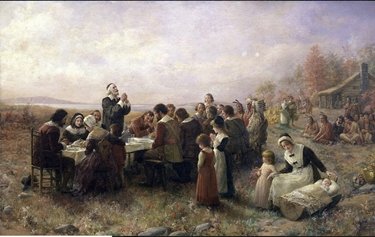
Mike Franc, at Human Events in 2005, identified the real reason for celebration at the first Thanksgiving.
Writing in his diary of the dire economic straits and self-destructive behavior that consumed his fellow Puritans shortly after their arrival, Governor William Bradford painted a picture of destitute settlers selling their clothes and bed coverings for food while others “became servants to the Indians,†cutting wood and fetching water in exchange for “a capful of corn.†The most desperate among them starved, with Bradford recounting how one settler, in gathering shellfish along the shore, “was so weak … he stuck fast in the mud and was found dead in the place.â€
The colony’s leaders identified the source of their problem as a particularly vile form of what Bradford called “communism.†Property in Plymouth Colony, he observed, was communally owned and cultivated. This system (“taking away of property and bringing [it] into a commonwealthâ€) bred “confusion and discontent†and “retarded much employment that would have been to [the settlers’] benefit and comfort.â€
Just how did the Pilgrims solve the problem of famine? In addition to receiving help from the local Indians in farming, they decided allow the private ownership of individual plots of land.
On the brink of extermination, the Colony’s leaders changed course and allotted a parcel of land to each settler, hoping the private ownership of farmland would encourage self-sufficiency and lead to the cultivation of more corn and other foodstuffs.
As Adam Smith would have predicted, this new system worked famously. “This had very good success,†Bradford reported, “for it made all hands very industrious.†In fact, “much more corn was planted than otherwise would have been†and productivity increased. “Women,†for example, “went willingly into the field, and took their little ones with them to set corn.â€
The famine that nearly wiped out the Pilgrims in 1623 gave way to a period of agricultural abundance that enabled the Massachusetts settlers to set down permanent roots in the New World, prosper, and play an indispensable role in the ultimate success of the American experiment.
A profoundly religious man, Bradford saw the hand of God in the Pilgrims’ economic recovery. Their success, he observed, “may well evince the vanity of that conceit…that the taking away of property… would make [men] happy and flourishing; as if they were wiser than God.†Bradford surmised, “God in his wisdom saw another course fitter for them.â€
The real story of Thanksgiving is the triumph of capitalism and individualism over collectivism and socialism, which is the summation of the story of America.