SNL-writer Simon Rich spoofs hyper-ambitious, pseudo-intellectual NYC parents in a new book, Spoiled Brats, excepted in the NY Post.
Glenn Reynolds contends that here may be found the explanation for Lena Dunham.
When the nurses handed me my son, I couldn’t believe how perfect he was. Ben was so robust, nearly 50 inches tall, including horns and tail. Even the doula was impressed.
“My God,†she said. “My holy God in heaven.â€
Alan and I knew instantly that our child was exceptional. He was just so adorable, with his pentagram birthmark and little, grasping claws. His red eyes gleamed with intelligence. When the doctors came in with all their charts, they just confirmed what we already knew. Our child was “one of a kind†and “unlike any creature born of man.â€
Alan and I were ecstatic — but also a little bit nervous. Raising a gifted child is a huge responsibility. And we were determined not to squander Ben’s talents. We vowed then and there that we would do all we could to ensure he achieved his full potential. …
We decided to enroll Ben at Dalton, because of its emphasis on creativity. I wasn’t going to let Ben’s talent go to waste at some cookie-cutter public school where every child is forced into the same dull mold. I wanted him to have a chance to find himself.
The truth is, both Alan and I had secretly hoped that our child would be a “creative.†We each harbored artistic dreams in our youth (Alan wrote poetry and I made collages). Our parents, though, discouraged us from pursuing “les arts.†In their opinion, it was just too financially risky. I’m thrilled that I ended up at Synergy Unlimited, and Alan loves his job at the Globex Corporation. But even though we’ve made successful careers in business, there’s still a part of us that wonders, What if? With Ben (who’s five times more talented than Alan and I ever were!) we finally had the chance to answer that question.
The Times also describes a developing fashion for all-glass high-rise bathrooms.
Among the many vertiginous renderings for the penthouse apartments at 432 Park Avenue, the nearly 1,400-foot-high Cuisenaire rod that topped off last month, is one of its master (or mistress) of the universe bathrooms, a glittering, reflective container of glass and marble. The image shows a huge egg-shaped tub planted before a 10-foot-square window, 90 or more stories up. All of Lower Manhattan is spread out like the view from someone’s private plane.
Talk about power washing.
The dizzying aerial baths at 432 Park, while certainly the highest in the city, are not the only exposed throne rooms in New York. All across Manhattan, in glassy towers soon to be built or nearing completion, see-through chambers will flaunt their owners, naked, toweled or robed, like so many museum vitrines — although the audience for all this exposure is probably avian, not human.
It seems the former touchstones of bathroom luxury (Edwardian England, say, or ancient Rome) have been replaced by the glass cube of the Apple store on Fifth Avenue. In fact, Richard Dubrow, marketing director at Macklowe Properties, which built 432 and that Apple store, described the penthouse “wet rooms†(or shower rooms) in just those terms.
Everyone wants a window, said Vickey Barron, a broker at Douglas Elliman and director of sales at Walker Tower, a conversion of the old Verizon building on West 18th Street. “But now it has to be  a Window.†She made air quotes around the word. “Now what most people wanted in their living rooms, they want in their bathrooms. They’ll say, ‘What? No View?’ †…
If there’s a view, there should be glass,†[Minimalist architect John] Pawson said. “It’s not about putting yourself on show, it’s about enjoying what’s outside. Any exhibitionism is an unfortunate by-product. I think what’s really nice is that at this level you’re creating a gathering space. You can congregate in the bathroom, you can even share the bath or bring a chair in.â€
On a recent Thursday, there were seven people standing in the master bathroom of an apartment on the 20th floor of 737 Park, another Macklowe project that’s a new conversion of a 1940s building by Handel Architects. (The apartment, three bedrooms in 4,336 square feet, is listed for $19.695 million.) At 21 by 11 feet, there was certainly room in the bathroom for a few more. Along two opposing walls, two toilets and two showers faced off behind glass walls. The by-now-familiar egg floated in the center of the room.
“Some people don’t mind showing a little, and some don’t mind showing a lot,†said Gary Handel, the principal of Handel Architects. “They are totally comfortable in their bodies.†…
Nine of the building’s C-line apartments expressed an even clearer idea: a wall of glass with two toilets at either end and a shower in the middle, which raised many an eyebrow among brokers and their clients because the toilets face each other. Design clarity — and a well-lit room — suggests questions about how private we want to be in our private spaces.
Jill Roosevelt, a broker at Brown Harris Stevens who has been leading her clients through a few of the new, glassy offerings, said 737 in particular sparked conversations about habits of intimacy. “It’s about how much proximity do you want to your partner who is performing these tasks?†she said. “It doesn’t affect sales, but there is always a reaction, ranging from nonchalant to amusement. It depends on how comfortable you feel with your spouse or partner. My traditional couples will say, ‘We’ll frost the glass.’ â€
One couple — “this would be the amused couple,†Ms. Roosevelt said — pondered the dueling commodes of the C-line at 737 Park with interest. “Well, I guess we could watch each other read the newspaper,†the wife said finally. …
Privacy, of course, is not an absolute value, but a value that has changed over time and circumstances, as Winifred Gallagher, an author who has written about the behavioral and psychological science of place, pointed out.
“And like everything else, the rich can buy more of it,†she said. “In the city, privacy is about shielding yourself from all the stimuli. Most of us can’t drop the shield entirely even when we’re in our own homes, because the city is right outside. But if you’re high enough, you can waltz around pretending you’re in the garden of Versailles.â€
Furthermore, Ms. Gallagher added, for many the bathroom can be the focus of a lot of anxiety. “You have the scale and there’s the magnifying mirror so you don’t put your makeup on and look like a clown,†she said. “And imagine yourself striding around the bathrooms with all that glass. It puts the pressure on you to be thin and fit, which are also perks of the rich. If you’re thin and fit, why wouldn’t you have this jewel box to show yourself off in?â€
Ann Althouse observes: “the rich folk of New York don’t mind if you look at them naked while they use the bathroom… as long as you have to look way, way up.“
“But, what has he done for me lately?” is a characteristic New York approach to memorial institutional names commemorating historic instances of philanthropy. Yet, paying off a donor’s heirs to let you take his name off the building so you can sell naming rights all over again constitutes a very special pure-New-York kind of tackiness.
Since its adolescence more than four decades ago, the New York Philharmonic’s home at Lincoln Center has been known as Avery Fisher Hall. Now, as the orchestra prepares for a major renovation expected to cost more than $500 million, the Fisher family has agreed to relinquish the name so the Philharmonic and Lincoln Center can lure a large donor with the promise of rechristening the building.
The unusual agreement, announced on Thursday, is a significant turnaround from 12 years ago, when the family of Avery Fisher, the music philanthropist who gave $10 million in 1973 to support the building, threatened legal action if the concert hall was rebuilt or renovated under a new name.
Lincoln Center is essentially paying the family $15 million for permission to drop the name and has included several other inducements, like a promise to feature prominent tributes to Mr. Fisher in the new lobby of the concert hall.
While the ability to raise money through naming opportunities has become a staple tool for arts organizations, perhaps no event speaks louder to its utility as a fund-raising mechanism than Lincoln Center’s willingness to pay the family of a veteran donor to step away so it can court a new benefactor.
Organizations like the Philharmonic and Lincoln Center cannot hope to raise the sums required for ambitious reconstructions or expansions without being able to dangle the carrot of a donor’s name emblazoned over the door.
“This unties the Gordian knot,†Katherine G. Farley, Lincoln Center’s chairwoman, said of the agreement. She said it was too early in the process to discuss whose name might replace Mr. Fisher’s on the building or what the price tag for such a high-profile philanthropic mantle might be.
When 24-year-old aspiring actress Shoshana Roberts was filmed with a hidden camera walking around New York in a plain T-shirt, jeans and trainers she received 108 “catcalls”.
Roberts’ social experiment has spawned many spoof videos since it came out, but recently, a model from Auckland, New Zealand, decided to conduct Roberts’ experiment in her native land.
The results are shockingly different.
Unlike Roberts who was stopped over 100 times, Simpson was only stopped twice. But how she was stopped in these situations were completely different.
The first time Simpson was stopped, an Italian man chased after her to ask if she was from Italy. The man then proceeded to apologize for stopping her. The second time was simply a man asking her for directions.
New York City is home to 8.4 million people, while Auckland only has a population of 1.3 million. That may have something to do with the difference in reactions, but it definitely doesn’t explain all of it. As you can probably tell, there’s just a culture difference at play.
Edward Hopper, Bridle Path, 1939, formerly San Francisco Museum of Modern Art, now privately owned. Sold for $10,386,500 at a Sotheby’s auction in 2012 to allow the SFMOMA to purchase a different Hopper.
SFMOMA evidently preferred a more characteristic Hopper painting, presenting a gritty image of Mid-20th Century Everyman’s loneliness and alienation to this glimpse of Pre-WWII, American Upper-Crust ecstasy.
The 1856 plan for Central Park by Frederick Law Olmsted and Calvert Vaux did not provide for horseback riding, although the planners did not expressly oppose it. William Alex, president of the Frederick Law Olmsted Association, said the bridle paths were among 17 suggested changes in the Central Park plan made by Robert J. Dillon, one of the original Central Park Commissioners, a Democratic politician and two-term Corporation Counsel.
Dillon’s proposals included waiting to lay out pathways until pedestrians established them by habit, and extending the Mall over the lake and up to Belvedere Castle with a large suspension bridge.
Olmsted & Vaux were able to fend off most meddling, but Dillon’s suggestion for bridle paths survived. By 1863 six miles of gravel- and sand-surfaced paths extended from 59th Street and Fifth Avenue to the west side of the park and around the reservoir. The rules of the park for 1873 specifically allowed horseback riding “with a free hand and a rapid rate of speed,” something not allowed anywhere else in the city.
The 1886 Appletons’ Dictionary of New York City said that renting a horse cost $3 for an afternoon. The Sun’s Guide to New York of 1892 noted that the stables’ business fell off markedly in the summer, when their patrons “go to the seashore or to the mountains.”
The soft surfaces of the bridle paths required intensive maintenance; the 1908 report notes that they were harrowed and leveled every evening and watered in the summer.
A 1929 editorial in The New York Times recalled the days when there were several hundred horses available from stables and riders frequently rode to the north end of the park, then up Seventh Avenue and along the Harlem River, and back down a bridle trail in Riverside Park.
In 1964, Hart’s Guide to New York City reported that there were only 50 horses for rent, out of Claremont Stables at 175 West 89th.
By the 1970’s the bridle paths were a shambles.
Claremont Riding Academy (where I used to rent horses to ride in early mornings in the Park) was located on West 89th Street. It closed forever in 2007. Wikipedia:
The location of the stable made for an unusual experience in the equestrian world: riding in heavy traffic. The stable was not in Central Park itself, but a block and a half away. Getting to the park required riding a horse on Manhattan streets, mixed in with the regular traffic, and crossing Central Park West.
The Academy was dependent on the structural condition of the bridle paths in nearby Central Park, as this was the primary designated area for horseback riding in Manhattan. At some point, the city allowed the bridle paths to be used by pedestrians, joggers, bicyclists and others, and discontinued structural maintenance of the paths. With the overuse of the paths in combination with the city’s discontinuance of maintenance, riders were no longer able to canter on the pathways, ending one of the pleasures of horseback riding which deterred new ridership. Due to declining patronage and increasing cost from renovations and taxes, Claremont closed forever at 5 p.m. April 29, 2007.
When I rented my first horse from Claremont, I was surprised to find that I’d been presented with a double bridle. (I was accustomed to riding only with a snaffle.) But, when the time came to ride through city traffic and the need to stop at a traffic light before crossing Central Park West arose, I was very happy indeed that I also had a curb bit at my disposal.
Some rather preposterous and pretentious interpretations of the painting, in French, (by a non-rider) are here.
John R. Shipp interprets the painting (in English). I’m afraid that I do not agree with his supposed connections myself. I think Hopper just chose to paint an image of three people riding at a gallop at a particular piece of Central Park architecture.
Gerard Van der Leun (very old bio here) recently published a nice essay about moving out of Manhattan to a small town somewhere in the (rural & gun-owning portion of the) Pacific Northwest.
By the time I left the Hive, whatever had once bound me to it had long since frayed away. The upward pace of a “career” seemed more and more like a pointless marathon, a mere job. Long days spent striving to “exceed corporate goals” came to resemble a game of pick-up-sticks played with cows. Efforts to save an enterprise that one didn’t own came down to admitting that the enterprise had no intrinsic worth other than maintaining the vulgar lifestyle of an aging monomaniac who could no longer reason his way through two and two to four. It all combined into a vast cloud of wind-spun detritus that obscured the plain and simple fact that while government employees were working 24 hours a day printing more money, nobody anywhere was printing more time.
And so, at last, “Man, you gotta go.”
Jack Kerouac, Bard of the Road, wrote “Man, you gotta go.” Then he went home, lived with his mother again, and died a drunk. Not my road.
Okay. Fair enough. But go where? Here? Maybe. But where, exactly, is “here?”
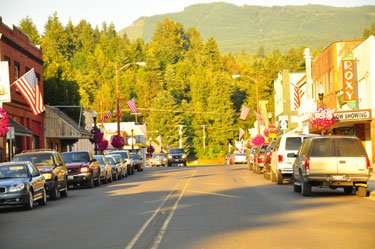
Today, for a week or so, “here” turns out to be a small town up on the northwest edge of the nation. In size and composition, architecture and attitude, it is just about the exact polar opposite of the Hive.
Where Central Park in the Hive is a large, long oblong of struggling overused green in the center of an immense slab of asphalt, steel and concrete, the central park of this town is about 25 yards on a side. It’s a pleasant patch of cool grass studded with picnic tables and ringed with oaks that drape it in a shawl of shade. At the east end is a brick and cedar bandstand where banjos, guitars and fiddles sing out on odd afternoons and evenings. You’ll hear some country and some rock, but mostly you’ll hear the strains of bluegrass brought down out of the old Alleghenies and carried far west to these higher, more distant and demanding mountains.
On the west side of the park is a five-foot by three-foot marble faced granite slab in the shape of two tablets donated and erected there by the local chapter of the Eagles. Carved into the marble face in polished script are the Ten Commandments, King James version.
It would seem that whatever local chapter of the ACLU exists in these parts has chosen to ignore this blatant eruption of the Christian tradition in the secular town park. One might suppose the ACLU has done this simply because it hasn’t gotten around to it. It would, however, be much more likely that the organization is aware that in this town an ACLU suit to remove the Ten Commandments would be answered not with a five year legal argument, but with 30 rounds of semi-automatic rifle fire into the offices and automobiles of those seeking its removal. Since, for all its posturing, the ACLU has devolved into a refuge for moral and physical cowards with law degrees, it’s not difficult to see why this stone, largely unread and unnoticed, has been given a pass.
This is a heavily armed part of the nation and, as a result, it is a very civil and polite part as well.
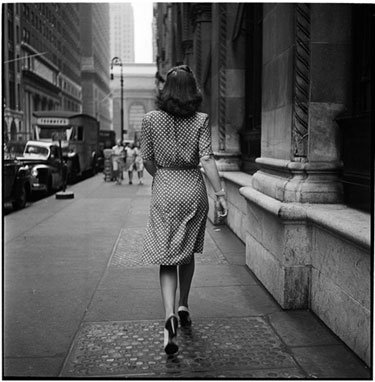
[B]efore he became famous for directing films like A Clockwork Orange, Lolita, and Dr. Strangelove, Stanley Kubrick was a poor kid from the Bronx who worked as a photojournalist for Look magazine. (He was their youngest staff photographer on record.) Kubrick’s striking black and white images of 1940s New York City — which were often shot on the sly, his camera concealed in a paper bag with a hole in it — hint at the dark beauty and psychological drama of his later creative output.
I was in the lobby of the Parsons School of Design when I had the sudden urge to pee. So I located the restroom, and discovered THIS SIGN on the door. I pondered my predicament for a moment, when someone noticed my hesitation and said: “Go on in, it’s for everybody.”
I opened the door slowly. This was no single-occupancy restroom. This was a multi-stalled bathroom complex. Inside there were three girls, who all made awkward eye contact with me when I walked in. One of them shrugged her shoulders: “Yep,” she said, “we’re all in here together.” She didn’t seem too excited about the fact.
I chose a stall and shut the door behind me. Aiming for that sweet spot right above the water line, I tried to pee as quietly as possible. The toilet had an automatic flusher, so when I finished, I turned around and left the stall. I heard no flush behind me. Outside, ANOTHER girl was waiting to use my stall.