There’s something happening here. What it is ain’t exactly clear, but we may, at long last, be seeing the rise of a popular movement that, unlike the Tea Party, is angry at the right people. …
When the Occupy Wall Street protests began three weeks ago, most news organizations were derisive if they deigned to mention the events at all. For example, nine days into the protests, National Public Radio had provided no coverage whatsoever.
It is, therefore, a testament to the passion of those involved that the protests not only continued but grew, eventually becoming too big to ignore. With unions and a growing number of Democrats now expressing at least qualified support for the protesters, Occupy Wall Street is starting to look like an important event that might even eventually be seen as a turning point.
What can we say about the protests? First things first: The protesters’ indictment of Wall Street as a destructive force, economically and politically, is completely right.
Proving, once and for all, that our political opponents are not rational adults.
What we are dealing with is children, Walter-Mitty-role-playing in a fantasy filled with stereotyped images of mustache-twirling villains foreclosing Little Nell’s mortgage and sturdy workers and peasants protesting for land and bread.
What do you do with a Nobel Prize winner in Economics who thinks the American financial industry is “a destructive force?” I’d suggest calling the little men in the white coats to throw a net over the poor zany and carry him away for an extended rest period in the laughing academy.
How can you debate with insanity?
The haute bourgeois American left is so thoroughly invested in imaginary archetypes of injustice and oppression, of class struggle and revolutionary glory, that it looks at ordinary life, at people going to work in offices and doing conventional lawful business, and sees some kind of diabolical conspiratorial wrong-doing going on.
Its members look at their balding, pot-bellied establishment selves, sitting in expensive chairs in offices in some of the best real estate in the land, and they see youthful muscular workers and revolutionists getting ready to storm the Winter Palace.
These people are completely demented.
One fellow gets a degree in finance, writes some papers that make a splash, gets tenure, conducts some seminars, wins some prizes, and writes lots of angry editorials.
Another chap also gets a degree in finance, goes to work for a bank, writes the analyses used in some important deals, rises higher in management, receives some hefty bonuses, and isn’t angry with anybody.
So, the first guy is a righteous fighter for causes greater than himself, and the second guy is a fiend in human form who has climbed to the top over the corpses of the poor? What a crock!
I don’t take a lot of interest in the academic field of Economics. I majored at school in Philosophy. But I gather that, at some point in the past, Mr. Krugman did some worthwhile writing, offering useful explanations for the efficacy and service to humanity of trade and economies of scale. When you read him today, you seriously wonder if somebody has not dropped this poor man on his head.
But Paul Krugman is not alone. My college class is filled with similar upper middle class professionals, well-educated, affluent, and successful, who nonetheless have their heads full of bizarre prejudices against banks, corporations, “the rich” (artfully defined, of course, so as to exclude themselves) and with fantasy images of oppression, class warfare, and political struggle.
All I can say is, our educational system, which filled these whackos’ heads with all this nonsense, has a great deal to answer for.
I sometimes like to fantasize to myself what things would have been like if our colleges and universities and elite culture had been otherwise hijacked, not by the radical left performing its Gramscian long march through the institutions, but by nerds obsessed with Marvel comic books. Paul Krugman, for instance, would be editorializing from the perspective of Ironman or the Silver Surfer, not that of Piotr Kropotkin, hero of the workers’ revolution.
It is too soon to decide whether the Republican Party ought to choose Sarah Palin as its nominee next year. She has not made it clear, so far, whether she actually intends to seek its nomination.
Were she to try to run, I think she has exhibited both potential major strengths and weaknesses that give one hope for her possible success, but leave one also uncertain of her ability to succeed. If Sarah Palin fails to convince most of us that she can perform consistently at a higher level of eloquence, I’d say that she ought not to be the nominee.
Palin has already carved out for herself a useful, practically effective, and very prominent role as a political commentator. It is possible that remaining free to be herself and operating in that capacity would be more congenial to her and more compatible with her talents and inclinations than campaigning for the presidency.
———————
Deciding not to run at this time, I think, speaks very, very positively for Sarah Palin’s good judgment. I think this decision, in fact, proves that she is highly intelligent and is operating politically at a level worthy of respect and admiration.
It is obvious enough why she isn’t running.
She clearly has concluded that running in the second position of a losing ticket does not really give one an automatic ticket to the GOP’s nomination and a firm claim on the presidency.
She undoubtedly recognizes that her resume was impaired by her decision to resign the Alaska governorship and write a book and cash in, in order to avoid her family winding up in bankruptcy as a result of the enormous legal expenses piling up as the result of a endless series of left-wing “ethics” attacks.
Sarah Palin is wise enough to realize that she sometimes appeared inarticulate and unprepared during her previous national campaign, and she has concluded that, before running again nationally, she needs to prove herself. She is only 47 years old, and she has plenty of time to run for the presidency.
Since leaving elected office, Sarah Palin has carved out for herself an extremely useful and highy influential role as national spokesperson for conservatism. She was already, in that role, able to have a real impact on the national debate, and she was, in fact, more effective most of the time than any member of Congress or any governor.
There are a lot of people who have doubts about whether she possesses sufficient knowledge and ability to express herself to serve as president. Serving for years as a national leader of the conservative cause, fighting the good fight in the national political wars, is actually the best way to establish anyone as a credible leader and inevitable candidate. Palin isn’t running for president this year, instead she is proposing to occupy the same national role formerly held in years gone by Ronald Reagan and Barry Goldwater.
Looking on, I find myself wondering why on earth that particular role has been vacant for so long. The reflection is inevitable that, if Newt Gingrich had done, some years ago, what Sarah Palin is doing now, Mitt Romney and Rick Perry would not be the front runners.
You often hear people talk about how bright Newt Gingrich is, and how dumb Sarah Palin is. I think all this proves that exactly the reverse is true. Palin has made the right decision, and there is a pretty good likelihood that she will keep on doing the right thing, and will one day go on to greater things.
“I want to put a ding in the universe.” – 1981 (probably)
——————-
We’re gambling on our vision, and we would rather do that than make “me too” products. Let some other companies do that. For us, it’s always the next dream (Jan. 1984, on the release of the Macintosh computer)
——————-
You can’t just ask customers what they want and then try to give that to them. By the time you get it built, they’ll want something new. (1989)
——————-
“I’m convinced that about half of what separates the successful entrepreneurs from the non-successful ones is pure perseverance.” – 1995
——————-
The only problem with Microsoft is they just have no taste. They have absolutely no taste. And I don’t mean that in a small way, I mean that in a big way, in the sense that they don’t think of original ideas, and they don’t bring much culture into their products. . . . I have no problem with their success. They’ve earned their success, for the most part. I have a problem with the fact that they just make really third-rate products. (1996)
——————-
You’ve baked a really lovely cake, but then you’ve used dog sh*t for frosting. (commenting on a NeXT programmer’s poor work)
——————-
When you’re young, you look at television and think, There’s a conspiracy. The networks have conspired to dumb us down. But when you get a little older, you realize that’s not true. The networks are in business to give people exactly what they want. That’s a far more depressing thought. Conspiracy is optimistic! You can shoot the bastards! We can have a revolution! But the networks are really in business to give people what they want. It’s the truth. (from interview in WIRED magazine, 1996)
——————-
I was worth about over a million dollars when I was twenty-three and over ten million dollars when I was twenty-four, and over a hundred million dollars when I was twenty-five and it wasn’t that important because I never did it for the money. (1996)
——————-
“That’s been one of my mantras – focus and simplicity. Simple can be harder than complex: You have to work hard to get your thinking clean to make it simple. But it’s worth it in the end because once you get there, you can move mountains.” – 1998
——————-
iMac is next year’s computer for $1,299, not last year’s computer for $999. (May 1998, on the release of the iMac computer)
——————-
Innovation has nothing to do with how many R&D dollars you have. When Apple came up with the Mac, IBM was spending at least 100 times more on R&D. It’s not about money. It’s about the people you have, how you’re led, and how much you get it. (1998)
——————-
Design is not just what it looks like. Design is how it works. – 2003
——————-
It will go down in history as a turning point for the music industry. This is landmark stuff. I can’t overestimate it. (2003, on the iPod and the iTunes Music Store)
——————-
If you haven’t found it yet, keep looking. Don’t settle. As with all matters of the heart, you’ll know when you find it. And, like any great relationship, it just gets better and better as the years roll on. – 2005
——————-
When I was 17, I read a quote that went something like: ‘If you live each day as if it was your last, someday you’ll most certainly be right.’ It made an impression on me, and since then, for the past 33 years, I have looked in the mirror every morning and asked myself: ‘If today were the last day of my life, would I want to do what I am about to do today?’ And whenever the answer has been ‘No’ for too many days in a row, I know I need to change something. – 2005
——————-
I think if you do something and it turns out pretty good, then you should go do something else wonderful, not dwell on it for too long. Just figure out what’s next. (quoted on MSNBC 2006)
——————-
Your time is limited, so don’t waste it living someone else’s life. Don’t be trapped by dogma — which is living with the results of other people’s thinking. Don’t let the noise of others’ opinions drown out your own inner voice. And most important, have the courage to follow your heart and intuition. They somehow already know what you truly want to become. Everything else is secondary. . . . Remembering that you are going to die is the best way I know to avoid the trap of thinking you have something to lose. You are already naked. There is no reason not to follow your heart. . . . Again, you can’t connect the dots looking forward; you can only connect them looking backwards. So you have to trust that the dots will somehow connect in your future. You have to trust in something — your gut, destiny, life, karma, whatever. This approach has never let me down, and it has made all the difference in my life. (Stanford U. commencement address, 2005)
——————-
I wish developing great products was as easy as writing a check. If that was the case, Microsoft would have great products. (at annual Apple stockholders’ meeting, 2007)
——————-
Stay hungry, stay foolish (his mantra, adopted from the final Whole Earth Catalog)
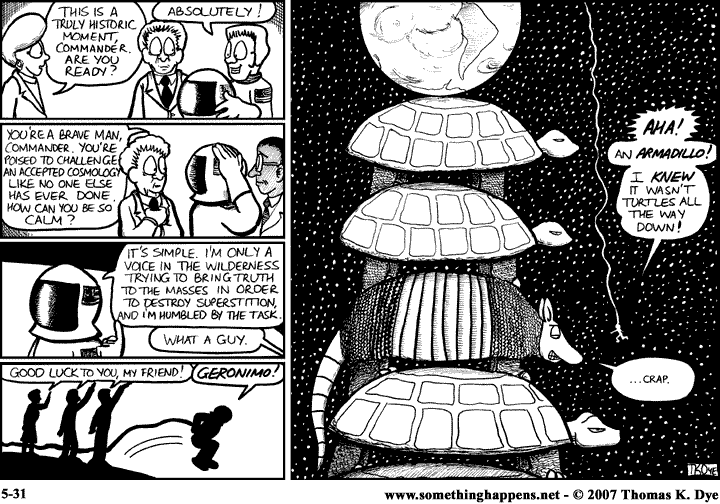
A well-known scientist (some say it was Bertrand Russell) once gave a public lecture on astronomy. He described how the earth orbits around the sun and how the sun, in turn, orbits around the center of a vast collection of stars called our galaxy. At the end of the lecture, a little old lady at the back of the room got up and said: “What you have told us is rubbish. The world is really a flat plate supported on the back of a giant tortoise.†The scientist gave a superior smile before replying, “What is the tortoise standing on?†“You’re very clever, young man, very clever,†said the old lady. “But it’s turtles all the way down!
The ability of the media to spin never fails to astonish.
They’ve managed to take the last debate (in which Republican rivals piled on Rick Perry), a meaningless Florida straw poll (which came out favoring Herman Cain), the former name of the location of a Perry family hunting camp, added some polling of their own (by CBS), and all the suckers are convinced that Herman Cain is the Republican front runner. Right!
The morale is: read the news a little less frequently and a lot more skeptically.
Heritage Auctions is selling some of the famous actor’s personal effects and papers in Los Angeles in a sale ending October 6-7th.
I have glanced through some of the catalogue, and there is some fascinating stuff: costumes, hats, and even scripts from famous movies, including his eye patch from True Grit, a tweed overcoat from The Quiet Man, a Marine Corps uniform from Sands of Iwo Jima . There are letters from Jimmy Stewart, Frank Sinatra, Ronald Reagan, and John F. Kennedy, and some very amusing letters from director John Ford, full of bawdy humor. They are even selling Wayne’s driver’s license and American Express card.
Lot 44129 is kind of interesting. It seems that, in 1977, just two years before his death, The People’s Almanac sent Wayne (along with other winners of the Academy Award) a poll questionnaire asking “who were and are the 5 best motion picture actors of all time…(and)…the 5 …best motion pictures of all time.”
John Wayne wrote down, as his list of actors: “1) Spencer Tracy 2) Elizabeth Taylor 3) Kathrine [sic] Hepburn 4) Laurence Olivier 5) Lionel Barrymore,” as his list of movies: “1) A Man for All Seasons 2) Gone with the Wind 3) The Four Horsemen of the Apocalypse 4) The Searchers 5) The Quiet Man.”
The lot includes the actual handwritten lists, signed by John Wayne, and is currently bid at $800.
I thought it was odd that John Wayne shared the fashionable critics’ high regard for The Searchers, among his own films. I would argue strenuously myself that She Wore a Yellow Ribbon featured his most impressive all-time job of acting.
Iowahawk imagines the Strangelove-esque phone call from the current occupant of the White House to Mexico, to explain that a little something has gone wrong with a BATF gun control operation.
Juan? Hola, amigo! Como esta?
Fine, fine. And how are Lupe and the kids?
College already? Boy, how time flies. Has she picked a major?
Splendid. And how is Juan Jr.? He’s what now, 13, 14? The last time I saw him he was only…
Oh.
Oh.
My goodness. Boy, that’s… that’s just terrible. My deepest sympathies to you and Lupe on your loss. I’ll have my secretary arrange for a memorial bouquet. I know he was a fine boy, and…
Now, Juan, let’s not jump to conclusions here. We both know there are lots of machine gun murders in Mexico, and it doesn’t necessarily mean that they’re all…
Yes, Juan, I got your messages. As a matter of fact that’s why I’m calling this afternoon. I’ve had my people look into this thing and…
Mmhmm.
Mmmhmm.
Now… now Juan… let’s just calm down here a minute. Just, okay.. okay… let me please explain, okay? See, the funny thing is, it turns out, a couple years back there was, well, this stimulus program money, and then there were these brainstorming sessions, where, well, there were some ideas what to do with it. So, anyhoo, one of the ideas that happened was, ‘hey, what if there were, say, 2000 machine guns that got sent to Mexican drug lords?’ and so forth.
Well no, of course we couldn’t tell you. It would have ruined the surprise.
The bottom of an antique souvenir saucer presents the image of similarly named topographic feature in Virginia.
The Washington Post set some new sort of record for opportunistic associative campaign smear reporting, by proceeding to headline a story informing its readers at length that Rick Perry hunted deer and entertained guests at hunting camps belonging to family and friends located in rural spot, known locally decades ago as “N-word-head.”
Wikipedia identifies the origin of such toponyms and mentions their date of extinction on official US maps.
In several English-speaking countries, Niggerhead or nigger head is a former name for several things thought to resemble a black person (“nigger”)’s head.
The term was once widely used for all sorts of things, including products such as soap and chewing tobacco, but most often for geographic features such as hills and rocks.[citation needed] In the U.S., more than hundred “Niggerheads” and other place names now considered racially offensive were changed in 1962 by the U.S. Board on Geographic Names.
Nor did “N-word-head” survive as the name of the area in which the Perry and Reed families’ hunting camps were sited. At some unknown point in the past, again decades ago, someone unknown removed and painted over the sign once identifying a rural Texas location by that name.
The Post obviously had no reason to believe that either Rick Perry, or any member of his family, had named the area “N-word-head.” The Post had no reason to believe that Rick Perry, or any member of his family, had erected a sign consisting of a rock with the “N-word-head” name painted on it. The Post had no reason to attribute any kind of meaningful responsibility for the existence or use in the distant past of that toponymic expression to Rick Perry at all. But associating a conservative Republican presidential candidate with the N-word, even so tangentially, is a way of flinging a big handful of mud at him, and who knows? Some of it might get into some voters’ heads and actually stick.
As an example of political opposition politics, or of journalism, this kind of thing is about as unethical, low, underhanded, cowardly, and despicable as you can try to get away with. I notice that the reptiles and invertebrates that wrote this contemptible story did not even sign their names to it, and I’m not surprised.
—————————-
Herman Cain dramatically diminished my liking and respect for his candidacy yesterday by jumping right in and trying to make hay by using this bilge. Screw him.
Older and more respectable (i.e. employed) lefties weren’t occupying Wall Street. Instead, they were smiling happily and fantasizing about the Revolution, or at least another great big wave of punitive regulation and taxation, as the young, the dumb, and the Bohemian took to the streets in Lower Manhattan to protest against Wall Street and the bankers.
Somebody gave those protesters the wrong address.
If they want to wave signs and shout slogans at the people really responsible for our economic problems, they ought to be protesting in front of the offices of their own educators, the same people who overcharged them and left them quite commonly without either wisdom or marketable skills, but buried in student loans.
Those protestors are typically college graduates, and there they are on the streets, bearing allegiance to political sentiments and theories alien to their own country’s fundamental values and traditions. They are overloaded with fashionable poses and slogans, but are perfectly innocent of serious political philosophy. They don’t like their own country’s political and economic system, institutions, and history, but they might think very differently if they had ever actually been informed accurately what any of those things are.
If those protestors knew enough of history and economics to associate the material prosperity and technological progress that they are accustomed to with the free economic system that produced them, if they even had been given enough of an adult understanding of the world that they could understand that business corporations, like Wall Street banks, are not, and cannot possibly be, charities, they would not be protesting where they are.
Wall Street did not cause the recession. Government caused the recession (by following the same left-wing philosophy that those protestors and the people who educated them embrace) by inadvertently grossly inflating home real estate prices, as the product of efforts to make long-term mortgage financing ever more widely and easily available. Government has worsened, and prolonged the recession, by dramatically meddling in the economy in the area of health care, by adding to the regulatory burden, and by generally increasing uncertainty. All of the damage was done on the basis of precisely the same ideas and philosophy that those demonstrators are trying to advance.
If all those kids, drop outs, poets, and Bohemians had the benefit of a decent education; if they actually understood history, economics, and political philosophy; if they understood how the world actually works and what banks do; none of them would be where they are doing what they are doing.
Dressing like a Preppy has been a successful marketing approach in men’s clothing for several decades, but offering to allow you to smell like a Preppy? (Those of us who once frequented locker rooms in the Yale gymnasium are shaking our heads at this one.)
Perhaps, this company has finally figured out how to compound the ultimate scent effective in the seduction of the opposite sex: the pure, distilled essential aroma of old money.
Mark Steyn has a few choice comments, as the chattering classes’ major case of buyer’s remorse becomes ever increasingly the topic of the day.
“Obamaism” was the Emperor’s new centrism: To a fool such as your average talk-radio host, His Majesty appears to be a man of minimal accomplishments other than self-promotion marinated in a radical faculty-lounge view of the world and the role of government. But, to a wise man such as your average presidential historian or New York Times columnist, he is the smartest guy ever to become president.
In part, this is a natural extension of an ever more conformist and unrepresentative establishment’s view of where “the center” is. On issues from abortion to climate change, a Times man or Hollywood activist or media professor’s notion of “centrism” is well to the left of where American opinion is.
That’s one reason why a supposedly “center-right” nation has wound up regulated into sclerosis, drowning in debt and embarking on its last decade as the world’s leading economy.
But in the case of Obama the chasm between soft, seductive, politico-media “centrism” and hard, grim reality is too big to bridge, and getting wider all the time.
You would think this might prompt some sober reflection from an American mainstream media dying in part because of its dreary ideological conformity. After all, a key reason why 53% voted for a man who was not, in Tina Brown’s word, “ready” is that Tina and all her pals assured us he was.
Occidental, Columbia, Harvard Law, a little light community organizing, a couple of years timeserving in a state legislature: That’s what America’s elites regard as an impressive resume rather than a bleak indictment of contemporary notions of “accomplishment.”
Obama would not have withstood scrutiny in any society with a healthy, skeptical press. Yet, like the high-rolling Wall Street moneybags, they failed to do due diligence.