Donald J. Boudreaux, at Cafe Hayek, makes a telling philosophical point about the inherent inconsistency of elite liberals’ obsession with inequality of income.
Paul Krugman agonizes [daily] over data that show high American income inequality. …
[W]hy focus on inequality of monetary incomes? What about other inequalities, such as the inequality of influence in public-policy debates? Mr. Krugman is certainly a one-percenter on this front. (Indeed, he’s a 0.001-percenter!)
Shouldn’t government ‘redistribute’ parts of Mr. Krugman’s New York Times column to me and other pundits who (according to the theory) can’t help but seethe with soul-shriveling envy at Mr. Krugman’s good fortune – good fortune that (also according to the theory) has less to do with Mr. Krugman’s merits as a columnist and more to do either with chance or with his pernicious and unfair influence with the Powers-that-Be?
Surely every ‘Progressive’ believes that those of us who now possess far less access than does Mr. Krugman to the opinion pages of the Times deserve to enjoy more of the access that he currently “controls.†And no ‘Progressive’ would let mere bourgeois obsessions with property rights and freedom block the state from forcibly redistributing such private property in the name of “social justice.â€
Sincerely,
Donald J. Boudreaux
Professor of Economics
George Mason University
Fairfax, VA 22030
When I was a kid, I used to imagine that digging a tunnel from my backyard in Shenandoah, Pennsylvania would take me to China, or maybe Australia. Good thing I never pursued the project. Now that I have a tool to identify where I’d be coming out, I see that I would have wound up all wet and far out to sea in the Indian Ocean.
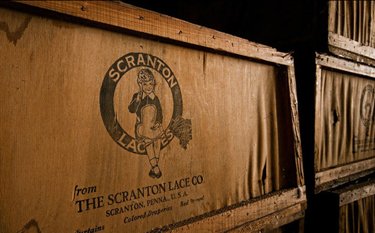
These photographs by Walter Arnold of the derelict Scranton Lace Company were recently linked on a North East Pennsylvania Genealogy list.
Incorporated in 1897, the Scranton Lace Company in its heyday employed 1400 people, and was the world’s largest producer of Nottingham lace. It possessed the largest looms ever built, each of which stood nearly three stories tall, was 50 feet long, and weighed over 20 tons. During World War II, the company expanded its production line to include mosquito and camouflage netting, bomb parachutes, and tarpaulins. After the war, the company returned to producing cotton yarn, vinyl shower curtains, and textile laminates for umbrellas, patio furniture, and pool liners.
Its factory complex boasted “bowling alleys in the basement, a fully staffed infirmary, a staff barber and a gymnasium, and owned its own cotton field and coal mine. Its clock tower was a city landmark. U.S. Sen. Hillary Rodham Clinton’s father and grandfather worked there.”
The Scranton Lace Company closed abruptly in 2002 with an announcement from the company’s vice president, in the middle of the daily work shift, that the company was closing “effective immediately.”
The photo essay is a moving testament to the scale of everything that has been lost as the American economy changed in recent decades to a postindustrial era and manufacturing in most cases moved overseas.
The Senator, a 125 feet (38 meters) tall pond cypress (Taxiodum ascendens), with a trunk diameter of 17.5 feet (5.3 meters), located in Big Tree Park, Longwood, Florida, was destroyed last night by an unexplained fire which initiated in the tree’s hollow interior.
The cypress, estimated to have been 3500 years old, was the oldest tree east of the Mississippi River, and counted on some lists as the fifth oldest tree in the world.
The Senator was 165 feet (50 meters) in 1925, before a hurricane took down its top. It was named for Senator M.O. Overstreet who donated the tree and the land surrounding it to Seminole County in 1927.
Local firefighters laid 800 feet (243.8 meters) of hose in a vain attempt to save the ancient tree.
Washington Post
When I was living a few years ago in the Bay Area of Northern California, I often divided shopping expeditions between Draeger’s (a sort of West Coast Zabar’s, a high end butcher shop-cum-gourmet food store) in San Mateo and Trader Joe’s in Foster City.
No matter how little I bought at Draeger’s, I marveled to find that the cash register receipt never came in under $100, while two or even three times the volume of purchases from Trader Joe’s often came in under $40. “These things even out.” I used to assure Karen.
Just the other day, I finally got to a Virginia branch of Trader Joe’s in Centreville. We residents of the real Northern Virginia make a point of avoiding entering the soul-destroying, built-up, suburban areas outside the District, referred to around here as “Occupied Virginia,” but Centerville is just at the edge of the suburban Erebus, and cases of Two-Buck-Chuck (priced on the East Coast at $3.29 a bottle) will definitely justify the occasional expedition.
Los Angeles Magazine has a long feature this week revealing the mysterious origins of the Counter-Culture’s favorite grocery store (which even some of us conservatives like).
Coulombe guessed he had less than a few years to think up a concept that could compete. Luckily, he was an avid magazine reader. In Scientific American he learned that a new class of overeducated, underpaid adults was being produced by the burgeoning college system. Sophisticated shoppers were not necessarily wealthy shoppers, Coulombe theorized; they were educated buyers trapped in economic stasis. He decided to mate the convenience store with the liquor store, and that was Trader Joe’s, “Phase I.†His customers would be the classical musician, the journalist, the teacher, the young doctor. In a different article Coulombe read that the more education a person had, the more they drank, so he stocked 70 bourbons and about 100 scotches. (“I had penciled out what a union journeyman made to figure what I would pay my employees,†he says, “and adding liquor was the easiest way to fund those wages.â€) Coulombe read about a jet known as the 747 that promised inexpensive air travel to Europe; Trader Joe’s would need to broaden its tastes to match the new traveler. In another magazine Coulombe discovered that the earth’s biosphere was threatened. Overnight, he says, he became a self-professed “Green†and spliced the health food store and the gourmet store onto Trader Joe’s. This was “Phase II†of Coulombe’s company.
Finally, Coulombe gave Trader Joe’s something most grocery chains didn’t have: a personality. It would have its own take on the world—cultivated but casual, spontaneous, moderately liberal, and smart. When you walked into a Trader Joe’s, you would know the store’s tone and its attitude. The personality that Coulombe conceived remains to this day the company’s voice: The Fearless Flyer.
Coulombe continued to tinker with Trader Joe’s. In 1972, he devised what he calls “Trader Joe’s, Phase III.†At that time the trend in grocery merchandising was bigger. Throughout the ’70s, supermarkets were headed toward becoming the 40,000-square-foot behemoths of today that can carry 50,000 items. Yet such steroidal markets would encounter drawbacks to their muscled dimensions. Eighty percent of supermarket shopping time is spent moving from product to product. Half of all store trips are for five purchases or less, and customers on such trips aren’t searching for sale items—price does not alter the behavior of someone looking for only a handful of things. What did this mean for supermarkets? As their floor plans expanded, their sales volume per square foot shrank. They were forced to invent new schemes to compensate for lost profits, charging fees to manufacturers for store placement and “floating†cash (earning bank interest on the daily take).
So once again Coulombe thought small. Instead of 50,000 shelved items, he would drop his number from 6,000 to 1,000. If supermarkets sold 20 kinds of cat food and 40 detergents, he would sell one of each. In doing so, Coulombe maximized the velocity of dollars entering his registers. Shoppers moving 5 feet between purchases instead of 50 pass through a store more quickly, leaving more cash behind. The average supermarket brings in $10 million to $30 million annually in sales. A Trader Joe’s one-fifth the size of a supermarket can make $1 million in a week’s time. Square foot for square foot, that Trader Joe’s outperforms an average Walmart, which would have to do $30 million in business to match it during the same period.
“I took her down to the rocker arms,†says Coulombe, describing the work he did in the late ’70s. “That’s the Trader Joe’s you know today.â€
Daimler AG wound up apologizing to Cuban-Americans, after two Florida state representatives denounced the luxury auto company’s use of the image of Che Guevara in the course of a PowerPoint presentation accompanying the keynote address at the International Consumer Electronics Show in Las Vegas.
The image of the cold-blooded Communist butcher popped up, as Dr. Zetsche boasted of the “revolutionary” impact on automobiles of recent advances in technology.
Over lunch with Peter Robinson, Victor Davis Hanson remarked reflectively:
When you think about it, Obama has kept the detention camp at Guantanamo. He’s going ahead with military tribunals. And where Bush only waterboarded three terrorists, Obama has used drones to execute about 2,600.
Though, he might have added: Piss also on the mainstream media that deliberately broke this trivial story to get the holier-than-thous on the warpath and to lend aid and comfort to all the enemies of the US military and the United States. And piss copiously on all the left-wing nincompoops, pillow-biters, and bed-wetters, Charles Johnson in particular, who are trying to make political hay at the expense of the young men in Afghanistan standing between their worthless selves and a brutal, fanatical and barbarous enemy.
NYM last September linked reports of sightings by US forces in Afghanistan of a mysterious large wild cat.
Michael Yon (who I’m reluctantly linking, despite his being on my shit list these days for devoting so much of his blogging recently to narcissistic attempts to play crusading journalist taking on the American military high command) has fresh photos from someone in the field today.
The pictures (taken from a helipcopter north of Kandahar) are clearly of a Jungle Cat (Felix chaus), an Asian critter a bit larger than a lynx or bobcat (20-24″ — 48 to 61 centimeters) running 22-37″ — 55 to 94 centimeters in length. The body color and tail markings are pretty distinctive. Try Google Images for comparable pictures.