Archive for April, 2013
15 Apr 2013


poetry reading
David Yezzi kicks the simpering, prating, effeminate ass of contemporary poetry around the block.
Poetry has become so docile, so domesticated, it’s like a spayed housecat lolling in a warm patch of sun. Most poets choose to play it safe, combining a few approved modes in a variety of unexceptional ways: lyrical, pastoral, whimsical, surrealist, lyrical-pastoral, pastoral-surrealist, interior-lyrical, whimsical-lyrical-interior-surrealist, and so on. These poems feel at home in coffee shops and on college campuses; they circulate breezily among crowds of like-minded poems and all of them work hard to be liked. (They are also beloved of prize committees and radio hosts.) Not since the Edwardians has a period style felt so pinched, though, ironically, today’s poetry is offered as “newâ€â€”either ground-breakingly populist or transgressively avant-garde. As Joshua Mehigan puts it in a recent issue of Poetry:
In the end, poetry looks radical only to the outside world, which ignores it, while from inside it looks static. Poets got out of these situations before by doing something new, but novelty is superfluous now. There is no way to get into the game without upping the ante, and there is no way out without bluffing or folding or everyone agreeing on a new game.
…
How did the main effects of poetry ever boil down to these: the genial revelation, the sweetly poignant middle-aged lament, the winsome ode to the suburban soul? The problem is that such poems lie: no one in the suburbs is that bland; no reasonable person reaches middle age with so little outrage at life’s absurdities. What an excruciating world contemporary poetry describes: one in which everyone is either ironic, on the one hand, or enlightened and kind on the other—not to mention selfless, wise, and caring. Even tragic or horrible events provoke only pre-approved feelings.
Poetry of this ilk has a sentimental, idealizing bent; it’s high-minded and “evolved.†Like all utopias, the world it presents exists nowhere. Some might argue that poetry should elevate, showing people at their best, each of us aspiring to forgive foibles with patience and understanding. But that kind of poetry amounts to little more than a fairy tale, a condescending sop to our own vanity.
15 Apr 2013

London mayor and notorious bad boy Boris Johnson retorts to all the nasty little leftist toads who made a point of rejoicing publicly over the passing of Margaret Thatcher.
Ding dong, the Soviet Union is dead! Ding dong, communism is dead! And so is the British disease. They are all dead as doornails – the myth of this country’s inevitable decline, the habit of capitulating to the unions, the belief in state control of everything from motor manufacturers to removals firms, taxation rates at 98 per cent: all the Lefty nostrums of the post-war epoch.
Ding dong! Old Labour’s dead! The Labour Party has given up its ridiculous belief in the common ownership of the means of production, distribution and exchange – the slogan that used to be printed on the back of every party membership card. Ding dong, Clause Four is dead as a dodo.
But I tell you what, my little Left-wing friends, and all you who think it amusing to break out the champagne at the death of an 87-year-old woman. There is one thing that is alive and well – and that is Thatcherism. Thatcherism lives; and will live as long as there are people in this country, and on this planet, who see how economic freedom can be the servant not just of the rich, but of our whole society.
14 Apr 2013

Esther Zuckerman poses as a SWUG. My commenters are often smarter than I am. One of them, unlike me, noticed that Esther Zuckerman actually used a picture of Tina Fey to illustrate the SWUG type. The “NBC” under the photo should have been a clue. Sigh.
The Urban Dictionary provides the definition:
Senior Washed-Up Girl.
The term goes back a couple of years, but the SWUG concept only recently attracted major attention as the result of a lengthy think piece in the Yale Daily News by Raisa Bruner exploring the culture, the pros and cons, and all possible nuances of SWUGdom, its relationship to Feminism, SWUGdom as fate, as life-phase, as life-style, and as identity.
—————————————–
Yale definitely teaches young people how to play theme and variations on a concept, and Ms. Bruner’s piece caught the attention of one Justin Rocket Silverman (Now that is a millenial generation name!) who, writing in The Cut brought all this to the attention of the World Outside Yale.
Yale senior Raisa Bruner [is] kind of tired of the free-wheeling frat hookup culture that’s so compelling to younger students. The guys know this about women her age, she says, and so they don’t generally hit on senior girls. If she went to Sigma Nu, she’d watch her male classmates focus on that infinitely more fun classmate, the female freshman.
Bruner is a self-identified SWUG — a senior washed up girl. As she explained in a recent feature in the Yale Daily News, to be a SWUG is to embrace “the slow, wine-filled decline of female sexual empowerment as we live out our college glory days. Welcome to the world of the ladies who have given up on boys because they don’t so much empower as frustrate, satisfy as agitate.â€
She and her fellow SWUGs are women who don’t bother dressing up for class, or even for fancy parties (though they might still attend them), don’t seek out meaningful (or even just sexual) relationships, spend weekends at their shared homes drinking in the company of other self-identified SWUGs, and feel utter apathy about their personal lives — all at the age of 21.
—————————————–
Gawker decided that all this SWUG stuff really amounted to just a pose and a demand for some attention.
Declaring “‘I don’t give a fuck’ at the right moment,” does not a “more complex person” make. Rather than embracing personal growth internally, there is a clamorous, exaggerated declaration that growing out of a social scene is the equivalent of being “washed-up” in the face of other’s halcyon days. Overall, SWUG-life appears to be a melodramatic desire to make an identity out of boredom and dissatisfaction with the collegiate social scene.
—————————————–
Esther Zuckerman (Y’ 12), at the Atlantic, tells us that she was already a SWUG as a junior two years ago.
I first heard about the term SWUG during my junior year when I was working at the Daily News. From what I can recall, it was described to me as having been coined by a group of girls in the senior class, and I hated it. Yale had been debating treatment of women on campus all year—the school was about to face a Title IX investigation—and the idea of calling any girls on campus “washed-up” was to me offensive and demeaning (the specific words I used in a heated Gchat conversation), even if some fellow women had used the label on themselves.
But I changed my mind on SWUGs as I sort of realized I was one. Looking back through my Gmail inbox today, I crossed into my senior year, when, for me and my friends, SWUG came to be a way we described an attitude that we already possessed. SWUG meant getting meatball subs on a snowy night. SWUGs watched an episode of New Girl twice in a row with a lot red wine. SWUGs baked brownies. In our version of SWUG, an idol might be Liz Lemon, to whom Jack Donaghy once said: “Big night, Lemon? Let me guess meatball sub extra, bottle of NyQuil, TiVo Top Chef, a little miss Bonnie Raitt, lights out.” My fellow would-be SWUGs and I listened to a lot of “I Can’t Make You Love Me.” We cared about our academics and our future careers, but when it came to our social lives in the confines of Yale, well, we, as seniors, couldn’t care less.
—————————————–
The whole SWUG business may have really been put on the map at Yale by a Daily News article by Chloe Drimal, published last September, titled: Profile of a SWUG.
You’ve all met one. They’re usually at penny shots promptly at 11 p.m. come Wednesday night, and are then found in Durfee’s around 1 p.m. the next day, buying every liquid they can get their hands on.
I was jealous of them when I was a freshman. They were on a nickname basis with the hottest guys at Yale and danced at the bar of DKE with their shirts off. But looking back on it, I realize the boys were trying to get with the freshmen, not the SWUGs. …
She’s the girl who Kevin, the bartender at Toad’s, hugs when she stumbles in Wednesday night. She’ll dance like no one’s looking. She’s a SWUG. She doesn’t care. Tommy at Box 63 and Compadre at Amigos will both give her free shots on occasion; they are not doing this for freshman girls — only for SWUGs.
She’s the girl in the Zeta basement, before the Coach Reno era, who is biting into a can with her teeth to shotgun on a Sunday. Although she could never beat the Zeta boys in a shotgun, she can beat most ADPhi boys.
She’s the girl who knows the code to get into DKE. She knows the code for ADPhi. (If any single senior girl has the key to Zeta, she may want to seek help.) Facebook bores her. She uses Facebook to find out different football players’ birthdays and plugs them into an astrology website to test their compatibility. She is compatible with no one.
She’s the girl who promised she would never hook up with someone younger than her but now finds herself texting sophomore boys who unavoidably turn her down. She thinks this is funny. She thinks about getting a vibrator; she may already have a vibrator. It may be better than that sophomore boy.
She doesn’t need to walk home late at night and chance getting mugged by a New Haven local because she will just sleep on a couch in one of the frats. The late night crew at G-Heav knows to start making her an egg and cheese when they see her stumble through the door, and sometimes they will allow her to dance behind the counter and crack an egg herself. Again, they don’t do this for the young, hot, freshman girls — only SWUGs.
She’s the girl who tells her friends she is going to have a “friendship night.†When they ask what this means she explains she is going to make a guy want her and then turn him down. She gets drunk and wakes up next to the guy she was going to turn down. She knows this will go nowhere, as she has already plugged his birthday into the compatibility website, and their score was a two. She makes up a short lie about a meeting and asks him to leave her room and then goes back to bed. She doesn’t return his texts. She’s a SWUG.
She is the last one at every party, because hey — who is she going home with? She’s not afraid to dance on tables and knows the top floor of any frat always has the cleanest bathroom. She is wise. She is hot, whether the boys believe it or not. She doesn’t give a hoot. She’s single because she wants to be; her daddy told her there’s more fish in the sea. She is a SWUG, and SWUG life is pretty awesome.
Drimal’s glorification of the SWUG made her in a campus celebrity, profiled by the Yale Herald.
—————————————–
If anyone is not totally SWUGed out at this point, he can turn to some more discussions which appeared in the Oldest College Daily.
—————————————–
On a personal note, we had hook ups at Yale in my day, but we did not have either the term or the identical hook up culture. I think that, as I remember it, quite a lot of female seniors in those days had long since taken anticipated Susan Patton’s advice and were in long-term relationships with Yale men.
The SWUG concept reminds me of the characteristic resentment of ordinarily-groomed-and-dressed Yale girls toward male friends’ dates from outside Yale.
The girl from Smith staying over at Yale would arrive at breakfast nicely dressed, in full make-up, hair in perfect order, and her escort’s female Yale friends and neighbors would glower and make faces, regarding his date’s superior efforts at presentation as personal affronts.
Yale girls all tended to think dating outside Yale constituted both punishable treason and firm evidence of bad taste. I once took a date to a performance of Carl Orff’s Carmina Burana, in which my current wife was singing in the chorus, and found Karen was using every opportunity that my then girlfriend’s eyes were averted to make faces at me.
14 Apr 2013

It has been more than 30 years since James Salter, whom I consider a quite interesting writer of the second rank, published his last novel. The publication of his new book has provoked frequent observation that Salter is really a much better writer writing more substantive and thematically worthy of attention novels than certain better-known establishment writers of fiction, but his work has, for five decades now, somehow mysteriously escaped wide attention.
The new novel is certainly not a masterpiece, but it is a very satisfactory read. It reminded me of John Marquand. The protagonist, Phillip Bowman, serves as a young naval officer in WWII, attends Harvard, and then becomes an editor in a NY publishing house. He marries a young woman out of the same Virginia equestrian circles I currently frequent, and Salter delivers a quite accurate portrait of the Virginia Hunt Country and its unique ethos. The marriage fails for reasons that are not entirely clear. The problem is apparently simply the fact that Bowman takes her away from Old Virginia and moves her to New York where she is obliged to live without horses and hunting and her family and home society. Bowman goes on without excessive perturbation to have other relationships and affairs. He meets a woman returning on a flight from Europe. They share a taxi, and ultimately live together. But she, too, leaves him, and opportunistically gains ownership of the house he purchased for their use by means of legal chicanery. A good while later, he runs into his former lover’s daughter, whom he had known when she was a child. He is friendly, dismissive of the wrong her mother did him, and he proceeds to take advantage of the opportunities which present themselves to make love to her. He persuades her to let him take her on a trip to Paris, where he shares with her his sophisticated knowledge of the city and its restaurants and Picasso’s paintings of Marie-Thérèse Walter, and skillfully makes love to her. When he has finally succeeded in bringing her to the peak of erotic fulfillment, he calculates that she will, before very long, come to her senses about the enormous gap between their ages and the unsuitability of their relationship. He then simply walks out, paying the hotel bill, and leaving her penniless in Paris, knowing full well that she will have to seek the assistance of her mother. The reader is likely to think Phillip Bowman cruel. Like Marquand, Salter writes basically about what he knows, and tends to present fictional versions of himself, portraits of the gentleman of accomplishment, the cynical and astute observer of society and humanity, and the homme moyen sensual, the connoisseur of sexual relationships and the female body.
“All That Is” is a novel about love, but Salter’s view of love is appreciative yet unsentimental. Phillip Bowman is grateful for the female companionship that life brings his way, but he is not wildly optimistic about his own motives and capacity for enduring affection or those of any of his successive string of partners. For Salter, love is always, as the title of an earlier novel put it, A Sport and a Pastime.
There was this count, and his wife said to him one day that their son was growing up and wasn’t it time he learned about the birds and the bees? All right, the count said, so he took him for a walk. They went down to a stream and stood on a bridge looking down at peasant girls washing clothes. The count said, your mother wants me to talk to you about the birds and the bees, what they do. Yes, father, the son said. Well, you see the girls down there? Yes, father. You remember a few days ago when we came here, what we did with them? Yes, father. Well, that’s what the birds and the bees do.”
14 Apr 2013

A standard cultural artifact in Japan is the darumaoki, the weighted and self-righting tumbler doll painted as a comical caricature of Daruma, aka Bodhidharma, the Buddhist monk who brought Zen (aka Ch’an) Buddhism to China in the 5th century and who founded at the Shaolin Temple the entire tradition of Oriental martial arts.
The dolls are visible embodiments of the Japanese slogan “Nanakorobi Yaoki,” “Seven times down, eight times up,” an admonition encouraging persistence, resilience, and the determination to overcome adversity.
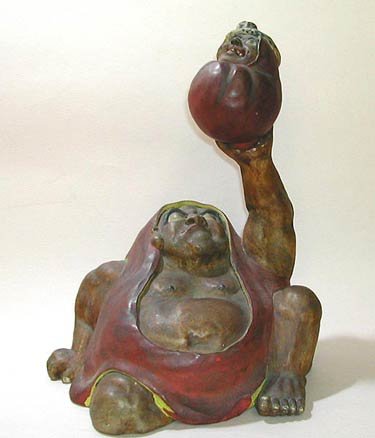
A disgruntled Daruma contemplates with visible dismay his own caricatured form as a darumaoki doll. 19th century ceramic, private collection.
12 Apr 2013

Hat tip to Bill Hobbs.
11 Apr 2013

In the 1940s, coal miners on their day off in my hometown used to dress better than Tech company executives do today.
In another, characteristically brilliant essay, Dan Greenfield discusses the Left’s reliance on the Idea of Progress as goal and justification.
The left tends to view the past negatively and future shock positively. It wants change to disrupt the old order of things in order to make way for a new order. It hews to a progressive understanding of history in which we have been getting better with the advance of time, the march of progress mimics evolution as a means of lifting humanity out of the muck and raising it up on ivory towers of reason through a ceaseless process of change.
The right often views the past positively, it sees change as a destroyer that undermines civilization’s accomplishments and threatens to usher in anarchy. It fights to conserve that which is threatened by the entropic winds of change. The conservative worldview is progressive in its own way, but it is the progress of the established order. It sees progress emerging from the accretion of civilization, rather than from the disruption of revolution.
Where the left tends to be unrealistically optimistic about the future, acting like a child running to the edge and jumping off, without remembering all the bumps and bruises before, the right tends to be pessimistic about the future. It tends to be wary of change because it is all too aware of how dangerous change can be.
Youth who do not understand the value of what is around them rush to the left. As they achieve a sense of worth, of the world around them and of their labors, they drift slowly to the right. Age also brings with it a sense of vulnerability. Knowing how you can be hurt, how fragile the thin skin of the body, the fleshy connections and organs dangling within, brings with it a different view of the world. Once you understand that you can lose and that you will lose, then you also understand how important it is to defend what you have left.
The vital mantra of the left is do something for the sake of doing something. Change for the sake of novelty. Action for the sake of action. This carnival drumbeat loses its appeal when you come to understand how dangerous change can be. Personal history becomes national history becomes personal history again as you live through it. Seeing what a mistake change can be as you watch politicians disgraced, causes revealed as fool’s errands and crusades fall apart, is a great teacher of the folly of change for the sake of change.
Reagan’s question, “Are you better off than you were four years ago?” is the fundamental challenge of the conservative that asks whether the change was really worth it. It is the question at the heart of the struggle between the right and the left.
Are you better off than you were twenty years ago or forty years ago? It’s an uncomfortable question because it has no simple answer. In some ways we are better off and in some ways we are worse off.
Read the whole thing.
11 Apr 2013

There are lovable parts of America, Montana, Vermont, the Virginia Horse Country, and there are the other kind of places where we wind up if we’ve been bad.
Gavin McInnes explains in a detailed rant exactly why he hates LA.
If my kids turned out to be gay, I’d say, “Oh great, there go my grandchildren†and move on. But if my son turned out to be the guy at The New York Times who covered modern dance, I would lie in the bath and dig a razor blade into my wrists so deep, you’d think there were vaginas living there. And if my daughter ever moved to LA, I’d send her my head in a box. Los Angeles is to life what New York City is to a woman’s ovaries. It’s an elephant’s graveyard where stupid losers go to die. Here are 10 reasons why.
Read the whole thing.
Personally, I found the undeserved complacent affluence, the outrageous self-entitlement, and the effeminate left-wing politics characteristic of the Northern California Bay area even more annoying.
10 Apr 2013

Jennifer Rubin marks Margaret Thatcher’s passing by identifying the characteristic liberal ways of dealing with the passing of conservative giants.
At the passing of each conservative legend we are reminded that liberals stick to some basic rules when commenting on these passings. These rules of the road (of the funeral procession, if you will) are thoroughly predictable and the subject of much guffawing by conservatives, while liberals remain clueless that their act has gotten old:
1. The only good conservative is a dead one. …
10. Allow no self-reflection on why no liberal icon in the past 50-plus years is regarded with such affection and esteem.
Read the whole thing.
————————————-
Matthew Burke has collected twenty-five excellent quotations from Margaret Thatcher “that crush Obama and the left.”
Sample:
“When all the objectives of government include the achievement of equality – other than equality before the law – that government poses a threat to liberty.†~ Margaret Thatcher
Read the whole collection.
10 Apr 2013

Hat tip to Henry Bernatonis.
10 Apr 2013

My wife Karen forwarded to me the other day Gizmodo’s story on a dry nook in the middle of a pond in Vöcklabruck, Austria, and it is certainly an eye-catching and amusing architectural gimmick.
The interesting coincidence is the location.
Vöcklabruck, in Upper Austria is my family’s ancestral home.
They were first recorded under the surname “Buchhaim,” which later became corrupted into Puchhaim and finally Pöchner. (Zienkiewicz came later.)
Seibmacher writes:
Über die Heimat der Pöchner ist nichts verlässliches bekannt. Während einige dieselben aus Schottland stammen lassen, wieder andere Steiermark als ihre Heimat nennen, kommen selbe zu Anfang des. 12. Jahrhunderts bereits in Salzburg vor, von wo sie sich nach Oberöstereich in die Gegend von Vöcklabruck wandten.
(translation:)
Concerning the homeland of the Pöchners there is no reliable information. According to some they originally emigrated from Scotland, but different sources call the Steiermark their homeland. From the beginning of the 12th Century onward they were in Salzburg, from whence they went to Upper Austria to the vicinity of Vöcklabruck.
The theory proposed by the former sources is that Buchhaim-Puchhaim-Pöchner surname comes actually from the Scottish Buchan, and that some Comyns related to the Norman Comyns who inherited via a Celtic maternal line the Scottish Earldom of Buchan moved to Austria.
This would be a plausible story if the emigration occurred in the years between 1306 and 1314 when the Comyns lost the struggle for power and the throne of Scotland to the Bruces, but the Pöchners are already in Austria two centuries earlier.
Below is the Pöchner coat of arms, which the heraldically-knowledgeable will perceive at once represents a simple reversal of the tinctures of the arms of Austria, i.e. of the Babbenburg Dukes of Austria, acquired by Leopold V (“Luitpold der Tugendhafte,” Leopold the Virtuous) in the course of the 1191 Siege of Acre.
Leopold’s arms consisted of “Gules, a fess Argent” because in the course of the fighting his tunic had become completely covered with blood except for a white band which had been covered by his belt.

/div>

Feeds
|




