Back in the 1960s, Bowdoin’s College Bowl team mopped up on the television contest show whose questions focused on academic knowledge. I thought seriously of going there, but took Yale’s offer instead simply because the larger university offered an even greater selection of course offerings.
Bowdoin is still generally regarded highly. In fact, it is ranked sixth in liberal arts by U.S. News & World Report. But a new study by the National Association of Scholars, released on Wednesday, contends that Bowdoin has become an instrument for partisan indoctrination with Progressive ideology.
Bowdoin boasts of training its students in critical thinking. The NAS study concludes:
[Allegedly] Bowdoin’s emphasis [is] on “critical thinking,†but the real… emphasis [is] on politics. Politics is enthroned at Bowdoin where Reason once reigned. Like all usurpers, this one presents itself as the legitimate heir of the old order. Bowdoin manages this substitution by claiming that Reason all along was political and that “truth claims,†seen accurately through the lens of “critical thinking,†are only assertions of self-interest by the powerful. Since everything was politics anyway, why not promote the politics you prefer? This is the short route to replacing open-minded liberal education with political activism centered on diversity, multiculturalism, same-sex marriage, sustainability, etc.
So, despite Bowdoin’s lack of cohesive intellectual order, it is a “whole†and can be examined as something that possesses organic unity. In that light, our guiding questions were: What kinds of knowledge does Bowdoin emphasize or prize? What does it want all Bowdoin students to learn? What does it want all Bowdoin faculty members to teach? What intellectual habits and attitudes does it cultivate? What understanding of the unity of knowledge does it prompt students to recognize? What divisions of knowledge? What abiding perplexities and matters for lifelong study? What moral yearnings does it plant in the souls of students? How does it urge students to comprehend the self, and what qualities does it uphold as worthy of pursuit? What qualities as better restrained or overcome? How should we treat other people? What obligations do we have as citizens? What are our obligations of stewardship to the achievements of past generations? What are our obligations to the generations to come? What combination of knowledge and character represents an ideal towards which students should strive? What is the good life? What is the good society?
Bowdoin does not spend much time debating possible answers. Rather, it has settled doctrine that informs students what sorts of knowledge, habits, dispositions, and aspirations are desirable. What does Bowdoin want all students to learn? The importance of diversity, respect for “difference,†sustainability, the social construction of gender, the need to obtain “consent,†the common good, world citizenship, and critical thinking. The answers embedded in these terms are not, as we have noted, arrived at by careful weighing of arguments and evidence. The general procedure has been for the college president to announce a “commitment,†such as President Mills’s announcement in 2007 that he had signed the “College and University Presidents’ Climate Commitment,†or the College’s 2009 release of its “Carbon Neutrality Implementation Plan.†The same procedures underlie Bowdoin’s creation of the Studies programs, its commitment to minority student recruitment, and its determination to increase the number of minority and women faculty members.
All of these decisions may well have captured the prevailing views of Bowdoin faculty members and students. They might well have, therefore, prevailed in open debate. But as far as we can tell, there was no meaningful debate. Without hesitation, Bowdoin skips to certainties on some of the most contentious issues of our time. What most should be subject to debate never is.
When critical thinking is most necessary, it is most absent. What happens at the level of college policy is reflected at the level of college culture. When Bowdoin speaks of the “common good,†when it promotes “diversity†and “inclusivity†and apotheosizes “difference,†it is similarly by-passing debate on the idea s that are at the center of the great debates in America today. Rather than give these debates a respectful and full hearing, the college pre-empts them with closed-minded orthodoxies.
Of course, not only Bowdoin practices this same kind of one-sided, ideological indoctrination. Yale certainly does, as well –to one degree or another– as every other elite university and college in America.
Ha! Those of us living outside the megalopolis should be so lucky. We get our less-than-high-speed Internet rationed out to us in a spoon by satellite modem services and we lose connectivity anytime there is heavy fog or strong precipitation. The video is amusing but naive. It fails to mention that these Oligopolicies are all created by successful arrangements with government.
Lars Seier Christensen, co-founder & CEO of Denmark’s Saxo Bank A/S, looks on at the destruction of Cyprus’s economy by the Euro Zone bailout and begins sounding like Tocqueville.
There are very few limits to what you can do to people in the modern interpretation of democracy. A version where only majority rule is required, but where there is no longer a respect for personal negative rights – as we know them from the American Constitution.
The easiest target will always be wealthy people, or even just working people and savers who did the right thing all their lives. As the bloated welfare states begin to collapse under their irresponsible promises, their crumbling value systems and their unsustainable demographics, it will be easy to convince more than 50 percent of voters that confiscating and stealing other people’s money is OK for the greater good. Boston Consulting Group calculated that 28 percent of ALL private wealth is needed to meet just existing debts – not future obligations , mind you – and the money can only come from one place… Your pockets. Beware.
A lot of things have gone wrong over the past few years, but the seeds were planted many years ago. In the form of pressure for more people having the “right†to own their properties, even if they did not fulfill the traditional mortgage criteria – hence subprime. In the form of enormous “entitlements†to not just poor, but also middle-class people in the welfare states – hence ballooning deficits and debt. In the form of a Euro, a grand, political project with no practical foundation – hence crisis after crisis, with the dominoes stretching far into the distance.
The United States has precisely the Liberal political tradition of well-established and legally-recognized Natural Rights protecting property, but we also have Barack Obama and a radical democrat majority in the US Senate sharing views identical to those of European Union socialists and caring absolutely nothing for the American Liberal political tradition, which they neither respect nor understand.
Bret Stephens remembers Michael Kelly, the American journalist killed ten years ago south of Baghdad Airport, traveling embedded with the US Army’s Third Division. His jeep came under enemy fire, and the driver lost control while trying to evade and went into a canal. Kelly drowned along with his driver, becoming the first American journalist to lose his life during the war.
Wouldn’t you know that it would be a reporter like Kelly who got killed, not one of the usual verminous breed?
Kelly treated a column as a sword, the obvious and most worthy purpose of which was to stab, slice, decapitate and—once he really got going—utterly disembowel the objects of his contempt.
Which objects? The pompous, the dishonest, the phony, the self-satisfied, the morally safe and smug, the debauched, the downright evil. To speak more precisely: Al Gore, Bill Clinton, Frank Sinatra, Mr. Gore again, the news media in general, Ted Kennedy, Yasser Arafat. And, of course, Hollywood, which pretty much exemplified all the above-mentioned qualities.
Kelly didn’t just deride these people and institutions. Before he could skewer them, he had to capture them. Writing about Oscar night, he catches Jack Nicholson “leering and sprawling paunchily in his ringside chair like an especially dissolute pasha waiting for his next lap dance.” From an early profile of Bill Clinton: “When he spoke, perception was not only reality. It was a reality that changed, quicksilver quick, from eye to eye and ear to ear.” Of one of Mr. Gore’s debate performances against George W. Bush: “It was much like the most infuriating of all husbandly marital-argument tactics. You know the one—where you play the part of the patient but pained party in the obvious right, too much a gentleman to say that your wife is spewing pure rubbish, but communicating utter contempt through creative breathing.”
Reading Kelly, I used to wonder: Did his power of observation explain his moral judgments, or was it the other way around? Usually (though few of us columnists will admit it), we make our judgments and then find our evidence. I don’t think this was true of Kelly: He was like a man born with a preternatural sense of smell. He couldn’t help smelling it. And he could smell it from a mile away.
Take his view of Frank Sinatra. Everyone loved Old Blue Eyes and mourned him when he died in 1998. Everyone except Michael Kelly.
Kelly hated Frank because Frank had invented Cool, and Cool had replaced Smart. What was Smart? It was Humphrey Bogart in Casablanca: “He possesses an outward cynicism, but at his core he is a square. . . . He is willing to die for his beliefs, and his beliefs are, although he takes pains to hide it, old-fashioned. He believes in truth, justice, the American way, and love. . . . When there is a war, he goes to it. . . . He may be world weary, but he is not ironic.”
Cool was something else. “Cool said the old values were for suckers. . . . Cool didn’t go to war; Saps went to war, and anyway, cool had no beliefs he was willing to die for. Cool never, ever, got in a fight it might lose; cool had friends who could take care of that sort of thing.”
It never, ever would have occurred to me to make the distinction until I read Kelly’s column. And then I understood Sinatra. And then I understood Kelly, too.
Kelly, who was killed 10 years ago as an embedded journalist just outside of Baghdad, was Smart. When the war came, he, too, went to it. Few columnists in America had argued as passionately, and none as cogently, for the overthrow of Saddam Hussein.
“To march against the war is not to give peace a chance,” he wrote six weeks before his death. “It is to give tyranny a chance.”
The Economist redraws the map of Europe, giving Poland and Lithuania a break by moving them out of their inconvenient position between Germany and Russia. Great Britain gets to bask in the sun off the coast of Spain. And there are other helpful changes.
People who find their neighbours tiresome can move to another neighbourhood, whereas countries can’t. But suppose they could. Rejigging the map of Europe would make life more logical and friendlier.
Britain, which after its general election will have to confront its dire public finances, should move closer to the southern-European countries that find themselves in a similar position. It could be towed to a new position near the Azores. (If the journey proves a bumpy one, it might be a good opportunity to make Wales and Scotland into separate islands).
In Britain’s place should come Poland, which has suffered quite enough in its location between Russia and Germany and deserves a chance to enjoy the bracing winds of the North Atlantic and the security of sea water between it and any potential invaders.
Belgium’s incomprehensible Flemish-French language squabbles (which have just brought down a government) are redolent of central Europe at its worst, especially the nonsenses Slovakia thinks up for its Hungarian-speaking ethnic minority. So Belgium should swap places with the Czech Republic. The stolid, well-organised Czechs would get on splendidly with their new Dutch neighbours, and vice versa.
Harry Binswanger, in Forbes, commences what, after years and years of demonstrable non-warming, is likely to becoming a growing chorus of mockery of the greatest scientific fraud in human history.
I’ve grown old waiting for the promised global warming. I was 35 when predictions of a looming ice age were supplanted by warmmongering. Now I’m 68, and there’s still no sign of warmer weather. It’s enough to make one doubt the “settled science†of the government-funded doom-sayers.
Remember 1979? That was the year of “We Are Family†by Sister Sledge, of “The Dukes of Hazard†on TV, and of “ Kramer vs. Kramer†on the silver screen. It was the year the Shah was forced out of Iran. It was before the web, before the personal computer, before the cell phone, before voicemail and answering machines. But not before the global warming campaign.
In January of 1979, a New York Times article was headlined: “Experts Tell How Antarctic Ice Could Cause Widespread Floods.†The abstract in the Times archives says: “If the West Antarctic ice sheet slips into the sea, as some glaciologists believe is possible, boats could be launched from the bottom steps of the Capitol in Washington and a third of Florida would be under water, a climate specialist said today.â€
By 1981 (think “Chariots of Fire“), the drum beat had taken effect. Quoting from the American Institute of Physics website: “A 1981 survey found that more than a third of American adults claimed they had heard or read about the greenhouse effect.â€
So where’s the warming? Where are the gondolas pulling up to the Capitol? Where are the encroaching seas in Florida? Or anywhere? Where is the climate change which, for 33 years, has been just around the corner?
After all this time, when the continuation of industrial civilization itself is on the table, shouldn’t there be some palpable, observable effect of the disaster that we are supposed to sacrifice our futures in order to avoid? Shouldn’t the doom-sayers be saying “We told you so!†backed up by a torrent of youtube videos of submerged locales and media stories reminding us about how it used to snow in Massachusetts?
Climate panic, after all, is fear of dramatic, life-altering climate changes, not about tenths of a degree. We are told that we must “take action right now before it’s Too Late!†That doesn’t mean: before it’s too late to avoid a Spring that comes a week earlier or summer heat records of 103 degrees instead of 102. It was to fend off utter disaster that we needed the Kyoto Treaty, carbon taxes, and Priuses.
With nothing panic-worthy–nothing even noticeable–ensuing after 33 years, one has to wonder whether external reality even matters amid the frenzy. (It’s recently been admitted that there has been no global warming for the last 16 years.) For the climate researchers, what matters may be gaining fame and government grants, but what about the climate-anxious trend-followers in the wider public? What explains their indifference to decade after decade of failed predictions? Beyond sheer conformity, dare I suggest a psychological cause: a sense of personal anxiety projected outward? “The planet is endangered by carbon emissions†is far more palatable than “My life is endangered by my personal evasions.†Something is indeed careening out of control, but it isn’t the atmosphere.
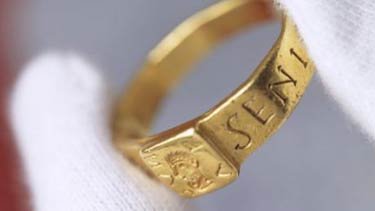
A Roman ring, found in a farmer’s field (presumably part of what was once the Roman town Calleva Atrebatum) near Silchester, Hampshire in 1785 in some unknown manner wound up preserved in the library of The Vyne, a stately 16th century home belonging (until 1958, damn Socialism!) to the Chute family.
The ring bears an image of Venus and a Latin inscription. That inscription apparently connects the ring to a Latin curse tablet found by Sir Mortimer Wheeler in an excavation of a temple complex associate with the god Nodens at Lydney Park in Gloucestershire.
The lead curse tablet read:
DEVO NODENTI SILVIANVS ANILVM PERDEDIT DEMEDIAM PARTEM DONAVIT NODENTI INTER QVIBVS NOMEN SENICIANI NOLLIS PETMITTAS SANITATEM DONEC PERFERA VSQVE TEMPLVM DENTIS
For the god Nodens. Silvianus has lost a ring and has donated one-half [its worth] to Nodens. Among those named Senicianus permit no good-health until it is returned to the temple of Nodens.
Sir Mortimer Wheeler in 1929 apparently consulted with J.R.R. Tolkien at Oxford about the natural hypothesis that the Silchester ring, with the inscription “SENI???”, might be the very same ring Silvianus had lost.
Tolkien took an interest in the matter, visited the Gloucestershire temple complex several times, and made a point of looking into the etymology of the name of the god Nodens.
It is believed today that it was this real world story of a lost, and very improbably rediscovered, gold ring, bearing an inscription, and weighted with a curse that may very well have been the inspiration of the One Ring featured in The Hobbit which appeared in 1937.
In any event, the Silchester ring is now being put on display by the combined efforts of the Tolkien Society and the National Trust in a newly-established “Ring Room” in The Vyne.
Obamacare is making Americans’ health care more expensive, not less. How can that be? Charles Krauthammer explains that when you arbitrarily sever one sixth of “the biggest economy on Planet Earth” from a functioning market system and then try winging the planning of its operation, bad things are inevitable.
William Penn’s statue stands atop Philadelphia’s City Hall
I grew up about 100 miles northwest of Philadelphia and occasionally visited the big city. I always thought that Philadelphia had an unusually unattractive local accent, one that could rival Brooklyn’s or Long Island’s in stigmatizing-as-lower-class potential. I certainly never thought it sounded Southern.
But the Atlantic has an article in which a U of P linguistics professor says that Philadelphians are losing the local accent and the cause is the triumph of the influence of Northern speech over Southern.
Sometime around the 1960s and ’70s, people in Philadelphia began slowly, subtly to change how they speak. The sound of their vowels started a gradual shift consciously imperceptible to the very people who were driving it. A’s evolved to bump into E’s. The sound of an O lost some of its singsong twang. After decades of speaking with what was in effect a southern dialect, Philadelphians were becoming – linguistically, that is – more northern.
“There’s one big question: How is it possible that Philadelphians all over the city are doing the same thing?” asks Bill Labov, a professor in the department of linguistics at the University of Pennsylvania. “What is it that makes Philadelphia operate as a whole, making it different from the neighboring cities?”
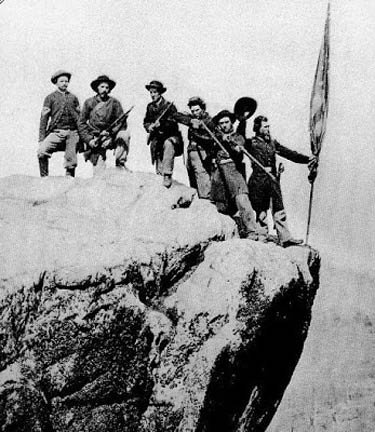
Lookout Mountain is a highly defensible position for riflemen.
Tennessean Andrew Exum rattles Volunteer State sabres in the direction of Georgia, and plots defensive strategies in a Wired article delightfully titled: Graveyard of Peaches.
The Georgia Legislature had better think twice about trying to move the state line in order to correct that surveying error made in 1818.
As a soldier, I fought in both Iraq and Afghanistan; as a scholar, I performed most of the fieldwork for my doctoral dissertation in southern Lebanon. Nowhere in the world, though, have I ever encountered a more brutal, tribal and violent race of people than the Scots-Irish of East Tennessee. Any Georgian occupation force would inevitably get sucked into our petty politics and family vendettas. We might share a language, but Georgia would struggle to relate to its new foreign subjects, let alone entrench its authority over us.