19 Jan 2016
Keith Reading the Obits
Keith Richards, Obituaries, Rock & Roll


|
Archive for 2016
19 Jan 2016
Bernie Sanders is a Commie2016 Election, Bernie Sanders, Communism
Paul Sperry, in the New York Post, points out that Bernie Sanders is not a “liberal,” not a “progressive.” He’s a lifelong, diehard, dyed-in-the-wool Communist.
Read the whole thing. 18 Jan 2016
Le Curieux aka Kilroy Was HereArchitecture, Humor, Sainte Foy
17 Jan 2016
New Gin Goes Horribly, Horribly WrongChemistry, Darwin Awards, Gin, Mustard Gas
17 Jan 2016
My God! What a Fall!Alice Pearson, Falls, Fox Hunting, Ledbury Hunt
British eventer Alice Pearson took a tremendous fall out with the Ledbury Hunt at Murrells End on January 15th latest, winding up under her struggling horse. Meanwhile, other members of the field poured over the same hedge, landing on both sides of the fallen horse and rider. This is the kind of thing the Irish refer to as “a crucifying fall.” The ground must have been soft that day because both Alice & Chocky survived without serious injury. If you can follow the link to Facebook, you can see the whole nearly disastrous sequence. 16 Jan 2016
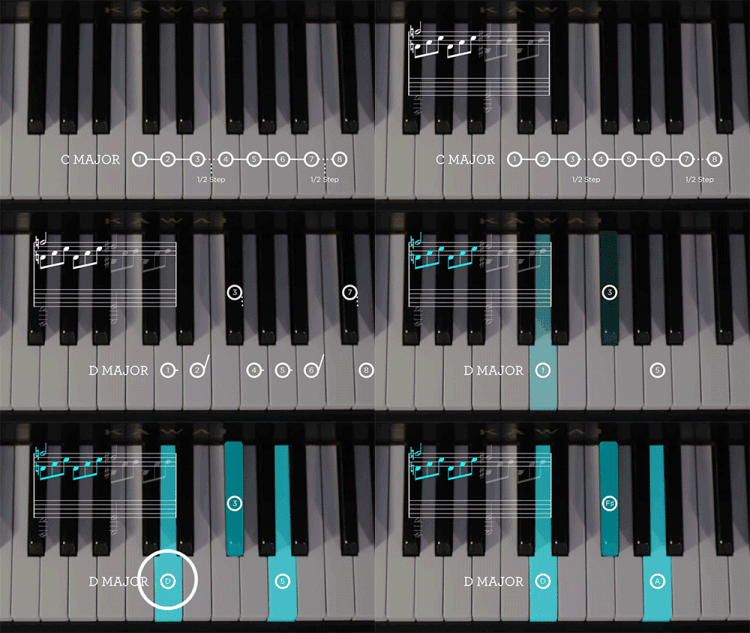
Music and MathClassical Music, Ludwig van Beethoven, MathematicsHow is it that Beethoven, who is celebrated as one of the most significant composers of all time, wrote many of his most beloved songs while going deaf? The answer lies in the math behind his music. Using the “Moonlight Sonataâ€, we can begin to understand the way Beethoven was able to convey emotion and creativity using the certainty of mathematics.
The standard piano octave consists of 13 keys, each separated by a half step. A standard major or minor scale uses 8 of these keys with 5 whole step intervals and 2 half step ones.
The first half of measure 50 of “Moonlight Sonata†consists of three notes in D major, separated by intervals called thirds that skip over the next note in the scale. By stacking the notes first, third, and fifth notes – D, F sharp, and A – we get a harmonic pattern known as a triad.
But, these aren’t just arbitrary magic numbers. Rather, they represent the mathematical relationship between the pitch frequencies of different notes, which form a geometric series. The stacking of these three frequencies creates ‘consonance’, which sounds naturally pleasant to our ears. Examining Beethoven’s use of both consonance and dissonance can help us begin to understand how he added the unquantifiable elements of emotion and creativity to the certainty of mathematics. For a deeper dive into the mathematics of the “Moonlight Sonataâ€, watch the TED-Ed Lesson Music and math: The genius of Beethoven – Natalya St. Clair Animation by Qa’ed Mai Via Ratak Monodosico. 16 Jan 2016
More From Matt BrackenIran, Riverine Command Boats
Posted at Gates of Vienna:
Welcome to
NEVER YET MELTED
Another Right-Wing Web Aggregator and Purveyor of Unpopular Opinions
 David Zincavage contact: jdz@usa.net blog advertising is good for General Bullmoose and good for the USA. 


Feeds
|