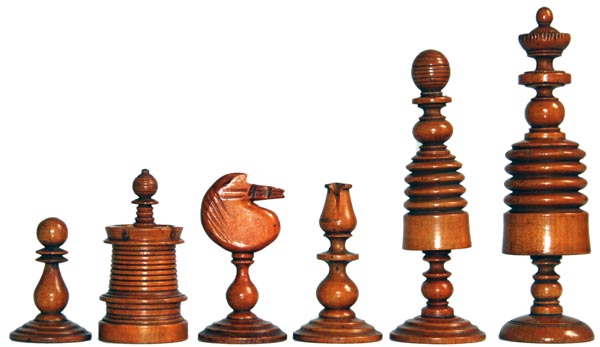
Smithsonian’s Design Decoded explains the architectural origin of today’s standard Staunton-style chess men.
Prior to 1849, there was no such thing as a “normal chess set.†At least not like we think of it today. Over the centuries that chess had been played, innumerable varieties of sets of pieces were created, with regional differences in designation and appearance. As the game proliferated throughout southern Europe in the early 11th century, the rules began to evolve, the movement of the pieces were formalized, and the pieces themselves were drastically transformed from their origins in 6th century India. Originally conceived of as a field of battle, the symbolic meaning of the game changed as it gained popularity in Europe, and the pieces became stand-ins for a royal court instead of an army. Thus, the original chessmen, known as counselor, infantry, cavalry, elephants, and chariots, became the queen, pawn, knight, bishop, and rook, respectively. By the 19th century, chess clubs and competitions began to appear all around the world, it became necessary to use a standardized set that would enable players from different cultures to compete without getting confused.
In 1849, that challenge would be met by the “Staunton†Chess Set.
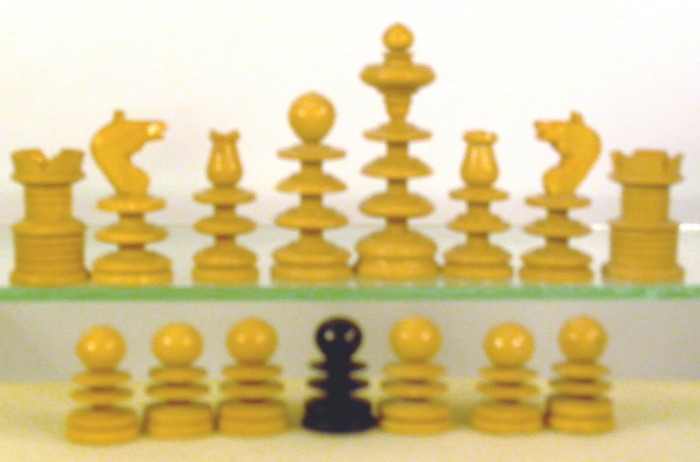
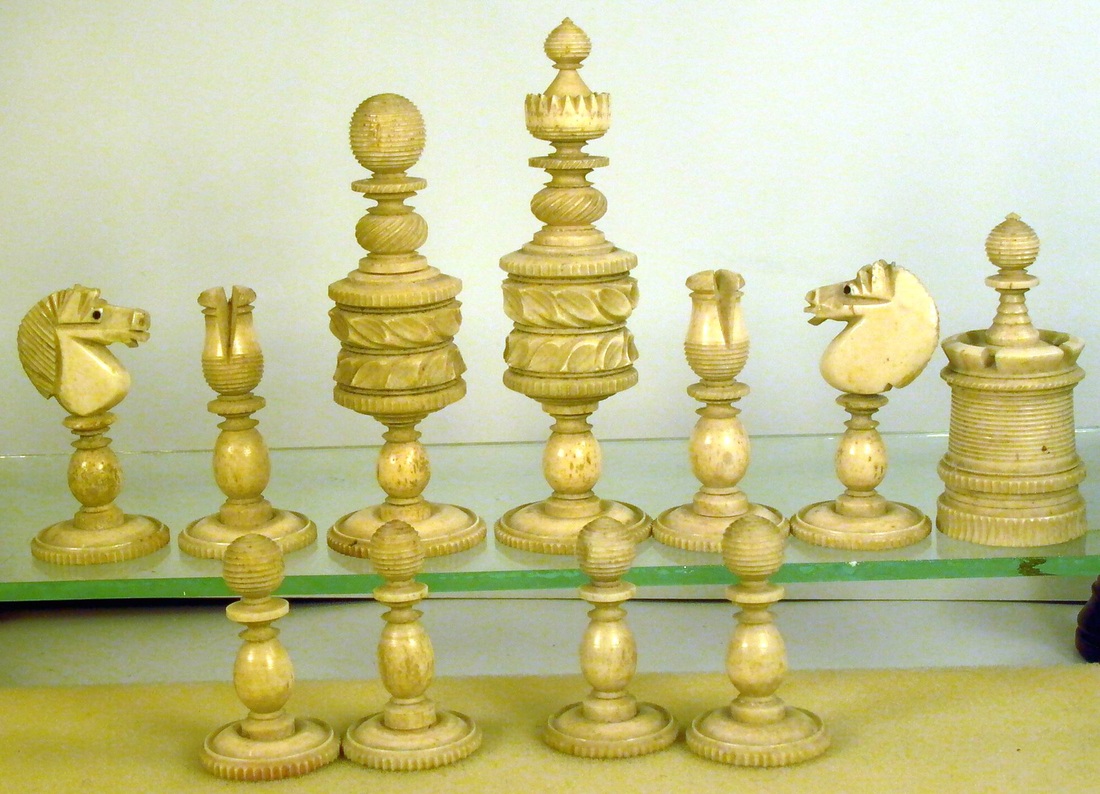
The Staunton chess pieces are the ones we know and love today, the ones we simply think of as chess pieces. Prior to its invention, there were a wide variety of popular styles in England, such as The St George, The English Barleycorn, and the Northern Upright. To say nothing of the regional and cultural variations. But the Staunton quickly would surpass them all. Howard Staunton was a chess authority who organized many tournaments and clubs in London, and was widely considered to be one of the best players in the world. Despite its name, the iconic set was not designed by Howard Staunton.
According to the most widely told origin story, the Staunton set was designed by architect Nathan Cook, who looked at a variety of popular chess sets and distilled their common traits while also, more importantly, looking at the city around him. Victorian London’s Neoclassical architecture had been influenced by a renewed interest in the ruins of ancient Greece and Rome, which captured the popular imagination after the rediscovery of Pompeii in the 18th century. The work of architects like Christopher Wren, William Chambers, John Soane, and many others inspired the column-like, tripartite division of king, queen, and bishop. A row of Staunton pawns evokes Italianate balustrades enclosing of stairways and balconies.
Projectophile pokes fun at mid-last-century architectural modernism’s dramatic gestures, economies, and built-in lethalities.
The clean lines, the geometric decorative elements, the seamless blending of indoor and outdoor space… I sure do love mid-century modern architecture.
Do you know what I love more? My children. And that is why I will never live in my MCM dream home. Because mid-century modern architecture is designed to KILL YOUR CHILDREN. (Also, moderately clumsy or drunk adults).
How do you demolish high-rise buildings in densely-constructed Japanese cities? Americans just use dynamite to bring them down, but the Japanese has a much subtler and stealthier approach.
Mayor Michael R. Bloomberg’s push to increase development in east Midtown would threaten some of the very buildings that give the neighborhood its character, preservation groups and community boards warn.
The buildings include the Barclay Hotel, the Yale Club, Brooks Brothers flagship store and the Graybar Building, which many New Yorkers may think — incorrectly — are protected as landmarks already.
The proposal is intended to provide a legacy of the Bloomberg administration by ensuring that the area around Grand Central Terminal stays on a competitive footing with business centers worldwide. It would increase the maximum allowable building density by 60 percent for some large sites near the terminal. Potential density would be increased 44 percent along an 11-block stretch of Park Avenue. Lesser increases would take effect elsewhere in the area between East 39th and East 57th Streets and between Fifth and Second Avenues, although most of the easternmost residential blocks would not be affected.
Such increases in density — meaning higher potential profits for landlords down the road — would give builders an incentive to spend the time and money needed to assemble large development parcels and then empty and demolish the buildings on them.
Westchester County Headquarters of the latest Bond villain or SUNY Purchase?
The Daily Caller picks (and mocks) the ugliest college campuses in America.
Hint: If you care about architectural beauty, do not attend any engineering schools built after WWII.
Yale has a lot of spectacularly beautiful buildings: the James Gamble Rogers colleges, Sterling Memorial Library, the Beinecke Rare Book Library (viewed from the inside), but Yale could compete in the ugliness stakes if it entered Morse and Stiles, the last built modern colleges; certain dormitories (Farnum, Lawrence, Durfee) on the Old Campus, which really resemble Victorian orphanages; and the Yale School of Architecture, Yale’s renownedly unhappy example of the school of Brutalism.
Personally, I would have included parts of Stanford in the Daily Caller essay.
I came across a spectacular Daily Mail feature on the interior photography of Massimo Listri.
I had not previously heard of the remarkable work of Listri, but I was thoroughly impressed at both the technical quality and the aesthetic sensibility of this extraordinary artist’s work.
Listri’s photography of historic and aristocratic interiors has attracted extravagant, and entirely justified, praise.
“Loosing oneself in Massimo Listri’s images, strong oneiric webs entwine themselves in one’s thoughts. Mainly they are dreams, dreams which in any case, contrary to what happens normally when we realise to be dreaming, are inexpungeable from our minds forevermore…” — Cesare Cunaccia
————————-
The central and frontal perspective of his photos involves the spectator in the silence of the rooms, in the magnificence of the constructions bringing to memory known spaces but ever visited in reality. Listri’s photographs, examples of technical perfection and formal rigor, testify his own personal aspiration to capture and to exalt the beauty, even where it doesn’t apparently seem to be present, and the desire to understand and to disclose the secrets of each human creation.
————————-
What makes his work unique is how he has made interiors look so absolutely vivid, as if they had a secret life of their own that only he knows how to portray. Listri has the extraordinary ability to capture all the small details that make the difference and reveal all the stories that remain hidden behind the surface. When asked about his distinctive approach, he reveals: ”It is purely a question of sensibility. The secret is in the light which highlights the details. That’s why I definitely prefer to use natural light when possible”. Listri’s photos transmit an almost deafening silence, as if time had stopped and humans had suddenly disappeared and the only thing reminiscent of them are the interiors they’ve left behind, the remains of their lives and their passions, their art and their culture. –Apostolos Mitsios
————————-
The Daily Mail feature seems to have been drawn from a tribute to Listri published in Yatzer last May.
————————-
Apparently, it is possible to purchase copies of Listri’s photographs which are published in very small editions (of 4 or 5) by Maison d’Art/Piero Corsini Inc. in Monaco.
The small number of readers familiar with Henryk Sienkiewicz’s novel of the 17th Century Swedish Invasion of Poland-Lithuania The Deluge will have some sense of its devastating impact on the country. No one living today, however, realised that Swedish looting included the theft of Polish architecture on a massive scale.
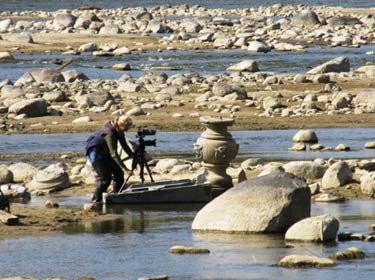
A recent major drought in Poland caused the waters of the River Vistula to recede to levels unprecedented in living memory, revealing tons of architectural masonry looted by the Swedes and loaded onto barges for transport down the river to Gdansk, and thence across the Baltic to Sweden. The invaders’ greed apparently exceeded their navigational judgment, and one or more of the barges sank in the river, possibly as the result of overloading.
Low rainfall over the past few months has brought the Vistula, Poland’s longest river, to its lowest level since regular records began 200 years ago. …
Historians believed that the Swedes who invaded Poland in the 17th century planned to move the looted cargo up the Vistula to Gdansk, where the river joins the Baltic Sea, and from there transport it home. There is still no firm explanation of why the boats sank on the way.
Kowalski said he and his team had so far located up to 10 tonnes of stonework, but this was only the beginning. “The boats had a capacity of 50-60 tonnes (each), so we think that we should find much more,” he said.
Once it has been removed from the river bed and catalogued, the plan is to take the masonry to Warsaw’s Royal Castle, one of the sites from which, historians believe, it was looted by the Swedish invaders.
For now though, the low water levels that revealed the artefacts are hampering efforts to retrieve them. Regular lifting equipment would sink into the mud, but the river is too low for the researchers to bring in floating cranes.
“We need to wait until it gets higher,” Kowalski said.
——————————-
Gość Warszawski [Warsaw’s Guest] has a slideshow
A moving and nostalgic video which adds a musical background to 19th century hand-colored sketches of palaces and manor-houses in the former Grand Duchy of Lithuania (today’s Lithuania and Belarus) by the artist Napoleon Orda. Orda’s drawings record the romantic architecture of an aristocratic world swept out of existence by Revolutionary violence and totalitarianism.
The “Eastern Borderlands” is a translation of the Polish word kresy.
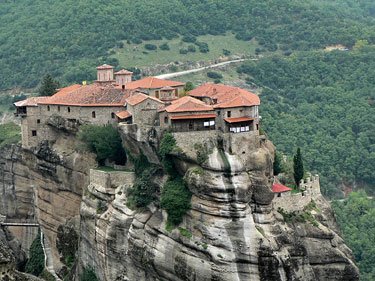
Greek Orthodox monks built 20 monasteries atop rock pillars at Meteora overlooking the Thessalian Plain, from the 10th to the 16th century, in order to get away from Byzantine politics and raiding Turks.
Wikipedia says:
Access to the monasteries was originally (and deliberately) difficult, requiring either long ladders lashed together or large nets used to haul up both goods and people. This required quite a leap of faith – the ropes were replaced, so the story goes, only “when the Lord let them break”. In the words of UNESCO, “The net in which intrepid pilgrims were hoisted up vertically alongside the 373 metres (1,224 ft) cliff where the Varlaam monastery dominates the valley symbolizes the fragility of a traditional way of life that is threatened with extinction.” In the 1920s there was an improvement in the arrangements. Steps were cut into the rock, making the complex accessible via a bridge from the nearby plateau. During World War II the site was bombed. Many art treasures were stolen.
Until the 17th century, the primary means of conveying goods and people from these eyries was by means of baskets and ropes.
Six of the monasteries remain today. Of these six, four were inhabited by men, and two by women. Each monastery has fewer than 10 inhabitants. The monasteries are now tourist attractions.
All that remains now of the former splendid edifice is the famous archway. Latest scientific investigations clearly prove that it was originally erected as a quadrifrons (Greek tetrapylon), a monument with pillars and four archways, which was built from 354 to 361 AD as a triumphal arch in honour of Emperor Constantius II and which rose protectively over the statue of the Emperor.
The name ‘Heidentor’ dates from the Middle Ages when the archway was thought to have been erected by non-Christians and was therefore called ‘heydnisch Tor’ (heathen gate).
Czocha Castle began as a stronghold, on the Czech-Lusatian border. Its construction was ordered by Wenceslaus I of Bohemia, in the middle of 13th century (1241–1247). In 1253 castle was handed over to Konrad von Wallhausen, Bishop of Meissen. In 1319 the complex became part of the dukedom of Henry I of Jawor, and after his death, it was taken over by another Silesian prince, Bolko II the Small, and his wife Agnieszka (see Duchy of Silesia). Origin of the stone castle dates back to 1329.
In the mid-14th century, Czocha Castle was annexed by Charles IV, Holy Roman Emperor and King of Bohemia. Then, between 1389 and 1453, it belonged to the noble families of von Dohn and von Kluks. Reinforced, the complex was besieged by the Hussites in the early 15th century, who captured it in 1427, and remained in the castle for unknown time (see Hussite Wars). In 1453, the castle was purchased by the family of von Nostitz, who owned it for 250 years, making several changes through remodelling projects in 1525 and 1611. Czocha’s walls were strengthened and reinforced, which thwarted a Swedish siege of the complex during the Thirty Years War. In 1703, the castle was purchased by Jan Hartwig von Uechtritz, influential courtier of Augustus II the Strong. On August 17, 1793, the whole complex burned in a fire.
In 1909, Czocha was bought by a cigar manufacturer from Dresden, Ernst Gutschow, who ordered major remodeling, carried out by Berlin architect Bodo Ebhardt, based on a 1703 painting of the castle. Gutschow, who was close to the Russian Imperial Court and hosted several White emigres in Czocha, lived in the castle until March 1945. Upon leaving, he packed up the most valuable possessions and moved them out.
After World War II, the castle was ransacked several times, both by soldiers of the Red Army, and Polish thieves, who came to the so-called Recovered Territories from central and eastern part of the country. Pieces of furniture and other goods were stolen, and in the late 1940s and early 1950s, the castle was home to refugees from Greece (see Greek Civil War). In 1952, Czocha was taken over by the Polish Army. Used as a military vacation resort, it was erased from official maps. The castle has been open to the public since September 1996 as a hotel[1] and conference center. The complex was featured in several movies, including a popular 1963 comedy, Gdzie jest general? (Where is the General?) and The Legend, Beyond Sherwood Forest, Secret Cipher Fortress, Spellbinder.
Looks like a good site for filming Prisoner of Zenda to me.