27 Jun 2013
Sobieski Lancers
Arms and Armor, Horses, Poland, Polish Cavalry

King John (Sobieski) Lancers of the 20th Uhlan Regiment demonstrate old-fashioned weapons and equestrian skills.
|
Category Archive 'Arms and Armor'
27 Jun 2013
Sobieski LancersArms and Armor, Horses, Poland, Polish CavalryKing John (Sobieski) Lancers of the 20th Uhlan Regiment demonstrate old-fashioned weapons and equestrian skills. 17 Apr 2013
Chinese SwordsArms and Armor, China, Francis Boyd, Swords, Technology
Collectors Weekly visits swordmaker Francis Boyd, learns the difference between Damascus layered and wootz steel, and gets to see a sword gifted in China by Marco Polo (or a close relative).
Read the whole thing. 24 Oct 2012
Bayonets, Horses, Subs, and Carriers2012 Election, Arms and Armor, Barack Obama, Bayonets, Horses, US Military, US Navy
“You mention the Navy, for example… That we have fewer ships than in 1916. … We also have fewer horses and bayonets because the nature of our military has changed. We have these things called aircraft carriers, where planes land on them. We have these ships that go underwater, nuclear submarines. So the question is not a game of Battleship where we are counting ships. It’s what are our capabilities?†Donald Sensing points out that he’s completely wrong about the bayonets.
———————- The President was right on the basic fact that the US military, decades ago, replaced horse cavalry with mechanized infantry, armour, and helicopters, but his statement is inevitably undermined by the generally well-known fact that when US military forces were obliged to operate in Afghanistan, it was found that horse-mounted soldiers were essential. US Special Operations Forces have consequently resumed training in horse-back riding at Fort Bragg. So, though the US military hasn’t today got as many horses as it had in 1916, it actually has more horses than it had in 1986.
———————- The President’s choice of submarines and aircraft carriers as a conceptual alternative to Mr. Romney’s larger number of ships than in 1916 (245) is particularly ironic when viewed in the light of the Obama Administration’s drastic plans to reduce both. The Obama Administration, for example, plans to allow US attack submarines (the contemporary equivalent of the kind of submarines we had in 1916*) to bottom out at 40. In 1916, we had 44. By the end of WWI, we had 80 submarines. *as opposed to ballistic submarines, used as launch platforms for ballistic missiles. With respect to aircraft carriers, the Obama Administration’s plans to reduce the current 11 US aircraft carriers down to 9. (Comparisons of carriers with 1916 are not possible, as aircraft carriers did not yet exist.) It is typical of Barack Obama’s rhetorical opportunism to try to exploit as examples of military strength, capability, and advanced thinking, some of the same portions of the Naval Fleet that he has actually dramatically cut. 03 Apr 2012
Robert E. Lee’s Sword Being Moved to AppomattoxArms and Armor, Civil War, Museum of the Confederacy, Robert E. Lee, Sword
The Museum of the Confederacy in Richmond is planning to re-locate a presentation sword made in Paris by Louis-Francois Devisme* as a gift to General Robert E. Lee to a new museum branch located at Appomattox, the site of Lee’s surrender in April of 1865. Future museum branches are planned for Hampden Roads and the Fredericksburg area. Lee naturally remained in possession of his sword after the surrender at Appomattox in accordance with General Grant’s generous terms which allowed Confederate officers to retain their sidearms. The Lee family loaned the sword to the museum in 1918, and permanently bequeathed it in 1982. —————————————- *Louis-François Devisme, gunmaker and inventor, is recorded in Paris between 1843 and 1870, first at 12 rue de Helder and then (ca 1850) at 36 Boulevard des Italiens. He is remembered today principally for the highly decorated pieces produced for a succession of Paris Exhibitions, and for the Great Exhibition in London in 1851 at Crystal Palace, for which he was awarded numerous medals. He ranks as one of the most accomplished of the 19th-century Parisian arms makers. —————————————-
15 Sep 2011
Very Neat Escape Tools From German PrisonsArms and Armor, Escape Tools, Germany, Knives, Photography
More neat and ingenious items. Hat tip to Marc Steinmetz Photography via NothingVia. 23 Jun 2011
Bernard Levine, Harvard ’69 (!)Arms and Armor, Bernard Levine, Books, Harvard, KnivesLevine’s Guide to Knives & Their Values Who would have imagined that Knife Collecting guru Bernard Levine is a Harvard ’69 dropout, who became an expert on knives as a way of surviving in the city on the Bay back in the era of the Summer of Love? Harvard Magazine reveals all:
Hat tip to Walter Olson. 12 Sep 2010
Robert Waldorf Loveless (January 2, 1929 – September 2, 2010)Arms and Armor, Bob Loveless, Custom Knives, Obituaries, Obituaries, Robert W. Loveless
America’s greatest custom knife maker and most influential designer, Bob Loveless, passed away recently at the age of 81 of lung cancer. I’ve never owned a Loveless knife. I called Bob Loveless once about 20 years ago and asked to purchase his catalogue. He offered to send me one, but assured me it was basically pointless. His waiting list was somewhere beyond 6 years. He charged (at that time) a cool $100 an inch for a knife, and there was an extra charge for a Naked Lady stamp. Both for the frontal and rear versions. I remember asking him if he charged extra not to put that on a knife, and he laughed. “Most of my customers are rich, vulgar guys, who absolutely love it.” he assured me. He proceeded to explain that he thought it was a pity that people who actually wanted to use them couldn’t afford to buy them and that the enormous wait made every knife a financial opportunity for the buyer. But he liked making that much money, he conceded. It was kind of a shame that the excellence of Loveless’s designs propelled within his lifetime his products into a stratospheric world of high-end collecting, but admirers could at least console themselves that Loveless spawned a nearly infinite number of imitators and copies of Loveless patterns could be found by the score, some made by bladesmiths collectible in their own right as well as by mass market cutlery companies. Like a lot of artists, Bob Loveless was an extremely smart guy and a colorful rascal. He will be missed. Local LA Times obit Wall Street Journal article Wikipedia article A Loveless dealer website
21 Feb 2010
Skeet Shooting With a TankAmusement, Arms and Armor, Artillery, Entertaining Commercials, Skeet, Skeet and Trap, TankAn Australian “Carlton Dry Dreams” commercial for Carlton Dry beer. 0:59 Video I think what they are doing is actually closer to Trap Shooting, but…. 16 Feb 2010
Marine Corps Using New Rounds in AfghanistanAfghanistan, Arms and Armor, Geneva Convention, Guns, SOST, Trophy Bonded Bear Claw, USMC
The Navy Times reports that the Marine Corps will be issuing 5.56mm ammunition loaded with 62 gr. “SOST” (Special Operations Science and Technology) bullets, a version of the Trophy Bonded Bear Claw bullet invented by Jack Carter in 1985.
Since al Qaeda and the Taliban are not signatories to the Geneva Convention and because the United States never ratified Protocols I and II of 1977, a non-expansive interpretation of US obligations would permit the use of hollow point projectiles, but TBBC bullets are not actually hollow points. As Bartholomew Roberts explains here:
In fact, though TBBC bullets do expand, they expand and fragment less than partition bullets commonly used in hunting. 30 Jan 2010
Roman Army KnifeArchaeology, Arms and Armor, Design, Fitzwilliam Museum, History, Rome, Swiss Army Knife, Technology
How old is the Swiss Army Knife? Conventional wisdom would hold that the multi-tool pocket knife was invented by Karl Elsener in Ibach Schwyz in 1896. But as this Daily Mail feature article proves, the idea of a folding knife incorporating additional tools is much, much older.
08 Sep 2009
Enthusiast Testing Replica Cannon Accidentally Hits Neighboring HouseArms and Armor, Artillery, Bizarre, Cannon, Cannonball, Hoplophobia, Pennsylvania, Pennyslvania
54-year-old William Masur, a resident of Georges Township, Fayette County, Pennsylvania (about 35 miles/56 km. southeast of Pittsburgh) is an arms collector, a historical reenactor, and an enthusiast who also builds replicas of antique arms. Last Wednesday, Masur was testing an 80lb/36.4 k. replica of a French and Indian War cannon firing a 2 lb./.9 kg. projectile. Unhappily, the cannonball hit a rock and ricocheted into the side of a house 400 yards/366 m. away. The cannonball penetrated an exterior wall breaking a window in the process, passed through another wall inside the house, and ended up in a closet. Fortunately, no one was injured. Masur apologized for the mishap, and promised to stop testing his replicas anywhere remotely near human habitations, but as the original story from the Pittsburgh Post-Gazette indicates, official reaction was swift. The replica cannon was confiscated, and Masur was charged with reckless endangerment, criminal mischief, and disorderly conduct. All the facile hoplophobic condemnation from the mainstream media provokes in me a certain sympathy for Mr. Masur. Doubtless the accident was a very unfortunate thing, and someone certainly could conceivably have been killed or injured (in which case Mr. Masur would have had some very serious liability problems). Realistically though, it seems obvious to me that the cannonball’s ricochet was fairly improbable. Its then actually hitting a house was even more unlikely, and so on. On the whole, I’d really rather live in a country in which eccentric people are free to do unusual things like firing off cannons, even if that involves some modest risk of misadventure, than live swaddled in so much safety that anything fun, adventuresome, and entertaining to do is utterly precluded by law. 0:57 video 13 Apr 2009
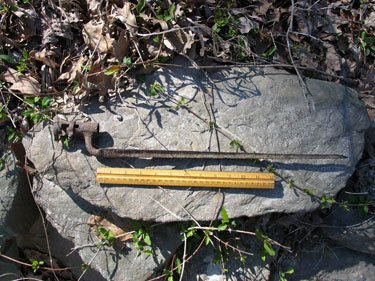
A Confederate Veteran of the Civil War1853 Pattern Enfield Bayonet, Arms and Armor, Civil War, Confederate Bayonet, Snickers Gap, Virginia
This Pattern 1853 Enfield Rifle-Musket bayonet was found by a neighbor of mine in 2004 lying on the west side of a stone wall in Snickers Gap overlooking the east entrance to the pass. It is probably a Confederate bayonet since, though 1853 Enfield rifles were used by units on both sides during the American Civil War, the Enfield was much more widely used by Southern forces and represented the primary Confederate long arm. From its position, it had to have been dropped by a soldier positioned behind the wall looking east, which means that, most likely, the bayonet was dropped by a Southerner defending the pass as the Union Sixth Corps under Horatio Wright, July 16-17, 1864, pursued Jubal Early‘s Army of the Valley District in its retreat through the pass following its victory at Monocacy on July 9th and unsuccessful probe of the defenses of Washington on July 11-12. Its owner probably drew the bayonet, and not wanting to make his 55 inch (1.397 m.) long rifle even longer and more unwieldy in a brushy wooded location until necessary, placed it ready for rapid use on the wall by his firing position. But Northern infantry or Duffie‘s cavalry advanced faster and in greater numbers than he had anticipated, and the Confederate was forced to make a run for it so quickly that he did not have time to bother trying to pick up his bayonet. His pursuers clambered over the wall, knocking the abandoned bayonet to the ground and dislodging several of the upper stones which fell down and covered it. Those fallen rocks protected it from the elements and significantly reduced the amount of oxidation that might have been expected over the 140 year interval before it was recovered. Welcome to
NEVER YET MELTED
Another Right-Wing Web Aggregator and Purveyor of Unpopular Opinions
 David Zincavage contact: jdz@usa.net blog advertising is good for General Bullmoose and good for the USA. 


Feeds
|


 is a key reference in any collector’s library and Bernard Levine’s earlier
  is a classic book on a very special subject.