Category Archive 'Auction Sales'
03 Jun 2015

A ROMAN GOLD AND GARNET WINGED THUNDERBOLT PENDANT
CIRCA 1ST CENTURY A.D.
From Christie’s.
01 Jun 2015


Profiles in History, Calabasas, CA, June 11, 2015, 11:00 AM PST, Lot 164:
Estimated Price: $60,000 – $80,000
General George Patton’s personally owned Colt .45 revolver with original stag horn grips, Pat. Sept.19.1871,. July2.72, Jan.19 75. Serial # is 351427, ca. 1928, with the vast majority of the blue finish fully intact. Excellent condition. General George S. Patton, Jr.’s Colt .45 single-action revolver – directly from Patton’s grandson, Robert H. Patton. This Colt .45 Model 1871 single-action revolver (Serial No. 351427) was acquired by George S. Patton, Jr. around 1928 and owned by him throughout the remainder of his life, along with his famous ivory-handled Colt .45 revolver that is today on display at The General George Patton Museum and Center of Leadership in Fort Knox, Kentucky. Patton was photographed carrying this weapon at least once – while dressed as Rhett Butler at a “Gone With the Wind†costume party which he attended with his wife, Beatrice (ca. 1941). The event is referenced on page 314 in the personal memoir, The Button Box, written by Patton’s daughter, Ruth Ellen Patton Totten. The photograph is included in Patton: The Man Behind the Legend, by Martin Blumenson (p. 148). The weapon was positively identified in the photograph by matching the original stag horn grip (the natural texture of which being absolutely unique), visible above Patton’s belt at the 1941 costume party. A Colt .45 single-action revolver (ca. 1928) in this condition, with original stag horn grips – without the Patton ownership heritage – has an appraised value of $16,200 (Blue Book of Gun Values, 17 March 2015). To the best of our knowledge, no other Patton personal Colt revolver with documentation from the Patton family has ever come to market. Interested bidders should note that this is a working firearm and must be shipped through a Federal Firearms Licensed dealer. Provenance: This Colt revolver comes directly from Robert H. Patton, grandson of the legendary WWII General, and includes a signed letter of authenticity stating in part: “…the Colt .45 model single-action revolver shown below, serial number 351427, belonged to my grandfather, General George S. Patton, Jr…The pistol was given to me by my father, General George S. Patton IV, nearly 30 years ago. It was purchased by his father, the General of WWII fame, in 1928. This pistol, with the fancy stag horn grip, was undoubtedly a version of his more famous ivory-handled Colt .45 now on exhibit at the Patton Museum and West Point. Patton owned and used this gun for about 17 years.â€
Nice grips.
13 May 2015
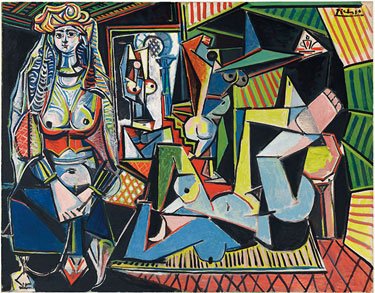
Visual News:
An anonymous buyer has just paid an astounding $179.36 million for Pablo Picasso’s 1955 painting Les femmes d’Alger (Version “Oâ€), putting it in top position in the world of very expensive artworks. The painting last sold in 1997 for a paltry $31.9 million.
Olivier Camu, Christie’s Deputy Chairman of Impressionist and Modern Art had these insights on the paintings history:
“Les femmes d’Alger, (Version “Oâ€) is the culmination of a herculean project which Picasso started after Matisse’s death, in homage to his lost friend and competitor, and which over a period of two months and after nearly 100 studies on paper and 14 other paintings led to the creation of this canvas in February 1955. Picasso painted a series of 15 variations on Delacroix’s Les femmes d’Alger, designated as versions A through O. Throughout his series, Picasso references the Spanish master’s two versions of the shared subject, intermingling their elements.â€
All of which shows that even the super-rich are not always financially sensible.
Is “Les femmes d’Alger” even arguably the greatest painting in the history of Western art? Not really. Is it even the greatest of all Picassos? Not really.
30 Apr 2015
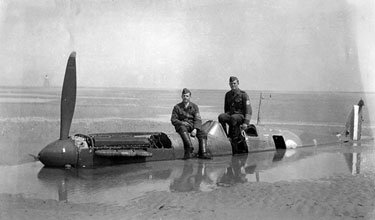
German soldiers sitting on the wreckage of Spitfire P9374, May, 1940.
The Mirror:
One of the first Spitfires ever made has gone up for sale for a staggering £2.5 million after spending 40 years buried in sand at the French beach it crashed on.
The iconic Mark 1 plane was among the first built in March 1940 as Britain scrambled to ready itself for the epic battle that took place in the skies just a few months later.
But Spitfire P9374 never made it to the Battle of Britain as it crash-landed in May 1940.
The fighter plane was being piloted by Flight Officer Peter Cazenove over Dunkirk when it was hit by a single bullet from a German Dornier bomber.
Cazenove, an Old Etonian flying his first combat mission, had no choice but to bring it down on the wet sands at Calais.
Cazenove was captured by the Nazis and taken to the Stalag Luft III prisoner of war camp, famous for ‘The Great Escape’.
His plane became consumed by the sandy beach and there it remained for the next 40 years.
In 1980 the wreckage was discovered when part of it was spotted poking out from its sandy grave.
It was corroded and covered in barnacles but amazingly still in tact. The plane was dragged from the beach and taken to the Mus e de l’Air in Paris.
Eventually it was bought by American billionaire philanthropist Thomas Kaplan, who has had the plane meticulously restored to its original condition by a team of expert engineers.
Mr Kaplan, an Oxford-educated gold trader, owns both of the surviving Mk1 Spitfires.
He has now listed the plane Cazenove piloted for sale through London auctioneers Christies 75 years since the Battle of Britain with an estimate of £2.5 million.
He plans to donate the proceeds to the RAF Benevolent Fund and wildlife charity Panthera.
—————————————————-
Don’t miss the grand presentation, complete with videos, from Christie’s.

Flight Officer Peter Cazenove
28 Mar 2015

If you have deep pockets, Rock Island Auctions will be auctioning one of these on April 25th.
21 Jan 2015

Jim Corbett’s the best quality boxlock W.J. Jeffery & Co. .450-400 double rifle, with which he killed so many man-eating tigers for the Indian government (Elmer Keith Estate Coll.).
Jim Corbett described using that .450/400 Jeffrey to slay the Thak Man-Eater at about 6:00pm on November 30, 1938, in “Man-Eaters of Kumaon”:
The tigress was now so close that I could hear the intake of her breath each time before she called, and as she again filled her lungs, I did the same with mine, and we called simultaneously. The effect was startingly instantaneous. Without a second’s hesitation she came tramping and then she stepped right out into the open, and, looking into my face, stopped dead. Owing to the nearness of the tigress, and the fading light, all that I could see of her was her head. My first bullet caught her under the right eye and the second, fired more by accident than with intent, took her in the throat and she came to rest with her nose against the rock. The recoil from the right barrel loosened my hold on the rock and knocked me off the ledge, and the recoil from the left barrel, fired while I was in the air, brought the rifle up in violent contact with my jaw and sent me heels over head right on top of the men and goats. Once again I take my hat off to those four men for, not knowing but what the tigress was going to land on them next, they caught me as I fell and saved me from injury and my rifle from being broken.â€
This was the last man-eater killed by Corbett.
—————————-
Elmer Keith died in 1984 and now, thirty years later, the famous writer’s personal firearms collection is finally appearing for sale in James D. Julia’s March 15th, 16th & 17th Firearms Auction.
Not many of us will be able to afford to own any of the highlights of the Keith Collection, but it’s certainly worth looking at the on-line catalog and imagining what you’d do if you won the Irish Sweepstakes in time to bid.
Here are two examples, either of which would be very difficult to top for historical significance and associations.
Hamilton Bowen will build you an unengraved replica (on a Ruger action) of Elmer Keith’s No. 5 .44 Special SA for a mere $4495.00. How high can the original possibly go? Six figures would not surprise me.
————————————–

“The most influential custom handgun ever made!” Elmer Keith’s own No. 5 Colt SA in .44 Special built in 1927 as “the last word in sixguns.”
27 Dec 2014
Christie’s bullshit is so totally audacious that the listener’s mind boggles at the notion that anyone with that kind of money would be stupid enough to buy it.
*And do note the spelling error!
Daily Paywall (not working today, but quoted by Fred Lapides) was appropriately skeptical.
Among the many records set at Christie’s astonishing $852.9m contemporary art sale in New York…, one has so far gone strangely unreported; the highest price ever paid for a urinal.
Robert Gober’s 1988 installation Three Urinals sold for $3.52m, which works out at just over $1m per urinal. They do not actually work – that is, they only take the proverbial in a figurative sense. But this is a good thing, for according to Christie’s their “smooth contours invite the viewer’s touchâ€, and hand sanitiser was not included in the price.
That a urinal by an artist you have probably never heard of is worth more than a masterpiece by one you have (a Gober urinal will buy you a fine Rubens) is down to the unique way in which the contemporary art world functions. There, the merit of works such as Gober’s is not judged in any traditional and objective artistic sense, but by value.
Expensive, say the experts, equals good. After all, Three Urinals is indistinguishable from three actual urinals except by virtue of its price, and several paragraphs of impenetrable art-speak in a catalogue. And if Gober’s urinals are worth $3.5m, then one of his sinks (he does a whole range of toilet ware) must also be worth millions.
In other words, we have collectively lost the ability to assess art for ourselves and on its own merits. Instead, we follow such indicators as fashion, price, and, in this case, hype. You may say it was ever thus. But the result today, when allied with an ever wealthier elite for whom buying contemporary art has become a form of conspicuous consumption, is an unprecedented art boom. Can it last?
Normally, speculative bubbles end when an underlying financial reality hits home. The subprime boom ended when homeowners stopped making repayments. But in the art world there are few such constraints. The only requirement is that works keep edging up in value.
Read the whole thing.

Robert Gober, Three Urinals, 1988. Sold for $3.52 million on 12 November 2014.
11 Dec 2014

Italia Living:
[A] record-setting 4.16-pound [1.8869 k.] white truffle [Tuber magnatum] found by Sabatino Truffles in Umbria, Italy, has sold for $61,250 at a New York City auction.
Sotheby’s says the fungus was sold Saturday to a food and wine lover from Taiwan bidding by phone.
The firm had said it turned down million-dollar offers from buyers in China. Instead, it chose to auction the truffle in New York to benefit Citymeals-on-Wheels and the Children’s Glaucoma Foundation.
Sabatino Truffles spokeswoman Jane Walsh had said the truffle was slightly smaller than an American football. She says the average white truffle that’s unearthed is about the size of a walnut.
Sotheby’s says the previous largest white truffle ever found was 2.5 pounds [1.1339 k.].
Via Ratak Monodosico.
13 Nov 2014

Lot 103. Colt Single Action Army Frontier Six Shooter Revolver Owned And Carried By Harvey “Kid Curry” Logan Of Butch Cassidy’s Wild Bunch
Amoskeag Auction Company, Sale No. 104, November 22nd & 23rd, 2014, Lot 103, Estimate: $50,000-75,000.
Harvey Logan, “Kid Curry†originally rode with the Black Jack Ketchum gang, formed his own gang sometime in 1897 and eventually wound up with Butch Cassidy and The Wild Bunch. He was described as “the wildest of the Wild Bunch†and before his career would end he had purportedly killed nine peace officers and two other men in an about 10 year career. While he was described by William Pinkerton (Pinkerton Detective agency) as having “not one single redeeming feature, he is the only criminal I know of who does not have one single good pointâ€, he was evidently always kind to the ladies; in fact would often spend his “take†from the Wild Bunch robberies laying up in brothels with friendly ladies and good liquor, until his share was exhausted. Logan rode with Butch and Sundance until they left for Buenos Aires in early 1901. In July of that year Curry, “Tall Texan†Ben Kilpatrick and “Deaf Charlie†Hanks decided they would rob the Great Northern Railroad Coast Flyer No. 3. This they did on July 3, very professionally and well, Logan commandeering the engine with engineer and fireman intact. The train was stopped a few miles outside of Malta Montana, engineer Thomas Jones was made to disconnect the baggage and express cars from the passenger cars and pull the train forward some miles. When safely away from the other train cars, Logan commanded the mail clerk and express messenger, each a Jimmy Martin and a C.H. Smith, to open the express car doors and jump out telling them he would not hurt them, Logan saying all he wanted was “Jim Hill’s money†(Hill being the president of the railroad). The men did so and, although it took three attempts, the outlaws blew the safe open and gathered their loot, amounting to 800 sheets of banknotes, each with four notes each of $10 and $20 denominations. They also took about $500 in notes from the American National Bank of Helena, a package of watches and a bag filled with silver coins, all told about $40,000. As the trio was leaving express messenger C.H. Smith hollered to Logan that he wanted his Colt pistol. When Logan asked him “what for young fellow†he told him as a souvenir of the day, Logan obliged by emptying the revolver into the air and tossing it to Smith saying “thanks for your helpâ€. Logan would later be captured in Knoxville Tennessee in 1902 and during his trial for the train robbery, eyewitness testimony, from the train’s fireman M.F. O’Neal and C.H. Smith himself both related the incident identically, of the outlaw emptying his gun and tossing it to the young express messenger. … The backstrap is very neatly engraved in small script, during the period of use, showing appropriate oxidation and wear from the years: “This pistol was given to me “C H Smith G.N. Ex. Mess†by Harvey Logan during train robbery July 1, 1901â€.

Della Moore with Harvey Logan
11 Nov 2014

Ebay lot 381041066398 was sitting there at $230.00 on Saturday as the auction drew toward its close at 8:27 pm. I had just bought a rifle on Gun Broker, so I was feeling a need for some restraint, but I certainly was not going to let this sell for $230.00 without bidding a bit higher. So I left an Esnipe bid somewhere near $300.
It’s impossible to tell what some auctions are going to do in their final moments, when all the snipers open fire. You can bid double the current bid sometimes and still find that you came in too low. I had no idea what this dagger would fetch. It was obviously worth a great deal more than $230, but beyond that I hadn’t a clue.
It sold, as things turned out, for $599.90, and I still think it was worth much more than that.
————————-
The seller described it as an “Old antique Italian Hunting knife/dagger SUPER NICE RARE.”
You are bidding on an antique Italian hunting knife. This is an exceptional example well made and well preserved. It probably dates from the first half of the 19th century. It is large 15-1/2 inches long, solid blade 11 inches long with two decorative fullers and mirror engraved images as well as a small section of brass inlay, the blade is 2 inches wide at the base. The handle is made from wood with two decorative brass side grips and a very interesting tang section that can be seen on the back. Nice file work on the mid section. Super nice knife.
But, what was it really?
I looked through George Cameron Stone’s A Glossary of the Construction, Decoration and Use of Arms and Armor in All Countries and in All Times, Together with Some Closely Related Subjects, and my conclusion is that it was an anelace aka anelec aka anlace, a long dagger variation of the cinquedea featuring a triangular double-edged blade tapering sharply to a point: used from the 13th to the 16th centuries. This weapon was often carried at an angle at the small of the back and would be the only weapon carried in cities, at court, traveling on horseback or riding during the hunt, also used to slide between the plates of platemail armour.
It does not look old enough to me to be 16th century. It has an 18th century look to me. But, I suppose, it might have been an extremely high quality 19th century reproduction.
26 Nov 2013

Also in the December Maine Antiques Digest Letter from London, sold at the 18-19 September last Sale 1186, the Collection of architect and scholar Professor Sir Albert Richardson, P.R.A., a patriotic Georgian Pearlware chamberpot, painted on the exterior with a band of ochre leaves within brown trailing circular branches and bands, and featuring within a bust of Napoleon accompanied by the motto: PEREAT. Let Him Perish!
The item, Lot 271, estimated to bring £400 – £600 ($610 – $900), actually fetched a whopping price of £6,250 ($10,081), despite a (repaired) crack across, a chip, and more than one riveted repair.
26 Nov 2013

Maine Antique Digest runs a monthly Letter from London column which describes some of the more interesting items appearing in recent sales.
At Sotheby’s “Art of Imperial India” sale, London, October 9th last, was sold a captured and re-hilted British sword decorated with the bubri symbol of Tipu Sahib, “the Tiger of Mysore,” one of the most formidable enemies of British rule in India, slain finally defending his own fortress at the Siege of Seringapatam in 1799.
Tipu is quoted as saying: “Better to die like a soldier than live a miserable life dependent on the infidels… I would rather live two days as a tiger, than two hundred years as a sheep.”
Interestingly, this sword was not taken at Seringapatnam, as it comes from the estate of Sir Charles Malet, Bart., who had left India a year before the siege. It was probably a trophy of the Third Anglo-Mysore War.
The sword sold for $157,695 (98,500 GBP). Lot 249.

Your are browsing
the Archives of Never Yet Melted in the 'Auction Sales' Category.
/div>

Feeds
|




