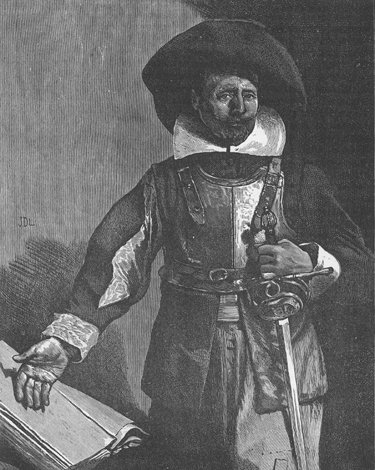
Mr. Valiant-for-truth (illustration by Frederick Barnard)
from John Bunyan’s The Pilgrim’s Progress from This World, to That Which Is to Come; Delivered under the Similitude of a Dream., Second Part, 1684:
Then they went on; and just at the place where Little-Faith formerly was robbed, there stood a man with his sword drawn, and his face all over with blood. Then said Mr. Great-Heart, Who art thou? The man made answer, saying, I am one whose name is Valiant-for-truth. I am a pilgrim, and am going to the Celestial City. Now, as I was in my way, there were three men that did beset me, and propounded unto me these three things: 1. Whether I would become one of them. 2. Or go back from whence I came. 3. Or die upon the place. [Prov. 1:11-14.] To the first I answered, I had been a true man for a long season, and therefore it could not be expected that I should now cast in my lot with thieves. Then they demanded what I would say to the second. So I told them that the place from whence I came, had I not found incommodity there, I had not forsaken it at all; but finding it altogether unsuitable to me, and very unprofitable for me, I forsook it for this way. Then they asked me what I said to the third. And I told them my life cost far more dear than that I should lightly give it away. Besides, you have nothing to do thus to put things to my choice; wherefore at your peril be it if you meddle. Then these three, to wit, Wild-head, Inconsiderate, and Pragmatic, drew upon me, and I also drew upon them. So we fell to it, one against three, for the space of above three hours. They have left upon me, as you see, some of the marks of their valor, and have also carried away with them some of mine. They are but just now gone; I suppose they might, as the saying is, hear your horse dash, and so they betook themselves to flight.
GREAT. But here was great odds, three against one.
VALIANT. ‘Tis true; but little and more are nothing to him that has the truth on his side: “Though an host should encamp against me,” said one, [Psa. 27:3], “my heart shall not fear: though war should rise against me, in this will I be confident,” etc. Besides, said he, I have read in some records, that one man has fought an army: and how many did Samson slay with the jawbone of an ass!
GREAT. Then said the guide, Why did you not cry out, that some might have come in for your succor?
VALIANT. So I did to my King, who I knew could hear me, and afford invisible help, and that was sufficient for me.
GREAT. Then said Great-Heart to Mr. Valiant-for-truth, Thou hast worthily behaved thyself; let me see thy sword. So he showed it him.
When he had taken it in his hand, and looked thereon awhile, he said, Ha, it is a right Jerusalem blade.
VALIANT. It is so. Let a man have one of these blades, with a hand to wield it, and skill to use it, and he may venture upon an angel with it. He need not fear its holding, if he can but tell how to lay on. Its edge will never blunt. It will cut flesh and bones, and soul, and spirit, and all. [Heb. 4:12.]
GREAT. But you fought a great while; I wonder you was not weary.
VALIANT. I fought till my sword did cleave to my hand; and then they were joined together as if a sword grew out of my arm; and when the blood ran through my fingers, then I fought with most courage.
GREAT. Thou hast done well; thou hast resisted unto blood, striving against sin. Thou shalt abide by us, come in and go out with us; for we are thy companions. Then they took him and washed his wounds, and gave him of what they had, to refresh him: and so they went together. Now, as they went on, because Mr. Great-Heart was delighted in him, (for he loved one greatly that he found to be a man of his hands.) …
————————
Then it came to pass a while after, that there was a post in the town that inquired for Mr. Honest. So he came to the house where he was, and delivered to his hand these lines: Thou art commanded to be ready against this day seven-night, to present thyself before thy Lord at his Father’s house. And for a token that my message is true, “All the daughters of music shall be brought low.” Eccles. 12:4. Then Mr. Honest called for his friends, and said unto them, I die, but shall make no will. As for my honesty, it shall go with me; let him that comes after be told of this. When the day that he was to be gone was come, he addressed himself to go over the river. Now the river at that time over-flowed its banks in some places; but Mr. Honest, in his lifetime, had spoken to one Good-conscience to meet him there, the which he also did, and lent him his hand, and so helped him over. The last words of Mr. Honest were, Grace reigns! So he left the world.
After this it was noised abroad that Mr. Valiant-for-truth was taken with a summons by the same post as the other, and had this for a token that the summons was true, “That his pitcher was broken at the fountain.” Eccl. 12:6. When he understood it, he called for his friends, and told them of it. Then said he, I am going to my Father’s; and though with great difficulty I have got hither, yet now I do not repent me of all the trouble I have been at to arrive where I am. My sword I give to him that shall succeed me in my pilgrimage, and my courage and skill to him that can get it. My marks and scars I carry with me, to be a witness for me that I have fought His battles who will now be my rewarder. When the day that he must go hence was come, many accompanied him to the river-side, into which as he went, he said, “Death, where is thy sting?” And as he went down deeper, he said, “Grave, where is thy victory?” [1 Cor. 15:55.] So he passed over, and all the trumpets sounded for him on the other side.
————————
Mr. Valiant-for-truth’s hymn (19th century revision)
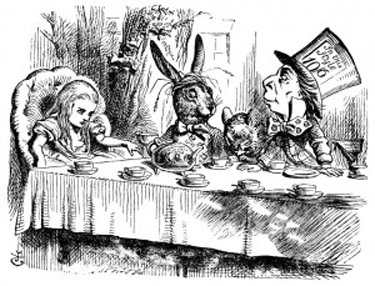
Mallory Ortberg imagines the result if Ayn Rand had written Alice in Wonderland.
If everybody minded their own business,†the Duchess said in a hoarse growl, “the world would go round a deal faster than it does.â€
“Which would not be an advantage,†said Alice, who felt very glad to get an opportunity of showing off a little of her knowledge. “Just think of what work it would make with the day and night! You see the earth takes twenty-four hours to turn round on its axis–â€
“Talking of axes,†said the Duchess, “chop off her head!â€
“You have no right to do that,†Alice said calmly. “The removal of heads does not fall under the purview of government.â€
The Duchess gasped.
“A society that robs an individual of her head,†Alice continued, “or in any way attempts to limit the freedom of her head, is not, strictly speaking, a society, but a mob held together by institutionalized gang rule. You cannot promote the aristocracy of non-value at the expense of individual liberty.â€
The Duchess fell silent.
“I am going to build a railroad here,†Alice said. “There is nothing you can do to stop me.â€
“By the way,†Alice said as she turned to leave, “The appropriate posture of a worthy woman to a worthy man is hero-worship, not in chopping off his head. She never loses the awareness of her own sexual identity and theirs. A properly feminine woman does not treat men as if she were their pal, sister, mother—or leader. There will never be a woman president.â€
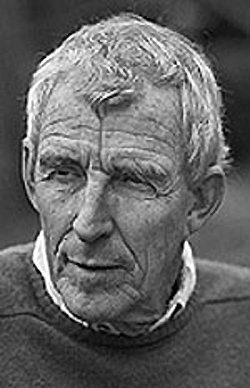
Peter Matthiessen (May 22, 1927 – April 5, 2014)
Jonathan Meiburg managed to get in a last interview with Peter Matthiessen shortly before his death from leukemia last April at age 86.
At first, the cab driver couldn’t find it; the empty fields to the left and the low trees to the right were covered in snow, and there was no looming Hamptons mansion at the end of the road. “I don’t think there’s anywhere else here,†he said. But then it appeared: a modest, low-slung house glimpsed through a tunnel in the trees. As we pulled into the drive, it was clear that Peter Matthiessen’s home for the last six decades wouldn’t be considered a normal home anywhere. An enormous skull—the cranium of a fin whale—was braced against a wall of the house, and clusters of other artifacts rested half-buried in the snow: driftwood, stumps, shells, small boulders, sculptures. I rang the doorbell and no one answered, and for a moment it was completely quiet: rain dripped off a row of icicles hanging from the roof. And then a kindly, deeply lined face peered through the glare in a pane of the front door.
What to say about Peter Matthiessen? There was no one quite like him: a writer and thinker, a naturalist and activist, and a fifty-year student of Zen Buddhism who, as his publicist put it, “lived so large, and so wild, for so long.†He was the only person ever to win the National Book Award for both fiction (Shadow Country, 2008) and nonfiction (The Snow Leopard, 1979), along with a bushel of medals and prizes for his elegant but unsentimental books (of which there are at least thirty), most of which concern the wild places, animals, and people “on the edge,†as he said, of the farthest parts of the globe, where pre-human landscapes and premodern pasts are (or were) still visible.
Above all, Matthiessen followed his own muse, and though he avoided repeating himself, all of his books combine his searching, acerbic intelligence with his gift for evoking landscapes and people, and all are shot through with glimpses of a reality beyond human understanding—a bit like what Werner Herzog calls “ecstatic truth.†It’s a marriage of the dignified and the avant that can make his writing seem, at times, like a really good translation from another language. Both nature writing and what’s now called creative nonfiction owe him a huge debt, though his pure fiction tends to be overlooked (Far Tortuga, the experimental novel that preceded The Snow Leopard, doesn’t get the notice it deserves). …
Inside his house, everything was orderly, earth-toned, and wooden, both genteel and rough-hewn. Photographs of the people of the New Guinean highlands he visited in 1961 (vividly recalled in Under the Mountain Wall: A Chronicle of Two Seasons in Stone Age New Guinea), some of them taken by expedition mate Michael Rockefeller, surrounded a weathered baby grand piano; a pair of binoculars rested on its back on the piano’s lid. Smooth river stones, one of them incised with an elongated face that might be the Buddha’s, lined the sills of tall windows, among potted maidenhair ferns and a blooming Christmas cactus. In the backyard, two wooly-coated deer flecked with ice craned their necks to suck bird seed from a feeder, displacing a little cloud of cardinals and white-throated sparrows.
We sat in a cramped spare room he was using as a study, since the small outbuilding where he’d done the bulk of his writing was losing a battle with mold. He took a swivel chair beside the computer where he was working on yet another book: a memoir. It was a form he regarded with suspicion, and he was still finding its structure, which he compared to the branching leaves of giant kelp. I had to place my recorder close to him to catch his deep, conspiratorial rasp, but there was plenty it didn’t capture: he talked with his face and his hands as much as his voice, widening his eyes in surprise or crinkling them in mirth, fluttering his fingers to dismiss the encrustations of “lush writing†or opening his palms in surrender to a great line of prose. Or he enlisted all his features in sudden imitations of people or animals: an Inupiat pilot swatting a mosquito, a grizzly bear recoiling at the sight of a human, a white shark trying to swallow an outboard motor. The landscape of his creased forehead, wild eyebrows, and silver hair suggested stormy weather, but his eyes were a surprisingly mild, even innocent, blue. Only a month before his death, at the age of eighty-six, he was still clearly the man from the jacket flap of The Snow Leopard, and his memory for the smallest details of books he wrote half a century ago was ironclad. The pad of his right thumb was stained with green ink.
A great interview moment:
PM: My great question, I would say, comes from Turgenev, from Virgin Soil. One of the characters kills himself, but he leaves a note, and the note says: “I could not simplify myself.†[Drops jaw] Boy, that’s like that Akhmatova line, the epigraph from In Paradise—
BLVR: “Something not known to anyone at all—â€
PM: “—but wild in our breast for centuries.†Yes, you know. Oh! [Groans as if smacked in the chest] I know that feeling so well. It’s been my great, great aim in life, simplification. Total failure.
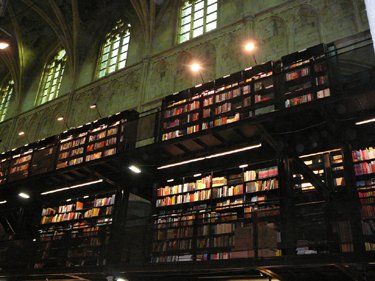
And you won’t be able to visit this Polare Bookstore, formerly located in a 13th Century Dominican Church in Maastricht, Netherlands. Polare went bankrupt last January.
But, even so, gush and misuse of “literally” notwithstanding, I recommend this Buzzfeed feature. I had not known myself that Brattle’s, in Boston, had actually reopened after the disastrous 1980 fire. Had I realized it still existed, I would definitely have dropped in every time I was in Boston.
Linda Grant recently reduced the size of her library. She now feels guilty, but she also knows how to milk another publication out of all this.
It is more than 50 years since I began to build my library from its earliest foundations in the elementary sentence construction of Enid Blyton. Now, at least half of the thousands of books I have bought are gone. It is one of the worst things I have ever done. I hate myself. But not as much as I have come to hate the books. Hate books! A thought-crime at the very least. Only a philistine, a religious zealot, a Nazi would hate books.
It is not the words I hate, not literature, but their physical manifestation as old, musty, dusty, yellowing, cracked objects, heavy to lug around. When I open the pages swarms of black ants dance on the paper. No one told me. No one said: “In the future you will squint and screw up your face and try to decipher these words you once read so easily.” When I look at my books I feel like Alice in the closing pages of Alice in Wonderland, when the cards all rise up and overwhelm her.
When the estate agent came to look at my flat he winced when he saw all those books. What did he see? Clutter. Estate agents do not think that books furnish a room; books make rooms look messy. You would not display the contents of your knicker and sock drawer or your bathroom cabinet with its face creams and cough remedies, so why put off potential buyers with your taste in literature?
In order to market my flat, the books had to be pruned back. At the very least, they would not be permitted to exceed the number of shelves available to house them. So the murder began.
My wife and I have a library of something on the order of 30,000 books. In our prime, we lived in a twenty-odd room 1712 Colonial house which had been enlarged a few generations back into an inn. As old age approached, we found ourselves obliged to uproot ourselves and move all over the country for business reasons. Some books went into storage.
We were finally compelled by the recession to retrench, and are living in retirement at our rural vacation home/hunting camp. Now we have two storage facilities. The nearby one is absolutely immense. It resembles the government facility where the Ark of the Covenant wound up.
Books packed in boxes stand piled high, and there are endless rows of metal library bookcases. The task of unpacking, sorting, and shelving is so intimidating that I go there, poke around, open up a few boxes, and decide to postpone further progress until next time.
The thing is: ironically enough, you can get just about any book published before the 1920s these days in electronic form for free. My entire life has been dominated by a constant effort to acquire and house every book I might need to satisfy an absurdly diverse range of interests and curiosities.
During my boyhood, books were difficult to find, rare, and valuable. So I grew up a book hoarder and idolater. Today, the wisdom of the ages and the complete (out-of-copyright) contents of essentially every research library in the world are a mouse-click away.
In the Wall Street Journal, Stefan Beck re-visits the perennial children’s classic Treasure Island.
One can witness, in scholarship about “Treasure Island,” an urge to study it in a postcolonial or Marxist context. Stevenson would have wanted it read a different way. In “The Day After To-morrow,” he wrote: “Our race has not been strained for all these ages through that sieve of dangers that we call Natural Selection, to sit down…in the tedium of safety…. The bourgeois is too much cottoned about for any zest in living; he sits in his parlour out of reach of any danger, often out of reach of any vicissitude but one of health; and there he yawns.” “Treasure Island” is a paean to risk and peril.
The Crimson did a feature on Harvard’s Anthropodermic items back in 2006.
A few individuals give new meaning to the idea of spending forever in the library—their skin binds three of the books in Harvard’s 15-million-volume collection.
Without extensive genetic testing, Harvard librarians still do not have the “foggiest notion†of how many volumes wrapped in human hide exist throughout the system, says Director of University Libraries Sidney Verba ’53. But they have identified three such volumes in the Langdell Law Library, Countway Library of Medicine, and the Houghton Collection. The three books range in content from medieval law to Roman poetry to French philosophy.
Langdell’s curator of rare books and manuscripts, David Ferris, says of his library’s man-bound holding: “We are reluctant to have it become an object of fascination.†But the Spanish law book, which dates back to 1605, may become just that.
Accessible in the library’s Elihu Reading Room, the book, entitled “Practicarum quaestionum circa leges regias…,†looks old but otherwise ordinary.
Delicate, stiff, and with wrinkled edges, the skin’s coloring is a subdued yellow, with sporadic brown and black splotches like an old banana. The skin is not covered in hair or marked by tattoos—except for a “Harvard Law Library†branding on its spine. Nothing about it shouts “human flesh†to the untrained eye.
The book’s 794th and final page includes an inscription in purple cursive: “the bynding of this booke is all that remains of my dear friende Jonas Wright, who was flayed alive by the Wavuma on the Fourth Day of August, 1632. King Mbesa did give me the book, it being one of poore Jonas chiefe possessions, together with ample of his skin to bynd it. Requiescat in pace.â€
Ferris, who believes the volume was “almost certainly rebound†after its initial assembly, sees it as “a kind of memento mori, in the spirit of rings and jewelry made out of the hair of deceased in the 19th century.â€
“While it strikes us as macabre,†the curator says, “it is honoring and memorializing this man.â€
In February 1946, Harvard acquired the tome from a New Orleans rare books dealer for $42.50. “Clem G. Hearsey, New Orleans,†is stamped on the book’s first page. In 1992, DNA tests on the binding’s skin proved inconclusive—the genetic evidence presumably was corrupted by the tanning process. Ferris says “he has never seen a book like this on the market,†and that, without its binding, the book probably values between $500 and $1000, while the skin makes it more valuable.
Jack Eckert, the reference librarian at the Countway Library’s Center for the History of Medicine in Longwood, writes in an e-mail that he believes only one human-skin volume exists in the Countway collection. According to Eckert, the Medical School’s 1597 French translation of Ovid’s “Metamorphoses†bears a small penciled annotation, “Bound in human skin,†on the inside cover.
But Eckert questions the binding’s authenticity. “I think even this is somewhat doubtful as [the book] doesn’t greatly resemble others I’ve seen in the past,†he adds.
Houghton’s associate librarian for collections, Thomas Horrocks, describes the light volume as one of the author’s lesser works.
Notes from a now-missing typed memorandum that once accompanied the book revealed that the binding’s skin comes from “the back of the unclaimed body of a woman patient in a French mental hospital who died suddenly of apoplexy.â€
Houssaye gave the book, printed in the 1880s, to his friend, Dr. Bouland. The doctor, who had the book rebound, included a note expressing his belief that “a book on the human soul merited that it was given a human skin.â€
Given to Houghton in June 1954 by the wife of John B. Stetson, the small book—approximately three by six inches—sports gold trim. Its binding features a greenish-gold hue as well as visible pores.
Anybody who buys used books gets regular spam emails from ABE, usually built around not-terribly-interesting book sale memes. The latest email, however, linked a feature on “the top 100 most searched for out-of-print books in 2013.”
The list is interesting, I thought, demonstrating substantial top end reader demand for the predictable and porny (Madonna), but also for canonical texts (the Harvard Classics), and for tales of glory (Jean Larteguy). The list also demonstrates that commercial publishers are prone to overlook demand in its less obvious manifestations.
The popularity of the commercial inspired British writer Michael Russell to take “J.R. Hartley” as a pen-name, which he used to publish Fly Fishing, Memories of Angling Days in 1991. The book sold remarkably well, and Russell published two more volumes, another fly fishing book and a title in golf, writing as J.R. Hartley.
There are all sorts of reasons to read books. In some cases, we may select our reading matter simply on the basis of its past selection by a reputable and respected publisher.
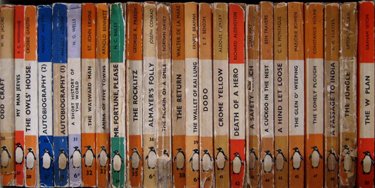
Karyn Reeves has a blog discussing her personal indulgence of reading one older edition (pre-1970) Penguin paperback per week.
I sympathize. I always buy unfamiliar old Penguins myself whenever I run into one with a promising title at a book sale or antiquarian book shop.
——————————
My capricious choice of Penguin cover, I find, was not felicitous. Efandrich wrote a terrific review, well and truly demolishing this one.
Our four characters are sailing the mysterious South Pacific seas, not humming Bali Hai because Rogers and Hammerstein haven’t written the song yet. Anyhow, clever Arnold discovers two things. One, Judy is a doctor. He deduces this from the way she hands her cousin a scissors to slit some book pages. (Tidbit for youngsters …This is a time when book pages have to be slit apart. If you go into a library and find an old book with unslit pages you know the book hasn’t been read, no matter how many times it may have been checked out. But I digress ….). Apparently Judy slapped the scissors into her cousin’s hand the way a surgeon would. And clever Arnold concluded Judy was not a surgical nurse because she looked more like a doctor. Okay….. The second thing Arnold discovered was that “THERE WAS PLAGUE ON THE SHIP.” Now, to give Judy some credit here, she noticed that bodies were being dropped overboard after dark and thought something was odd, especially since some of the bodies, including the doctor, weren’t really, most sincerely dead. Besides, a rat dramatically expires at the entrance to the dining room. Most of the passengers just figured it had eaten some of their dinner.
WHAT TO DO!!!! Should Judy reveal she is a doctor and come to the aid of the passengers who are becoming sick??? Not our Judy!! Screw the Hippocratic Oath! Let’s get off this damn ship! So Judy and the two heroes plan their escape when the ship docks at a small village. They have to sneak off the ship because there is a cholera epidemic in the village so passengers can’t disembark! (Talk about the headache and upset stomach dilemna….plague or cholera, maybe even both!) Quietly, Judy prepares. She takes some quinine, lots of money, and dresses in her prettiest outfit with silk stockings and lovely dancing slippers. Then they hail a passing canoe and climb aboard, only to be discovered by Mrs. Mardick. Afraid she will blow the whistle on their escape and thwart them (neat word, thwart), they force her into the canoe. Didn’t think to tie her up and stuff her in a life boat where she would be discovered the next morning. Nope, much better to bring her along.
THE VILLAGE The plan was to hire a fishing boat to sail up the coast 30 miles to a port where they can get connections to Europe. They will be on their way home before their passenger ship gets out of quarantine. Now they face their first major obstacle. The village fishermen won’t sail them up the coast because they are “fighting” with the fishermen up the coast. Now, considering this is a very, very poor village and that our heroes’ pockets are stuffed with money, wouldn’t it be sensible to “rent” or even “buy” one of the little fishing boats? It would probably be more money than the villagers saw in a lifetime and both Judy and Stewart are world-class sailors.. Noooo… There would be no novel if this happened. Instead, they hire a guide who speaks a sort of English and head into the jungle!!!!! Let me stress, THERE IS NO REASON TO HEAD INTO THE JUNGLE!!! So our six adventurers.. ..Deotlan the faithful Indian companion, the faithful guide and his beautiful native girlfriend Wan Nau……and our four Europeans head into the deep, dark, dank, dim, dismal, damp and dangerous jungle. (Guess which two do not survive, bearing in mind that “white is right”.)