My pseudointellectual liberal classmates have been reacting to the Supreme Court decision in favor of Hobby Lobby, excusing religious employers from providing contraception through employee health insurance, with ridicule, treating the very idea of moral reservations toward contraception as bizarre, insane, and a fringe position.
But the civilization of Europe and the Modern World were actually built by people of traditional religious faith, who until very recently in overwhelming percentage believed on the basis of revealed religion that contraception was wrong. I am not myself a believer, but I differ from most of my Yale classmates in declining to believe that today’s community of fashion has arrived at some uniquely superior and sophisticated position on every issue and that anyone who disagrees is some sort of troglogyte.
Thomas Babbington Macauley was the ultimate Whig historian, but even Macauley found himself obliged to acknowledge that Modernism and Scientism are not actually competent to refute religious faith.
Natural theology, then, is not a progressive science. That knowledge of our origin and of our destiny which we derive from revelation is indeed of very different clearness, and of very different importance. But neither is revealed religion of the nature of a progressive science. All divine truth is, according to the doctrine of the Protestant churches, recorded in certain books. It is equally open to all who, in any age, can read those books; nor can all the discoveries of all the philosophers in the world add a single verse to any of those books. It is plain, therefore, that in divinity there cannot be a progress analogous to that which is constantly taking place in pharmacy, geology, and navigation. A Christian of the fifth century with a Bible is neither better nor worse situated than a Christian of the nineteenth century with a Bible, candor and natural acuteness being, of course, supposed equal. It matters not at all that the compass, printing, gunpowder, steam, gas, vaccination, and a thousand other discoveries and inventions, which were unknown in the fifth century, are familiar to the nineteenth. None of these discoveries and inventions has the smallest bearing on the question whether man is justified by faith alone, or whether the invocation of saints is an orthodox practice. It seems to us, therefore, that we have no security for the future against the prevalence of any theological error that ever has prevailed in time past among Christian men. We are confident that the world will never go back to the solar system of Ptolemy; nor is our confidence in the least shaken by the circumstance that even so great a man as Bacon rejected the theory of Galileo with scorn; for Bacon had not all the means of arriving at a sound conclusion which are within our reach, and which secure people who would not have been worthy to mend his pens from falling into his mistakes. But when we reflect that Sir Thomas More was ready to die for the doctrine of transubstantiation, we cannot but feel some doubt whether the doctrine of transubstantiation may not triumph over all opposition. More was a man of eminent talents. He had all the information on the subject that we have, or that, while the world lasts, any human being will have. The text, “This is my body,†was in his New Testament as it is in ours. The absurdity of the literal interpretation was as great and as obvious in the sixteenth century as it is now. No progress that science has made, or will make, can add to what seems to us the overwhelming force of the argument against the real presence. We are, therefore, unable to understand why what Sir Thomas More believed respecting transubstantiation may not be believed to the end of time by men equal in abilities and honesty to Sir Thomas More. But Sir Thomas More is one of the choice specimens of human wisdom and virtue; and the doctrine of transubstantiation is a kind of proof charge. A faith which stands that test will stand any test.
Thezman celebrates the World Cup with a good anti-soccer (aka Fag Ball) rant.
What turns me off of soccer is the cultural angle. When I was a boy, our betters were trying to force soccer and the metric system on us. The people doing it were all dickheads. Not a single one was anything but a loathsome snob. Worse yet, all of them were the children of working class people who knew better. But, Johnny and Betty went off to the state college and came back thinking they were better than everyone else.
Over time, those people have remained with us. When I think of soccer, I think of those smug assholes of my youth. I’ve probably heard “it is the most popular sport in the world†a million times in my life. That is the sort of thing stupid say when they want to sound sophisticated. In most of the world, soccer is the sport of the lower classes. That means out bourgeois bohemians are aping the mores of chavs. Good job.
What I despise about soccer is the way suburban bouzhy parents promoted this sissy European game in preference to Walter Camp’s All American football, motivated a) by cowardice and fear that their precious little urchins might get injured and b) by a snobbish rejection of ordinary down home American culture in favor of a supposedly more chic and sophisticated recreation esteemed in other countries.
I had words on Facebook with James Delingpole this morning, consisting of my dissenting from his agreement with Boris Johnson’s Telegraph editorial echoing the left-wing perspective that it was the removal of Saddam Hussein from power by a coalition of 49 countries led by the United States in 2003 which, eleven years later, is the cause of the latest outbreak of barbarians in that part of the world.
Boris the blonde (who obviously devoted his time at Oxford to partying and up-sucking, rather than critical reflection) faithfully parrots the international community of fashion’s articles of faith.
The truth is that we destroyed the institutions of authority in Iraq without having the foggiest idea what would come next. As one senior British general has put it to me, “we snipped the spinal cord†without any plan to replace it. There are more than 100,000 dead Iraqis who would be alive today if we had not gone in and created the conditions for such a conflict, to say nothing of the troops from America, Britain and other countries who have lost their lives in the shambles.
No, Boris, your “more than 100,000 dead Iraqis” figure is only a supposititious estimate cooked up for propagandistic purposes, and whatever quantity of Iraqis wound up as casualties in the course of opposing Coalition military operations or as incidental collateral damage was obviously not the fault of George W. Bush (or Tony Blair), but their own fault and the fault of Saddam Hussein and the rest of the Nationalist-Socialist leadership of that country which chose to adopt an extraordinarily belligerent and anti-Western posture and which defiantly undertook to violate an existing armistice agreement.
It is, moreover, obviously totally impossible to tell today just which and how many Iraqis might still be alive, absent the 2003 and invasion and the removal of that regime from power. Possibly some even greater number of Iraqis might have died at the hands of their own regime, in another major war instigated by Saddam, or via American retaliatory strikes after WMDs provided by Saddam’s regime to non-state jihadi actors were used to kill massive numbers of innocent Western civilians.
Many of the same countries participating in the 2003 invasion of Iraq previously participated in the 1944 invasion of Normandy aimed that the “destruction of institutions of authority” and “snip[ping] the spinal cord” of a highly similar regime to that of Saddam’s, erected in point of fact on the same foundation principles of (aggrieved) Nationalism and (militarist and despotic) Socialism. No one sheds a tear for the far more than 100,000 Germans, Austrians, Hungarians, and other Europeans slain in the course of opposing that coalition, nor for the many hundreds of thousands of civilians at that time intentionally targeted as the objects of strategic bombing.
The real differences, of course, reside in the much larger scale of WWII casualties and destruction, and in the thorough and completely ruthless post-war de-Nazification of the enemy.
The real tragedy in Iraq is that coalition efforts at regime change were too limited and piecemeal, too half-hearted and too confused in purpose. The WWII allies reduced their opponents to prostration and unconditional surrender, then occupied and ruled them for years, completely and fundamentally liberalizing, democratizing, and remodeling their cultures along our own lines. We attempted no such thing in Iraq, instead deluding ourselves with fantasies of being welcomed as liberators by friendly natives and trusting that the gift of democracy would in itself suffice to convert murderous and bigoted Mussulmen into bourgeois liberals.
It only required the setback of an unexpected Insurgency to unleash the hounds of treason and pacifism throughout Western intelligentsia circles. George W. Bush and his coalition allies found themselves far more effectively under attack from behind in the Times, the Post, and the Guardian than they ever were in Fallujah or Ramadi.
Boris Johnson would be right if he had attacked George W. Bush and Tony Blair for failing to put domestic traitors behind barbed wire and for not finishing the job, but when he accuses them of destroying some kind of legitimate authority or when he implies that Iraq would be better off under Saddam, he is just being a conformist tool and a complete ass.
That whirring sounds you hear faintly in the background are Henry Luce and Briton Hadden, both Y’1920, the founders of Time Magazine, spinning in their graves as Nancy Gibbs, Y’1982, Time’s current managing editor, celebrates a very special “tipping point” by identifying Transgender-ism as a Civil Rights Movement now officially recognized by the national bien pensant establishment as a worthy cause entitled to receive public celebration and state-enforced privileges and immunities.
Sexual deviance and perversity were racking up lots of victories this week. The National Park Service announced that it was going to make places and people of significance to the history of lesbian, gay, transgender and bisexual Americans part of the national narrative. (That bronze historic marker in the public lavatory where so-and-so was once arrested may look a little out of place, but there you are.)
The Spirit of Enlightenment leaped suddenly from California to Texas as Houston’s mayor and city council announced that that city’s bathrooms, showers, and dressing facilities will henceforward be unrestricted by gender.
The self-congratulatory smugfest was, however, unkindly interrupted by National Review’s Kevin D. Williamson’s “nasty” and “offensive” “takedown” of Time’s munificent gesture. Williamson deliberately spoiled all the fun by noting that Time’s latest covergirl Laverne Cox is not actually a woman, and even the consensus of the community of fashion aided by the all powers of modern science cannot really make him into one.
Regardless of the question of whether he has had his genitals amputated, Cox is not a woman, but an effigy of a woman. Sex is a biological reality, and it is not subordinate to subjective impressions, no matter how intense those impressions are, how sincerely they are held, or how painful they make facing the biological facts of life. No hormone injection or surgical mutilation is sufficient to change that.
Genital amputation and mutilation is the extreme expression of the phenomenon, but it is hardly outside the mainstream of contemporary medical practice. The trans self-conception, if the autobiographical literature is any guide, is partly a feeling that one should be living one’s life as a member of the opposite sex and partly a delusion that one is in fact a member of the opposite sex at some level of reality that transcends the biological facts in question. There are many possible therapeutic responses to that condition, but the offer to amputate healthy organs in the service of a delusional tendency is the moral equivalent of meeting a man who believes he is Jesus and inquiring as to whether his insurance plan covers crucifixion.
The most amusing response to this unanswerable argument came from Mediate’s Matt Wilstein.
Williamson is right. Cox is not a “woman†in the narrow, traditional sense that he is capable of comprehending. But nor is she a “man†in the way he insists on describing her throughout his intentionally offensive screed. Cox proudly identifies as transgender. …
This passage demonstrates a fundamental lack of understanding about the difference between sex and gender. There is a reason the term “transexual†is no longer used while “transgender†has become the accepted descriptor. While someone’s sex may be defined by biological characteristics, gender is essentially a psychological identification.
Ah, yes! The difference between sex and gender. Sex is an unalterable physical reality. “Gender” is a social construct, invented by academic sophisters, which is optionally chosen and modifiable at will. In other words, gender is BS.
Noemie Emerie describes how the Progressive elite found the champion of their dreams, marched into power, but then wildly overreached.
They had a dream. For almost a hundred years now, the famed academic-artistic-and-punditry industrial complex has dreamed of a government run by their kind of people (i.e., nature’s noblemen), whose intelligence, wit, and refined sensibilities would bring us a heaven on earth. Their keen intellects would cut through the clutter as mere mortals’ couldn’t. They would lift up the wretched, oppressed by cruel forces. Above all, they would counter the greed of the merchants, the limited views of the business community, and the ignorance of the conformist and dim middle class.
Out of sorts and out of office after 1828, when power passed from the Adamses to the children of burghers and immigrants, they had begun to strike back by the 1920s, led by the likes of George Bernard Shaw, H. G. Wells, H. L. Mencken, Herbert Croly, and Sinclair Lewis. Their stock in trade was their belief in themselves, and their contempt for the way the middle class thought, lived, and made and spent money: Commerce was crude, consumption was vulgar, and industry, which employed millions and improved the lives of many more people, too gross and/or grubby for words. “For the American critics of mass culture, it was the good times of the 1920s, not the depression of the 1930s, that proved terrifying,†says Fred Siegel, whose book The Revolt Against the Masses describes and eviscerates this group and its aspirations. In their dream world, “intellectuals, as well as poet-leaders, experts, and social scientists such as themselves would lead the regime,†as Siegel tells us. “It was thus a crucial imperative to constrain the conventional and often corrupt politics of middle-class capitalists so that these far-seeing leaders might obtain the recognition and power that was only their due.†…
[T]he elites had to wait for the man of their dreams.
When they found him, he was a rare breed: a genuine African American (his father was Kenyan) who thought and talked like the academics on both sides of his family, a product of the faculty lounge who dabbled in urban/race politics, a man who could speak to both ends of the liberals’ up-and-down coalition, and a would-be transformer of our public life whose quiet voice and low-key demeanor conveyed “moderation†in all that he spoke and did. Best of all, he was the person whom the two branches of the liberal kingdom—the academics and journalists—wanted to be, a man who shared their sensibilities and their views of the good and the beautiful. This was the chance of a lifetime to shape the world to their measure. He and they were the ones they were waiting for, and with him, they longed for transcendent achievements. But in the event they were undone by the three things Siegel had pegged as their signature weaknesses: They had too much belief in the brilliance of experts, they were completely dismissive of public opinion, and they had a contempt for the great middle class.
From the beginning, they made it clear that the Obama regime would be different from all others that had come before. The damaged economy was the critical issue, but the creation of jobs took a back seat to boutique left-wing causes. The stimulus, costing more than a trillion dollars, came and went leaving nothing behind it, unlike the spending of FDR’s era, which at least for a while gave jobs to real people, and left behind things like bridges and dams and parks. “Climate change†had become an obsession, symbolized by the refusal to act on the Keystone pipeline proposal, which would have created jobs in Middle America, but which Obama’s Hollywood backers denounced as unclean.
But nothing did so much as the historic, transcendent health care proposal to contradict David Brooks’s contention, in the summer of 2009, that the president “sees himself as a Burkean†and “understands complexity and the organic nature of change.†Social Security had been large, but made no change in the structure of government, and the Welfare Reform Act of 1996 (signed by Bill Clinton at the Republicans’ urging) was based on successful experiments at the state level conducted by governors of both parties. The Affordable Care Act looked for advice to academics, not governors, and proposed the state takeover of an industrial complex responsible for one-sixth of the gross national product based not on what had been proved to work through experience, but on what some intellectuals had guessed might work. If a camel is a horse designed by a committee, this camel was a 2,801-page non-bestseller filled with labyrinthine riddles that nobody seemed to know how to solve. To insure approximately 18 million out of 300-plus million Americans (they confessed the plan would still leave 20 million uninsured), they proposed to spend trillions on a reengineering of the entire system that would in time cause 80 to 100 million of the currently insured to lose and to seek new insurance.
Kristian Niemietz argues that political correctness constitutes what economists call “a positional good,” i.e., one differentiating you from others and defining your place in the social hierarchy.
PC-brigadiers behave exactly like owners of a positional good who panic because wider availability of that good threatens their social status. The PC brigade has been highly successful in creating new social taboos, but their success is their very problem. Moral superiority is a prime example of a positional good, because we cannot all be morally superior to each other. Once you have successfully exorcised a word or an opinion, how do you differentiate yourself from others now? You need new things to be outraged about, new ways of asserting your imagined moral superiority.
You can do that by insisting that the no real progress has been made, that your issue is as real as ever, and just manifests itself in more subtle ways. Many people may imitate your rhetoric, but they do not really mean it, they are faking it, they are poseurs (here’s a nice example). You can also hugely inflate the definition of an existing offense (plenty of nice examples here.) Or you can move on to discover new things to label ‘offensive’, new victim groups, new patterns of dominance and oppression.
If I am right, then Political Correctness is really just a special form of conspicuous consumption, leading to a zero-sum status race. The fact that PC fans are still constantly outraged, despite the fact that PC has never been so pervasive, would then just be a special form of the Easterlin Paradox.
Same Sex Marriage, in the typical way culture war victories are won, is on the way to becoming the law of the land by the well-worn route of advocacy by a left-wing avante-garde, followed by conversion into a class indicator by the community of fashion, with a final victory effected by legislation from the judicial bench.
When the powers-that-be at Mozilla proceeded to defenestrate newly-appointed CEO Brendan Eich for the thought crime of having previously donated $1000 in support of Proposition 8, it all began getting a bit too heavy-handed for Andrew Sullivan, the formerly conservative Limey poof who more or less invented the notion of Gay Marriage, who quickly editorialized against black listing dissenters.
Having, somewhat unexpectedly, found themselves effectively getting their way, bursting through ineffective opposition to obtain complete control of the levers and handles allowing revolutionary alteration of the basic foundation of civilization, being now able to pillage, loot, vandalize, and profane at will the sacred inner sanctum of human society, the more reflective fashionistas are disposed to be gracious in their victory.
The rural paganes, it was recently proposed in a manifesto from liberaltarians (and Mr. Sullivan) ought to be accorded the privilege of grumbling, without penalty!
Merina Smith, at Ricochet, finds the condescension of the victors a little hard to take. And she’s perfectly correct. A massive propaganda wave of slogans, followed by a series of judicial coup d’etats is really not the same thing as “winning a debate.”
It is admirable that the well-respected signatories are calling for tolerance, but I am less than impressed with their statement. First, they repeat that deceptive little slogan “marriage equality†in a celebratory way, as if it really explained or illuminated anything. Can these smart people be unaware that equality simply means treating like things alike? The question, which has never been answered satisfactorily by anyone on that side of the debate, is what is the significance of the differences, particularly for children? Might there be a good reason why sexual unions that produce children should be treated differently than those that can’t? That nasty little question-begging slogan â€marriage equality†has in fact been a means of preventing discussion about the real issues at stake.
I do like their next point, that diversity is the natural consequence of liberty. They also say that this entails paying serious attention to the arguments of those they oppose. That’s good. Would that they would do so.
But since they assert unequivocally throughout the piece that they all support redefining marriage and are certain that this course is correct — without ever acknowledging that there might be some good reasons that marriage has always been limited to connecting males and females — one has to doubt that they have taken their opposition seriously, especially when they claim that “free speech created the social space for us to criticize and demolish the arguments against gay marriage and LGBT equality.†Uh, might there be some hubris going on here? The term “marriage equality†demolished no arguments, just avoided them.
Similarly, their use of judges to force their will on people who had voted against their side is not “demolishing†any sort of argument. In fact, Justice Kennedy’s shameful claim that there can be no reason besides animus against gays (read: “hate,†the queen of all delegitimizing words) is similarly a way to avoid dealing with objections and arguments.
Michael Walsh pooh-pooh’s various people on the Right’s efforts to draw conclusions about Jay Carney & Claire Shipman’s political opinions from their tastes in interior decoration.
There’s been a lot of nonsense written on the Right about the Soviet posters in White House press secretary Jay Carney’s kitchen. Here’s some now, first from Reason – “Jay Carney, Communist Propaganda Connoisseur:â€
White House press secretary and occasional beard grower Jay Carney likes political art. Particularly, he likes Soviet military propaganda.
This fact was accidentally revealed in, of all places, the latest issue of Washingtonian MOM magazine. The journal did a profile on Carney’s wife, Claire Shipman. There’s a lot of fun facts about Carney’s preferred brand of $275 sneakers (Hugo Boss) and how the family’s Portuguese water dog is related to Obama’s (cousins!)… Can you spot the strangest thing about this totally candid picture? Hint: It’s not that each member of the Carney clan eats a pyramid’s worth of food for breakfast.
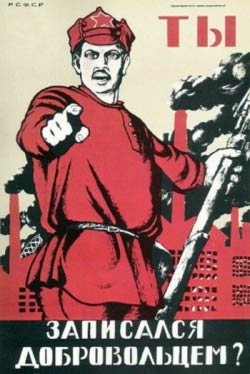
Rather, it’s the World War II-era Soviet poster pointing over Shipman’s shoulder, which asks if you’ve enlisted in the Red Army yet (because you’re going to get drafted anyway), and the other one beyond the sink, which asks if you’ve gotten a factory job to fill in for your husband (who has probably been shot on the front lines).
The sad fact is that progressives in much of the developed world have a soft spot in their hearts for communism. Yeah, it murdered a hundred million people or more, but you can’t make an omelet without breaking a few eggs. And those who were murdered were not very fashionable, for the most part.
The Washingtonian photo is a tell. There is a sickness, a willful blindness toward the crimes of communism because it is so close to the progressive ideology that animates the American Ruling Class. Shipman and Carney are the perfect exemplars of that class. Smart, fit, busy, anxious to make their own lives perfect, and convinced that the price other people pay for their progressive dreams is not worth mentioning or even noticing.
Oh, please. By this standard, I’m a Commie symp myself, since I also have Soviet-era posters adorning the walls of my home; I picked them up in Moscow and Leningrad during my various working trips to the late Soviet Union. Which is where I met my old Time colleague, Jay Carney. …
As soon as the photograph of Soviet propaganda posters in Jay Carney’s kitchen hit the Internet, right-wing pundits began to draw conclusions about White House Press Secretary’s ideology, morals, and political leanings. It was as if things that a man merely places on his walls and looks at day after day can be any indication of his life choices. …
It is beyond imagination that anyone could misconstrue the Soviet agitprop in Jay Carney’s kitchen as an indication that White House Press Secretary Jay Carney and his wife somehow share the same ideas as the perpetrators of a brutal regime that starved its own citizens while the political elites lived in luxury, abused power, prosecuted the opposition, and ruled the country by means of executive orders.
Next, they would claim that that a neat stack of Chairman Mao’s Little Red Books in Valery Jarrett’s bathroom is not there merely to serve as an elegant accent to complement the shower curtains; or that the Black Panther Party insignia on Michelle Obama’s pajamas isn’t merely a bold decorative pattern; or that the black flag of holy Jihad in Huma Abedin’s bedroom is somehow indicative of her sympathies towards the Muslim Brotherhood.
Following such flawed right-wing logic, one might even speculate that Saul Alinsky’s books on Hillary Clinton’s living room mean anything other than an effort to disguise an obscure dried spot that had mysteriously appeared on the coffee table in the last year of her husband’s presidency.
Claire Shipman (wife to Obama press Secretary Jay Carney) is co-author of a book coming out (apparently grounding self-help career advice for women in junk science) and her promotional campaign includes just about the puffiest puff piece that anyone’s ever seen in Washington Mom.
Tout le monde is twittering about the piece this morning, gleefully mocking the supposed perfection of the successful couple’s home and family life.
Does something about this portrait of the WH press secretary’s family seem, I don’t know, stagey and overly polished? Somehow I imagine the shoot wrapping and the crew breaking set (“okay, you clean up the carefully strewn blueberries, I’ll start Photoshopping in the bookcases, tell them they can change back into regular clothes.”)
The cherished and framed Soviet propaganda posters in the kitchen shot did not go unremarked. But what really brought the house down was the photo below featuring Photoshopped evidence of the mouthpiece of the smart people’s book collection. The duplication of the kid’s finger was particularly admired. Twitter 1Twitter 2
Little Ezra Klein published on Sunday, in Vox, a must-read article making the intelligent point that political arguments are commonly not decided on the basis of facts and evidence, and that even intelligent people, when faced with information contrary to their preferred beliefs, tend to use their intellectual skills to manipulate or evade in favor of preserving their positions, rather than revising their own opinions on the basis of better arguments or the facts.
[T]here are some kinds of debates where people don’t want to find the right answer so much as they want to win the argument. Perhaps humans reason for purposes other than finding the truth — purposes like increasing their standing in their community, or ensuring they don’t piss off the leaders of their tribe. If this hypothesis proved true, then a smarter, better-educated citizenry wouldn’t put an end to these disagreements. It would just mean the participants are better equipped to argue for their own side.
Quite amusingly, Ezra then proceeds, quite unconsciously, to demonstrate the truth of all of this in the real world by selecting as examples of “identity-protective cognition” classic current left-right controversies like “climate change.” Ezra then proceeds to treat the left’s side of the argument as factual and decisive, diagnosing people on the other side, like Justice Antonin Scalia, as afflicted with delusional infatuation with identity precluding perception of the force and authority of the other side’s arguments.
Poor Ezra is hilariously oblivious to his own delusion-inducing investment in his identity as an elite member of the enlightened community of fashion, which his own belief system supposes inevitably knows the truth about matters of fact like Anthropogenic Climate Change and every issue of public policy.
and a group of especially obnoxious characters declare they are smarter, nobler, and kinder than everyone else, and are foreordained to rule, lifted on the wave of history.
Bruce Braley (D) demonstrates how to lose a race for the Senate in Iowa in 37 seconds. Posing next to all the booze (with no necktie) while delivering this condescending plea for support adds extra points.
It’s awfully nice when your opponent writes your most effective campaign ad for you and then delivers it.
George Washington was a farmer who never attended college, let alone law school. So was John Marshall.