John D. Davidson reviews Mario Vargas Llosa’s just-released Notes on the Death of Culture, a must-read pessimistic essay discussing the West’s rate of decline since 1948 (the year of my birth) and our civilization’s gloomy prospects for the future.
In his 1948 essay, Notes Towards the Definition of Culture, T.S. Eliot argued that the highest levels of culture are only attainable by relatively small groups of people, and that in order for a civilization to sustain high culture a class system of some kind is necessary. Because culture is transmitted primarily through the family and religion—not schools—and because it relies to a large extent on these particular loyalties for its perpetuation, when these institutions fail, “we must expect our culture to deteriorate.â€
At the risk of over-simplifying Eliot’s argument, one of his basic contentions sounds rather old-fashioned, perhaps even bigoted by today’s standards, that “we can distinguish between higher and lower cultures; we can distinguish between advance and retrogression.†This notion flies in the face of multiculturalism, not to say the notion of equality. Yet it’s a necessary premise for his assessment of the state of contemporary culture:
“We can assert with some confidence that our own period is one of decline; that the standards of culture are lower than they were fifty years ago; and that the evidences of this decline are visible in every department of human activity. I see no reason why the decay of culture should not proceed much further, and why we may not even anticipate a period, of some duration, of which it is possible to say that it will have no culture.â€
According to Peruvian writer and Nobel laureate Mario Vargas Llosa, the culture-less period foreseen 67 years ago by Eliot is the one in which we are all now living.
Kit Wilson identifies the leading cultural disease of modern times.
We seek to make society blinkered, mindless and immature. Look at the way today’s businesses choose to market themselves. They invent names that imitate the nonsense words of babies: Zoopla, Giffgaff, Google, Trivago. They deliberately botch grammar in their slogans to sound naïve and cutesy: “Find your happyâ€, “Be differenterâ€, “The joy of doneâ€. They make their advertisements and logos twee and ironic — a twirly moustache here, a talking dog there — just to show how carefree and fun they are.
Those in our society who actually still have children have them later and in smaller numbers than ever. Many simply choose to forego the responsibilities of parenthood altogether. Marriage is an optional extra — one from which we can opt out at any point, regardless of the consequences for the children.
Students expect to be treated like five-year-olds: one conference recently prohibited applause for fear it would, somehow, trigger a spate of breakdowns. Many of my fellow twentysomethings reach adulthood believing they can recreate in their everyday lives the woolly comforts of social media. They discover, with some surprise, that they cannot simply click away real confrontation, and — having never developed the psychological mechanisms to cope with it — instead seek simply to ban it.
The effects of social media don’t end there. A Pew Research Centre study last year found that regular social media users are far more likely than non-users to censor themselves, even offline. We learn to ignore, rather than engage with, genuine disagreement, and so ultimately dismantle the most important distinction between civil society and the playground — the ability to live respectfully alongside those with whom we disagree.
Social media assures us that the large civilisational questions have already been settled, that undemocratic nations will — just as soon as they’re able to tweet a little more — burst into glorious liberty, and that politics is, thus, merely a series of gestures to make us feel a bit better. Hence the bewildering range of global issues we seem to think can be somehow resolved with a sober mugshot and a meaningful hashtag.
In reality, our good fortune is an anomaly. We’ll face again genuine, terrifying confrontations of a kind we can scarcely imagine today. And we’ll need something a little more robust than an e-petition and a cat video.
Sadly, our philosophical approach seems to have been to paper over Nietzsche’s terrifying abyss with “Keep calm . . .†posters. If one were to characterise the West’s broad philosophical outlook today, it would be this: sentimental nihilism. We accept, as “risen apesâ€, that it’s all meaningless. But hey, we’re having a good time, right?
This is gleefully expressed by our society’s favourite spokespeople — comedians, glorifying the saccharine naivety of a culture stuck in the present. When the New York Times columnist Ross Douthat asked the comedian Bill Maher to locate the source of human rights, he simply shrugged his shoulders and said, “It’s in the laws of common sense.â€
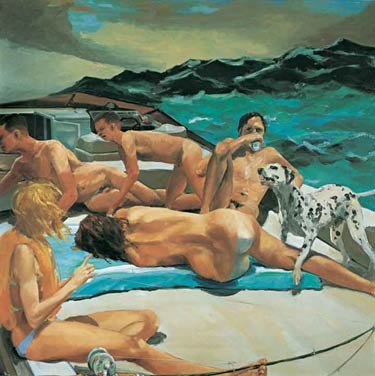
Eric Fischl, The Old Man’s Boat and the Old Man’s Dog, 1982. –Our time’s version of The Raft of the Medusa.
And Dan Greenfield argues that it really does not do a terribly good job.
Liberalism has become a revolt against the middle class that its grandparents struggled to reach, a rejection of their “materialism” while substituting the “ethical materialism” of liberalism in its place that envisions a much smaller upper and middle class that derives its wealth and power not from hard work in the private sector, but highly profitable social justice volunteerism in the public sector.
An American Dream of universal prosperity has been pitted against the left’s dream of a benevolent feudal system in which the few will be very well paid to oversee the income equality of the many.
io9 describes a 1972 experiment which demonstrated that urbanization, increased population density, led to dystopian decadence and inequality featuring exactly the same kind of urban community of fashion elite we have ruining America today.
In 1972, animal behaviorist John Calhoun built a rat paradise with beautiful buildings and limitless food. He introduced eight mice to the population. Two years later, the mice had created their own apocalypse. Here’s why.
Universe 25 was a giant box designed to be a rodent utopia. The trouble was, this utopia did not have a benevolent creator. John B. Calhoun had designed quite a few mouse environments before he got to the 25th one, and didn’t expect to be watching a happy story. Divided into “main squares” and then subdivided into levels, with ramps going up to “apartments,” the place looked great, and was always kept stocked with food, but its inhabitants were doomed from the get-go.
Universe 25 started out with eight mice, four males and four females. By day 560, the mouse population reached 2,200, and then steadily declined back down to unrecoverable extinction. At the peak population, most mice spent every living second in the company of hundreds of other mice. They gathered in the main squares, waiting to be fed and occasionally attacking each other. Few females carried pregnancies to term, and the ones that did seemed to simply forget about their babies. They’d move half their litter away from danger and forget the rest. Sometimes they’d drop and abandon a baby while they were carrying it.
The few secluded spaces housed a population Calhoun called, “the beautiful ones.” Generally guarded by one male, the females—- and few males — inside the space didn’t breed or fight or do anything but eat and groom and sleep. When the population started declining the beautiful ones were spared from violence and death, but had completely lost touch with social behaviors, including having sex or caring for their young.
In 1972, with the baby boomers coming of age in a ever-more-crowded world and reports of riots in the cities, Universe 25 looked like a Malthusian nightmare. It even acquired its own catchy name, “The Behavioral Sink.” If starvation didn’t kill everyone, people would destroy themselves. The best option was to flee to the country or the suburbs, where people had space and life was peaceful and natural.
The Washington City Paper notes another watershed mark of decadent hipster self-indulgence.
A Manhattan will set you back $14 at forthcoming downtown restaurant and bar Second State. Want it on the rocks? That will be a dollar more—for a total of $15.
The Pennsylvania-themed spot, which is set to open in the former Mighty Pint space at 1831 M St. NW on Oct. 21, will be the first place in D.C. with an ice surcharge listed on its cocktail menu. (Most bars eat the cost or build it into the price of the drink.) Granted, these are no freezer-burned, generic tray cubes. This is the fancy, unclouded artisanal stuff from D.C.’s boutique ice company, Favourite Ice, founded by local bartenders Owen Thomson and Joseph Ambrose. Second State bartenders will chip off the eight corners for a more spherical shape that sits in the glass like an iceberg.
————————————-
Mother Jones reports that ice cube connoisseurship is actually already a national fad (and the green-on-the-outside-pink-on-the-inside left is all in a dither about its environmental impact).
Yes, artisanal ice is now a thing. In hipster meccas from Portland to Williamsburg, bars are serving up their drinks on extra-dense, extra-clear cubes, produced through a laborious process of freezing and carving. Cocktail connoisseurs swear the difference in flavor is worth the extra effort: In addition to being more aesthetically pleasing, the cubes’ density and relatively large size mean they melt more slowly and dilute your drink less. …
Demand for artisanal ice grew out of the past decade’s “cocktail renaissance”—the rise of small-batch liquor producers, the rediscovery of pre-Prohibition recipes, and an increasing emphasis on fresh, homemade ingredients. …
[Artisanal ice is made] in a special type of freezer called a Clinebell machine—the same device that ice sculptors use to form the blocks they carve into statues for weddings and bar mitzvahs. Most freezers chill water from the top down, which traps air bubbles under the upper layer of ice and leads to a cloudy cube. Clinebells cool from the bottom up, circulating the top layer of water to get rid of bubbles until it’s all frozen. Every three days, the machine spits out two 300-pound, crystal-clear chunks of ice, which [the specialist dealer] then break down with saws and deliver to clients around the city.
Is this the end? The end of the hipster and the new beginning for normal people? I doubt it but its wishful thinking. One would think that when a couple of douchebag ****** ******* hipsters decide to charge people extra for “artisanal†ice in their drinks, that we’ve hit rock bottom and things are sure to get better. May lightning strike these ******* ***********.
Eric Fischl, The Old Man’s Boat and the Old Man’s Dog, 1982. –Our time’s version of The Raft of the Medusa.
Fred Reed is not impressed with what egalitarian progressive modernism has wrought.
The bleakness of American culture leads one to despair. Subtract technology and nothing is left. Music? Classical composition is dead. The symphony orchestras hold on by their teeth. Opera is unheard and almost unheard of. Book sales drop, and those that sell are mostly trash. Poetry is dead, Shakespeare a comic shorthand for ridiculous irrelevant pedantry.
Talented painters abound, but the nation has no interest in them. Sculpture means curious blobs and shapes said to be art and chosen by suburban arts committees. Theater? How many people have seen a play recently other than a high-school production?
In all the things that once marked civilization, the United States has become a desert, a waste of self-satisfied, pampered, arrogantly ignorant sidewalk peasants. This is curious, since anything the cultivated might want awaits on the web. One may think of Amazon as an automated fifth-century monastery, saving things of worth for an awakening centuries hence.
Thomas Babbington Macauley: “[The Roman Catholic Church] saw the commencement of all the governments and of all the ecclesiastical establishments that now exist in the world; and we feel no assurance that she is not destined to see the end of them all. She was great and respected before the Saxon had set foot on Britain, before the Frank had passed the Rhine, when Grecian eloquence still flourished at Antioch, when idols were still worshipped in the temple of Mecca. And she may still exist in undiminished vigour when some traveller from New Zealand shall, in the midst of a vast solitude, take his stand on a broken arch of London Bridge to sketch the ruins of St. Paul’s.”
Oscar Halecki, The Limits and Divisions of European History, 1950 is ultimately optimistic.
It has been frequently stressed that, from the point of view of the historical method, ancient history is so instructive to study because it is completed;we are able to contemplate the whole process of its evolution from beginning to end. The same can be said today [1950] of European history. That comparison with the ancient, Greco-Roman world is both suggestive and comforting, for it shows that the end of an age, and even of a whole cultural world, need not necessarily mean complete extinction like that which occurred, for instance, in the case of the pre-Columbian civilizations of America. Europe’s present decline need not lead to what Oswald Spengler calls an Untergang, although the crisis is much more acute today than it was when he wrote his sensational book. Nor need Macauley’s gloomy vision of a New Zealander meditating over the ruins of London ever come true, although this time seemed so near in 1940. …
Europe came into existence as an historical community because numerous peoples entirely different from each other, without effacing their particularities and without ever uniting politically, joined in a co-operation based upon common cultural conceptions, traditions, and principles. The individual nations which developed within that community were rather small if compared, for instance, with the peoples of India or China. Likewise small was the area in which they had their home; and compared with the length of other histories –to mention only that of Egypt– the age of their common greatness was of rather short duration.
But within these narrow limits of time we see the same variety of events in rapidly changing periods that is so striking in Europe’s physical and ethnical backgrounds. This certainly is an unusually dynamic history, whether proceeding through evolution or through revolutionary upheavals. And that is the first argument in favor of the conviction that the end of the European Age in history is not necessarily the end of Europe, or of a civilization which, though inseparable from the European heritage, has ceased to be exclusively European.
That whirring sounds you hear faintly in the background are Henry Luce and Briton Hadden, both Y’1920, the founders of Time Magazine, spinning in their graves as Nancy Gibbs, Y’1982, Time’s current managing editor, celebrates a very special “tipping point” by identifying Transgender-ism as a Civil Rights Movement now officially recognized by the national bien pensant establishment as a worthy cause entitled to receive public celebration and state-enforced privileges and immunities.
Sexual deviance and perversity were racking up lots of victories this week. The National Park Service announced that it was going to make places and people of significance to the history of lesbian, gay, transgender and bisexual Americans part of the national narrative. (That bronze historic marker in the public lavatory where so-and-so was once arrested may look a little out of place, but there you are.)
The Spirit of Enlightenment leaped suddenly from California to Texas as Houston’s mayor and city council announced that that city’s bathrooms, showers, and dressing facilities will henceforward be unrestricted by gender.
The self-congratulatory smugfest was, however, unkindly interrupted by National Review’s Kevin D. Williamson’s “nasty” and “offensive” “takedown” of Time’s munificent gesture. Williamson deliberately spoiled all the fun by noting that Time’s latest covergirl Laverne Cox is not actually a woman, and even the consensus of the community of fashion aided by the all powers of modern science cannot really make him into one.
Regardless of the question of whether he has had his genitals amputated, Cox is not a woman, but an effigy of a woman. Sex is a biological reality, and it is not subordinate to subjective impressions, no matter how intense those impressions are, how sincerely they are held, or how painful they make facing the biological facts of life. No hormone injection or surgical mutilation is sufficient to change that.
Genital amputation and mutilation is the extreme expression of the phenomenon, but it is hardly outside the mainstream of contemporary medical practice. The trans self-conception, if the autobiographical literature is any guide, is partly a feeling that one should be living one’s life as a member of the opposite sex and partly a delusion that one is in fact a member of the opposite sex at some level of reality that transcends the biological facts in question. There are many possible therapeutic responses to that condition, but the offer to amputate healthy organs in the service of a delusional tendency is the moral equivalent of meeting a man who believes he is Jesus and inquiring as to whether his insurance plan covers crucifixion.
The most amusing response to this unanswerable argument came from Mediate’s Matt Wilstein.
Williamson is right. Cox is not a “woman†in the narrow, traditional sense that he is capable of comprehending. But nor is she a “man†in the way he insists on describing her throughout his intentionally offensive screed. Cox proudly identifies as transgender. …
This passage demonstrates a fundamental lack of understanding about the difference between sex and gender. There is a reason the term “transexual†is no longer used while “transgender†has become the accepted descriptor. While someone’s sex may be defined by biological characteristics, gender is essentially a psychological identification.
Ah, yes! The difference between sex and gender. Sex is an unalterable physical reality. “Gender” is a social construct, invented by academic sophisters, which is optionally chosen and modifiable at will. In other words, gender is BS.
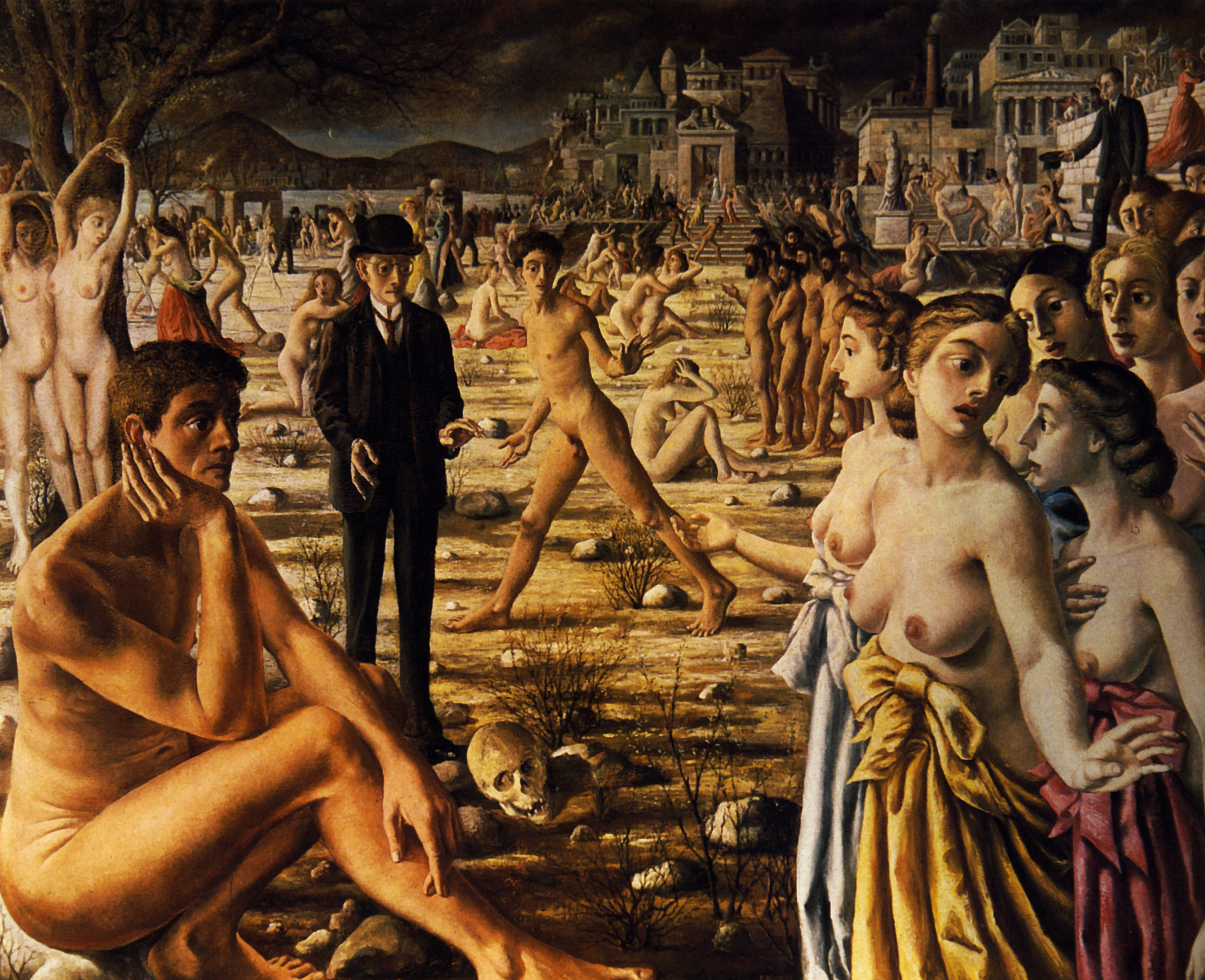
Paul Delvaux, City Worried, 1941, Private Collection.
“Western civilization at the present day is passing through a crisis which is essentially different from anything that has previously been experienced. Other societies in the past have changed their social institutions or their religious beliefs under the influence of external forces or the slow development of internal growth. But none, like our own, has ever consciously faced the prospect of a fundamental alteration of the beliefs and institutions on which the whole fabric of social life rests.”