Labour policies resulted in food rationing continuing in post-WWII Britain until 1954. Today’s Global Warming bugaboo may again offer renewed opportunities to both regulators and black marketeers, the Daily Mail reports.
Every adult should be forced to use a ‘carbon ration card’ when they pay for petrol, airline tickets or household energy, MPs say.
The influential Environmental Audit Committee says a personal carbon trading scheme is the best and fairest way of cutting Britain’s CO2 emissions without penalising the poor.
Under the scheme, everyone would be given an annual carbon allowance to use when buying oil, gas, electricity and flights.
Anyone who exceeds their entitlement would have to buy top-up credits from individuals who haven’t used up their allowance. The amount paid would be driven by market forces and the deal done through a specialist company.
MPs, led by Tory Tim Yeo, say the scheme could be more effective at cutting greenhouse gas emissions than green taxes.
But critics say the idea is costly, bureaucratic, intrusive and unworkable.
The Government says it supports the scheme in principle, but warns it is ‘ahead of its time’.
The idea of personal carbon trading is increasingly being promoted by environmentalists. In theory it could be used to cover all purchases – from petrol to food.
Says the New York Times: there are people starving in Sub-Saharan Africa, and throwing food away causes Global Warming, too.
Americans waste an astounding amount of food — an estimated 27 percent of the food available for consumption, according to a government study — and it happens at the supermarket, in restaurants and cafeterias and in your very own kitchen. It works out to about a pound of food every day for every American. …
The numbers seem all the more staggering now, given the cost of groceries and the emerging food crisis abroad.
After President Bush said recently that India’s burgeoning middle class was helping to push up food prices by demanding better food, officials in India complained that not only do Americans eat too much — if they slimmed down to the weight of middle-class Indians, said one, “many people in sub-Saharan Africa would find food on their plate†— but they also throw out too much food.
And consider this: the rotting food that ends up in landfills produces methane, a major source of greenhouse gases.
Lots of luck, NY Times pinkos, Americans know that charitable garbage donation begins at home.
If cities full of liberals get flooded, that’s just too bad. And we won’t have to eat rocks, we’ll have all those tasty fish who’ve been mopping up the drowned liberals.
The New York Times rather outdid itself on Sunday in serving up its traditional ration of stupidity and cant, but Earth Day occurs this week and provided the occasion for the Times to devote the entire Sunday Magazine to an Enviro-PC-Fest of preening libs.
Michael Pollan, for instance, took a long, hard look into his own navel, and understood that changing the world, the choices, habits, lifestyles, and behavior of all of the world’s 6 and a half billion inhabitants, reversing the course of history, and rejecting capitalism, consumerism, and modern industrial civilization might be only a matter of setting a personal good example.
It’s hard to argue with Michael Specter, in a recent New Yorker piece on carbon footprints, when he says: “Personal choices, no matter how virtuous [N.B.!], cannot do enough. It will also take laws and money.†So it will. Yet it is no less accurate or hardheaded to say that laws and money cannot do enough, either; that it will also take profound changes in the way we live. Why? Because the climate-change crisis is at its very bottom a crisis of lifestyle — of character, even. The Big Problem is nothing more or less than the sum total of countless little everyday choices, most of them made by us (consumer spending represents 70 percent of our economy), and most of the rest of them made in the name of our needs and desires and preferences.
For us to wait for legislation or technology to solve the problem of how we’re living our lives suggests we’re not really serious about changing — something our politicians cannot fail to notice. They will not move until we do. Indeed, to look to leaders and experts, to laws and money and grand schemes, to save us from our predicament represents precisely the sort of thinking — passive, delegated, dependent for solutions on specialists — that helped get us into this mess in the first place. It’s hard to believe that the same sort of thinking could now get us out of it.
Thirty years ago, Wendell Berry, the Kentucky farmer and writer, put forward a blunt analysis of precisely this mentality. He argued that the environmental crisis of the 1970s — an era innocent of climate change; what we would give to have back that environmental crisis! — was at its heart a crisis of character and would have to be addressed first at that level: at home, as it were. …
f you do bother, you will set an example for other people. If enough other people bother, each one influencing yet another in a chain reaction of behavioral change, markets for all manner of green products and alternative technologies will prosper and expand. (Just look at the market for hybrid cars.) Consciousness will be raised, perhaps even changed: new moral imperatives and new taboos might take root in the culture. Driving an S.U.V. or eating a 24-ounce steak or illuminating your McMansion like an airport runway at night might come to be regarded as outrages to human conscience. Not having things might become cooler than having them. And those who did change the way they live would acquire the moral standing to demand changes in behavior from others — from other people, other corporations, even other countries.
All of this could, theoretically, happen. What I’m describing (imagining would probably be more accurate) is a process of viral social change, and change of this kind, which is nonlinear, is never something anyone can plan or predict or count on.
And even if what you do personally doesn’t actually have any real impact on the world, you should, of course, do all this goofy green stuff anyway, since even if you can’t meaningfully change the world, you can change yourself into an environmentally-PC member of the more-enlightened-than-thou elite, a nobler, finer being, capable of experiencing the orgasmic sense of narcissistic self-righteousness that only comes from composting.
Who knows, maybe the virus will reach all the way to Chongqing and infect my Chinese evil twin. Or not. Maybe going green will prove a passing fad and will lose steam after a few years, just as it did in the 1980s, when Ronald Reagan took down Jimmy Carter’s solar panels from the roof of the White House.
Going personally green is a bet, nothing more or less, though it’s one we probably all should make, even if the odds of it paying off aren’t great. Sometimes you have to act as if acting will make a difference, even when you can’t prove that it will. That, after all, was precisely what happened in Communist Czechoslovakia and Poland, when a handful of individuals like Vaclav Havel and Adam Michnik resolved that they would simply conduct their lives “as if†they lived in a free society. That improbable bet created a tiny space of liberty that, in time, expanded to take in, and then help take down, the whole of the Eastern bloc.
So what would be a comparable bet that the individual might make in the case of the environmental crisis? Havel himself has suggested that people begin to “conduct themselves as if they were to live on this earth forever and be answerable for its condition one day.†Fair enough, but let me propose a slightly less abstract and daunting wager. The idea is to find one thing to do in your life that doesn’t involve spending or voting, that may or may not virally rock the world but is real and particular (as well as symbolic) and that, come what may, will offer its own rewards. Maybe you decide to give up meat, an act that would reduce your carbon footprint by as much as a quarter. Or you could try this: determine to observe the Sabbath. For one day a week, abstain completely from economic activity: no shopping, no driving, no electronics.
But the act I want to talk about is growing some — even just a little — of your own food. Rip out your lawn, if you have one, and if you don’t — if you live in a high-rise, or have a yard shrouded in shade — look into getting a plot in a community garden. Measured against the Problem We Face, planting a garden sounds pretty benign, I know, but in fact it’s one of the most powerful things an individual can do — to reduce your carbon footprint, sure, but more important, to reduce your sense of dependence and dividedness: to change the cheap-energy mind.
The conceit that scientists and bureaucrats can use the power the state to manage nature has lead to disaster in the past, and will again if the global warmists keep getting their way.
When Yellowstone National Park was first created, park officials believed they had to “save†the native fauna as well as protect the visitors by killing off the native wolf population. This they did in grand form. Additionally, they noticed the yearly occurrences of wildfires which, according to the then “modern†and “progressive†thought of the day, should be stamped out at all cost.
The net result of these notions was that 110 years or so later half the park burned down. It turns out that without the wolves the ruminants ran wild and ate up the deciduous trees, leaving only the pine trees to go forth and multiply. Anyone who’s started a campfire knows what happens when you compound this with 110 years of pine needles and flotsam and jetsam — you end up with the perfect firestorm. This is nothing natural. This situation was created by us — by human intervention into a formerly pristine ecosystem that was supposedly “managed†by the federal government – and the result was that half the park burned down.
Once again, on the issue of “global warming†we’re faced with government control — in this case not of the national park system, but of the entire globe. The “progressives†and their “grand thoughts†of the age seek to “manage†the globe in the same “modern†way our ancestors “managed†Yellowstone. Like our ancestors of yore, today’s environmentalists believe the government can control the environment better than Mother Nature can. Are we to suppose that the people who give us the DMV and the IRS are going to “manage†the globe in the same efficient and benevolent manner? In the grand scheme of things are we supposed to believe that we humans are actually better than Mother Nature at “managing†the global environment? For some reason, the enviro-nazis of the age seem to believe that Mother Nature is some kind of octogenarian Alzheimer’s patient and they’re the designated colostomy bag.
There is something residing deep in human nature which believes that mankind is not entitled to comfort or prosperity and that the jealous gods of Nature are even now preparing to punish our insolence in illuminating our cities and heating our homes. The same impulse which actuated the medieval penitents who flagellated themselves to turn aside the wrath of God remains active and alive in today’s secular age.
Displays of piety, of course, are not necessarily entirely penitential or propitiatory. When cult membership is associated with social rank, religious behavior can function as a status marker. Thus, in today’s Western community of fashion, penitence no longer pertains to sin, and society’s elect proudly displays possession of the visible signs of grace by publicly repenting for consumption.
Twenty-six major cities around the world are expected to turn off the lights on major landmarks, plunging millions of people into darkness to raise awareness about global warming, organisers said.
‘Earth Hour’ founder Andy Ridley said 371 cities, towns or local governments from Australia to Canada and even Fiji had signed up for the 60-minute shutdown at 0900 GMT on March 29.
“There are definitely 26 (cities) that we think, if it all goes to plan, we are going to see a major event of lights going off,” he told AFP.
Cities officially signed on include Chicago and San Francisco, Dublin, Manila, Bangkok, Copenhagen and Toronto, all of which will switch off lights on major landmarks and encourage businesses and homeowners to follow suit.
Ridley said it was also likely that other major European cities such as Rome and London, and the South Korean capital Seoul, although not officially taking part, would turn off lights on some attractions or landmarks.
The initiative began in Sydney last year and has become a global event, sweeping across 35 countries this year.
From 8:00 pm local time in Sydney, the energy-saving campaign will see harbourside icons such as the Sydney Harbour Bridge and the Opera House bathed only in moonlight, restaurant diners eat by candlelight and city skyscrapers turn off their neon signs.
Organisers hope the initiative will encourage people to be more aware of their energy usage, knowing that producing electricity pollutes the atmosphere through the burning of fossil fuels which are contributing to global warming.
But they are also aware that it will be just a small step in solving the problem of rising temperatures around the globe.
Don Surber loses his temper over the irrationality of it all.
Kansas Gov. Sebelius kills 2 new coal plants.
Does she prefer some other fossil fuel?
Or nukes?
Or flooding half her state for hydro-power?
Because unless she is willing to put up with one of those alternatives, Democratic Gov. Kathleen Sebelius of Kansas just doomed her state by vetoing a bill that would have cleared the way for two state-of-the-art coal-fired plants to serve the state’s electric needs in the 21st century.
She has no plan.
She prefers darkness.
“Instead of building two new coal plants, which would produce 11 million new tons of carbon dioxide each year, I support pursuing other, more promising energy and economic development alternatives,†she said in a statement accompanying the veto.
What are those alternatives?
Rubbing lamps to conjure up genies?
Hamsters in wheels?
If she is talking about solar power, then she is either an idiot or a charlatan. America has pursued that pipe-dream for 30 years or more.
In 2006, solar supplied 1% of 1% of America’s electric use. Wind supplied about ½%. Combined they produced 26.3 billion kilowatt hours of power – in a nation that consumed 4,053 billion kilowatt hours of electricity.
Will anyone challenge this woman’s ignorance on the subject?
The stupidity of people is truly amazing. My college class, for instance, is full of people who get all their opinions from the daily papers, and who are utterly econonically illiterate. They are perfectly prepared to believe that an injection of government funding will change reality, and all those idle technologists (unmotivated by the paltry rewards available right now via the sale of cheaper, cleaner forms of energy) will suddenly spring into action and, abracadabra! new magical ways will be found to make wind and solar power economically competitive. They’re nuts.
The Telegraph has an amusing story on the rise of eco-snobbery.
What was it, this frisson that passed between the young woman behind the counter at Pret A Manger and me? It wasn’t flirtation, exactly. It was more conspiratorial than that. A knowing look. A social judgment shared.
As she asked me if I wanted a plastic bag for my two items – a (wild) salmon sandwich and a banana – the man at the head of the queue next to mine was asked the same question by another assistant. He had a sandwich and an apple. The point is, I said no. He said yes. That was when the look was exchanged.
That, I am ashamed to admit, was the moment I felt superior, if only by one degree, if only for a second. The man had committed a faux pas. He had transgressed an unwritten ethical code. He had fallen foul of the new morality, which actually, if you think about it, is also the new snobbery.
It is apparent everywhere. In a restaurant the other night our companions asked us if we wanted sparkling water or whether we were happy with a jug of tap. The clue to the correct answer was in the word “happy”. We went with the tap. It wasn’t that we were being cheap – but we probably were being a little smug. My wife and I are paid-up members of the enlightened middle classes, you see. Our consciousnesses have been raised. We are E, the modern equivalent of U.
Just as Nancy Mitford divided society into the upper classes and the aspiring middle classes – that is, into U and Non-U – so society is being divided into the environmentally aware and environmentally unaware, or E and Non-E. It satisfies a need we seem to have to judge one another.
Today’s spoiled haute bourgeoisie extend aspirational self-affirmation far beyond mere careerism and materialistic consumption into realms of spiritual narcissicism and ethical pretension undreamt of by previous generations.
Polar bears are drowning, Al Gore warns us, complaining of Global Warming shrinking Arctic ice. But, look! ice levels west of Greenland are at 15 year highs this year.
“Doesn’t matter,” reply Anthropogenic Global Warming supporting scientists, “It’s just an insignificant variation in weather patterns, perfectly normal, and it doesn’t mean a thing.”
The ice between Canada and southwestern Greenland has reached its highest level in 15 years.
Minus 30 degrees Celsius. That’s how cold it’s been in large parts of western Greenland where the population has been bundling up in hats and scarves. At the same time, Denmark’s Meteorological Institute states that the ice between Canada and southwest Greenland right now has reached its greatest extent in 15 years.
‘Satellite pictures show that the ice expansion has extended farther south this year. In fact, it’s a bit past the Nuuk area. We have to go back 15 years to find ice expansion so far south. On the eastern coast it hasn’t been colder than normal, but there has been a good amount of snow.’
But how do these new reports fit in with continual reports that ice in the Arctic Ocean has been melting at a record rate due to increasing temperatures? And isn’t global warming at the top of the political agenda these years?
If it’s up to meteorologists from Denmark’s Meteorological Institute, there is not anything inherently contradictory that extreme cold is replaced by higher temperatures than average. Or that melting sea ice occasionally is replaced by expanding ice sheets.
‘Weather is a phenomenon which changes from year to year and right now the atmosphere has changed so we have cold weather. That will certainly mean that melting ice in the North Pole will be less this year, but next year the situation can look completely different,’ according to Henriksen.
To sum things up, global warming hasn’t been called off. In the meanwhile, western Greenlanders will have to accept that the cold weather continues for some time. At least until next Tuesday when milder weather could be on the way, according to Polarfronten online.
David Shearman, co-author of The Climate Change Challenge and the Failure of Democracy, thinks democracy and individual liberty can get in way of the quick implementation of the kinds of measures experts like himself have decided are necessary. Calling people like himself “communists” is so unfair!
Liberal democracy is sweet and addictive and indeed in the most extreme case, the USA, unbridled individual liberty overwhelms many of the collective needs of the citizens. The subject is almost sacrosanct and those who indulge in criticism are labeled as Marxists, socialists, fundamentalists and worse. These labels are used because alternatives to democracy cannot be perceived! Support for Western democracy is messianic as proselytised by a President leading a flawed democracy.
There must be open minds to look critically at liberal democracy. Reform must involve the adoption of structures to act quickly regardless of some perceived liberties. It is not that liberal democracy cannot react once it sees a threat, for example, the speedy response to a recent international financial emergency. If governments can recognise a financial emergency and in an instant move heaven and earth (and billions of dollars, pounds sterling and euros) to contain it, why are they unable to do the same in response to a global environmental emergency? Quite simply our system is seen to live and breathe by the present economic system; the problem is that living and breathing within the confines of the world ecological systems is contrary to the activity of progress and development as defined within liberal democracy. …
We are going to have to look how authoritarian decisions based on consensus science can be implemented to contain greenhouse emissions. It is not that we do not tolerate such decisions in the very heart of our society, in wide range of enterprises from corporate empires to emergency and intensive care units. If we do not act urgently we may find we have chosen total liberty rather than life.
If there was ever any doubt that inside the environmentalist movement’s green, there lurked a bright pink core, Shearman is there to prove it.
The San Jose Mercury News reports a fascinating legal battle is underway which could only take place on the left coast.
In a case with statewide significance, the Santa Clara County District Attorney’s Office is pursuing a Sunnyvale couple under a little-known California law because redwood trees in their backyard cast a shadow over their neighbor’s solar panels.
Richard Treanor and Carolynn Bissett own a Prius and consider themselves environmentalists. But they refuse to cut down any of the trees behind their house on Benton Street, saying they’ve done nothing wrong.
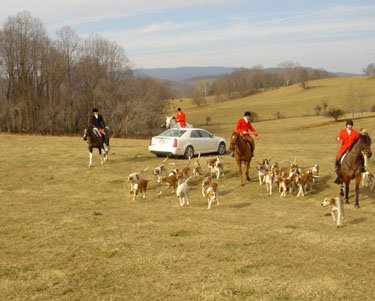
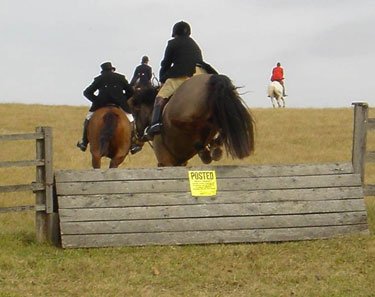
The wife and I attended today the Old Dominion Hounds’ Joint Meet with the Casanova Hunt (to which numerous other Northern Virginia Hunts –including our own Blue Ridge Hunt– were invited).
The joint meet was a fund raiser undertaken to support efforts to oppose Dominion Power’s plan to build 16-story 500-kv electrical transmission towers through scenic and historic Frederick, Warren, Rappahannock, Culpeper, Fauquier, Prince William and Loudoun counties.
And for what? To bring more electrical power to the District of Columbia to illuminate federal offices whose functionaries are busily employed drafting new regulations and spending more tax dollars.
If the evil federal government wants more power, let ’em build nuclear power plants in the District, or do without and borrow some cardigan sweaters from Jimmy Carter.
Not in my backyard, and not in my neighboring fox hunt’s backyard, say I.
We did not get our fair share of abuse, actually. But we did see some fine riding and some lovely scenery. The Blue Ridge really is blue down there in Fauquier County. And the natives are as charming and hospitable as in the rest of the Commonwealth of Virginia.