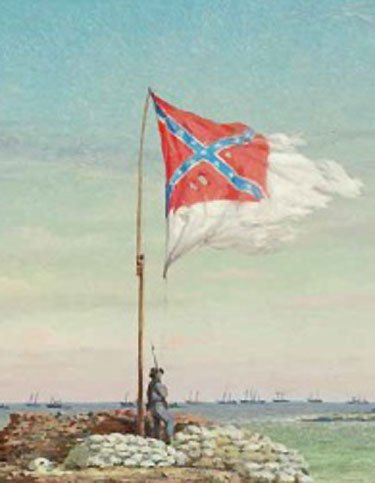
It was widely predicted that historical purging would proceed farther when recently a nation-wide campaign of execration broke out targeting the Confederate flag.
The Connecticut Post confirms the accuracy of those predictions, reporting that:
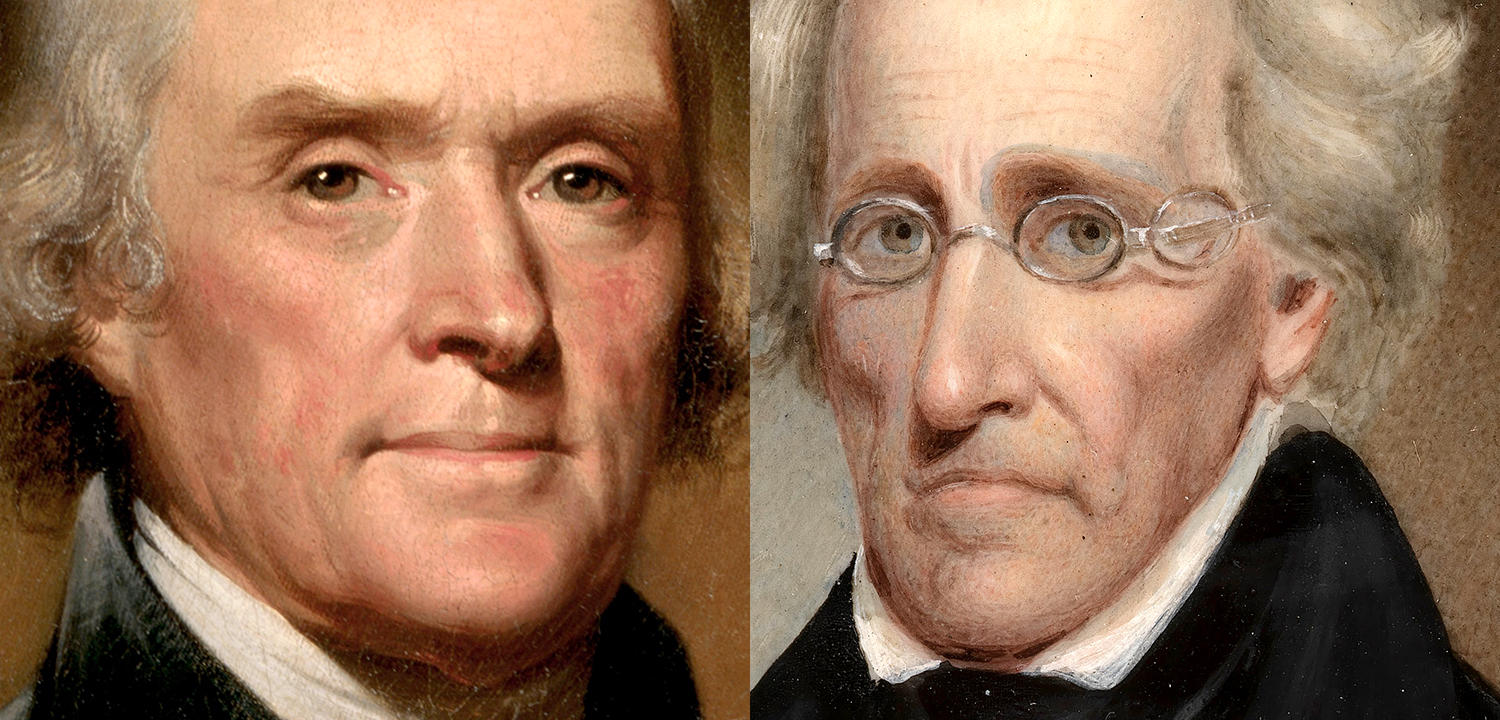
Thomas Jefferson and Andrew Jackson are history in Connecticut.
Under pressure from the NAACP, the state Democratic Party will scrub the names of the two presidents from its annual fundraising dinner because of their ties to slavery.
Party leaders voted unanimously Wednesday night in Hartford to rename the Jefferson Jackson Bailey dinner in the aftermath of last month’s fatal shooting of nine worshipers at a historic black church in Charleston, S.C.
The decision is believed to be unprecedented and could prompt Democrats in other states with similarly named events to follow suit.
“I see it as the right thing to do,†Nick Balletto, the party’s first-year chairman, told Hearst Connecticut Media on Wednesday night.
“I wasn’t looking to be a trailblazer or set off a trend that’s going to affect the rest of the country. Hopefully, they’ll follow suit when they see it’s the right thing to do.â€
Democrat Party annual dinners nationally have long been named the Jefferson and Jackson Dinner, since Thomas Jefferson and Andrew Jackson are, historically speaking, indisputably the two greatest presidents and the two greatest American leaders associated with that political party. Unless, of course, you are a contemporary subscriber to the Marxist “critical studies” approach to history. In which case, you recognize the democrat party’s notoriously libertarian early icons stood for essentially everything you are against: particularly limited government and individual and states’ rights. Worse yet, both were Southerners and thus slave owners. And General Jackson was notoriously unsympathetic to Native American Rights, defeating the Creek Indians in war and deporting the Cherokee to a designated Indian Territory which would one day become Oklahoma.
What do you do, if you are a radical left-wing democrat obliged to face the reality that your party’s two greatest leaders were ultra-libertarians with little to no commitment to equality-at-any-cost? Obviously, you vote that history out of existence.
Olivia Nuzzi, at the Daily Beast, is a typical example of the commentators going after Trump for declining to reverence John McCain’s POW sufferings, when Trump himself avoided military service in the Vietnam War.
Trump’s decision to criticize McCain’s military record is all the more puzzling given the circumstances surrounding his lack of one.
Trump claimed, in an April interview on WNYW, that he avoided the Vietnam War because “I actually got lucky because I had a very high draft number.†He said, while attending the Wharton School of Finance, that “I was watching as they did the draft numbers and I got a very, very high number and those numbers never got up to me.â€
But The Smoking Gun reported that Trump’s draft number was 365, and when it was drawn on Dec. 1, 1968, “18 months after Trump graduated†from the Wharton School, Trump “had already received four student deferments and a medical deferment,†according to records obtained by the publication.
Rieckhoff joked, “He was so interested in seeing the president’s birth certificate, I’m sure he’d be willing to provide the documentation about that.â€
Despite his lack of service, Trump, in the post-insult statement, said, “I am not a fan of John McCain because he has done so little for our Veterans and he should know better than anybody what the Veterans need, especially in regards to the VA. He is yet another all talk, no action politician who spends too much time on television and not enough time doing his job and helping Vets.â€
It just isn’t that simple, folks.
John Kerry, just for example, graduated from Yale in 1965, before the Anti-War Movement had really developed. John Kerry had been planning to run for president presumably since pre-school, so he naturally did go into the Armed Forces, taking the comparatively safe choice of the Navy.
Kerry wound up serving on Swift Boats and saw minor combat. Kerry then came home with a collection of medals, which some of those who served with him say he had written himself up for, grotesquely exaggerating his alleged valor and falsely describing some accidentally self-inflicted wounds as resulting from hostile fire. Kerry then went AWOL; joined the Anti-War Movement as a principal national spokesman, then testified before Congress that his fellow American servicemen behaved like “Genghis Khan,” burned villages, and routinely killed women and children. Kerry even traveled to Paris in order to participate in private planning sessions with North Vietnamese negotiators.
Someone like Trump, who didn’t go to war at all, deserves to be rated as a whole lot more patriotic than a scoundrel and traitor like John Kerry.
The Vietnam War was grossly mismanaged by two administrations, and — at the time — anybody with an IQ over room temperature could see we were never going to win, all the lives lost would be wasted, and the end was merely going to be withdrawal. By the later 1960s, nobody who was clever or well-connected was going.
John McCain served in the war because he was the son and grandson of Navy admirals. He attended Annapolis, following in his father’s footsteps and simply going into the family business. Graduates of the service academies and members of military families had less choice.
There were all sorts of ways to avoid being conscripted, and since American lives and efforts were obviously being wasted and serving in that war could easily be recognized as futile, I’d say that nobody has any right to reproach anybody for draft dodging.
Reproach Lyndon Johnson and Richard Nixon for not dropping a blocking force of a couple of airborne divisions somewhere north and west of Hanoi, and then not sending in an amphibious corps of Marines to assault Hanoi and Haiphong. We could have won the War in Vietnam. We needed only to capture the enemy’s government, military high command, principal supply center, and general staff. We always had the military power to do that. We just knuckled under to Soviet and Chinese saber-rattling (the same way we did in Korea), and never did. We fought a limited war, on terms dictated by the enemy, until the left destroyed the war’s legitimacy and our domestic morale, which forced us to give up.
Donald Trump was obviously smart enough to tell which way the wind blows, and he merely took the practical approach of stepping off the tracks and out of the path of the speeding railroad engine of History. A lot of people did exactly the same thing. I don’t think anybody ever had an obligation to be a sucker and have his time, efforts, and potentially his life wasted by venal and incompetent political leaders. Nor do I think that being smart enough not to be used and played, being able to avoid being taken advantage of, disqualifies anyone from political office or participation in later debates of foreign policy.
Mark Steyn was getting ready to appear on the Bill Bennett show to discuss the recent Supreme Court decision mandating Same-Sex Marriage across the country when someone named Claudine exposed the conservative side of the argument to ridicule by violating Godwin’s Law, i.e. by making a slippery slope comparison to Nazi Germany.
You need to understand that “violating” Godwin’s Law, in sophisticated circles, is customarily taken to amount to losing the debate by forfeit. Any kind of objectionable sort of statism compared to Nazi Germany’s, or identified as representing a landmark on a similar kind of slippery slope, is automatically dismissed as a species of absurd exaggeration.
But Mark Steyn, for one, does not agree.
Claudine came on and said that’s what Germans reckoned in the 1930s: just keep your head down and the storm will pass. How’d that work out?
David Kelsey writes from the University of South Carolina to scoff at that:
In one corner, we have government recognition of marriage contracts between gays. In the other corner, we have Jews, Catholics, gays, their sympathizes [sic] and other undesirables being put in Nazi concentration camps.
One of these things is nothing like the other, unless you’re a lunatic. Maybe the reason conservatives keep “losing everything that matters” is because they really can’t tell the difference. Which causes increasing numbers of people to recognize them as lunatics.
Since you call me and Claudine “lunatics”, allow me to return the compliment and call you an historical illiterate. If “one of these things is nothing like the other”, it’s because that’s never the choice: It’s never a question of being Sweden, say, vs being the Islamic State (although, if you’re a Jew in Malmö, they’re looking a lot less obviously dissimilar than you might think).
All societies exist on a continuum. Neither Claudine nor I said a word about “concentration camps”. But you give the strong impression that that’s the only fact you know about Nazi Germany: Nazis = concentration camps, right? No wonder you think everything divides neatly into opposing “corners”. In the world as lived, there are no neatly defined corners. Things start off in the corners and work their way toward the center of the room.
Claudine and I were talking about Germany in the Thirties – before the concentration camps and the Final Solution, before millions of dead bodies piled up in the gas chambers. So you need to have an imaginative capacity. It’s not clear from your email that you do, but give it a go: Imagine being a middle-class German in 1933. No one’s talking about exterminating millions of people – I mean, that would be just “lunatic” stuff, wouldn’t it? And you belong to a people that regards itself as the most civilized on the planet – with unsurpassed achievements in literature and music and science. You might, if you were so minded, call it Teutonic Exceptionalism. And you’re “progressive”, too: you pioneered the welfare state under Bismarck, and prototype hate-speech laws under the Weimar republic. And yes, some of the beer-hall crowd are a bit rough, but German Jews are the most assimilated on the planet. The idea that such a society would commit genocide is not just “lunatic”, it’s literally unimaginable.
So don’t even bother trying to imagine that. Instead try to imagine it’s early 1933. The National Socialist German Workers Party is the largest party in parliament and thus President von Hindenburg has appointed its leader, Herr Hitler, as Chancellor – not der Führer, just Chancellor, the same position Frau Merkel holds today. And the National Socialist German Workers Party starts enacting its legislative programme, and so a few weeks later the Civil Service Restoration Law is introduced. Under this law, Jews would no longer be allowed to serve as civil servants, teachers or lawyers, the last two being professions in which Jews are very well represented.
But that wily old fox Hindenburg knows a thing or two. So as president he refuses to sign the bill into law unless certain exemptions are made – for those who’ve been in the civil service since August 1st 1914 (ie, the start of the Great War), and for those who served during the Great War, or had a father or son who died in action. And the practical effect of these amendments is that hardly any Jew in the public service has to lose his job.
And so in April 1933 it would be easy to say, if you were a middle-class German seeking nothing other than a quiet life, that, yes, these National Socialist chappies are a bit uncouth, but the checks and balances are still just about working. What’s the worst they can do?
Paul von Hindenburg died the following year, and his amendments were scrapped.
That’s Germany’s civil service in 1933. What of America’s civil service in 2015?
Right now across the land town and county clerks are resigning because they cannot in conscience issue same-sex marriage licenses. In one Tennessee county, the entire clerk’s office has resigned. They are observant Christians – which is to say they hold the same view of marriage that Barack Obama and Hillary Clinton claimed to until the day before yesterday. But an observant Christian can no longer work in the American civil service, or at least in those branches of it responsible for issuing marriage licenses:
County Clerk Katie Lang cited religious beliefs as her reason for refusing to file the marriage application for Dr. Jim Cato and his partner Joe Stapleton. She did, however, promise that someone in her office would accommodate the couple.
Not good enough. Dr Cato and Mr Stapleton are suing Ms Lang. What else you got?
A Kentucky clerk of court wants the state to issue marriage licenses online so he doesn’t have to…
Monday, Davis tried to meet with Democratic Gov. Steve Beshear to ask him to call for a special session of the state legislature so it can pass a law allowing people to purchase marriage licenses online, similar to the process of purchasing a hunting or fishing license.
That’s not good enough, either. Who the hell are you to compare a lesbian wedding to a fishing license?
So observant Christians will no longer be able to serve as town or county clerk. Are comparisons really so “lunatic”? . Are comparisons really so “lunatic”? The logic of the 1933 Civil Service Restoration Act is that the German public service will be judenrein. The logic of the 2015 Supreme Court decision is that much of the American public service will be christenrein – at least for those who take their Scripture seriously. That doesn’t strike me as a small thing – even if one thought it were likely to stop there.
We live in a contemptibly stupid society in a loathsome time in which bigoted morons and moon-maddened fanatics occupy the most prominent and influential establishment positions in the land and get to call the shots nearly all the time concerning our laws, institutions, history, and culture.
Americans have been living under a Second Reconstruction regime for roughly 50 years now. The first Reconstruction affected only the states which had seceded, been defeated in the war, and were under military occupation, and lasted only 12 years. The Second Reconstruction has been national in scope, has already lasted five decades, and shows no signs of ever coming to an end. No Knights of the White Camelia are coming riding to the rescue as they did at the end of D.W. Griffith’s Birth of a Nation (1915). (How’s that for an un-PC reference?)
The national establishment has been taken over by radicals and fanatics whose opinions and philosophies are typically somewhere to the left of those of Thaddeus Stevens, Charles Sumner, and Benjamin Butler.
Currently, pretty much the entire national media, all of the left and quite a number of Quislings on the right, are busy mau-mau’ing the public display of the Confederate flag and are even demanding the removal and/or replacement of public monuments to Southern military leaders and statesmen. The Southern Confederacy, and all its heroes and leaders, must be ostracized for the crimes of Racism and a belief in White Supremacy.
Of course, by contemporary standards, everyone alive in 1860 and 1865 and not as fanatically Afrophiliac as Thaddeus Stevens, was a “Racist” and a “White Supremacist.” The list of guilty parties can hardly be held to be restricted to members of the Confederate Government, like Jefferson Davis, or generals in the Confederate Army, like Nathan Bedford Forest. Ulysses Grant, William Tecumseh Sherman, and Abraham Lincoln himself were all, by current standards, indisputably racist believers in the intellectual and cultural inferiority of the Negro race and –worse, yet!– White Supremacists bent upon a vision of a future United States comprised of an overwhelmingly white population of European descent and governed by white men.
Be sure to send the bulldozers over to the Lincoln Memorial, as soon as they finish crushing the statue of former Secretary of War Jefferson Davis.
This little exercise in sarcasm is intended to be funny, but it really is not a joking matter. Rush Limbaugh and some other commentators have already warned that, if the radical left is permitted to succeed in defining the Confederate Flag as a hateful emblem of Slavery, Racism, and White Supremacy and get it pulled down from every public display and banned like the swastika in post-WWII Germany, they are next going to come after one more American historical icon after another. George Washington and Thomas Jefferson were slave-owners! Get their names and faces off our currency and out of our public buildings. The American Flag flew over a once White Supremacist and Segregated America. Looking at the Stars-and-Stripes snapping in the breeze is bound to be painful to Ta-Nehisi Coates as a reminder of the days when Slavery even flourished in Northern states. We need to tear that flag down as well, and adopt the Gay Rainbow Banner as our national colors.
We’ve obviously reached a point where we need to draw the line and say: Enough! The Civil War ended 150 years ago. Segregation ended more than 50 years ago, and we’ve had 50 years since of Affirmative Action, Federal supervision of Americans’ hearts and minds, national grovelling to victim groups, self-hatred, and reverse racism. Enough. The Civil Rights era should be declared over and the era of Political Correctness and of National Rule by Rancid Radicals should be over, too.
There were, all rational adults should recognize, complexities in the politics of the 19th century. There was more than one possible legitimate point of view on how, when, and by whom slavery ought to be ended. Slavery was not somehow mystically forgivable when practiced before 1783 in Massachusetts, before 1841 in New York, or before 1848 in Connecticut, but a crime against Humanity when practiced in South Carolina or Alabama in 1861.
Secession was undoubtedly constitutionally problematic, but it is necessary to reflect that when sectional passions were uncontrollably inflamed, and overwhelming majorities of state conventions and votes in state-wide referenda confirmed that political course, the best, the most intelligent, the most honorable and patriotic men of Southern states, many of whom had always opposed secession, accepted the decision of the citizens of their own states and supported the cause of Southern Independence.
The preservation of the Union by forcible conquest and armed invasion of fraternal states was, I think it is very easy to argue, rather more problematic legally and constitutionally even than secession. Several former presidents, including two Northerners (Pierce & Buchanan), opposed and condemned Abraham Lincoln’s decision to wage war on fraternal states, and one former president (John Tyler) actually served in the Congress of the Confederacy.
It is simply not the case that the sectional conflicts leading to Civil War are reducible simply to being for or against Slavery. And the generation of Americans residing in Southern states in 1861 were not personally responsible for institutions and economic circumstances inherited over the course of two centuries.
History, Fate, and God (if you believe in God) decided against the cause of Southern Independence. The South was conquered and forcibly reunified, but Abraham Lincoln, and Grant and Sherman, his leading generals, all believed in generosity on the part of the victor toward the vanquished. The country was successfully reunited, within the lifetimes of many men who served in the Confederate Army, precisely because Northerners rejected the policies of the Northern radicals, allowed Reconstruction to be ended, and in general took the position that Southerners had fought gallantly and honorably, if perhaps misguidedly, and treated their former adversaries with affection and respect. There is a touching film clip of a 1913 (50th Anniversy) reunion at Gettysburg. Old men who decades earlier had faced each other as enemies met this time as friends, and as aged Confederates limpingly tried reenacting a portion of Pickett’s Charge, their former adversaries stood atop Cemetery Ridge cheering for them.
The American left is utterly and completely intoxicated with the pleasures of racial politics and is carried away with its success in obtaining any and all demands it cares to make after applying the moral jiu-jitsu of pointing to some pitiable victim. It’s long past time to declare the Civil Rights Movement and politics of the 1960s over and done with. We need to tell the leftists and their craven conformist establishment allies we’ve had enough and we are putting out more Confederate flags.
After the light had already gone bad, but before Adkins had finished his string, a man whose thick silver hair betrayed a life longer than three-score years, walked across the field to the Wimbledon firing line. His khaki shirt and dungarees bore no team insignia. As he carried a modest improvised shooting bag and his rifle to the firing point, he appeared to be only one of the many old fellows whose team mates instinctively christen “Dad.†But the shoulders of his angular body, the glint of his bright blue eyes, surrounded by those tiny wrinkles that are penciled on the faces of outdoors men from gazing overlong at great distances and the firm, smiling mouth under the close-cropped mustache, might have given a hint to anybody who chanced to notice him that he was not the ordinary old-timer who turns up at National Matches now and again, never to finish in the money and seldom to reappear.
The squadding card from which the Range Officer called his name identified him as George R. Farr, of the Seattle Rifle and Revolver Club, and a member of the Washington Civilian Team. His age, of course, was not on the card. Later it was learned he is sixty-two. He had joined the team fresh off the trail in the Olympic Mountains. Many of the throng who had watched Adkins while he ran his record-breaking score had drifted away; the few who remained took little heed of him when he drew five clips of Frankford Arsenal ammunition and lay down at the peg, opening his shooting bag and taking therefrom as meager a shooting outfit as could be imagined—a “Mike,†a pair of steel-rimmed nose glasses—far-sightedness is a characteristic of his vision—and the strangest spotting scope that could be imagined; one barrel of a cylinder field glass that had been cut apart with a hack saw.
The old blue eyes peered down the range from under the brim of a black slouch hat, and Farr knowing nothing of the elevations required by the rifle he was using—he had drawn it that morning to replace another that had “gone badâ€â€”estimated his sight settings from those he had used on the 600-yard range from which he had come. As a matter of cold fact, he sighted in his rifle for 1,000 yards with the two sighters permitted in the Wimbledon conditions.
“Dad†Farr, from the Olympics, fired his first sighter at 4:30 p.m. Through his sawed-off glass, the spotter showed a Three. He perched the steel-rimmed glasses on his nose, took his “Mike†and made an adjustment, removed his glasses and fired. This time the spotter showed stark against the black of the bull, and his first record shot followed it. When five bullets had sped down the range, Farr jammed in another clip with no more concern than if he had been shooting a string of rapid-fire and continued shooting.
Nineteen record shots had found the black when Farr seemed to grow a bit nervous. His later explanation of this circumstance, in the light of what followed, is particularly interesting.
“When that nineteenth shot scored a bull’s-eye,†he said, “I just happened to think that if my next shot got in I’d make a possible. I’d never made a possible at 1,000 yards; not even a 10-shot one, and I just thought I’d be mighty proud to make one at the National Matches. So I was a little bit shaky, but I looked around and nobody seemed to be paying any attention to me, so I fired.â€
“Mr. Farr’s twentieth shot for recordâ€â€”the scorer droned, “a Five.â€
Then to the unfeigned surprise of the range officer, “Dad†Farr rose from the firing point and started away.
“Wait a minute; keep on firing,†the Range Officer called.
“What for?†Farr asked.
“Well, you might win something.â€
“All right; I reckon I can shoot some more, only I haven’t any cartridges.â€
“Here are some,†the Range Officer said, offering two clips.
“I reckon one of them will be enough,†the old man replied as he climbed back into his sling, jammed in another clip and lined his sights again on the target.
From then on, George Farr from Seattle, disregarding every known range custom—firing from the magazine instead of loading singly, moving his elbows from their position, now and again hunching his body into a more comfortable position—continued to hang up bull’s-eyes while an astounded gallery gathered behind him, and the Range Officer was kept busy finding ammunition for him, for Frankford Arsenal issue stuff had not been overly popular with the shooters in this match wherein the 180-grain bullets were permitted.
His group kept growing, creeping across the target from left to right, and sometimes climbing a bit as the keen old eyes fought the darkness.
Although Farr shot as rapidly as he could—the frequency of his shots being remarkable, considering the range—he did not get quick service at the butts. If he had, it is possible that a different story would be told.
Between shots, like Jones during his Wakefield run, Farr frequently rested his head on his arms.
Until he had fired his sixtieth shot, the light was fairly good; then it rapidly began to die away.
After the 65th shot, the light was very bad. On the 66th shot he began holding down on the butts, with added elevation, but this device served him in the fading light, for only four more bulls. His 71st shot was a Four, and the most remarkable of all service-rifle-and-service-sight records was completed. It was 6:10 p.m.
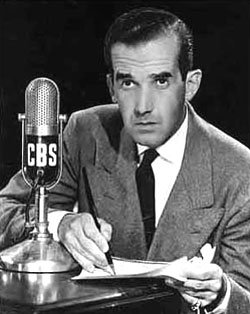
Edward R. Murrow (1908-1965) was a classic user of “Announcer Speak”
James Fallows, in the Atlantic, identifies a broadcasting convention, the use of a slightly Anglicized version of grammatically correct Standard Mid-Western English as the formal voice of news reader, announcer, or celebrity on the radio, which he contends has recently disappeared.
The narrator of [this] film [“Wings Over the Golden Gate” (1930s)](spoke in a way instantly recognizable to anyone who has seen footage of FDR-era newsreels, or for that matter listened to recordings of FDR himself. It was a style of phony-British “Announcer Speak†that dominated formal American discourse from the 1920s to maybe the 1950s—and now has entirely disappeared.
I mention this because today I was listening to a rebroadcast of a great 2012 Fresh Air interview with the musician and writer Michael Feinstein, which included a rare, brief interview that George Gershwin had done on Rudy Vallee’s hyper-popular radio show in 1933. The amazing thing was that even George Gershwin sounded this way!
The revolutionary genius of modern American music, the son of Russian-Jewish immigrants, the child of Brooklyn who moved to Hollywood, the epitome of whatever seemed jazzy about America of the Depression years—even he had that Voice of Time diction.
Here is what I asked four years ago, and would still like to know: Who was the last American to speak this way? And when and why did this accent disappear? We often think of language change as evolving over long historic periods. But this is something that has happened with comparative speed. By the time I became conscious of TV, radio, or movie voices in the late 1950s, the formal Announcer version of American English still existed. Now, no one would use it except as a joke.
When? How? Why?
———————————-
———————————-
I think the slightly more stressed consonants (British style) did tend to disappear, along with the last remnants of the British Empire, sometime in the course of the 1950s, but news broadcasters like Walter Cronkite and David Brinkley still, in my opinion, delivered the news in much the same carefully-articulated and artificially-elevated tones as 1930s announcers.
Perhaps, we can attribute a slightly more recent preference for a less formal and pretentious, a more natural kind of broadcasting diction to Culture Wars conflicts, and the wide American recognition that Voice-of-God news readers (like Cronkite) frequently served up atrociously biased reporting and outright misinformation (Cf. Cronkite’s misreporting on the supposed Viet Cong “victory” in the 1968 Tet Offensive) and that (despite those elevated accents) broadcasting talking heads had commonly in reality roughly the same I.Q. as your average box turtle.
The astonishingly dim but equally pretentious anchorman rapidly became an American comedy staple. After all that, it should not be surprising that the preferred broadcasting style has become more natural and less affected.
Vikings have made the headlines this week across the globe after a surprising announcement from scholars at the University of York, in the U.K. Researchers claim they have found evidence that the Viking Age may have begun long before the academically accepted date of 793—the sack of Lindisfarne. According to researchers, they have found deer antlers fashioned into various tools, most notably a comb, which date to as early as 725 A.D. These artifacts were uncovered in the port town of Ribe, in Denmark, and indicate strong trade ties between the Danes and the Norwegians far earlier than previously thought. …
technicalities aside, the news of the finds in Ribe are of course tremendously exciting for scholars in the field of Scandinavian studies. The finds raise more questions than they answer, but at least we have now confirmed what scholars have theorized for several decades: the Vikings were traveling the world as merchants long before they began to raid. This reinforces several leading theories on why the Viking Age began. Traditionally, scholars blamed a rising population and a changing climate for the exodus of the young male population from the North. However, competing theories have suggested that the massacre on the Elbe (read about it HERE) and the closing of ports to non-Christians by Charlemagne may have contributed to the increasing violence carried out by the Vikings. If they had been trading with the South as early as 725, it now stands to reason that the Danes and Norwegians had grown dependent on foreign trade for much of their livelihood, and closing off trade would have brought about immediate economic woes and later…very well known history.
Robert Tracinski, in The Federalist, points to the changes in the course of the last century in the ideology of Progressivism to explain why lefties refuse to recognize the aggression and intolerance inherent in Islam.
The left seeks to gain moral authority, not from what they are for, but from what they are against. If you look at the history of the left, you find that they have frequently changed their favorite causes and their vision of the ideal society, often in ways that are wildly contradictory. But the one thing that remains constant is what they oppose.
The left used to present themselves as hyper-industrial and super-technological. In H.G. Wells’s The Shape of Things to Come, the ideal future society was going to be ruled by a technological elite of airplane pilots, while the Soviets projected a grandiose vision of industrial giantism, with huge hydroelectric dams, steel mills, railroads, and chunky Bakelite telephones. Then the left flipped, and now they’re anti-industrial and their central crusades are to shut down power plants and to eat locally grown organic kale. You can frequently catch them making this flip in mid-conversation, as with an acquaintance I was talking to recently who expressed his concern for the plight of the poor under capitalism—and then a few minutes later, after I argued that hundreds of millions of people across the world have been lifted out of poverty by capitalism, he told me that Western affluence is overrated and destroys the environment. Everyone on the right has, at some point, had a conversation exactly like this, and it is maddening.
Or: if you go back and look at early 20th-century Progressivism, you will find it shot through with racism of the pseudo-scientific sort—Progressive icon Woodrow Wilson introduced segregation in the federal government—along with schemes for eugenics and a generally uncomplimentary view of homosexuals. Yet today’s Progressives claim the opposite position on these issues as one of their central virtues. Or: the left will champion insults to Christianity as so essential to free speech that they must be funded by the government—then regard insults to Islam as so inflammatory that they must be banned as “fighting words.â€
So everything changes, but one thing stays the same. Capitalism is bad, the West is bad, America is vicious and corrupt and needs to be fundamentally transformed. Transformed into what? That’s always vague and subject to change without notice, and ultimately it doesn’t matter.
The left is fundamentally reactionary. It is a reaction against capitalism and against America. The left are defined by what they are against, or more accurately who they hate. So they are drawn to sympathy toward Islam because it is not-us: non-Western, non-American, neither Christian nor a product of the Enlightenment. And I guess that’s what the two ideologies have in common: they are both reactions against the supposed evils of the West. Which explains why leftists tend to find themselves uncomfortable and look for excuses to retreat when they are called upon to defend the West against this rival group of reactionaries.
Saltford Manor House claims the title of Britain’s oldest continuously occupied home. The house has details, particularly in the ornate windows, which date it to around 1148 – the same completion date of Hereford Cathedral, which has similar Norman features. It is believed that the house originally consisted of a large single room on each floor with a vaulted chamber on the ground floor. Remodelling was carried out in the 17th century. Important features in the house include a rare fragment of a medieval painting and a Norman window in the main bedroom.
Abroad in the Yard profiles a dozen British buildings still surviving today which date back to the time of Richard III or even earlier.
Piero della Francesca, Resurrection, circa 1463, Museo Civico, Sansepolcro
From Robert Chambers, The Book of Days, 1869:
Easter
Easter, the anniversary of our Lord’s resurrection from the dead, is one of the three great festivals of the Christian year,—the other two being Christmas and Whitsuntide. From the earliest period of Christianity down to the present day, it has always been celebrated by believers with the greatest joy, and accounted the Queen of Festivals. In primitive times it was usual for Christians to salute each other on the morning of this day by exclaiming, ‘Christ is risen;’ to which the person saluted replied, ‘Christ is risen indeed,’ or else, ‘And hath appeared unto Simon;’—a custom still retained in the Greek Church.
The common name of this festival in the East was the Paschal Feast, because kept at the same time as the Pascha, or Jewish passover, and in some measure succeeding to it. In the sixth of the Ancyran Canons it is called the Great Day. Our own name Easter is derived, as some suppose, from Eostre, the name of a Saxon deity, whose feast was celebrated every year in the spring, about the same time as the Christian festival—the name being retained when the character of the feast was changed; or, as others suppose, from Oster, which signifies rising. If the latter supposition be correct, Easter is in name, as well as reality, the feast of the resurrection.
Though there has never been any difference of opinion in the Christian church as to why Easter is kept, there has been a good deal as to when it ought to be kept. It is one of the moveable feasts; that is, it is not fixed to one particular day—like Christmas Day, e. g., which is always kept on the 25th of December—but moves backwards or forwards according as the full moon next after the vernal equinox falls nearer or further from the equinox. The rule given at the beginning of the Prayer-book to find Easter is this: ‘Easter-day is always the first Sunday after the full moon which happens upon or next after the twenty-first day of March; and if the full moon happens upon a Sunday, Easter-day is the Sunday after.’
The paschal controversy, which for a time divided Christendom, grew out of a diversity of custom. The churches of Asia Minor, among whom were many Judaizing Christians, kept their paschal feast on the same day as the Jews kept their passover; i. e., on the 14th of Nisan, the Jewish month corresponding to our March or April. But the churches of the West, remembering that our Lord’s resurrection took place on the Sunday, kept their festival on the Sunday following the 14th of Nisan. By this means they hoped not only to commemorate the resurrection on the day on which it actually occurred, but also to distinguish themselves more effectually from the Jews. For a time this difference was borne with mutual forbearance and charity. And when disputes began to arise, we find that Polycarp, the venerable bishop of Smyrna, when on a visit to Rome, took the opportunity of conferring with Anicetas, bishop of that city, upon the question. Polycarp pleaded the practice of St. Philip and St. John, with the latter of whom he had lived, conversed, and joined in its celebration; while Anicetas adduced the practice of St. Peter and St. Paul. Concession came from neither side, and so the matter dropped; but the two bishops continued in Christian friendship and concord. This was about A.D. 158.
Towards the end of the century, however, Victor, bishop of Rome, resolved on compelling the Eastern churches to conform to the Western practice, and wrote an imperious letter to the prelates of Asia, commanding them to keep the festival of Easter at the time observed by the Western churches. They very naturally resented such an interference, and declared their resolution to keep Easter at the time they had been accustomed to do. The dispute hence-forward gathered strength, and was the source of much bitterness during the next century. The East was divided from the West, and all who, after the example of the Asiatics, kept Easter-day on the 14th, whether that day were Sunday or not, were styled Qiccertodecimans by those who adopted the Roman custom.
One cause of this strife was the imperfection of the Jewish calendar. The ordinary year of the Jews consisted of 12 lunar months of 292 days each, or of 29 and 30 days alternately; that is, of 354 days. To make up the 11 days’ deficiency, they intercalated a thirteenth month of 30 days every third year. But even then they would be in advance of the true time without other intercalations; so that they often kept their passover before the vernal equinox. But the Western Christians considered the vernal equinox the commencement of the natural year, and objected to a mode of reckoning which might sometimes cause them to hold their paschal feast twice in one year and omit it altogether the next. To obviate this, the fifth of the apostolic canons decreed that, ’ If any bishop, priest, or deacon, celebrated the Holy Feast of Easter before the vernal equinox, as the Jews do, let him be deposed.’
At the beginning of the fourth century, matters had gone to such a length, that the Emperor Constantine thought it his duty to take steps to allay the controversy, and to insure uniformity of practice for the future. For this purpose, he got a canon passed in the great Ecumenical Council of Nice (A.D. 325), that everywhere the great feast of Easter should be observed upon one and the same day; and that not the day of the Jewish passover, but, as had been generally observed, upon the Sunday afterwards. And to prevent all future disputes as to the time, the following rules were also laid down:
‘That the twenty-first day of March shall be accounted the vernal equinox.’
‘That the full moon happening upon or next after the twenty-first of March, shall be taken for the full moon of Nisan.’
‘That the Lord’s-day next following that full moon be Easter-day.’
‘But if the full moon happen upon a Sunday, Easter-day shall be the Sunday after.’
As the Egyptians at that time excelled in astronomy, the Bishop of Alexandria was appointed to give notice of Easter-day to the Pope and other patriarchs. But it was evident that this arrangement could not last long; it was too inconvenient and liable to interruptions. The fathers of the next age began, therefore, to adopt the golden numbers of the Metonic cycle, and to place them in the calendar against those days in each month on which the new moons should fall during that year of the cycle. The Metonie cycle was a period of nineteen years. It had been observed by Meton, an Athenian philosopher, that the moon returns to have her changes on the same month and day of the month in the solar year after a lapse of nineteen years, and so, as it were, to run in a circle. He published his discovery at the Olympic Games, B.C. 433, and the cycle has ever since borne his name. The fathers hoped by this cycle to be able always to know the moon’s age; and as the vernal equinox was now fixed to the 21st of March, to find Easter for ever. But though the new moon really happened on the same day of the year after a space of nineteen years as it did before, it fell an hour earlier on that day, which, in the course of time, created a serious error in their calculations.
A cycle was then framed at Rome for 84 years, and generally received by the Western church, for it was then thought that in this space of time the moon’s changes would return not only to the same day of the month, but of the week also. Wheatley tells us that, ‘During the time that Easter was kept according to this cycle, Britain was separated from the Roman empire, and the British churches for some time after that separation continued to keep Easter according to this table of 84 years. But soon after that separation, the Church of Rome and several others discovered great deficiencies in this account, and therefore left it for another which was more perfect.’—Book on the Common Prayer, p. 40. This was the Victorian period of 532 years. But he is clearly in error here. The Victorian period was only drawn up about the year 457, and was not adopted by the Church till the Fourth Council of Orleans, A.D. 541.
Now from the time the Romans finally left Britain (A.D. 426), when he supposes both churches to be using the cycle of 84 years, till the arrival of St. Augustine (A.D. 596), the error can hardly have amounted to a difference worth disputing about. And yet the time the Britons kept Easter must have varied considerably from that of the Roman missionaries to have given rise to the statement that they were Quartodecimans, which they certainly were not; for it is a well-known fact that British bishops were at the Council of Nice, and doubtless adopted and brought home with them the rule laid down by that assembly. Dr. Hooke’s account is far more probable, that the British and Irish churches adhered to the Alexandrian rule, according to which the Easter festival could not begin before the 8th of March; while according to the rule adopted at Rome and generally in the West, it began as early as the fifth. ‘They (the Celts) were manifestly in error,’ he says; ‘but owing to the haughtiness with which the Italians had demanded an alteration in their calendar, they doggedly determined not to change.’—Lives of the Archbishops of Canterbury, vol. i. p. 14.
After a good deal of disputation had taken place, with more in prospect, Oswy, King of Northumbria, determined to take the matter in hand. He summoned the leaders of the contending parties to a conference at Whitby, A.D. 664, at which he himself presided. Colman, bishop of Lindisfarne, represented the British church. The Romish party were headed by Agilbert, bishop of Dorchester, and Wilfrid, a young Saxon. Wilfrid was spokesman. The arguments were characteristic of the age; but the manner in which the king decided irresistibly provokes a smile, and makes one doubt whether he were in jest or earnest. Colman spoke first, and urged that the custom of the Celtic church ought not to be changed, because it had been inherited from their forefathers, men beloved of God, &c. Wilfrid followed:
‘The Easter which we observe I saw celebrated by all at Rome: there, where the blessed apostles, Peter and Paul, lived, taught, suffered, and were buried.’ And concluded a really powerful speech with these words: ‘And if, after all, that Columba of yours were, which I will not deny, a holy man, gifted with the power of working miracles, is he, I ask, to be preferred before the most blessed Prince of the Apostles, to whom our Lord said, “Thou art Peter, and upon this rock will I build my church, and the gates of hell shall not prevail against it; and to thee will I give the keys of the kingdom of heaven†?’
The King, turning to Colman, asked him, ‘Is it true or not, Colman, that these words were spoken to Peter by our Lord?’ Colman, who seems to have been completely cowed, could not deny it. ‘It is true, 0 King.’ ‘Then,’ said the King, ‘can you shew me any such power given to your Columba? ’ Colman answered, ’ No.’ ‘You are both, then, agreed,’ continued the King, are you not, that these words were addressed principally to Peter, and that to him were given the keys of heaven by our Lord?’ Both assented. ‘Then,’ said the King, ‘I tell you plainly, I shall not stand opposed to the door-keeper of the kingdom of heaven; I desire, as far as in me lies, to adhere to his precepts and obey his commands, lest by offending him who keepeth the keys, I should, when I present myself at the gate, find no one to open to me.’
This settled the controversy, though poor honest Colman resigned his see rather than submit to such a decision.
On Easter-day depend all the moveable feasts and fasts throughout the year. The nine Sundays before, and the eight following after, are all dependent upon it, and form, as it were, a body-guard to this Queen of Festivals. The nine preceding are the six Sundays in Lent, Quinquagesima, Sexagesima, and Septuagesima; the eight following are the five Sundays after Easter, the Sunday after Ascension Day, Whit Sunday, and Trinity Sunday.
EASTER CUSTOMS
The old Easter customs which still linger among us vary considerably in form in different parts of the kingdom. The custom of distributing the ‘pace’ or ‘pasche ege,’ which was once almost universal among Christians, is still observed by children, and by the peasantry in Lancashire. Even in Scotland, where the great festivals have for centuries been suppressed, the young people still get their hard-boiled dyed eggs, which they roll about, or throw, and finally eat. In Lancashire, and in Cheshire, Staffordshire, and Warwickshire, and perhaps in other counties, the ridiculous custom of ‘lifting’ or ‘heaving’ is practised.
On Easter Monday the men lift the women, and on Easter Tuesday the women lift or heave the men. The process is performed by two lusty men or women joining their hands across each other’s wrists; then, making the person to be heaved sit down on their arms, they lift him up aloft two or three times, and often carry him several yards along a street. A grave clergyman who happened to be passing through a town in Lancashire on an Easter Tuesday, and having to stay an hour or two at an inn, was astonished by three or four lusty women rushing into his room, exclaiming they had come ‘to lift him.’ ‘To lift me!’ repeated the amazed divine; ‘what can you mean?’ ‘Why, your reverence, we’re come to lift you, ‘cause it’s Easter Tuesday.’ ‘Lift me because it’s Easter Tuesday? I don’t understand. Is there any such custom here?’ ‘Yes, to be sure; why, don’t you know? all us women was lifted yesterday; and us lifts the men today in turn. And in course it’s our rights and duties to lift ‘em.’
After a little further parley, the reverend traveller compromised with his fair visitors for half-a-crown, and thus escaped the dreaded compliment. In Durham, on Easter Monday, the men claim the privilege to take off the women’s shoes, and the next day the women retaliate. Anciently, both ecclesiastics and laics used to play at ball in the churches for tansy-cakes on Eastertide; and, though the profane part of this custom is happily everywhere discontinued, tansy-cakes and tansy-puddings are still favourite dishes at Easter in many parts. In some parishes in the counties of Dorset and Devon, the clerk carries round to every house a few white cakes as an Easter offering; these cakes, which are about the eighth of an inch thick, and of two sizes —the larger being seven or eight inches, the smaller about five in diameter— have a mingled bitter and sweet taste. In return for these cakes, which are always distributed after Divine service on Good Friday, the clerk receives a gratuity- according to the circumstances or generosity of the householder.