Atul Gawande shares a great story of the pre-anaesthesia age, in the New England Journal of Medicine.
The limits of patients’ tolerance for pain forced surgeons to choose slashing speed over precision. With either the flap method or the circular method, amputation could be accomplished in less than a minute, though the subsequent ligation of the severed blood vessels and suturing of the muscle and skin over the stump sometimes required 20 or 30 minutes when performed by less experienced surgeons. No matter how swiftly the amputation was performed, however, the suffering that patients experienced was terrible. …
Before anesthesia, the sounds of patients thrashing and screaming filled operating rooms. So, from the first use of surgical anesthesia, observers were struck by the stillness and silence. In London, [Robert] Liston called ether anesthesia a “Yankee dodge†— having seen fads such as hypnotism come and go — but he tried it nonetheless, performing the first amputation with the use of anesthesia, in a 36-year-old butler with a septic knee, 2 months after the publication of Bigelow’s report. As the historian Richard Hollingham recounts, from the case records, a rubber tube was connected to a flask of ether gas, and the patient was told to breathe through it for 2 or 3 minutes. He became motionless and quiet. Throughout the procedure, he did not make a sound or even grimace. “When are you going to begin?†asked the patient a few moments later. He had felt nothing. “This Yankee dodge beats mesmerism hollow,†Liston exclaimed.
It would take a little while for surgeons to discover that the use of anesthesia allowed them time to be meticulous. Despite the advantages of anesthesia, Liston, like many other surgeons, proceeded in his usual lightning-quick and bloody way. Spectators in the operating-theater gallery would still get out their pocket watches to time him. The butler’s operation, for instance, took an astonishing 25 seconds from incision to wound closure. (Liston operated so fast that he once accidentally amputated an assistant’s fingers along with a patient’s leg, according to Hollingham. The patient and the assistant both died of sepsis, and a spectator reportedly died of shock, resulting in the only known procedure with a 300% mortality.
In his surgical exuberance, Liston apparently had cut through the coat tails of a distinguished visitor, who thought he’d been stabbed in the vitals and proceeded to die of fright.
A short film celebrating the passage of the first liberal constitution in Europe by the Polish senate, May 3, 1791, the passage of which provoked treason by magnatial aristocrats (The Confederacy of Targowica) followed by intervention and partition of the country by Russia, Prussia, and Austria. Tadeusz Kosciuszko led the national resistance to the partition. The final defeat of Kosciuszko’s forces was followed in 1795 by the Third and final Partition of Poland-Lithuania. The actual document wound up locked in an iron box under guard in Moscow’s Kremlin, so much terror did it strike in the hearts of despots. Poles and Lithuanians still sing the praises of the Constitution of the 3rd of May which extended the rights enjoyed by the nobility to the entire country. The Third of May is today a national holiday in both countries.
There was general wonder and astonishment over the revelation that Obama’s New York girlfriend in Dreams from My Father was actually a composite character based on multiple girlfriends in New York and Chicago.
Jim Geraghty contended that the use of composite characters in Obama’s autobiography was a key aspect of the book’s evasive, downright mendacious, character.
Why was young Obama’s mentor in Hawaii, Frank Davis only identified as “Frank� (Probably because Davis was alleged to be a Communist.)
Why does Obama’s description of his duties at a consulting house not match the memories of his co-workers at all?
Why does the book’s kind, easygoing portrait of Jeremiah Wright… not match the man seen in videos of his sermons and at National Press Club years later?
Every autobiography probably includes some inaccurate or self-serving memories, some interpretation of past events that portrays the author in the best possible light. But when Obama describes conversations and interactions with people who didn’t exist, or at least existed in a quite different form from the way they’re described on the page, readers have a right to wonder if they’re reading fiction or nonfiction.
Among the conservative grassroots, it is an article of faith that one of the reasons Barack Obama won in 2008 was because he misrepresented himself to the American people, and he was “not vetted. 
When you think about telling the world your story, and telling the world about the people who shaped you… would you use a composite?
———————————
Some excerpts from a 1982 letter from Barack Obama to girlfriend Alex McNear provoked discussion.
I haven’t read “The Waste Land†for a year, and I never did bother to check all the footnotes. But I will hazard these statements—Eliot contains the same ecstatic vision which runs from Münzer to Yeats. However, he retains a grounding in the social reality/order of his time. Facing what he perceives as a choice between ecstatic chaos and lifeless mechanistic order, he accedes to maintaining a separation of asexual purity and brutal sexual reality. And he wears a stoical face before this. Read his essay on Tradition and the Individual Talent, as well as Four Quartets, when he’s less concerned with depicting moribund Europe, to catch a sense of what I speak. Remember how I said there’s a certain kind of conservatism which I respect more than bourgeois liberalism—Eliot is of this type. Of course, the dichotomy he maintains is reactionary, but it’s due to a deep fatalism, not ignorance. (Counter him with Yeats or Pound, who, arising from the same milieu, opted to support Hitler and Mussolini.) And this fatalism is born out of the relation between fertility and death, which I touched on in my last letter—life feeds on itself. A fatalism I share with the western tradition at times. You seem surprised at Eliot’s irreconcilable ambivalence; don’t you share this ambivalence yourself, Alex?
On a Yale conservative discussion list, one of our alumni who teaches English Literature at a major Eastern university, remarked that from the perspective of a professional student of Eliot, Yeats, and Pound Obama’s verbiage struck him as “half gibberish, half misunderstanding,” and commented with frustration that he’d never heard of “Münzer” and could not even find him in Wikipedia.
I, too, was puzzled, but only a little investigation made it clear that Obama had misspelled the name of Thomas Müntzer, an early Reformation era heretic extremist and leader of a servile insurrection in Thuringia, who was defeated and well-deservedly executed in 1525.
Müntzer is, like Gracchus Babeuf, the kind of obscure historical figure that is remembered by specialists in the particular period and by members of the hard-core revolutionary left. Obama’s knowledge of the very existence of Thomas Müntzer is one more proof of his upbringing in a communist family, the kind of family in which the works of Engels are a standard reading staple.
———————————
The above and this additional excerpt of the same letter seem to, at least, clear up, once and for all, more than one major historical controversy.
Moments trip gently along over here. Snow caps the bushes in unexpected ways, birds shoot and spin like balls of sound. My feet hum over the dry walks. A storm smoothes the sky, impounding the city lights, returning to us a dull yellow glow. I run every other day at the small indoor track [at Columbia] which slants slightly upward like a plate; I stretch long and slow, twist and shake, the fatigue, the inertia finding home in different parts of the body. I check the time and growl—aargh!—and tumble onto the wheel. And bodies crowd and give off heat, some people are in front and you can hear the patter or plod of the steps behind. You look down to watch your feet, neat unified steps, and you throw back your arms and run after people, and run from them and with them, and sometimes someone will shadow your pace, step for step, and you can hear the person puffing, a different puff than yours, and on a good day they’ll come up alongside and thank you for a good run, for keeping a good pace, and you nod and keep going on your way, but you’re pretty pleased, and your stride gets lighter, the slumber slipping off behind you, into the wake of the past.
John Hinderaker: That, folks, is not a parody. It may provide a hint as to why Obama’s college and law school grades remain a well-kept secret.
Ann Althouse concluded: “I am now willing to believe Obama wrote his own memoir.”
Butler, the historian of the Romish calendar, repudiates George of Cappadocia, and will have it that the famous saint was born of noble Christian parents, that he entered the army, and rose to a high grade in its ranks, until the persecution of his co-religionists by Diocletian compelled him to throw up his commission, and upbraid the emperor for his cruelty, by which bold conduct he lost his head and won his saintship. Whatever the real character of St. George might have been, he was held in great honour in England from a very early period. While in the calendars of the Greek and Latin churches he shared the twenty-third of April with other saints, a Saxon Martyrology declares the day dedicated to him alone; and after the Conquest his festival was celebrated after the approved fashion of Englishmen.
In 1344, this feast was made memorable by the creation of the noble Order of St. George, or the Blue Garter, the institution being inaugurated by a grand joust, in which forty of England’s best and bravest knights held the lists against the foreign chivalry attracted by the proclamation of the challenge through France, Burgundy, Hainault, Brabant, Flanders, and Germany. In the first year of the reign of Henry V, a council held at London decreed, at the instance of the king himself, that henceforth the feast of St. George should be observed by a double service; and for many years the festival was kept with great splendour at Windsor and other towns. Shakspeare, in Henry VI, makes the Regent Bedford say, on receiving the news of disasters in France:
Bonfires in France I am forthwith to make
To keep our great St. George’s feast withal!’
Edward VI promulgated certain statutes severing the connection between the ‘noble order’ and the saint; but on his death, Mary at once abrogated them as ‘impertinent, and tending to novelty.’ The festival continued to be observed until 1567, when, the ceremonies being thought incompatible with the reformed religion, Elizabeth ordered its discontinuance. James I, however, kept the 23rd of April to some extent, and the revival of the feast in all its glories was only prevented by the Civil War. So late as 1614, it was the custom for fashionable gentlemen to wear blue coats on St. George’s day, probably in imitation of the blue mantle worn by the Knights of the Garter.
In olden times, the standard of St. George was borne before our English kings in battle, and his name was the rallying cry of English warriors. According to Shakspeare, Henry V led the attack on Harfleur to the battle-cry of ‘God for Harry! England! and St. George!’ and ‘God and St. George’ was Talbot’s slogan on the fatal field of Patay. Edward of Wales exhorts his peace-loving parents to
‘Cheer these noble lords,
And hearten those that fight in your defence;
Unsheath your sword, good father, cry St. George!’
The fiery Richard invokes the same saint, and his rival can think of no better name to excite the ardour of his adherents:
‘Advance our standards, set upon our foes,
Our ancient word of courage, fair St. George,
Inspire us with the spleen of fiery dragons.’
England was not the only nation that fought under the banner of St. George, nor was the Order of the Garter the only chivalric institution in his honour. Sicily, Arragon, Valencia, Genoa, Malta, Barcelona, looked up to him as their guardian saint; and as to knightly orders bearing his name, a Venetian Order of St. George was created in 1200, a Spanish in 1317, an Austrian in 1470, a Genoese in 1472, and a Roman in 1492, to say nothing of the more modern ones of Bavaria (1729), Russia (1767), and Hanover (1839).
Legendarily the Sacred Military Constantinian Order of Saint George was founded by the Emperor Constantine (312-337 A.D.). On the factual level, the Constantinian Order is known to have functioned militarily in the Balkans in the 15th century against the Turk under the authority of descendants of the twelfth-century Byzantine Emperor Isaac II Angelus Comnenus.
We Lithuanians liked St. George as well. When I was a boy I attended St. George Lithuanian Parish Elementary School, and served mass at St. George Lithuanian Roman Catholic Church in Shenandoah, Pennsylvania.
RMS Titanic at the dock at Southhampton, April 5, 1912
Smithsonian describes the history of the world’s obsession with the Titanic disaster.
————————-
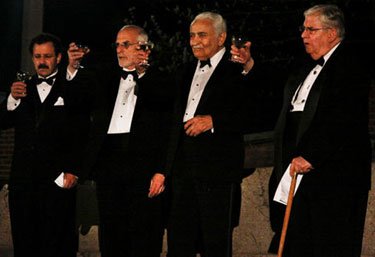
In Washington, the GW Hatchet reports a group of elite members of the national media gather to honor and remember the courage and sacrifice of the men aboard the Titanic.
The group holds a formal black tie dinner replicating the last meal aboard the Titanic at the National Press Club, after which they adjourn to the Titanic Memorial, an 18-foot granite sculpture standing beside the Washington Channel, where a liveried waiter passes out champagne in custom-made Orrefors crystal flutes for the annual toast. A bell is rung three times to commence the solemn ceremony. The society toast, delivered annually since 1931, goes:
“With no hesiÂtaÂtion, no demur, men to whom life was as precious as to you or to me accepted the likelihood of a speedy death. All the vain distinction of class and creed and race were forgotten. Magnate and deckhand, millionaire and stoker, railway executive and steward, capitalist and cabin boy alike conquered the primitive instinct to fight for life and joined in sacrifice. Insofar as the sacrifice of the men we here commemorate shall have lessened the perils of the sea, they will not have died in vain. Nobler will be their reward if they have helped to teach us how to live and how to die.â€
Major Innes Randolph’s defiant “I’m a Good Old Rebel” song (1914) boasted of Northern casualties inflicted and expressed regret that Southern resistance had not piled up an even larger score.
I followed old Mars’ Robert
For four year, near about,
Got wounded in three places
And starved at Pint Lookout;
I cotched the rheumatism
A campin’ in the snow,
I killed a chance of Yankees,
I’d like to kill some mo’.
Three hundred thousand Yankees
Is stiff in Southern dust;
We got three hundred thousand
Before they conquered us;
They died of Southern fever
And Southern steel and shot,
I wish we got three million
Instead of what we got.
A new examination of Civil War enumerated losses, reported in the New York Times, contends that Major Randolph came closer to his expressed goal than was previously thought.
For 110 years, the numbers stood as gospel: 618,222 men died in the Civil War, 360,222 from the North and 258,000 from the South — by far the greatest toll of any war in American history.
But new research shows that the numbers were far too low.
By combing through newly digitized census data from the 19th century, J. David Hacker, a demographic historian from Binghamton University in New York, has recalculated the death toll and increased it by more than 20 percent — to 750,000.
The new figure is already winning acceptance from scholars.
Stuart Schneiderman mercilessly rubs in what has become increasingly obvious this week: the chosen representative of our nation’s establishment elite is really an ignoramus who’d flunk basic questions from a high school Civics course.
America’s thinking class saw Barack Obama as a light shining in the wilderness.
In deep despair over the coarsening of public discourse during the Dark Ages of the Bush administration, American intellectuals saw Barack Obama as one of their own, someone who could restore their exalted social status and raise the level of deliberative democratic debate.
Obama hadn’t accomplished anything of note; he wasn’t really qualified for the presidency; but he was superbly intelligent, had presided over the Harvard Law Review, had professed Constitutional Law at the University of Chicago Law School, and had authored two brilliant books. …
A few days ago the curtain was drawn and people could see that the Wizard of Oz was not what he claimed to be.
In an effort to get personally involved in Supreme Court deliberations over his signature piece of legislation—Obamacare—our president made it appear that he did not understand the most fundamental doctrine in American jurisprudence.
The former president of the Harvard Law Review, former professor at the University of Chicago Law review managed to mangle an explanation of “judicial review.†As every high school history student knows the doctrine was adumbrated in 1803 by Chief Justice John Jay in the case of Marbury v. Madison.
Obama asserted:
Ultimately, I’m confident that the Supreme Court will not take what would be an unprecedented, extraordinary step of overturning a law that was passed by a strong majority of a democratically elected Congress.
As everyone but Obama knows, Marbury v. Madison established the right of the Supreme Court to strike down Congressional legislation that it deemed unconstitutional.
The Court has done just that on hundreds of occasions.
Walnut Grove, pre-Revolutionary War click on picture for larger image
I was away from keyboard today visiting, photographing, and admiring the latest real estate acquisition of a local friend in fox hunting circles.
He is adding to his portfolio of properties an interesting pre-Revolutionary landmark, Walnut Grove farm, for some two and a half centuries the home of the Briarly family. Captain R. S. Briarly stepped out of the front door of this house to lead the local militia company against the British in the War for American Independence.
A stone set in the brick informs us that the small wing with bay window to the right was added in 1784.
Some of the basic objectionable features of liberalism include a profound contempt for the past combined with an overwheening sense of personal superiority. Barack Obama excels at embodying liberalism.
His energy policy speech, delivered on Thursday at Prince George Community College, was a truly classic performance, featuring an utterly empty and fraudulent claim to eminence based upon superior learning and understanding embodied in a series of totally erroneous self-flattering comparisons.
Barack Obama demonstrated, once and for all, that he is an historically-illiterate imbecile, too ignorant, vainglorious, and incompetent to factcheck supposed historical claims, which really constituted a series of excellent examples of “things every badly educated idiot know to be true,” all of which were dead wrong.
Mark Steyn did a fine job of kicking Barack Obama’s boneheaded and abysmally ignorant butt around the block for this one, not failing to remind his readers of the time liberal presidential historian Michael Beschloss (Andover, Williams, Harvard) shared his opinion with the savant Don Imus that Barack Obama “is a guy whose IQ is off the charts” and “probably the smartest guy ever to become president.” The gods of history fell over laughing.
As John Hinderaker reports “the smartest guy ever to become president”‘s public pratfall was not without consequences. A new Internet meme of captioned portraits of Rutherford B. Hayes, avenging himself for Barack Obozo’s inaccurate slights, has taken off and become a craze.
You can see page after page of examples via this QuickMeme link.
Almost as many countries arrogate the honour of having been the natal soil of St. Patrick, as made a similar claim with respect to Homer. Scotland, England, France, and Wales, each furnish their respective pretensions: but, whatever doubts may obscure his birthplace, all agree in stating that, as his name implies, he was of a patrician family. He was born about the year 372, and when only sixteen years of age, was carried off by pirates, who sold him into slavery in Ireland; where his master employed him as a swineherd on the well-known mountain of Sleamish, in the county of Antrim. Here he passed seven years, during which time he acquired a knowledge of the Irish language, and made himself acquainted with the manners, habits, and customs of the people. Escaping from captivity, and, after many adventures, reaching the Continent, he was successively ordained deacon, priest, and bishop: and then once more, with the authority of Pope Celestine, he returned to Ireland to preach the Gospel to its then heathen inhabitants.
The principal enemies that St. Patrick found to the introduction of Christianity into Ireland, were the Druidical priests of the more ancient faith, who, as might naturally be supposed, were exceedingly adverse to any innovation. These Druids, being great magicians, would have been formidable antagonists to any one of less miraculous and saintly powers than Patrick. Their obstinate antagonism was so great, that, in spite of his benevolent disposition, he was compelled to curse their fertile lands, so that they became dreary bogs: to curse their rivers, so that they produced no fish: to curse their very kettles, so that with no amount of fire and patience could they ever be made to boil; and, as a last resort, to curse the Druids themselves, so that the earth opened and swallowed them up. …
The greatest of St. Patrick’s miracles was that of driving the venomous reptiles out of Ireland, and rendering the Irish soil, for ever after, so obnoxious to the serpent race, that they instantaneously die on touching it. Colgan seriously relates that St. Patrick accomplished this feat by beating a drum, which he struck with such fervour that he knocked a hole in it, thereby endangering the success of the miracle. But an angel appearing mended the drum: and the patched instrument was long exhibited as a holy relic. …
When baptizing an Irish chieftain, the venerable saint leaned heavily on his crozier, the steel-spiked point of which he had unwittingly placed on the great toe of the converted heathen. The pious chief, in his ignorance of Christian rites, believing this to be an essential part of the ceremony, bore the pain without flinching or murmur; though the blood flowed so freely from the wound, that the Irish named the place St. fhuil (stream of blood), now pronounced Struill, the name of a well-known place near Downpatrick. And here we are reminded of a very remarkable fact in connection with geographical appellations, that the footsteps of St. Patrick can be traced, almost from his cradle to his grave, by the names of places called after him.
Thus, assuming his Scottish origin, he was born at Kilpatrick (the cell or church of Patrick), in Dumbartonshire. He resided for some time at Dalpatrick (the district or division of Patrick), in Lanarkshire; and visited Crag-phadrig (the rock of Patrick), near Inverness. He founded two churches, Kirkpatrick at Irongray, in Kireudbright; and Kirkpatrick at Fleming, in Dumfries: and ultimately sailed from Portpatrick, leaving behind him such an odour of sanctity, that among the most distinguished families of the Scottish aristocracy, Patrick has been a favourite name down to the present day.
Arriving in England, he preached in Patterdale (Patrick’s dale), in Westmoreland: and founded the church of Kirkpatrick, in Durham. Visiting Wales, he walked over Sarn-badrig (Patrick’s causeway), which, now covered by the sea, forms a dangerous shoal in Carnarvon Bay: and departing for the Continent, sailed from Llan-badrig (the church of Patrick), in the island of Anglesea. Undertaking his mission to convert the Irish, he first landed at Innis-patrick (the island of Patrick), and next at Holmpatrick, on the opposite shore of the mainland, in the county of Dublin. Sailing northwards, he touched at the Isle of Man, sometimes since, also, called. Innis-patrick, where he founded another church of Kirkpatrick, near the town of Peel. Again landing on the coast of Ireland, in the county of Down, he converted and baptized the chieftain Dichu, on his own threshing-floor. The name of the parish of Saul, derived from Sabbal-patrick (the barn of Patrick), perpetuates the event. He then proceeded to Temple-patrick, in Antrim, and from thence to a lofty mountain in Mayo, ever since called Croagh-patrick.
He founded an abbey in East Meath, called Domnach-Padraig (the house of Patrick), and built a church in Dublin on the spot where St. Patrick’s Cathedral now stands. In an island of Lough Deng, in the county of Donegal, there is St. Patrick’s Purgatory: in Leinster, St. Patrick’s Wood; at Cashel, St. Patrick’s Rock; the St. Patrick’s Wells, at which the holy man is said to have quenched his thirst, may be counted by dozens. He is commonly stated to have died at Saul on the 17th of March 493, in the one hundred and twenty-first year of his age.
Poteen, a favourite beverage in Ireland, is also said to have derived its name from St. Patrick: he, according to legend, being the first who instructed the Irish in the art of distillation. This, however, is, to say the least, doubtful: the most authentic historians representing the saint as a very strict promoter of temperance, if not exactly a teetotaller. We read that in 445 he commanded his disciples to abstain from drink in the day-time, until the bell rang for vespers in the evening. One Colman, though busily engaged in the severe labours of the field, exhausted with heat, fatigue, and intolerable thirst, obeyed so literally the injunction of his revered preceptor, that he refrained from indulging himself with one drop of water during a long sultry harvest day. But human endurance has its limits: when the vesper bell at last rang for evensong, Colman dropped down dead—a martyr to thirst. Irishmen can well appreciate such a martyrdom; and the name of Colman, to this day, is frequently cited, with the added epithet of Shadhack—the Thirsty.
‘In Burgo Duno, tumulo tumulantur in uno,
Brigida, Patricius, atque Columba pins.’
Which may be thus rendered:
‘In the hill of Down, buried in one tomb,
Were Bridget and Patricius, with Columba the pious.’
The shamrock, or small white clover (trifolium repens of botanists), is almost universally worn in the hat over all Ireland, on St. Patrick’s day. The popular notion is, that when St. Patrick was preaching the doctrine of the Trinity to the pagan Irish, he used this plant, bearing three leaves upon one stem, as a symbol or illustration of the great mystery. To suppose, as some absurdly hold, that he used it as an argument, would be derogatory to the saint’s high reputation for orthodoxy and good sense: but it is certainly a curious coincidence, if nothing more, that the trefoil in Arabic is called skamrakh, and was held sacred in Iran as emblematical of the Persian Triads. Pliny, too, in his Natural History, says that serpents are never seen upon trefoil, and it prevails against the stings of snakes and scorpions. This, considering St. Patrick’s connexion with snakes, is really remarkable, and we may reasonably imagine that, previous to his arrival, the Irish had ascribed mystical virtues to the trefoil or shamrock, and on hearing of the Trinity for the first time, they fancied some peculiar fitness in their already sacred plant to shadow forth the newly revealed and mysterious doctrine. …
In the Galtee or Gaultie Mountains, situated between the counties of Cork and Tipperary, there are seven lakes, in one of which, called Lough Dilveen, it is said Saint Patrick, when banishing the snakes and toads from Ireland, chained a monster serpent, telling him to remain there till Monday.
The serpent every Monday morning calls out in Irish, ‘It is a long Monday, Patrick.’
That St Patrick chained the serpent in Lough Dilveen, and that the serpent calls out to him every Monday morning, is firmly believed by the lower orders who live in the neighbourhood of the Lough.
Jacopo Bassano, St Valentine Baptizing St Lucilla, 1575, oil on canvas, Museo Civico, Bassano del Grappa
The popular customs associated with Saint Valentine’s Day undoubtedly had their origin in a conventional belief generally received in England and France during the Middle Ages, that on 14 February, i.e., half way through the second month of the year, the birds began to pair. Thus in Chaucer’s Parliament of Foules we read:
For this was sent on Seynt Valentyne’s day
Whan every foul cometh ther to choose his mate.
For this reason the day was looked upon as specially consecrated to lovers and as a proper occasion for writing love letters and sending lovers’ tokens. Both the French and English literatures of the fourteenth and fifteenth centuries contain allusions to the practice. Perhaps the earliest to be found is in the 34th and 35th Ballades of the bilingual poet, John Gower, written in French; but Lydgate and Clauvowe supply other examples. Those who chose each other under these circumstances seem to have been called by each other their Valentines.
In the Paston Letters, Dame Elizabeth Brews writes thus about a match she hopes to make for her daughter (we modernize the spelling), addressing the favoured suitor:
And, cousin mine, upon Monday is Saint Valentine’s Day and every bird chooses himself a mate, and if it like you to come on Thursday night, and make provision that you may abide till then, I trust to God that ye shall speak to my husband and I shall pray that we may bring the matter to a conclusion.
——————————————–
From Robert Chambers, The Book of Days, 1869: Feast Day: St. Valentine, priest and martyr, circ. 270.
ST. VALENTINE’S DAY
Valentine’s Day is now almost everywhere a much degenerated festival, the only observance of any note consisting merely of the sending of jocular anonymous letters to parties whom one wishes to quiz, and this confined very much to the humbler classes. The approach of the day is now heralded by the appearance in the print-sellers’ shop windows of vast numbers of missives calculated for use on this occasion, each generally consisting of a single sheet of post paper, on the first page of which is seen some ridiculous coloured caricature of the male or female figure, with a few burlesque verses below. More rarely, the print is of a sentimental kind, such as a view of Hymen’s altar, with a pair undergoing initiation into wedded happiness before it, while Cupid flutters above, and hearts transfixed with his darts decorate the corners. Maid-servants and young fellows interchange such epistles with each other on the 14th of February, no doubt conceiving that the joke is amazingly good: and, generally, the newspapers do not fail to record that the London postmen delivered so many hundred thousand more letters on that day than they do in general. Such is nearly the whole extent of the observances now peculiar to St. Valentine’s Day.
At no remote period it was very different. Ridiculous letters were unknown: and, if letters of any kind were sent, they contained only a courteous profession of attachment from some young man to some young maiden, honeyed with a few compliments to her various perfections, and expressive of a hope that his love might meet with return. But the true proper ceremony of St. Valentine’s Day was the drawing of a kind of lottery, followed by ceremonies not much unlike what is generally called the game of forfeits. Misson, a learned traveller, of the early part of the last century, gives apparently a correct account of the principal ceremonial of the day.
‘On the eve of St. Valentine’s Day,’ he says, ‘the young folks in England and Scotland, by a very ancient custom, celebrate a little festival. An equal number of maids and bachelors get together: each writes their true or some feigned name upon separate billets, which they roll up, and draw by way of lots, the maids taking the men’s billets, and the men the maids’: so that each of the young men lights upon a girl that he calls his valentine, and each of the girls upon a young man whom she calls hers. By this means each has two valentines: but the man sticks faster to the valentine that has fallen to him than to the valentine to whom he is fallen. Fortune having thus divided the company into so many couples, the valentines give balls and treats to their mistresses, wear their billets several days upon their bosoms or sleeves, and this little sport often ends in love.’
St. Valentine’s Day is alluded to by Shakespeare and by Chaucer, and also by the poet Lydgate (who died in 1440).
The origin of these peculiar observances of St. Valentine’s Day is a subject of some obscurity. The saint himself, who was a priest of Rome, martyred in the third century, seems to have had nothing to do with the matter, beyond the accident of his day being used for the purpose. Mr. Douce, in his Illustrations of Shakespeare, says:
“It was the practice in ancient Rome, during a great part of the month of February, to celebrate the Lupercalia, which were feasts in honour of Pan and Juno. whence the latter deity was named Februata, Februalis, and Februlla. On this occasion, amidst a variety of ceremonies, the names of young women were put into a box, from which they were drawn by the men as chance directed. The pastors of the early Christian church, who, by every possible means, endeavoured to eradicate the vestiges of pagan superstitions, and chiefly by some commutations of their forms, substituted, in the present instance, the names of particular saints instead of those of the women: and as the festival of the Lupercalia had commenced about the middle of February, they appear to have chosen St. Valentine’s Day for celebrating the new feast, because it occurred nearly at the same time.”
February 14th, prior to 1969, was the feast day of two, or possibly three, saints and martyrs named Valentine, all reputedly of the Third Century.
The first Valentine, legend holds, was a physician and priest in Rome, arrested for giving aid to martyrs in prison, who while there converted his jailer by restoring sight to the jailer’s daughter. He was executed by being beaten with clubs, and afterwards beheaded, February 14, 270. He is traditionally the patron of affianced couples, bee keepers, lovers, travellers, young people, and greeting card manufacturers, and his special assistance may be sought in conection with epilepsy, fainting, and plague.
A second St. Valentine, reportedly bishop of Interamna (modern Terni) was also allegedly martyred under Claudius II, and also allegedly buried along the Flaminian Way.
A third St. Valentine is said to have also been martyred in Roman times, along with companions, in Africa.
Because of a lack of historical evidence, the Roman Catholic Church dropped the February 14th feast of St. Valentine from its calendar in 1969.
Tintoretto, Presentation of Jesus at the Temple, 1550-1555, Gallerie dell Accademi, Venice
From Robert Chambers, The Book of Days, 1869:
From a very early, indeed unknown date in the Christian history, the 2nd of February has been held as the festival of the Purification of the Virgin, and it is still a holiday of the Church of England. From the coincidence of the time with that of the Februation or purification of the people in pagan Rome, some consider this as a Christian festival engrafted upon a heathen one, in order to take advantage of the established habits of the people; but the idea is at least open to a good deal of doubt. The popular name Candlemass is derived from the ceremony which the Church of Rome dictates to be observed on this day; namely, a blessing of candles by the clergy, and a distribution of them amongst the people, by whom they are afterwards carried lighted in solemn procession. The more important observances were of course given up in England at the Reformation; but it was still, about the close of the eighteenth century, customary in some places to light up churches with candles on this day.
At Rome, the Pope every year officiates at this festival in the beautiful chapel of the Quirinal. When he has blessed the candles, he distributes them with his own hand amongst those in the church, each of whom, going singly up to him, kneels to receive it. The cardinals go first; then follow the bishops, canons, priors, abbots, priests, &c., down to the sacristans and meanest officers of the church. According to Lady Morgan, who witnessed the ceremony in 1820:
‘When the last of these has gotten his candle, the poor conservatori, the representatives of the Roman senate and people, receive theirs. This ceremony over, the candles are lighted, the Pope is mounted in his chair and carried in procession, with hymns chanting, round the ante-chapel; the throne is stripped of its splendid hangings; the Pope and cardinals take off their gold and crimson dresses, put on their usual robes, and the usual mass of the morning is sung.’
Lady Morgan mentions that similar ceremonies take place in all the parish churches of Rome on this day.
It appears that in England, in Catholic times, a meaning was attached to the size of the candles, and the manner in which they burned during the procession; that, moreover, the reserved parts of the candles were deemed to possess a strong supernatural virtue:
‘This done, each man his candle lights,
Where chiefest seemeth he,
Whose taper greatest may be seen; And fortunate to be,
Whose candle burneth clear and bright: A wondrous force and might
Both in these candles lie, which if At any time they light,
They sure believe that neither storm Nor tempest cloth abide,
Nor thunder in the skies be heard, Nor any devil’s spide,
Nor fearful sprites that walk by night,
Nor hurts of frost or hail,’ &c.
The festival, at whatever date it took its rise, has been designed to commemorate the churching or purification of Mary; and the candle-bearing is understood to refer to what Simeon said when he took the infant Jesus in his arms, and declared that he was a light to lighten the Gentiles. Thus literally to adopt and build upon metaphorical expressions, was a characteristic procedure of the middle ages. Apparently, in consequence of the celebration of Mary’s purification by candle-bearing, it became customary for women to carry candles with them, when, after recovery from child-birth, they went to be, as it was called, churched. A remarkable allusion to this custom occurs in English history. William the Conqueror, become, in his elder days, fat and unwieldy, was confined a considerable time by a sickness. ‘Methinks,’ said his enemy the King of France, ‘the King of England lies long in childbed.’ This being reported to William, he said, ‘When I am churched, there shall be a thousand lights in France !’ And he was as good as his word; for, as soon as he recovered, he made an inroad into the French territory, which he wasted wherever he went with fire and sword.
At the Reformation, the ceremonials of Candlemass day were not reduced all at once. Henry VIII proclaimed in 1539:
‘On Candlemass day it shall be declared, that the bearing of candles is done in memory of Christ, the spiritual light, whom Simeon did prophesy, as it is read in. the church that day.’
It is curious to find it noticed as a custom down to the time of Charles II, that when lights were brought in at nightfall, people would say—’ God send us the light of heaven!’ The amiable Herbert, who notices the custom, defends it as not superstitious. Some-what before this time, we find. Herrick alluding to the customs of Candlemass eve: it appears that the plants put up in houses at Christmas were now removed.
Down with the rosemary and bays,
Down with the mistletoe;
Instead of holly now upraise The greener box for show.
The holly hitherto did sway,
Let box now domineer,
Until the dancing Easter day Or Easter’s eve appear.
The youthful box, which now hath grace
Your houses to renew,
Grown old, surrender must his place Unto the crisped yew.
When yew is out, then birch comes in,
And many flowers beside,
Both of a fresh and fragrant kin’, To honour Whitsuntide.
Greeu rushes then, and sweetest bents,
With cooler oaken boughs,
Come in for comely ornaments, To re-adorn the house.
Thus times do shift; each thing in turn does hold;
New things succeed, as former things grow old.’
The same poet elsewhere recommends very particular care in the thorough removal of the Christmas garnishings on this eve:
‘That so the superstitious find
No one least branch left there behind;
For look, how many leaves there be
Neglected there, maids, trust to me,
So many goblins you shall see.’
He also alludes to the reservation of part of the candles or torches, as calculated to have the effect of protecting from mischief:
‘Kindle the Christmas brand, and then
Till sunset let it burn,
Which quenched, then lay it up again, Till Christmas next return.
Part must be kept, wherewith to tend
The Christmas log next year;
And where ‘tis safely kept, the fiend Can do no mischief there.’
Considering the importance attached to Candlemass day for so many ages, it is scarcely surprising that there is a universal superstition throughout Christendom, that good weather on this day indicates a long continuance of winter and a bad crop, and that its being foul is, on the contrary, a good omen. Sir Thomas Browne, in his Vulgar Errors, quotes a Latin distich expressive of this idea:
‘Si sol splendescat Maria purificante,
Major erit glacies post festum quam fait ante;
which may be considered as well translated in the popular Scottish rhyme:
If Candlemass day be dry and fair,
The half o’ winter’s to come and mair;
If Candlemass day be wet and foul,
The half o’ winter’s gave at Yule.’
In Germany there are two proverbial expressions on this subject: 1. The shepherd would rather see the wolf enter his stable on Candlemass day than the sun; 2. The badger peeps out of his hole on Candlemass day, and when he finds snow, walks abroad; but if he sees the sun shining, he draws back into his hole. It is not improbable that these notions, like the festival of Candlemass itself, are derived from pagan times, and have existed since the very infancy of our race. So at least we may conjecture, from a curious passage in Martin’s Description of the Western Islands. On Candlemass day, according to this author, the Hebrideans observe the following curious custom:
The mistress and servants of each family take a sheaf of oats and dress it up in women’s apparel, put it in a large basket, and lay a wooden club by it, and this they call BrÃd’s Bed.; and then the mistress and servants cry three times, “BrÃd is come; BrÃd is welcome!†This they do just before going to bed, and when they rise in the morning they look among the ashes, expecting to see the impression of Brad’s club there; which, if they do, they reckon it a true presage of a good crop and prosperous year, and the contrary they take as an ill omen.



 , hitting the shelves on June 19th.
 was actually a composite character based on multiple girlfriends in New York and Chicago.